Table of contents
Your competitors are bidding on the same keywords, targeting the same audiences, and running ads on the same networks — and PPC spy tools let you see exactly how they do it. Below is a breakdown of the best PPC spy tools available today, what each one reveals about your competitors' Google Ads campaigns, and how to turn that intelligence into a real performance advantage.
Key Takeaways
- SEMrush tracks over 162 million Google Ads keywords across 144 countries, making it the largest PPC intelligence database available for competitor analysis.
- The Google Ads Transparency Center is a free tool that shows every ad a verified advertiser runs across Search, Display, and YouTube — no subscription needed.
- SpyFu stores 18 years of PPC history for any domain, letting you trace a competitor's keyword and ad copy evolution since 2006.
- Google Ads Auction Insights reports reveal 6 key metrics — impression share, overlap rate, outranking share, position above rate, top-of-page rate, and absolute top-of-page rate — directly inside your own account.
- Businesses that use competitor analysis tools to refine their PPC campaigns see an average 15–20% reduction in wasted ad spend by identifying negative keyword gaps and high-performing competitor strategies.
- iSpionage monitors over 92 million keywords across Google, Bing, and Yahoo, and maps competitor keywords directly to their landing pages for conversion-focused insights.
- The best PPC spy strategy combines one free tool (Transparency Center or Auction Insights) with one paid platform (SEMrush, SpyFu, or Adthena) for complete coverage of keyword data, ad creative, and bidding strategy.
What PPC Spy Tools Actually Do
PPC spy tools reverse-engineer your competitors' paid search campaigns. Instead of guessing which keywords a rival bids on or what their ads say, these competitor analysis tools pull data from public indexes, ad libraries, and proprietary databases to show you the specifics: which keywords competitors target, how much they spend, what their ads look like, and where those ads send traffic.
There are two main categories of PPC spy tools. Keyword and spend intelligence tools like SEMrush and SpyFu reverse-engineer a competitor's keyword list, estimated budget, and bidding history from their own large databases. Creative and messaging tools focus on the ads themselves — what a competitor says and shows, how their creative changes over time, and which ad formats they use across different campaigns. Most PPC teams pair a free tool like the Google Ads Transparency Center with one paid platform to cover both angles.
The data you gather from PPC spy tools feeds directly into three critical decisions: which keywords to add to your own Google Ads campaigns, which call-to-action copy angles to test in your ads, and where your competitors' landing pages reveal gaps you can exploit. Used well, a PPC intelligence tool turns guesswork into strategy. For a broader look at how competitive intelligence fits within your overall paid strategy, see the growth marketing services at Web Tonic.
Google Ads Transparency Center — The Free Starting Point
Before spending on any paid PPC spy tool, start with what Google gives you for free. The Google Ads Transparency Center launched in 2023 and is the Google equivalent of the Meta Ads Library — a public database of ads running across Google Search, Display, and YouTube.
You can search by advertiser name, keyword, or topic, and filter by country, date range, and ad format. The tool shows text ads on Search, banner creatives on Display, and video campaigns on YouTube — three ad types the Meta Ad Library does not cover. To access it, go directly to adstransparency.google.com or click the three-dot menu on any live Google ad to see that advertiser's full ad library.
The Google Ads Transparency Center has limitations: no performance data, no keyword targeting information, and it only shows ads from verified advertisers. It will not tell you what a competitor bids or how much they spend. But it is the fastest way to see every active ad a competitor runs, spot their messaging angles, and identify creative patterns — completely free.
| Feature | Google Ads Transparency Center | Meta Ads Library |
|---|---|---|
| Cost | Free | Free |
| Search Ads | Yes — full text ad copy | No |
| Display Ads | Yes — banner creatives | Yes — image ads |
| Video Ads | Yes — YouTube campaigns | Yes — Facebook/Instagram video |
| Keyword Data | No | No |
| Spend Estimates | No | Political ads only |
| Geographic Filters | Yes — by country | Yes — by country |

Google Ads Auction Insights — Intelligence Inside Your Account
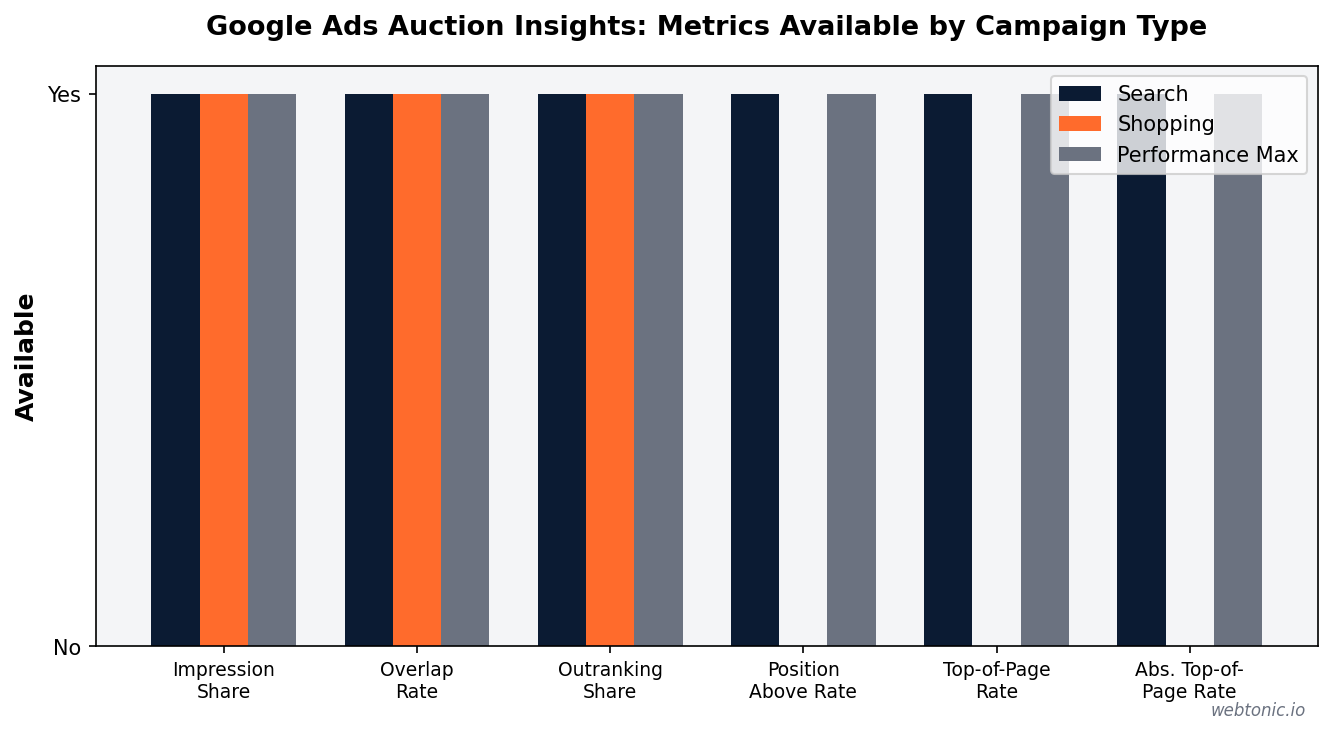
The Auction Insights report is the only PPC spy tool built directly into your Google Ads account. It shows you exactly who else participates in the same auctions you compete in — and how your performance compares to theirs. Available for Search, Shopping, and Performance Max campaigns, it is the closest thing to a direct competitor benchmark Google offers.
For Search campaigns, the Auction Insights report provides 6 statistics: impression share, overlap rate, outranking share, position above rate, top-of-page rate, and absolute top-of-page rate. Shopping campaigns show 3 statistics: impression share, overlap rate, and outranking share. Performance Max campaigns provide auction insights data for Search and Shopping ads served on the Search Network.
Here is what each metric tells you about your PPC competitors:
| Metric | What It Measures | Strategic Use |
|---|---|---|
| Impression Share | Percentage of eligible impressions you actually received | Identify budget or bid gaps vs. competitors |
| Overlap Rate | How often a competitor's ad appeared alongside yours | Find your most direct PPC competitors |
| Outranking Share | How often your ad ranked higher than a competitor's | Measure dominance on head terms |
| Position Above Rate | How often a competitor's ad appeared above yours | Decide whether to increase bids on key terms |
| Top-of-Page Rate | How often your ad appeared at the top of the page | Evaluate ad rank and Quality Score impact |
| Abs. Top-of-Page Rate | How often your ad appeared in the very first position | Track brand-term defense and conquest performance |
The Auction Insights report does not show competitor keywords, bids, or budgets — but it tells you who you are losing to and how often. Cross-reference the competitor domains from your Auction Insights report with a paid PPC spy tool like SEMrush or SpyFu to get the complete picture of their PPC strategy.
SEMrush — Best All-Round PPC Intelligence Platform
SEMrush is the most comprehensive PPC spy tool on the market. It tracks over 162 million Google Ads keywords across 144 countries, letting you enter any domain to see its top keywords, ad copy history, estimated monthly spend, and landing pages. The Keyword Gap feature compares up to five domains side by side, revealing keywords your competitors bid on that you miss entirely.
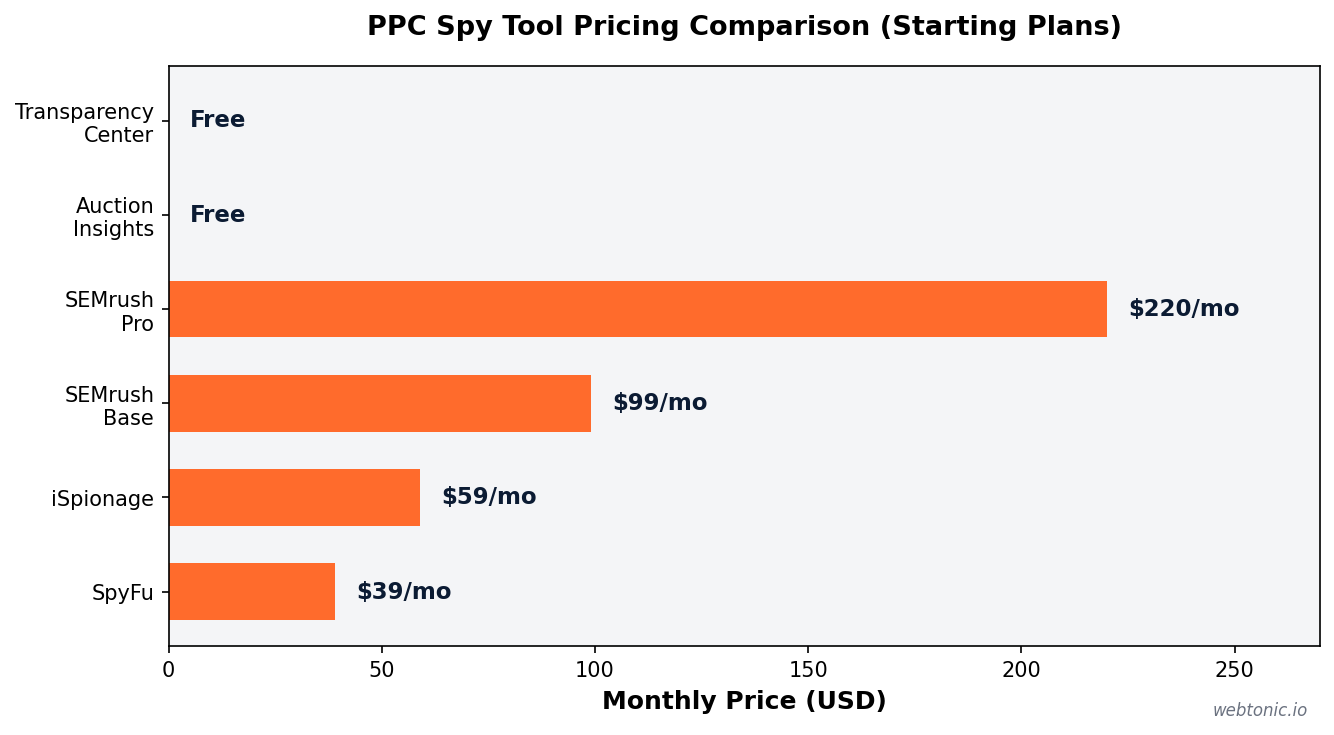
The Advertising Research module inside SEMrush shows competitors' PPC campaigns broken down by keyword, position, CPC, traffic percentage, and ad copy. Ad History displays creative evolution over 12 months, so you can spot seasonal patterns and messaging shifts before they happen again. For teams that also need display and video intelligence, the Pro plan at $220/month unlocks AdClarity — an advanced tool that reveals competitor display, video, and social ad placements, creatives, and estimated spend across the web.
SEMrush's strength for PPC competitor analysis is breadth: it covers keyword research, competitor keyword lists, ad copy archives, landing page analysis, search volume trends, and CPC data — all in one platform. The Base Advertising Toolkit plan starts at $99/month and includes Advertising Research, PLA Research, and the Ads Launch Assistant.
SpyFu — Deepest Historical PPC Data
SpyFu specializes in one thing: long-term competitor PPC history. It stores 18 years of Google Ads data for any domain — every keyword ever purchased, every ad variation ever tested, and every organic ranking ever held. That historical depth is unmatched by any other PPC spy tool.
Enter a competitor's domain into SpyFu and you see their most profitable keywords, estimated monthly PPC budget, number of ad variations tested, and click-through rate estimates. The Kombat feature overlaps 3 competitors' keyword lists simultaneously, highlighting shared keywords and exclusive terms. SpyFu also reveals negative keyword gaps — keywords your competitors actively exclude — which is intelligence you cannot get from Google Ads Auction Insights or the Transparency Center.
SpyFu's pricing makes it accessible for smaller teams: plans start at $39/month (annual billing) with unlimited keyword and domain searches, unlimited data exports, and full ad history access. For PPC agencies managing multiple client accounts, SpyFu offers bulk competitor reports and a white-label option.

More PPC Spy Tools Worth Considering
Beyond the top three, several other PPC intelligence tools serve specific use cases or budgets. Here is how they compare:
| Tool | Key Strength | Starting Price | Best For |
|---|---|---|---|
| SEMrush | 162M+ keywords, full ad research suite | $99/mo | All-round PPC intelligence |
| SpyFu | 18 years of PPC history per domain | $39/mo | Historical trend analysis |
| iSpionage | 92M+ keywords, landing page monitoring | $59/mo | Keyword-to-landing-page mapping |
| Adthena | Whole-market view, 20M SERPs/day | Custom | Enterprise market share tracking |
| Auction Insights | 6 direct metrics inside Google Ads | Free | Identifying direct auction competitors |
| Transparency Center | Full ad library across Search, Display, YouTube | Free | Creative and messaging research |
| Hawky | Agentic creative intelligence, weekly change alerts | Custom | Automated creative gap analysis |
iSpionage monitors over 92 million keywords across Google, Bing, and Yahoo. Its unique advantage is mapping every competitor keyword directly to the landing page it sends traffic to — so you see not just what they bid on, but where they send users and how those pages convert. Plans start at $59/month.
Adthena takes a different approach. Rather than showing individual keyword data, it builds a Whole Market View by indexing 20 million Google SERPs per day. The result is market share data — Share of Clicks, Share of Spend, and Share of Impressions — for every advertiser in an industry. Adthena is enterprise-priced and best suited for large brands or agencies that need to track data intelligence across an entire competitive landscape.
How to Build a PPC Spy Strategy That Works
Owning a PPC spy tool is not the same as having a strategy. Here is a repeatable process for turning competitor data into performance gains in your own Google Ads campaigns:
- Identify your top 5 PPC competitors. Start with the domains that appear in your Auction Insights report. Cross-reference with a paid tool like SEMrush to confirm which ones share the most keyword overlap.
- Audit their keyword portfolios. Use SpyFu or SEMrush to pull each competitor's top keywords. Sort by estimated traffic and CPC to find high-value terms you are missing.
- Analyze their ad creative. Check the Google Ads Transparency Center for current ads, then use SEMrush Ad History or SpyFu Ad Variations to see what messaging they have tested over time. Look for patterns in headlines, CTAs, and value propositions.
- Study their landing pages. Use iSpionage or manually visit the URLs from competitor ads. Note the page structure, offers, trust signals, and conversion mechanisms. Identify gaps you can address in your own web development and landing page strategy.
- Mine negative keywords. SpyFu reveals keywords competitors explicitly exclude from their campaigns. These negative keyword lists represent years of optimization learning you can apply to your own Google Ads account immediately.
- Monitor changes weekly. Set up alerts in your PPC spy tool to track when competitors launch new ads, target new keywords, or shift their bidding strategy. Competitive intelligence is not a one-time exercise — the PPC landscape shifts constantly.
The most effective PPC spy strategy combines one free tool with one paid platform. Use Google Ads Auction Insights and the Transparency Center for real-time competitor activity, and pair them with SEMrush or SpyFu for historical keyword data, spend estimates, and ad copy analysis. This two-layer approach gives you both breadth and depth without overspending on overlapping subscriptions.
Common Mistakes When Using PPC Spy Tools
Competitor intelligence is powerful, but it comes with traps. Here are the mistakes that waste the most time and budget when using PPC spy tools:
- Copying competitors blindly. Just because a competitor bids on a keyword does not mean it is profitable for them. PPC spy tools show keywords and ads — not profit margins or conversion rates. Use competitor data as inspiration, then test with your own responsive search ads and measure results.
- Ignoring search volume context. A keyword showing high estimated spend in SEMrush might have declining search volume. Always cross-reference keyword rankings and search volume trends before adding competitor keywords to your campaigns.
- Over-focusing on one competitor. Track 3–5 competitors, not just the biggest one. Smaller competitors often test innovative ad copy angles and keyword strategies that larger brands overlook.
- Skipping the landing page. Ad copy intelligence without landing page analysis is incomplete. A competitor's high impression share on a keyword means nothing if their landing page experience outperforms yours — Google Ads bidding rewards relevance and quality through Quality Score.
- Treating competitor analysis as a one-time task. PPC campaigns change weekly. A keyword your competitor dropped last month might reappear next quarter with new ad copy. Set a recurring schedule for competitor review — monthly at minimum, weekly for high-spend accounts.
Related reading
- PPC Audit: The Complete Checklist to Stop Wasting Ad Spend
- PPC Optimization: The Complete Guide to Lowering CPC and Boosting ROAS
- What Is PPC? Pay-Per-Click Advertising Explained
- Paid Search services at Web Tonic
FAQ
What are PPC spy tools and how do they work?
PPC spy tools are software platforms that collect and analyze data about competitors' paid search campaigns. They work by scraping search engine results, indexing ad placements, and building databases of keyword targets, ad copy variations, landing page URLs, and estimated spending. Tools like SEMrush track over 162 million keywords, while Google's own Auction Insights report provides direct performance comparisons within your Google Ads account. Together, these tools help advertisers understand which keywords competitors bid on, what their ads say, and how much they likely spend.
Is there a free PPC spy tool for Google Ads?
Yes — two of the most useful PPC competitor analysis tools are completely free. The Google Ads Transparency Center at adstransparency.google.com shows every active ad a verified advertiser runs across Google Search, Display, and YouTube. The Auction Insights report inside your Google Ads account compares your impression share, overlap rate, and outranking share against specific competitors in the same auctions. Both are free but limited: neither shows keyword-level data, competitor budgets, or historical performance. For deeper PPC intelligence, most teams pair these free tools with a paid platform like SEMrush or SpyFu.
How often should I check my competitors' PPC campaigns?
For high-spend accounts (over $10,000/month in ad spend), review competitor activity weekly — set up automated alerts in SEMrush or SpyFu to track new keywords, ad copy changes, and bidding shifts. For smaller budgets, a monthly competitor audit is sufficient. The key metrics to monitor are changes in competitors' impression share (via Auction Insights), new ad copy variations (via Transparency Center), and keyword portfolio shifts (via SEMrush or SpyFu). Seasonal businesses should increase monitoring frequency 4–6 weeks before peak periods to catch early competitive moves.
What is the best PPC spy tool for small businesses?
For small businesses with limited budgets, SpyFu at $39/month offers the best value — unlimited keyword searches, full ad history, and competitor overlap analysis at a fraction of SEMrush's price. Combined with the free Google Ads Transparency Center for creative research and Auction Insights for direct competitor benchmarks, a small business can build a complete competitive intelligence workflow for under $40/month. The free tools alone cover creative monitoring and auction positioning; SpyFu adds the keyword-level data and historical depth that free tools lack.
Can PPC spy tools show my competitors' exact budgets?
No PPC spy tool shows exact competitor budgets. Tools like SEMrush and SpyFu provide estimated monthly spend based on keyword volume, estimated CPC, and click-through rate models — but these are approximations, not actuals. Google Ads Auction Insights shows relative impression share (which correlates with budget) but not dollar amounts. The estimates are directionally useful for understanding which competitors invest heavily in PPC and which keywords receive the most spending, but you should treat specific dollar figures as rough benchmarks rather than precise numbers.
Sources
Google Ads Help — Auction Insights
Google Ads Transparency Center
SEMrush — Pricing and Plans
SEMrush — Advertising Research
Adlude — Google Ads Transparency Center Guide
Hawky — Best Google Ads Competitor Analysis Tools 2026
Adthena — PPC Market Share Reports