Table of contents
PPC (pay-per-click) is an advertising model where you only pay when someone actually clicks your ad, not when it is shown. It is the billing engine behind paid search on Google and Microsoft Ads, and behind most paid social and shopping placements.
Below is how the auction really works, what a click costs by industry in 2026, and the numbers you need before you fund a first campaign.
Key Takeaways
- The all-industry average search CPC is $5.42, with average CTR at 6.64%, conversion rate 8.18% and cost per lead $66.69.
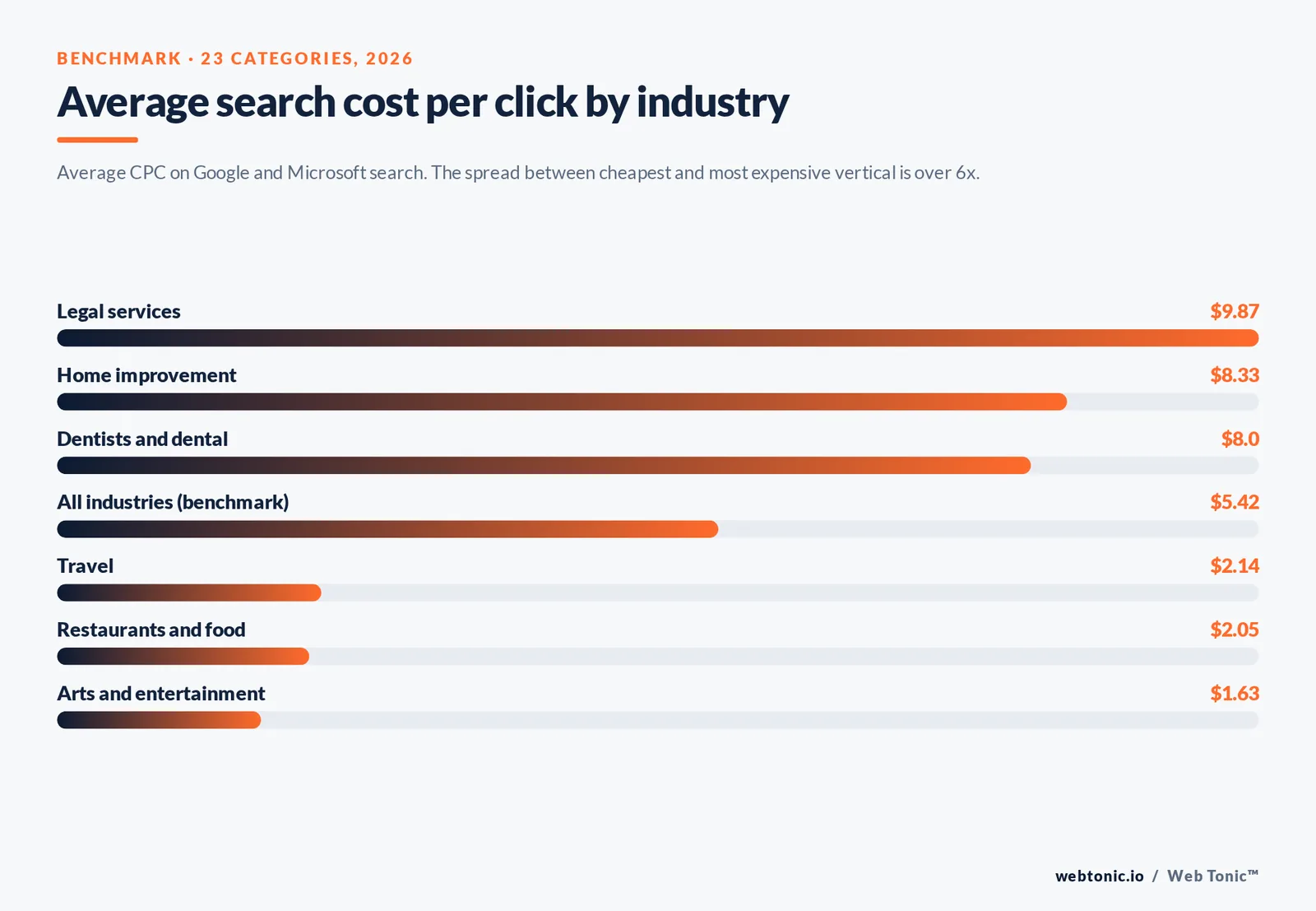
- Cost per click swings more than 6x between verticals: legal at $9.87 versus arts and entertainment at $1.63.
- Google holds 91.25% of global search, so a first PPC budget almost always starts there before expanding to Bing's 4.68%.
- Position matters even in paid results: the top organic result earns roughly 39.8% of clicks, and ads sit above it.
- Ad Rank is not just money — it combines your bid with expected CTR, ad relevance and landing page experience, all scored out of 10.
- Global search advertising spend is measured in the hundreds of billions of dollars a year, making PPC the single largest paid channel online.
What PPC actually means
Pay-per-click is a pricing model, not a channel. An advertiser sets a maximum they will pay for a click, the platform runs an auction each time a user's query or profile matches that targeting, and money only leaves the account when a real click happens. Impressions are free. That single rule is why PPC became the default way to buy intent-based traffic: you are buying visits rather than exposure.
Three terms cause most of the confusion:
| Term | What it means | How it is billed |
|---|---|---|
| PPC | The pricing model: payment triggered by a click | Per click, usually below your max bid |
| Paid search | The channel: text and shopping ads on search engines | Almost always PPC |
| CPM | Cost per thousand impressions, used for reach buying | Per 1,000 views, clicks free |
| CPA / tCPA | Cost per acquisition target set for automated bidding | Still per click, optimised to a conversion goal |
So "PPC advertising" covers search ads, most display and video placements sold on a click basis, retail and shopping listings, and the click objectives inside social platforms. Google explains the model itself in its Google Ads billing and bidding documentation, and Microsoft runs the same mechanics across Bing, Yahoo and DuckDuckGo inventory through Microsoft Advertising.
How the ad auction works, step by step
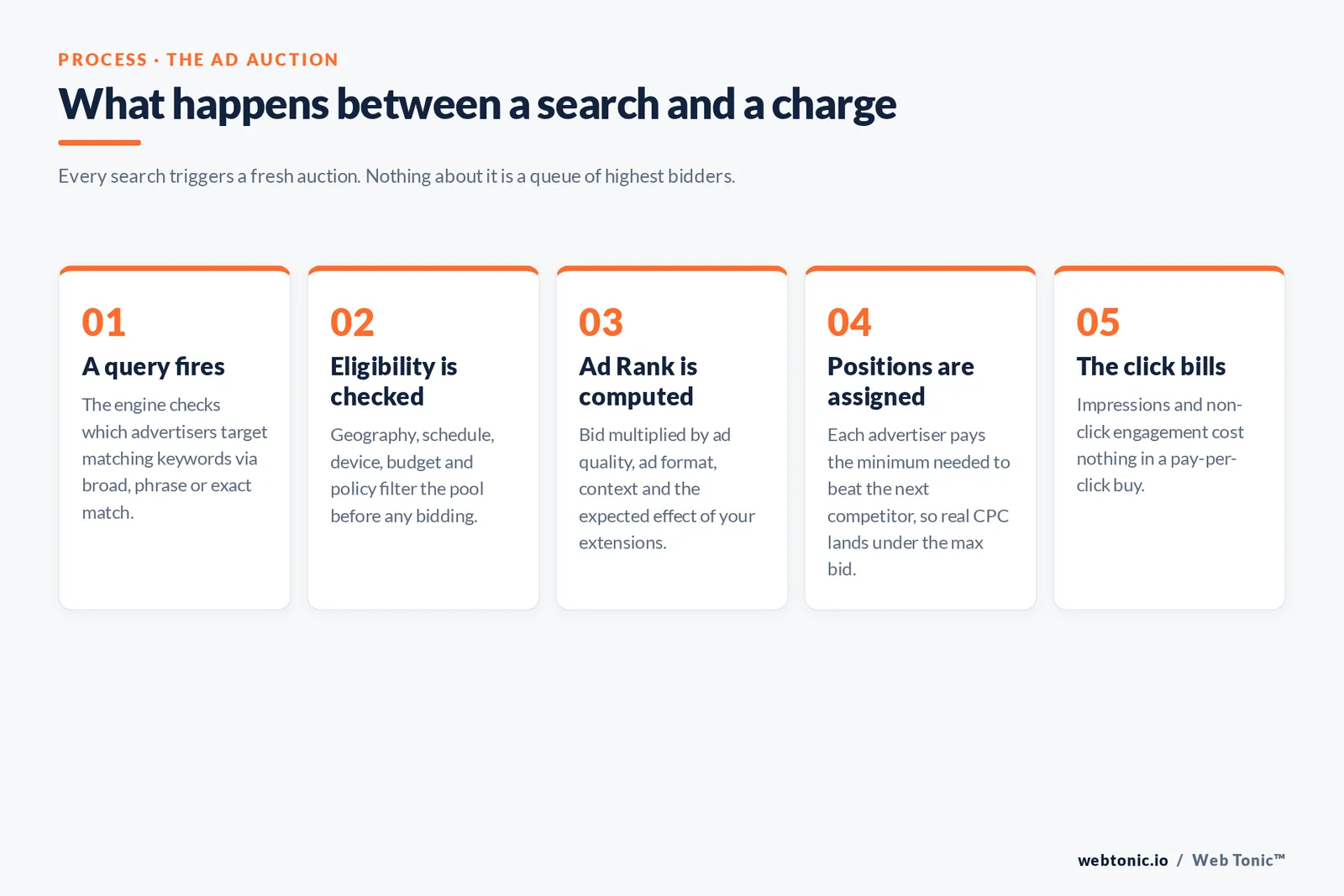
Nothing about PPC is a queue of highest bidders. Every search triggers a fresh auction, and the winner is decided by Ad Rank, a score that multiplies your bid by quality signals and expected impact.
- A query fires. The engine checks which advertisers are targeting keywords that match, using broad, phrase or exact keyword match types.
- Eligibility is checked. Geography, schedule, device, budget and policy all filter the pool before bidding.
- Ad Rank is computed from bid, ad quality, ad format, context and the expected effect of your extensions.
- Positions are assigned and each advertiser pays the minimum needed to beat the next competitor, which is why real CPC lands under your maximum bid.
- The click bills. Impressions, video views under thresholds and non-click engagement cost nothing in a PPC buy.
Quality Score is the visible summary of those quality signals, rated 1 to 10 across expected click-through rate, ad relevance and landing page experience. Google documents the components in its Quality Score help centre, and Semrush's breakdown of Quality Score shows why two advertisers with identical bids routinely pay different amounts for the same click. A better score means a cheaper click at the same position — the closest thing PPC has to a free lunch.
What a click costs in 2026
Averages hide enormous spread. LocaliQ's 23-category analysis of Google and Microsoft search campaigns puts the all-industry benchmark at a $5.42 CPC and a $66.69 cost per lead, but the range between the cheapest and most expensive verticals is more than six-fold.
| Category | Average CPC | Why it sits there |
|---|---|---|
| Legal services | $9.87 | Very high case value, few available clicks |
| Home improvement | $8.33 | Large ticket jobs, dense local competition |
| Dentists and dental services | $8.00 | High lifetime patient value |
| All industries (benchmark) | $5.42 | Blended average across 23 categories |
| Travel | $2.14 | High volume, thin margin per booking |
| Restaurants and food | $2.05 | Low order value, huge click supply |
| Arts and entertainment | $1.63 | Cheapest clicks of any tracked vertical |
Two implications follow. First, a $1,000 monthly budget buys around 185 clicks in a $5.42 market but only about 101 in legal — so vertical, not ambition, sets your minimum viable test budget. Second, the same LocaliQ dataset shows an 8.18% average conversion rate, which means roughly 12 clicks per lead. Budget for at least 30 to 50 conversions before you judge results. Current benchmark data is published in LocaliQ's search advertising benchmarks report, and category-level spend forecasts sit in Statista's search advertising outlook.
For industry-by-industry CPC benchmarks, budget tiers and break-even math, see our full PPC cost and pricing breakdown.
Where PPC ads run
The model spans far more surfaces than a search results page. Choosing between them is mostly a question of how much intent the placement carries.
| Placement | Intent level | Best used for |
|---|---|---|
| Search text ads | Highest | Capturing people already searching for the solution |
| Shopping and product listings | High | Retail catalogues with clear price competition |
| Local and map placements | High | Service businesses with a catchment radius |
| Display and native | Low | Remarketing and cheap incremental reach |
| Video and connected TV | Low to medium | Demand creation before search demand exists |
| Paid social click campaigns | Medium | Interest and lookalike targeting at scale |
Distribution decides where the first dollar goes. Statcounter's June 2026 data gives Google 91.25% of global search against Bing's 4.68%, per Statcounter's search engine share tracker. Microsoft inventory is still worth testing once Google is stable, because competition is thinner and CPCs are often lower for the same query. Industry-wide channel trends are tracked by the IAB and eMarketer's search advertising coverage.
PPC versus SEO: the honest comparison
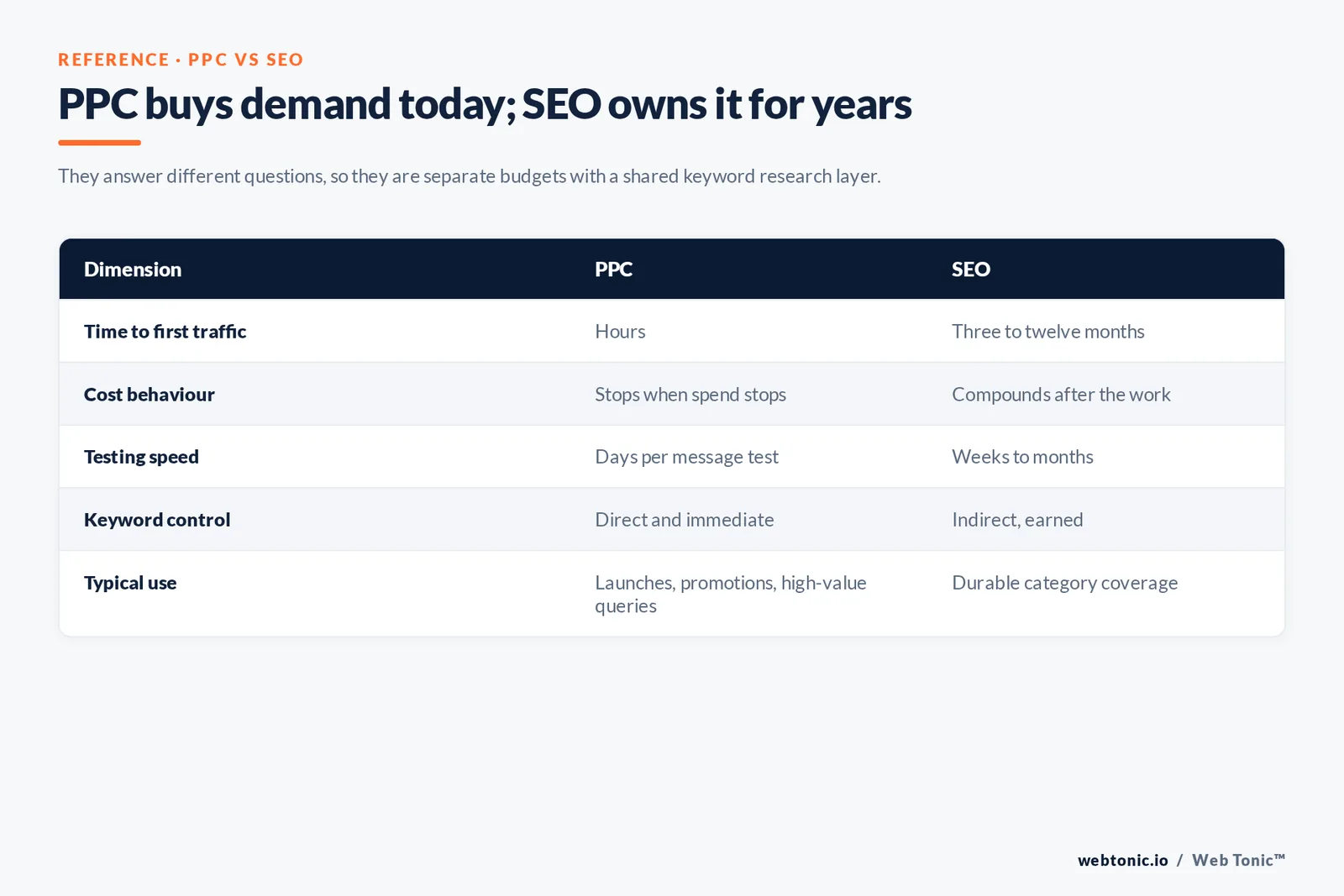
They answer different questions. PPC answers "can we buy demand today", SEO answers "can we own demand for years". The top organic result attracts roughly 39.8% of clicks according to First Page Sage's CTR study, which is exactly why ads are sold above it.
| Dimension | PPC | SEO |
|---|---|---|
| Time to first traffic | Hours | Three to twelve months |
| Cost behaviour | Stops when spend stops | Compounds after the work |
| Testing speed | Days per message test | Weeks to months |
| Keyword control | Direct and immediate | Indirect, earned |
| Typical use | Launches, promotions, high-value queries | Durable category coverage |
In practice the two feed each other: PPC data reveals which phrases convert, and those phrases become the priority list for content. Google's own SEO starter guide is explicit that paid clicks do not influence rankings, so treat them as separate budgets with a shared keyword research layer. If you want both handled together, that is what our growth marketing service and data intelligence practice exist to coordinate.
Building a first PPC campaign that does not waste money
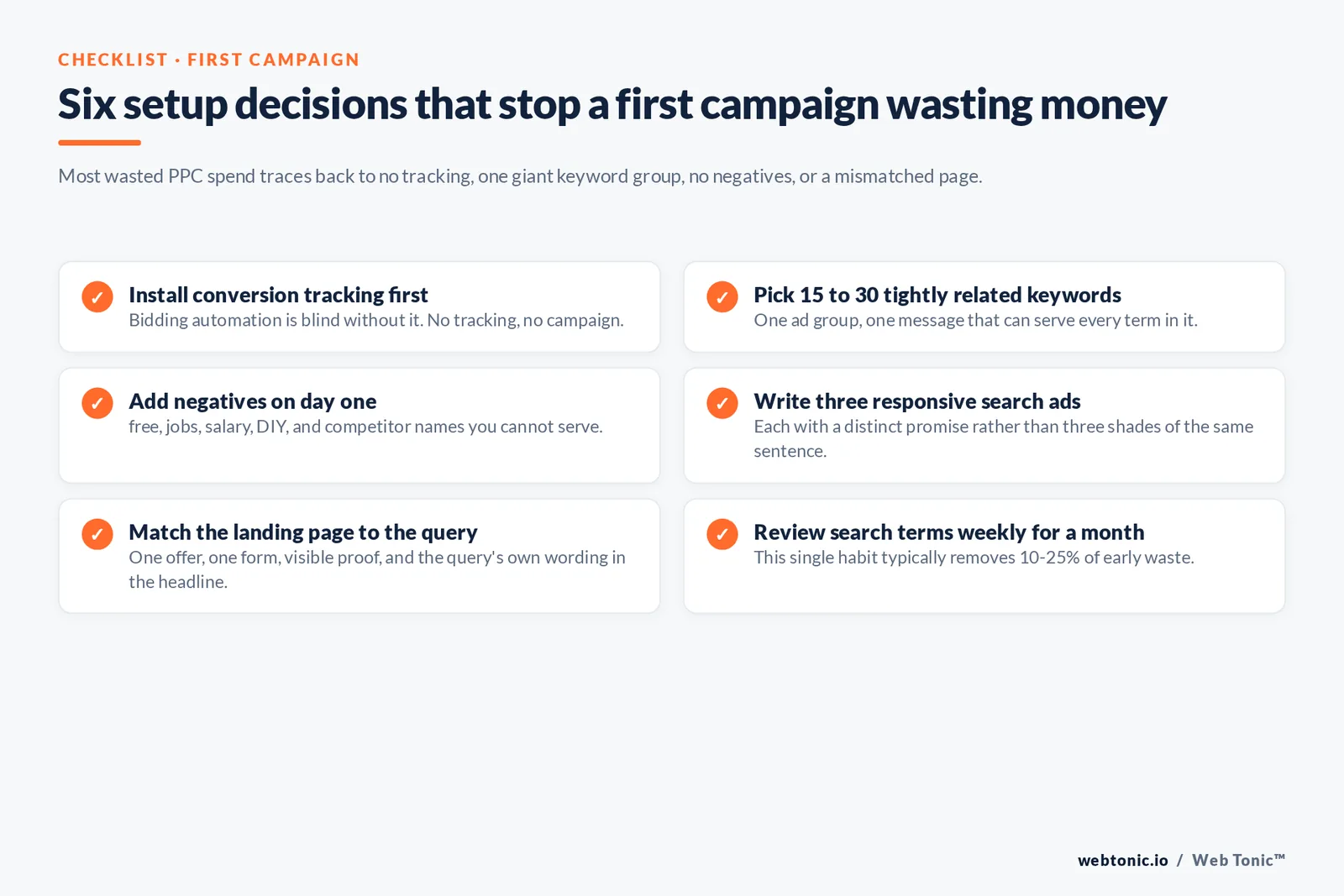
Most wasted PPC spend traces back to four fixable setup errors: no conversion tracking, one giant keyword group, no negatives, and a landing page that answers a different question than the ad.
- Install conversion tracking first. Bidding automation is blind without it, and Google's conversion tracking setup docs are the reference. No tracking, no campaign.
- Pick 15 to 30 tightly related keywords per ad group so one message can serve them all.
- Add negatives on day one — "free", "jobs", "salary", "DIY", competitor names you cannot serve.
- Write three responsive search ads per group, each with a distinct promise rather than three shades of the same sentence.
- Match the landing page to the query. One offer, one form, visible proof, and the query's own wording in the headline.
- Start on manual or maximise clicks until you have 30-plus conversions, then move to a target CPA or ROAS strategy.
- Review search terms weekly for the first month. This single habit typically removes 10-25% of early waste.
Structural choices are documented in Google's account structure guidance, and industry practice changes fast enough that Search Engine Land's Google Ads library is worth a monthly scan. For a broader primer on channel selection, HubSpot's PPC overview is a solid companion read.
The metrics that actually decide profitability
Impressions and clicks are diagnostics. Only three numbers decide whether PPC works for your business.
| Metric | Formula | Healthy reference |
|---|---|---|
| CTR | Clicks / impressions | 6.64% search average |
| Conversion rate | Conversions / clicks | 8.18% search average |
| Cost per lead | Spend / leads | $66.69 all-industry |
| ROAS | Revenue / spend | Above your gross margin break-even |
| Impression share | Impressions / eligible impressions | Below 100% means room to scale |
Work backwards from margin, never forwards from budget. If a customer is worth $900 in gross profit and you close one in four qualified leads, you can afford about $225 per lead — comfortable in almost any vertical. If a customer is worth $40, a $5.42 click needs a conversion rate above 13% before the maths works, and paid search may simply be the wrong channel. Attribution windows and lag are where most reporting arguments start, so agree on the model before launch; our performance creative team and full service stack set that up as part of onboarding, and there are more channel breakdowns in the Web Tonic blog.
The PPC vocabulary every advertiser needs
Paid search has its own dialect, and most beginner mistakes come from misreading one of these words inside a platform interface. This is the working glossary for anyone running a PPC account.
| Term | Plain definition | Why an advertiser cares |
|---|---|---|
| Keyword | The word or phrase you target in a search campaign | Decides which queries can trigger your ads |
| Search term | What the user actually typed | Where wasted spend is found and negated |
| Max bid | The ceiling you will pay for one click | Sets your entry price into the auction |
| Ad Rank | Bid multiplied by quality and format signals | Determines position and real cost per click |
| Quality Score | A 1-to-10 diagnostic of relevance | Higher scores buy the same position for less |
| Impression share | Share of eligible auctions you appeared in | Shows how much headroom the market still has |
| Negative keyword | A term you block from matching | The cheapest optimisation in paid search |
| Ad extensions | Extra links, callouts and structured snippets | Lift CTR and occupy more of the results page |
| Landing page experience | How well the destination serves the query | One of three Quality Score inputs |
| Smart Bidding | Automated bidding to a CPA or ROAS target | Needs about 30 conversions a month to work |
A few practical rules attach to that vocabulary. Broad match keywords will collect queries you never imagined, so pair them with a hard negative list rather than trusting the platform. Bid adjustments by device matter because mobile traffic converts differently to desktop in almost every category. Impression share below 60% on a profitable campaign is a signal to raise budget rather than tinker with copy. And because Google's automated bidding learns from your conversion data, feeding it a weak signal — a thank-you page view instead of a real qualified lead — is the single most expensive mistake a new advertiser can make.
Finally, treat every campaign as a marketing test rather than a traffic tap. The ads that win are the ones whose promise matches the search intent, and the accounts that scale are those where the keyword, the ad copy, the landing page headline and the offer all repeat the same sentence. Paid search rewards that consistency more directly than any other channel, because the platform prices relevance into every click you buy.
FAQ
What does PPC stand for?
PPC stands for pay-per-click. It is an advertising model where the advertiser is charged only when a user clicks the ad, rather than each time it appears. Impressions cost nothing under this model.
How much should a small business spend on PPC?
Start with enough budget to generate 30 conversions a month, because that is roughly the volume automated bidding needs. At an $5.42 average CPC and an 8.18% conversion rate that means about 370 clicks, or close to $2,000 a month in an average vertical — proportionally less in cheap categories and more in legal or home services.
Is PPC better than SEO?
Neither is better; they solve different problems. PPC buys traffic within hours and stops when spend stops, while SEO takes three to twelve months and then compounds. Most durable programmes run both and use paid search term data to prioritise organic content.
Why is my cost per click higher than the average?
Usually one of three reasons: a competitive high-value vertical, low Quality Score pushing your Ad Rank down, or overly broad keywords pulling in irrelevant queries. Tightening match types, adding negatives and improving landing page relevance are the fastest levers.
Do PPC ads help organic rankings?
No. Paid clicks are not a ranking signal and Google documents them as separate systems. The indirect benefit is data: paid search reveals which queries convert, which informs which organic pages are worth building.
Sources
LocaliQ search advertising benchmarks (23 categories, Google and Microsoft Ads) · Google Ads Help: Quality Score, conversion tracking, keyword match types, account structure · Semrush Quality Score analysis · Statcounter global search engine market share, June 2026 · First Page Sage click-through rate by position report · Statista search advertising outlook · IAB insights · eMarketer search advertising coverage · Microsoft Advertising · Google Search Central SEO starter guide · Search Engine Land Google Ads library · HubSpot PPC overview.