Table of contents
Google Shopping feeds were never available for plumbing work itself: Google's policy excludes repair and maintenance services, so the question only applies to businesses that sell fixtures and parts. For those sellers, the 2025 data points toward local inventory, because much plumbing stock is bought at a branch.
Key Takeaways
- 4.25 million gas residential storage water heaters shipped in 2025, up 1.8% (AHRI via ACHR News).
- 5.03 million electric residential storage water heaters shipped, down 0.6%.
- December 2025 gas water heater shipments rose 19.3% year over year.
- Ferguson's calendar 2025 net sales reached USD 31.3 billion, up 5.0%.
- Ferguson runs about 1,700 locations with about 35,000 associates.
- Home Depot operated 2,359 stores and over 1,250 SRS locations at fiscal 2025 year-end.
- Local inventory ads are available in more than 45 countries including the US and Canada.
- 65% of marketers exclude some items from feeds (DataFeedWatch 2022, 15,000+ stores).
- Google Shopping investment rose 18% year over year in Q2 2026 (Tinuiti via SEJ).
The policy line every plumber hits first
Google's Unsupported Shopping content page says services are not allowed: "labor, time, effort, expertise, or actions, which do not result in ownership of a tangible product", including "any services sold bundled with physical goods." The example list starts with maintenance or repair services. Drain clearing, leak detection, repiping and water heater installation all fall on the wrong side of that line.
So "worth it" has two answers. For a service-only plumbing company, Shopping is not available at any price. For a company that sells fixtures, heaters or parts, it can be, provided the product is really sold and the feed is kept accurate.
| Plumbing offer | Can it list? | Policy reason | Suggested Google route |
|---|---|---|---|
| Faucets, toilets, sinks sold in store or online | Yes | Tangible product | Shopping or local inventory ads |
| Water heater sold for pickup | Yes | Tangible product | Local inventory ads |
| Emergency leak repair | No | Repair service | Local Services Ads |
| Drain cleaning | No | Maintenance service | Local Services Ads, Search |
| Water heater with installation | No | Service bundled with goods | Search, Performance Max |
Local inventory: the plumbing-shaped part of Shopping
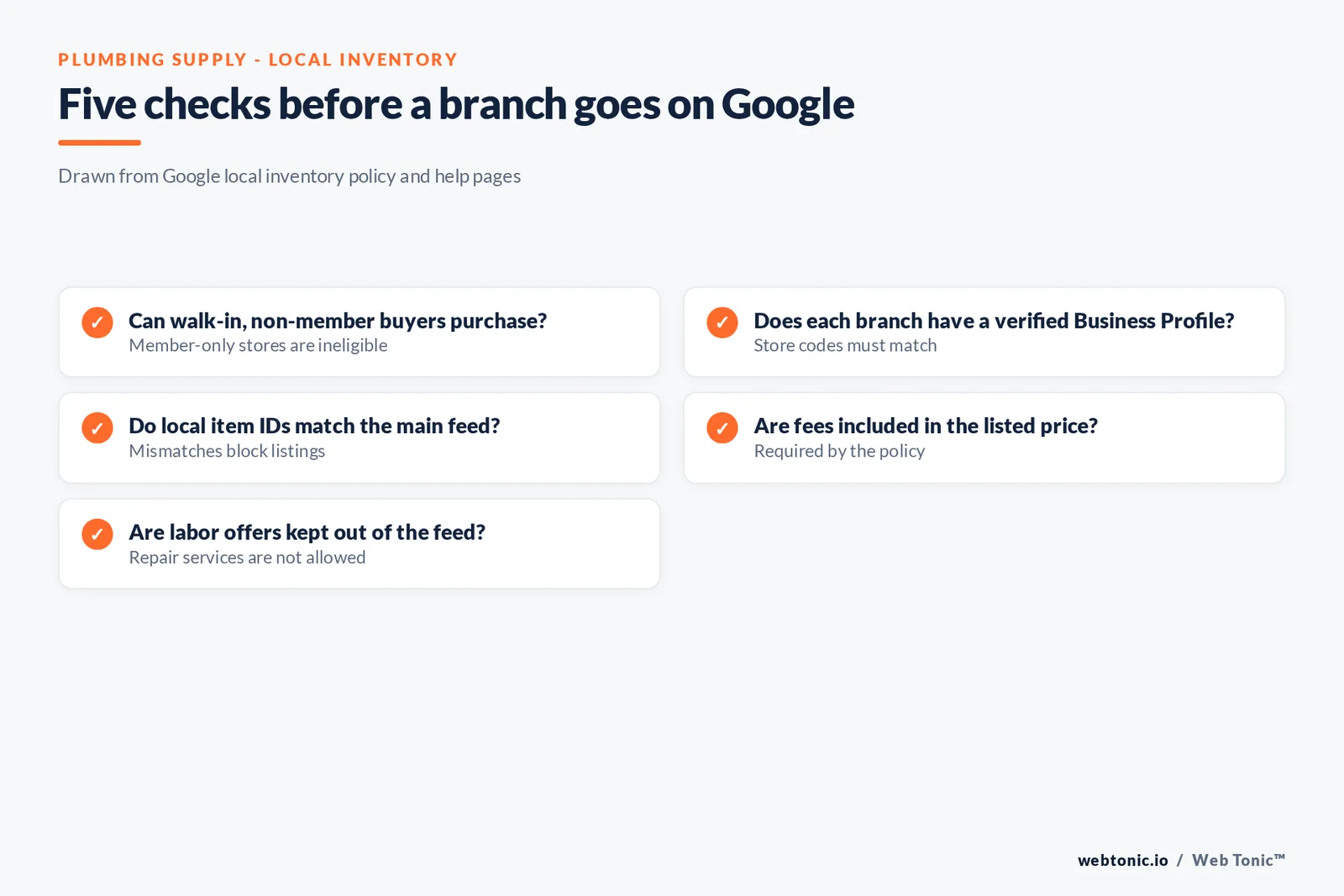
Google's local inventory ads and free local product listings policy is built for stores. It is available to retailers with physical locations in more than 45 countries, and it removes two Shopping requirements: no online checkout and no shipping information, because purchase and pickup happen in the store. In return it adds conditions. There must be a brick-and-mortar location where customers can "physically visit, view, and purchase" the item; stores that require membership are ineligible unless non-members can also buy; extra fees must be included in the price; and the business must be physically located in the target country.
Two setup details trip plumbing suppliers most often, according to the same page: store codes in the local inventory data must match the Google Business Profile, and each item ID must match the primary product feed.
| Local inventory rule (Google) | Requirement | Plumbing supply reading |
|---|---|---|
| Physical location | Customers can visit, view and buy | Branch counters and showrooms qualify |
| Membership | Non-members must be able to buy | Trade-account-only counters do not |
| Online checkout | Not required | Fine for heavy fixtures sold in branch |
| Shipping details | Not required | Pickup covers bulky water heaters |
| Store codes | Must match Business Profile | Each branch needs a verified profile |
Free local listings versus paid local inventory ads
Google's policy page covers two products at once: free local product listings, which show in-store stock on Google surfaces at no click cost, and paid local inventory ads, which buy placement for the same data. Both run on the same feeds and follow the same Shopping content policies, so the eligibility work is done once. A supply house can start with free listings to confirm its store codes, item IDs and prices are matching, then decide whether paid placement is worth adding for high-margin lines such as designer fixtures or tankless heaters.
The page also warns that Google may ask merchants to take part in inventory verifications, and that a store whose primary purpose is to promote products that violate Shopping content policies cannot participate. Neither is a common problem for plumbing products, but the first means stock counts need to be honest: listing a unit as in stock at a branch that cannot hand it over is the fastest way to lose the program.
| Option | Cost | Data needed | Best plumbing use |
|---|---|---|---|
| Free local product listings | No click cost | Product feed + local inventory + store codes | Validate branch stock data |
| Local inventory ads | Paid clicks | Same feeds, linked Google Ads account | Urgent replacements like water heaters |
| Standard Shopping ads | Paid clicks | Product feed + checkout + shipping | Online fixture stores |
| Free product listings | No click cost | Product feed + checkout | Long-tail parts catalogs |
| Local Services Ads | Per lead | Service profile, licence, insurance | Plumbing labor, not products |
Water heaters: the one plumbing category with shipment data
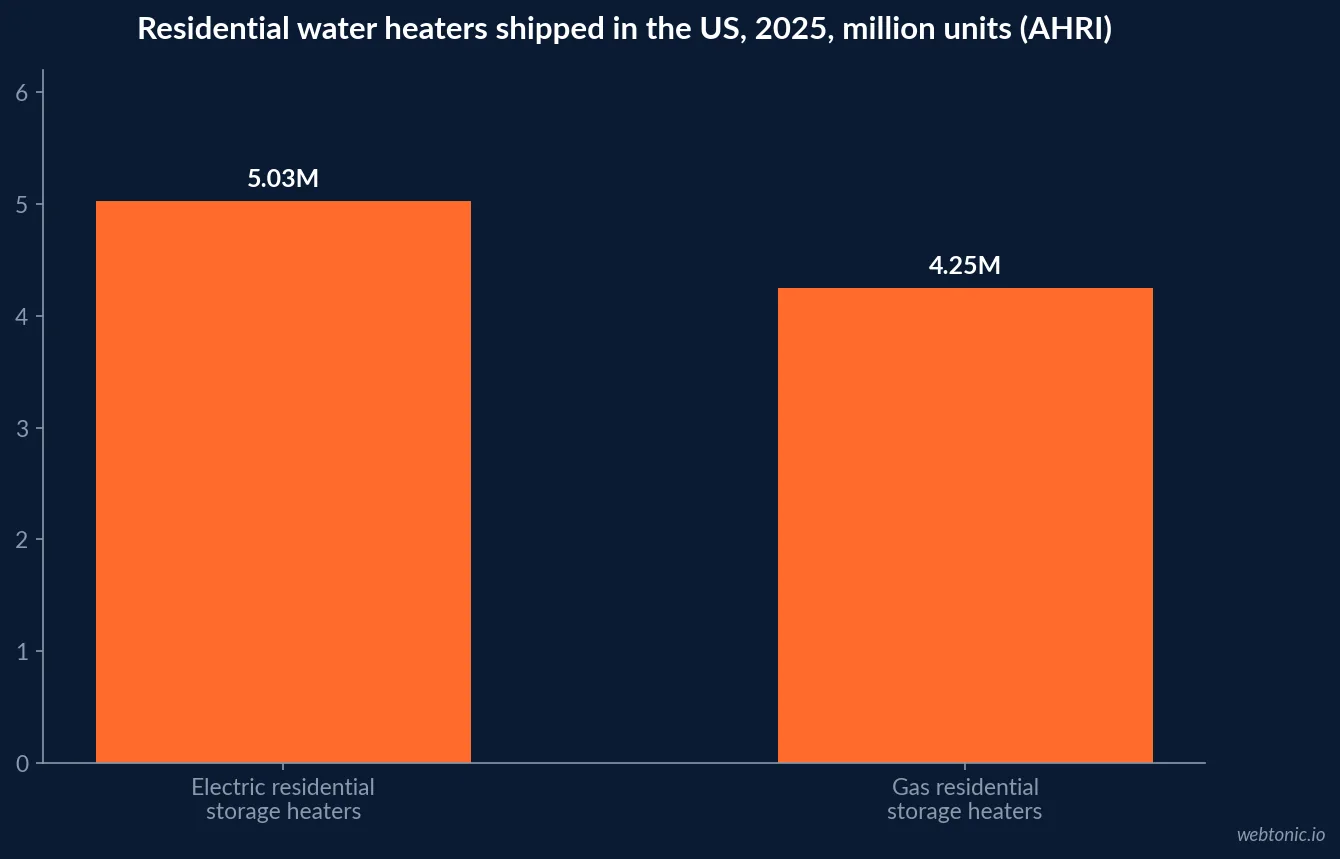
Most plumbing products have no public unit data, but water heaters do. AHRI figures reported by ACHR News show 4.25 million residential gas storage water heaters shipped in 2025, up 1.8% from 4.18 million, and 5.03 million electric units, down 0.6% from 5.06 million, for about 9.28 million combined. December was strong: gas units rose 19.3% to 418,518 and electric units 16.8% to 462,252 against December 2024.
That is replacement-driven demand, which tends to be urgent and local. It is exactly the search where a buyer wants to know whether a branch has a 50-gallon unit today, and exactly what local inventory data answers.
| Water heater type (AHRI) | 2025 units | 2024 units | Change |
|---|---|---|---|
| Residential gas storage | 4.25 million | 4.18 million | +1.8% |
| Residential electric storage | 5.03 million | 5.06 million | -0.6% |
| Gas storage, December only | 418,518 | 350,875 | +19.3% |
| Electric storage, December only | 462,252 | 395,719 | +16.8% |
| Combined residential storage | About 9.28 million | About 9.24 million | Roughly flat |
Who owns the plumbing catalog
Ferguson reported calendar 2025 net sales of USD 31.3 billion, up 5.0%, with organic growth of 4.5%, and describes itself as operating in over 1,700 locations with about 35,000 associates. It noted double-digit non-residential growth against "a challenging residential market". On the retail side, Home Depot reported fiscal 2025 sales of USD 164.7 billion and ended the year with 2,359 retail stores plus more than 1,250 SRS locations.
These are the advertisers with store networks big enough for local inventory feeds. An independent supply house competes with them branch by branch, which is where accurate local stock data helps.
Scale also explains why the big players can afford feed tooling that a two-branch supplier cannot. A national network updates thousands of store-level stock records every day; an independent can get most of the same benefit by limiting its local feed to the few hundred items buyers actually search for urgently, such as common water heater sizes, toilet repair parts, supply lines, shut-off valves and popular faucet lines, and by keeping those counts exact. Ferguson's own description of 2025, with residential described as challenging and non-residential growing, is a reminder that residential replacement demand is the part of the market local listings are best placed to catch.
Keeping a fixtures feed clean
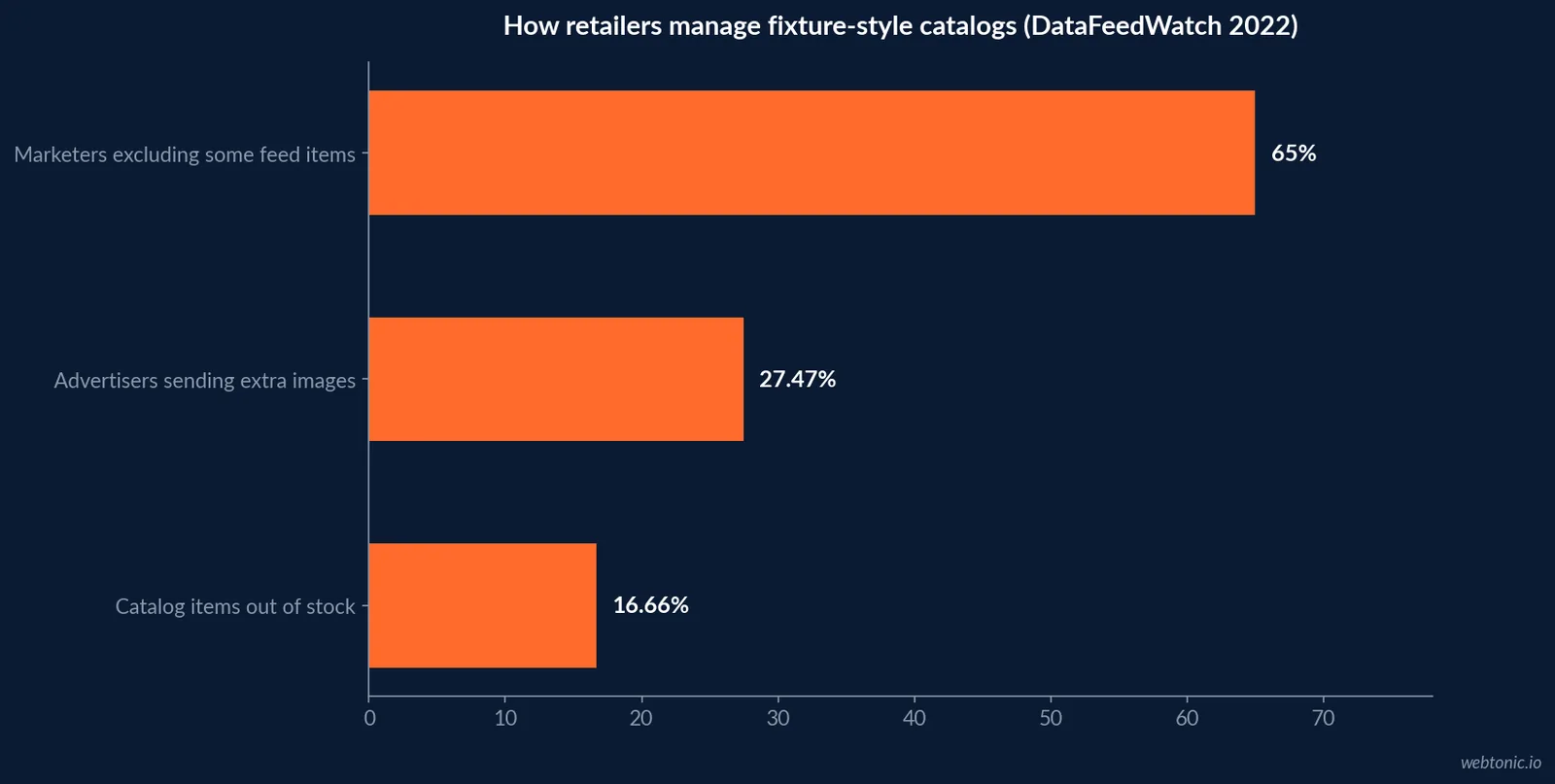
Showroom catalogs carry thousands of finish and size variants. The DataFeedWatch Feed Marketing Report 2022, built on more than 15,000 online stores, found 7% of Google Shopping feed items rejected for data errors and 16.66% of advertised products out of stock. It also found 65% of marketers exclude some items from their feeds, especially less profitable ones, and 27.47% send additional images to improve listing appeal.
For fixtures, variant data carries most of the weight: finish, flow rate, rough-in size and connection type should be distinct attributes or title elements, so that a chrome and a matte-black faucet do not collapse into one listing.
Feed platform matters as well. The same 2022 study measured 5.47% of listings disapproved for Shopify sellers against nearly 10% of products affected for Magento sellers, and found shipping settings and images behind 44% of disapprovals. A heavy toilet or a water heater with no shipping rule is a typical plumbing example of the first; a generic manufacturer image shared across ten finishes is a typical example of the second.
Retail and auction context for 2026
The Census Bureau estimated US retail e-commerce at USD 340.2 billion in Q2 2026, 17.1% of retail and up 12.2% year over year. In the auction, Tinuiti's Q2 2026 benchmark reports Amazon at 0% US Shopping impression share against the median retailer, and Search Engine Journal reports Tinuiti's finding of Shopping investment up 18% year over year with search CPCs up about 1%. None of these are plumbing figures; no public source publishes a plumbing Shopping CPC or ROAS.
| Metric | Value | Scope | Source |
|---|---|---|---|
| US retail e-commerce, Q2 2026 | USD 340.2 billion | All retail | Census |
| E-commerce share of retail | 17.1% | All retail | Census |
| Google Shopping investment growth | +18% YoY | Tinuiti clients | Tinuiti via SEJ |
| Amazon US Shopping impression share | 0% vs median retailer | Tinuiti clients | Tinuiti |
| Plumbing Shopping CPC or ROAS | Not published | n/a | No public source |
What plumbers use instead
Google lists Plumbers among US Local Services Ads categories, with leads arriving as calls and messages, and positions Performance Max for lead goals across Search, YouTube, Maps and more. See our plumbing Google Ads statistics and the Google Ads pricing guide for those costs.
A plumbing company that also sells products can run both at once: Local Services Ads for the emergency call, and a local inventory feed for the customer who would rather collect a replacement part and fit it themselves. The two audiences overlap less than they appear to, so the budgets rarely compete.
Is it worth it? A decision list
- Service-only plumbing company: no, the policy excludes it.
- Showroom or supply house open to the public: test local inventory first.
- Online fixtures store: standard Shopping, with variant-level data.
- Trade-only counter: ineligible for local listings unless non-members can buy.
- Mixed business: products in Shopping, services in Local Services Ads.
More plumbing marketing data
For demand-side channels, see our plumbing CTV statistics and plumbing influencer and UGC statistics.
Frequently Asked Questions
Can a plumber advertise drain cleaning or repairs on Google Shopping?
No. Google's Unsupported Shopping content policy disallows labor, time, effort, expertise or actions that do not result in ownership of a tangible product, and names maintenance or repair services as examples. Services sold bundled with goods are also excluded. Plumbers use Local Services Ads, where Plumbers is a US category, plus Search and Performance Max.
Who in plumbing can use Google Shopping feeds?
Anyone who sells physical plumbing products: supply houses, fixture showrooms, home-improvement retailers and online stores selling faucets, toilets, water heaters, valves, pipe and fittings. A contractor that also runs a retail counter open to the public can list that counter's stock.
What are local inventory ads and do they suit plumbing supply?
Local inventory ads and free local product listings show products available in a nearby store. Google's policy drops the online checkout and shipping requirements, but requires a brick-and-mortar location where customers can view and buy the item, and bars stores that sell only to members. Trade-only counters need non-member access.
How big is the plumbing product market?
Ferguson, the largest US plumbing distributor, reported calendar 2025 net sales of USD 31.3 billion, up 5.0%. AHRI data reported by ACHR News counted 4.25 million gas and 5.03 million electric residential storage water heaters shipped in 2025.
Is Shopping spend still rising in 2026?
Across retailers, Tinuiti's Q2 2026 benchmark, as reported by Search Engine Journal, showed Google Shopping investment up 18% year over year. It is cross-retail vendor data, not a plumbing benchmark.
Sources
Google Merchant Center - Unsupported Shopping content
Google - Local inventory ads policy
ACHR News - AHRI 2025 shipments
Ferguson - Calendar 2025 results
Home Depot - Fiscal 2025 results
DataFeedWatch - Feed Marketing Report 2022
US Census - Quarterly e-commerce Q2 2026
Tinuiti - Digital Ads Benchmark Q2 2026
Search Engine Journal - Q2 2026 paid search
Google - Local Services Ads