Table of contents
Key Takeaways
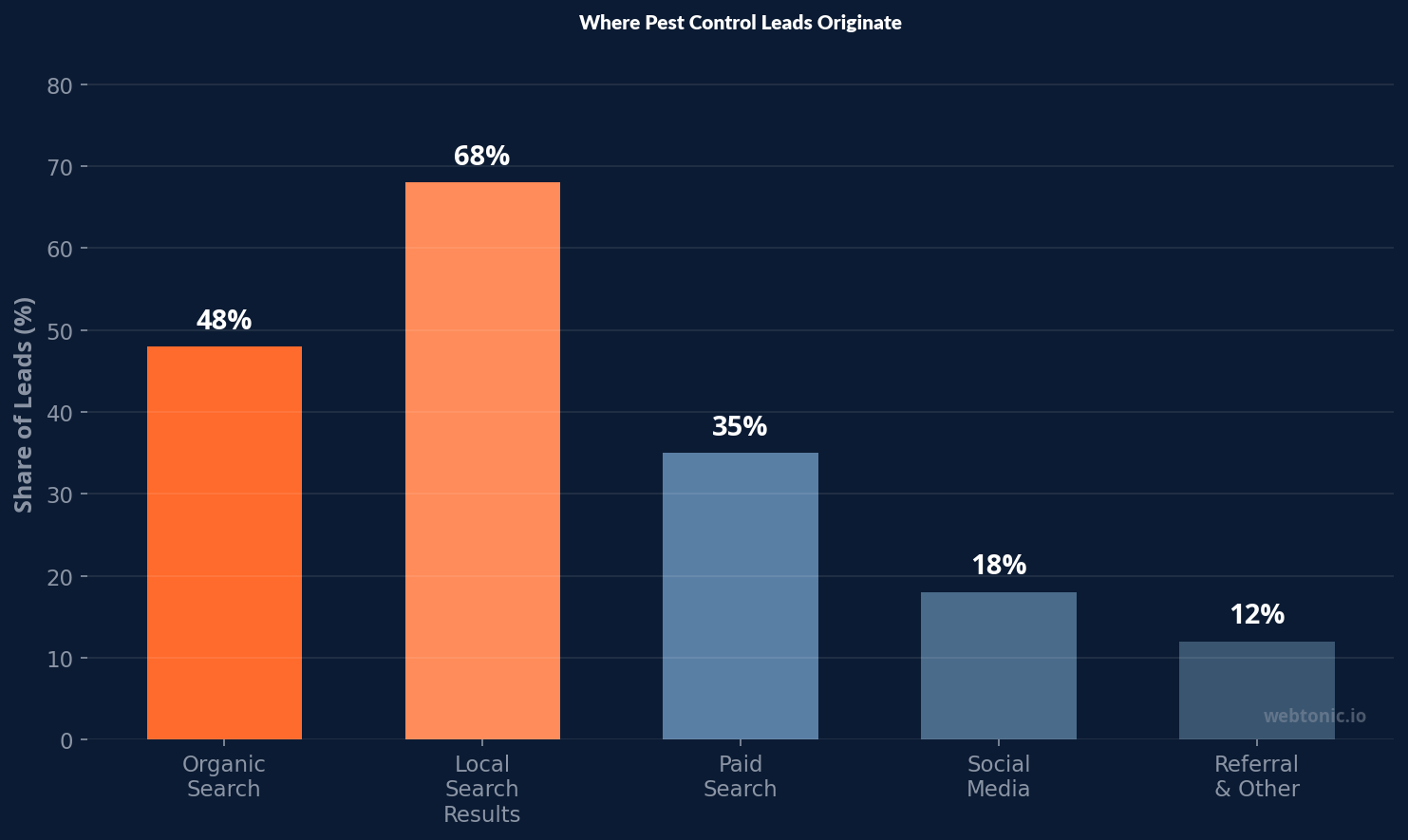
- 48% of pest control leads originate from organic search traffic, making it the single largest inbound channel for the industry (MarketingLTB, 2026).
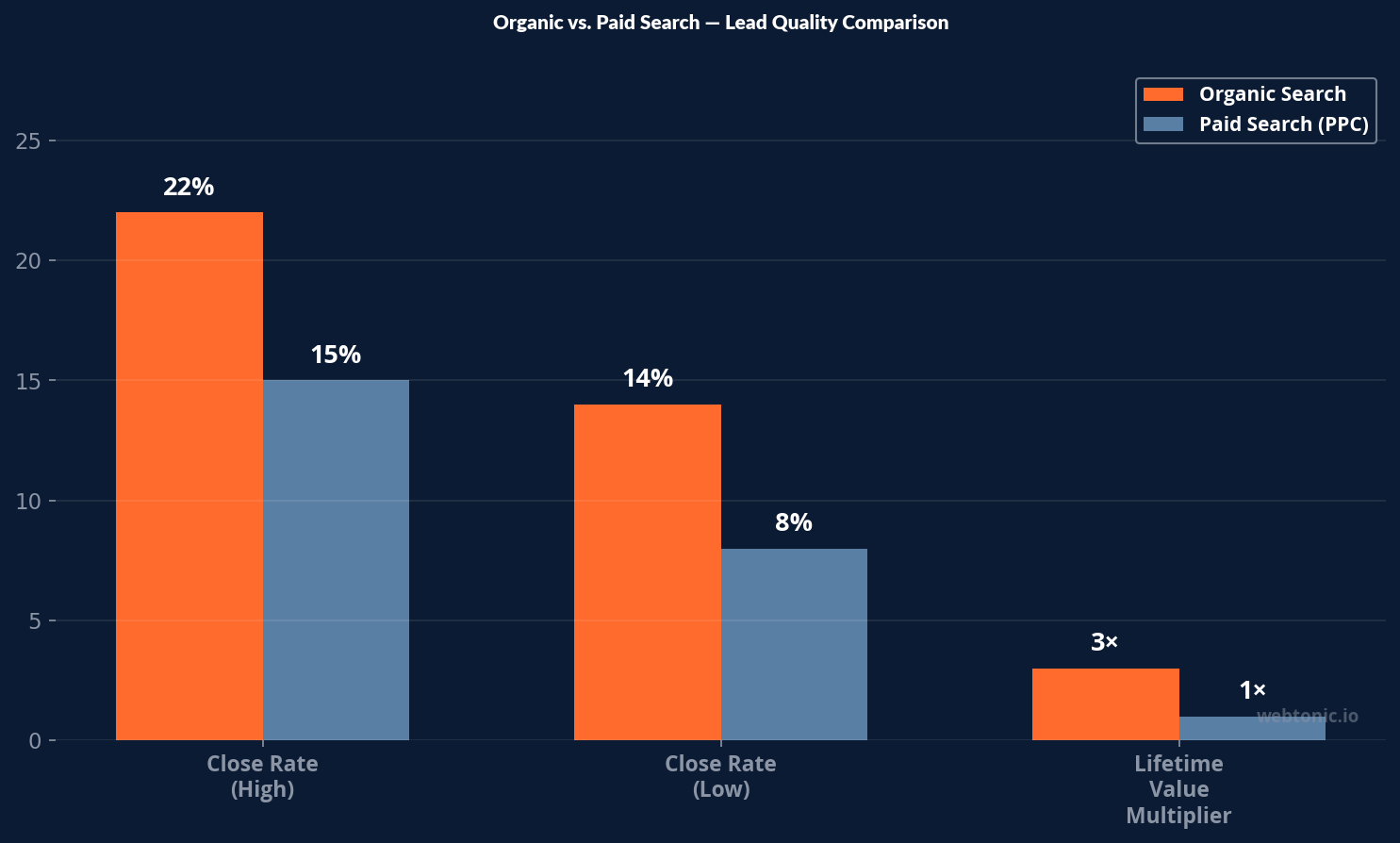
- Organic leads close at a 14%–22% rate, outperforming pay-per-click leads that close at 8%–15% (MarketingLTB, 2026).
- "Pest control near me" averages 214,200 monthly searches at an $18.04 CPC, demonstrating the enormous commercial intent behind local pest queries (HomeServiceBase, 2025).
- Optimized pest control websites convert 3%–8% of organic visitors into leads, with emergency-intent pages converting at even higher rates (AuthoritySpecialist, 2026).
- 68% of pest control leads originate specifically from local search results, underlining the critical role of Google Business Profile optimization (MarketingLTB, 2026).
- One regional operator expanded from 1 to 4 counties on organic alone, generating a 280% increase in inbound quote requests after eliminating a $4,800/month ad spend (The SEO Doctors, 2026).
Pest Control Search Demand at a Glance
The pest control industry generates massive search volume driven by urgent, high-intent queries. Over 32,000 pest control companies compete for visibility in the United States alone (MediaSearchGroup, 2026), and the top keywords carry significant commercial value. The table below shows the highest-volume pest control queries and their associated cost-per-click benchmarks.
| Keyword | Monthly Volume | Avg. CPC |
|---|---|---|
| Pest control near me | 214,200 | $18.04 |
| Pest control in near me | 208,600 | $17.77 |
| Exterminator pest control near me | 171,800 | $17.89 |
| Exterminator near me | 86,400 | $20.03 |
| Pest control services near me | 29,700 | $12.06 |
| Termite control near me | 20,600 | $38.89 |
| Rodent control near me | 18,200 | $28.99 |
Source: HomeServiceBase, 2025. Based on analysis of 10,000 high-intent industry keywords.
Seasonal demand peaks between March and August, when warm weather triggers pest activity. Search volume for core queries can spike 40%–60% above winter baselines during this window (AuthoritySpecialist, 2026). Operators that begin ranking campaigns in winter position themselves to capture these surges when organic traffic is most valuable.
Organic Traffic and Lead Generation Benchmarks
Organic search is the dominant lead-generation channel for pest control businesses. According to MarketingLTB's 2026 analysis of 93+ industry data points, 48% of all pest control leads come from organic search, with 53% of website traffic arriving through local-focused landing pages (MarketingLTB, 2026).
| Metric | Benchmark | Source |
|---|---|---|
| Leads from organic search | 48% of total | MarketingLTB 2026 |
| Traffic from local pages | 53% of total traffic | MarketingLTB 2026 |
| Leads from local search results | 68% of total | MarketingLTB 2026 |
| Organic visitor-to-lead conversion | 3%–8% | AuthoritySpecialist 2026 |
| Organic lead close rate | 14%–22% | MarketingLTB 2026 |
| PPC lead close rate (comparison) | 8%–15% | MarketingLTB 2026 |
| Organic traffic LTV vs. paid | 3× higher | MarketingLTB 2026 |
| Organic conversion rate (SEO channel) | 14.6% | Cube Creative 2026 |
The gap between organic and paid lead quality is striking. Organic leads close at 14%–22% compared with 8%–15% for PPC leads. Over a customer lifecycle, organic traffic delivers 3× the lifetime value of paid traffic. These numbers explain why many operators increasingly divert budget toward content and technical optimization. Complementing organic with performance-driven strategies covered in our growth marketing services creates a dual-channel approach rather than expanding ad spend. Operators evaluating how to allocate their marketing investment can compare organic and paid approaches in our guide to Google Ads strategy (MarketingLTB, 2026).
Local Search and Map Pack Visibility
Local search dominance is non-negotiable for pest control operators. 68% of all pest control leads originate from local search results, and 42% of local-pack clicks go to businesses in the top three positions (MarketingLTB, 2026; Ignite Digital, 2026). Google Business Profile signals account for 32% of the overall ranking weight in local pack results.
AuthoritySpecialist's campaign data shows that Map Pack positions generate disproportionately more calls than blue-link organic rankings for service-area businesses. This is driven by mobile behavior: users searching for emergency pest issues tap the phone number directly from the Map Pack without visiting a website (AuthoritySpecialist, 2026).
Companies with optimized Google Business Profiles and location-specific service pages consistently outperform competitors relying on a single homepage. The median pest control pack leader carries 87 reviews, operates with 2.9× the review advantage over competitors outside the top three, and maintains regularly updated photos and posts (ES Studios/BrightLocal, 2026).
SEO ROI vs. Paid Channels
When measuring the return on organic investment against paid alternatives, the data overwhelmingly favors sustained search optimization. Google Ads cost pest control companies $20–$30 per LSA lead and $40–$60 per PPC lead, while organic search delivers leads at a 14.6% conversion rate — the highest-quality inbound channel (Cube Creative, 2026).
| Channel | CPL Range | Conv. Rate | Lead Quality |
|---|---|---|---|
| Organic search (overall) | No direct CPL | 14.6% | Highest-quality |
| Google Local Services Ads | $20–$30 | 38%–45% book rate | High-intent |
| Google PPC (search) | $40–$60 | 7.33% | Medium-high |
| Meta (Facebook/Instagram) | $50–$80+ | Varies | Lower intent |
Sources: Cube Creative, 2026; BaaDigi, 2026.
One case study illustrates the compounding effect of organic investment. Shield Pest Solutions, a Tampa-area operator, expanded from 1 county to 4 counties on organic traffic alone. After restructuring their website around pest-specific and location-specific landing pages, the company achieved a 280% increase in inbound quote requests while eliminating a $4,800/month Google Ads spend. Each new customer represented $400–$1,200 in annual recurring value from termite bonds, quarterly sprays, and mosquito programs (The SEO Doctors, 2026).
Technical and On-Page Optimization Statistics
Despite the clear ROI of organic search, many pest control websites have significant technical deficiencies. A 300-site audit by Cube Creative found that 89.7% of pest control websites are losing traffic due to structural issues, with 65% carrying critical technical problems including slow page speed, missing service pages, and poor mobile rendering (Cube Creative, 2026). Another 56% are invisible in the local map pack despite being within serviceable areas.
AuthoritySpecialist's 2026 diagnostic framework identifies five layers where pest control sites most commonly fail:
- Technical health — crawl errors, slow page speed, and missing structured data block rankings before content quality matters.
- Local signal consistency — mismatched NAP (name, address, phone) across directories directly suppresses Map Pack visibility.
- Content depth — thin or missing individual service pages are the most common content gap across audited pest control sites.
- Backlink authority — operators lacking relevant local backlinks struggle to outrank national chains even with better reviews.
- Conversion readiness — the layer most operators skip entirely. Missing click-to-call buttons, excessive form fields, and slow load times limit ROI even when rankings improve.
Content Marketing and Backlink Impact
Content-driven link building remains a primary organic growth lever. Backlinks improve organic traffic by 35% on average for pest control websites, while on-page content signals account for 15%–19% of ranking factor weight (MarketingLTB, 2026; AFFiNCO, 2026).
Pest control companies that maintain a regularly updated blog with seasonal pest guides, identification resources, and prevention tips generate substantially more indexable pages and long-tail keyword coverage. Seasonal content timed to spring emergence, summer mosquito season, or fall rodent migration captures intent-rich traffic during the exact weeks when conversion rates peak.
Link-building strategies that work specifically for pest control include citation directory submissions (10–15 high-authority directories recommended), local partnerships with real estate and property management firms, and educational content syndication. Companies with diversified backlink profiles from 9+ referring domains across local, industry, and educational sources show the strongest ranking stability (AuthoritySpecialist, 2026).
AI Search and the Evolving Landscape
The rise of AI-powered search is reshaping how pest control companies acquire leads. AI adoption in local search has grown from 6% to 45% in recent years, with platforms like ChatGPT and Google AI Overviews generating high-quality referral traffic (AFFiNCO, 2026). Early data from Invoca and PCT Online shows that ChatGPT-referred visitors convert at a 49% lead rate — the highest intent of any digital channel (Invoca/PCTOnline, 2026).
For pest control operators, this means structured data, comprehensive FAQ content, and clear entity signals (NAP consistency, schema markup, topical authority across pest types) are increasingly important. Sites that answer specific pest questions with authoritative, data-backed content are more likely to be cited in AI-generated answers, creating a new organic channel that compounds on existing optimization investments. Companies looking to complement organic efforts with paid campaigns can explore our Google Ads agency services.
Best Practices for Pest Control Search Optimization
- Build individual service pages for each pest type and treatment method — sites with pest-specific pages rank for significantly more long-tail queries than those using a single services page.
- Create location-specific landing pages for every service area — operators covering multiple cities or counties should have dedicated pages with localized content, not just city-name swaps.
- Optimize Google Business Profile aggressively — maintain 50+ reviews, upload recent job photos monthly, post weekly updates, and ensure NAP consistency across all directories.
- Invest in seasonal content calendars — publish pest prevention guides 4–6 weeks before seasonal demand peaks to allow indexing time before search volume surges.
- Implement click-to-call and reduce form friction — Cube Creative's audit found that 67.9% of form submissions are abandoned when forms exceed 4–6 fields (Cube Creative, 2026).
- Add FAQ and HowTo schema markup to service pages — structured data increases eligibility for rich results and AI search citations.
- Track calls separately from form fills — many operators discover organic search drives significantly more phone leads than analytics dashboards suggest without call tracking. Our data intelligence services help connect these attribution gaps.
Related reading
- Pest Control Technical SEO Statistics: Speed, Indexing and Schema in 2026
- Does Pest Control Enterprise SEO Actually Work?
- Local vs Global: Pest Control International SEO Data
- GEO & AEO services at Web Tonic
Frequently Asked Questions
What percentage of pest control leads come from organic search?
Approximately 48% of pest control leads come from organic search traffic, making it the largest single lead source for the industry. When narrowed to local search results specifically, 68% of leads originate from local listings including Google Maps and the local 3-pack. These organic leads also close at a higher rate (14%–22%) compared with pay-per-click leads (8%–15%), delivering roughly three times the customer lifetime value of paid channels.
How much does it cost to rank for pest control keywords?
The cost of ranking depends on market density and competition. In competitive metros, the top pest control keywords carry CPCs of $18–$39, reflecting the commercial value of those positions. While organic rankings have no direct per-click cost, most pest control companies invest $1,500–$5,000 per month in ongoing optimization including content creation, link building, and technical maintenance. For operators spending $4,000+ monthly on ads, organic investment frequently delivers better long-term ROI within 6–12 months.
How long does it take for a pest control website to rank?
Based on campaign data from AuthoritySpecialist and The SEO Doctors, pest control websites typically see measurable ranking improvements within 3–6 months, with significant traffic growth at the 6–12 month mark. Campaigns started in winter tend to mature right as spring-summer demand peaks, maximizing the revenue impact of early rankings. For a broader perspective on paid search costs, see our Google Ads pricing guide. Shield Pest Solutions achieved a 280% increase in inbound quotes after restructuring their site for individual service and location pages over a multi-month engagement.
Why is local search optimization more important than general website ranking for pest control?
Local search dominates because pest control is inherently a geo-specific service. The majority of searches include city names, zip codes, or "near me" modifiers. Google's local 3-pack appears above organic results for these queries, and 42% of clicks go to map pack listings. Companies that invest in Google Business Profile optimization, local citations, and area-specific content capture a disproportionate share of the highest-intent traffic.
What technical issues most commonly prevent pest control sites from ranking?
A 300-site audit found that 89.7% of pest control websites are losing traffic due to preventable issues. The most common problems include slow mobile page speed, missing individual service pages for specific pests, inconsistent NAP data across directories, and absent structured data markup. Conversion readiness — including click-to-call placement and form field count — is the optimization layer most operators overlook entirely, limiting ROI even when rankings improve.
Sources
MarketingLTB — Pest Control Marketing Statistics 2026
AuthoritySpecialist — Pest Control SEO Statistics 2026
HomeServiceBase — Pest Control Industry Statistics 2025
The SEO Doctors — Shield Pest Solutions Case Study
Cube Creative — Pest Control Cost Per Lead 2026
BaaDigi — Pest Control Marketing Benchmarks 2026
MediaSearchGroup — SEO Keywords for Pest Control
AFFiNCO — Local SEO Statistics 2026
AuthoritySpecialist — Pest Control SEO Audit Guide
Ignite Digital — State of Search 2026