



Table of contents
No published study proves enterprise SEO works for pest control, and none proves it fails. What the data does allow is an evidence audit: how concentrated the industry is, what the largest roll-up reports, and which Google rules decide whether a multi-brand network keeps its traffic.
Key Takeaways
- NPMA counted 16,565 US pest control firms in 2025.
- 81.4% of them ran one or two locations.
- Industry service revenue reached USD 13.416 billion, up 6%.
- Recurring revenue made up 85.4% of residential service revenue.
- Rollins serves more than 2.8 million customers from more than 850 locations.
- Rollins Q4 2025 revenue grew 9.7%: 5.7% organic, 4.0% from acquisitions.
- 96.55% of pages in Ahrefs' 2023 index got no Google traffic.
- Google asks for redirects to be kept generally at least 1 year after a site move.
- No study isolates an SEO return for pest control.
The short answer: what "works" would have to mean
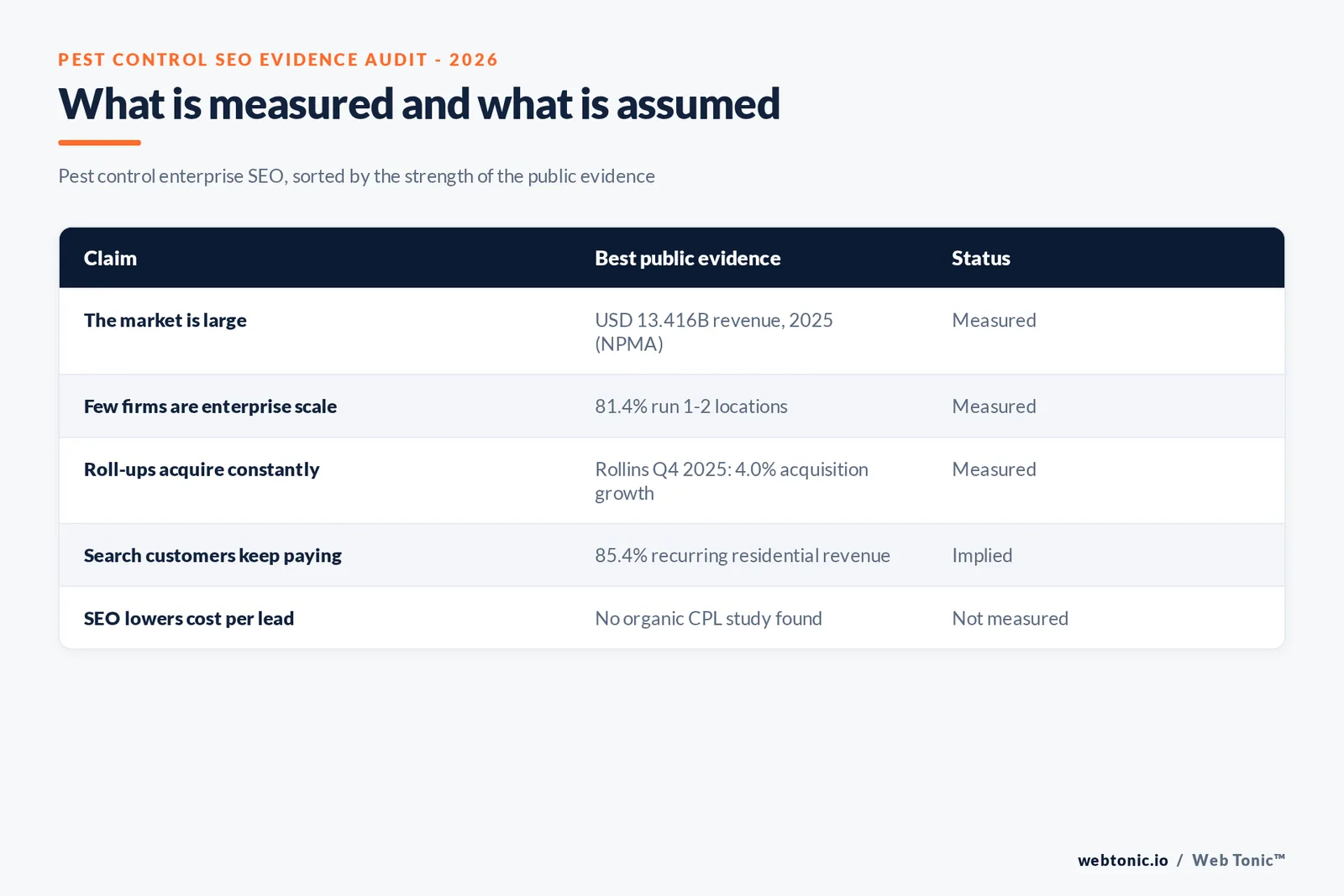
For SEO to "work" at enterprise scale, a pest brand would need to show more calls or bookings from organic search than it would have had otherwise, at a cost below its other channels. No public dataset reports that for this industry. Vendors publish case studies, but a case study is a selected success, not a benchmark. So this page separates what is measured from what is assumed.
| Question | Evidence available | Verdict |
|---|---|---|
| Is the market big enough to matter? | USD 13.416 billion revenue, 2025 (NPMA) | Yes, measured |
| Are there enterprise-scale operators? | Rollins: 850+ locations, 2.8M+ customers | Yes, measured |
| Does search carry web traffic? | Organic 53% of trackable traffic (BrightEdge, 2019) | Yes, dated |
| Is SEO revenue for pest brands published? | Not in any filing we found | Not measured |
| Is organic CPL for pest control published? | No study found | Not measured |
| Does a customer from search keep paying? | 85.4% of residential revenue is recurring | Implied, not proven |
A fragmented industry with a few giants
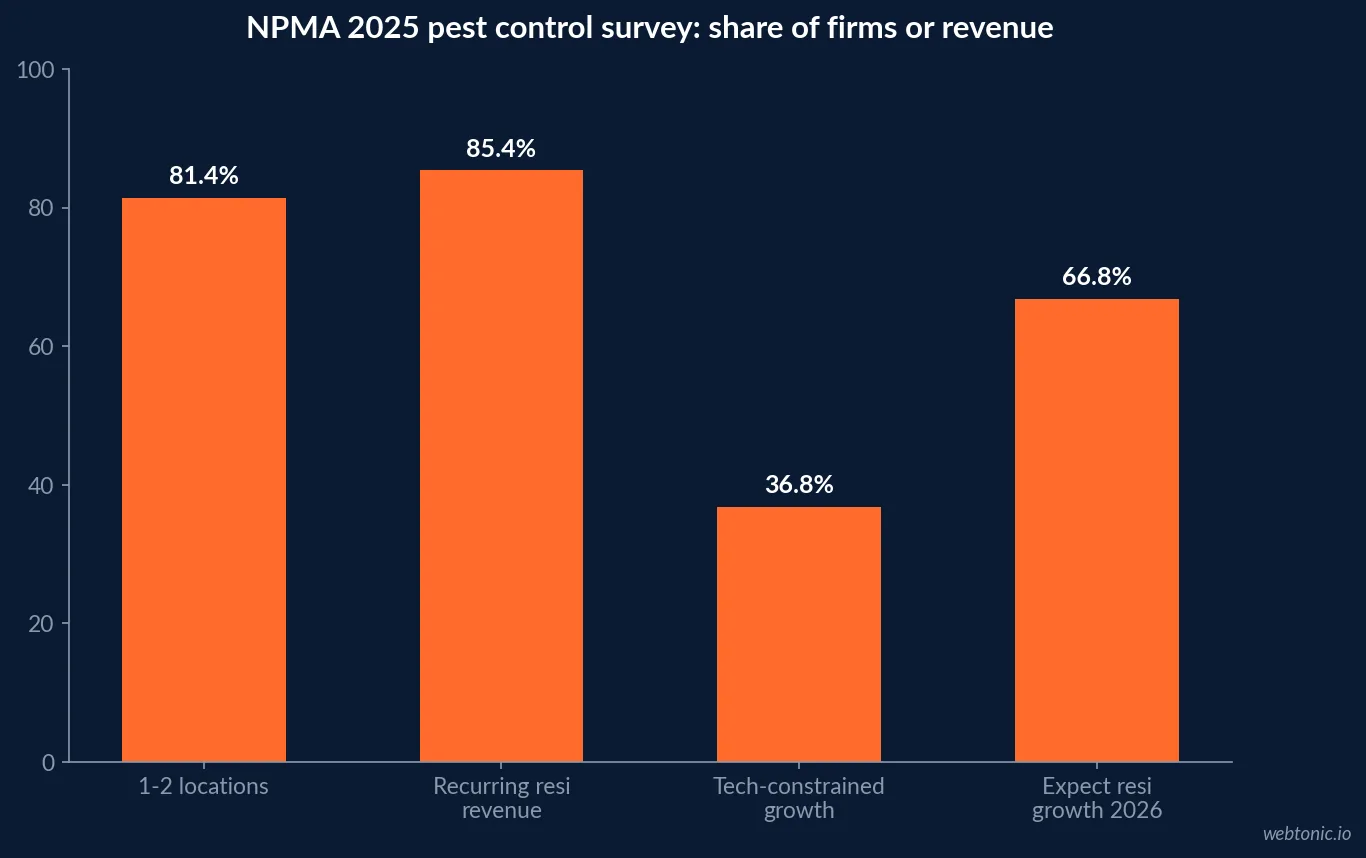
The NPMA's 2025 industry analysis, based on a survey of 800 owners and managers for the 26th edition of Specialty Consultants' strategic analysis, counted 16,565 firms and found 81.4% run one or two locations. The industry employed about 109,384 service technicians, and 36.8% of respondents said growth was held back by too few technicians.
That last number matters for SEO. A brand that cannot staff more routes gains little from more leads, so enterprise SEO in pest control is often about filling capacity in specific branches rather than raising national traffic.
| NPMA 2025 figure | Value | SEO implication |
|---|---|---|
| Pest control firms | 16,565 | Most local results are small competitors |
| Firms with 1-2 locations | 81.4% | Enterprise SEO is a minority problem |
| Service revenue | USD 13.416 billion (+6%) | Enough demand to fund search |
| Residential customers | Nearly 13.29 million | Large installed base of searchers |
| Recurring share of residential revenue | 85.4% | Lifetime value favours acquisition |
| Growth constrained by technicians | 36.8% | Leads only help where routes have room |
| Expect residential growth in 2026 | 66.8% | Most operators plan to add customers |
Rollins: what a roll-up discloses
Rollins' fourth-quarter 2025 results describe a family of brands (Orkin, Clark Pest Control, Critter Control, Fox Pest Control, HomeTeam Pest Defense and others) serving more than 2.8 million customers with about 22,000 employees from more than 850 locations. Fourth-quarter revenue was USD 913 million, up 9.7%, with organic revenue up 5.7% and acquisition-related revenue up 4.0%.
Rollins does not attribute any of that growth to search, so neither do we. What the filing does show is the shape of the SEO problem: many brands, many domains, frequent acquisitions. That is a site-architecture and migration problem before it is a content problem.
| Rollins disclosure | Figure | Enterprise SEO consequence |
|---|---|---|
| Customers | More than 2.8 million | Brand and review volume at scale |
| Locations | More than 850 | Hundreds of Business Profiles to govern |
| Employees | About 22,000 | Many hands editing listings |
| Q4 2025 revenue growth | 9.7% | Context only, not SEO attribution |
| Acquisition-related growth | 4.0% | Each deal can mean a site move |
Acquisitions and site moves
When an acquired brand's site is merged into a parent domain, Google's site move guide sets the rules: map old URLs to new ones, use permanent 301 or 308 redirects, avoid chains (Googlebot follows up to 10 hops but Google advises redirecting straight to the final URL), move large sites in sections and keep the redirects "generally at least 1 year." Google also states that permanent redirects do not cause a loss in PageRank.
The risk is operational. A roll-up that closes a domain without a URL map throws away the one asset an acquired brand's SEO produced: its links and rankings.
| Site move rule (Google) | What to do in a pest roll-up |
|---|---|
| Map old URLs to new URLs | One row per service, town and blog URL of the acquired site |
| Use 301 or 308 redirects | Server-side, never a meta refresh |
| Avoid redirect chains | Point legacy URLs straight at the final page |
| Keep redirects at least 1 year | Longer if the old domain still earns links |
| Move large sites in sections | Migrate branch by branch and watch Search Console |
Town pages and the doorway line
Pest brands love service-area pages, one per suburb. Google's spam policies call it doorway abuse when sites have "multiple domain names or pages targeted at specific regions or cities that funnel users to one page." A town page is defensible when it names the branch that serves the area, the local pests that drive calls (NPMA respondents named ants at 51.6% and cockroaches at 42.6% as the top callback pests) and genuine local reviews.
The practical test is whether a homeowner in that town learns something on the page that they would not learn on the neighbouring town's page. If the only difference is the place name in the H1 and the meta title, the page is a template, and a network with hundreds of them is exposed to exactly the pattern the policy describes. Merging thin town pages into a branch page that lists every area it serves is usually the safer structure for a roll-up, because the branch is a real place with a real address, staff and route schedule behind it.
| Town page element | Doorway risk version | Real destination version |
|---|---|---|
| Heading | City name swapped into a shared template | Branch and service area named together |
| Pest content | Generic pest list copied across towns | Local callback pests and seasonality |
| Proof | Brand-wide review widget | Reviews from customers in that area |
| Contact | One national number | Branch phone, hours and response window |
| Links | Every page funnels to one booking page | Browseable hierarchy: region, branch, town |
Business Profiles across hundreds of branches
Google Business Profile allows bulk verification for 10 or more locations of the same business. For a multi-brand roll-up, each brand is a separate business, so each needs its own organisation account and its own spreadsheet. Duplicate or suspended profiles do not count towards the minimum, which makes cleaning up old franchise listings the first job after an acquisition. See our pest control local SEO statistics for the branch-level picture.
Most pages never get search traffic
A large pest network can publish thousands of pages and still see little from most of them. Ahrefs' 2023 study of about 14 billion pages found 96.55% got zero traffic from Google and 1.94% got one to ten monthly visits. That is a cross-industry figure, but it is the best argument for pruning thin town pages rather than adding more.
On the other side of the ledger, BrightEdge's 2019 research found organic search supplied 53% of trackable website traffic, and organic plus paid search together 68%. It is seven years old, and the zero-click era has moved on, so treat it as dated context rather than a 2026 number.
Clicks in 2026: the AI summary effect
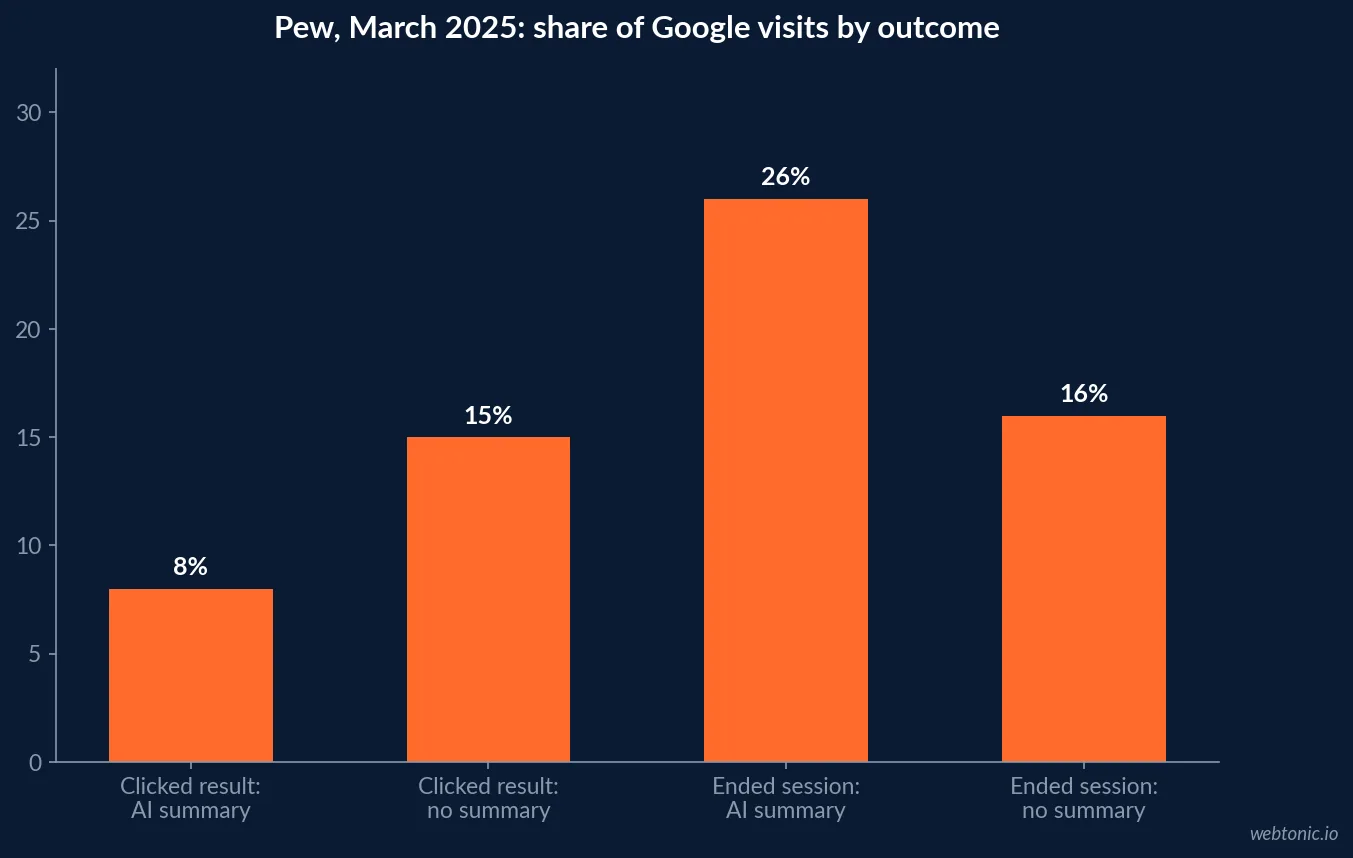
Two independent datasets show clicks thinning. Pew Research found users ended their browsing session on 26% of pages with an AI summary against 16% without one, and clicked a link inside the summary on just 1% of visits (March 2025, 900 US adults). The SparkToro and Datos 2024 study found 58.5% of US Google searches ended with zero clicks, and Ahrefs measured a 58% lower top-result click-through rate when an AI Overview appeared (December 2025 data).
"How to get rid of carpenter ants" is exactly the informational query AI summaries answer. "Pest control near me" is not. Enterprise pest content should lean towards the second kind.
The paid comparator
Pest control has no organic cost-per-lead benchmark. WordStream's 2025 benchmarks (16,000+ US campaigns, April 2024 to March 2025) do not list pest control either; the nearest category is Home and Home Improvement at a USD 90.92 cost per lead, 7.33% conversion rate and USD 7.85 cost per click, against USD 70.11 per lead across all industries. Statcounter puts Google at 86.1% of US search in August 2026, so that is the auction every pest brand competes in. Our guide to what Google Ads costs explains how those auctions price.
How to prove it for your own network
- Tag organic calls separately from paid and map-pack calls in call tracking.
- Report by branch, because capacity differs and 36.8% of firms say technicians limit growth.
- Value a customer on recurring revenue, not the first visit.
- Run a before-and-after on every acquisition migration with the redirect map attached.
- Prune or merge town pages that get no impressions after six months.
Our growth marketing team builds that measurement for multi-location service brands. For the channel overview, see the enterprise SEO statistics hub.
Frequently Asked Questions
Does enterprise SEO actually work for pest control companies?
There is no published, controlled study that proves it for this industry, and we would not trust anyone who quotes one without a method. What exists is circumstantial: search carries a large share of trackable web traffic in general (53% organic in BrightEdge's 2019 research), Google handles 86.1% of US search, and pest control revenue is 85.4% recurring, so a customer won through search keeps paying. Whether SEO works for a given network is answered by its own Search Console and call-tracking data, not by an industry stat.
How many pest control companies operate at enterprise scale?
Very few. NPMA's 2025 industry analysis counted 16,565 pest control firms in the US, and 81.4% ran one or two locations. At the other end, Rollins reports more than 850 locations and more than 2.8 million customers across its family of brands. Enterprise SEO is a problem for the roll-ups and the largest regionals, not for the typical operator.
What SEO risk comes with acquiring pest control companies?
Site moves. Each acquired brand that is folded into a parent site needs a URL map and permanent redirects. Google recommends 301 or 308 redirects, advises against chains, says Googlebot follows up to 10 hops, and asks sites to keep redirects generally at least 1 year. Brands kept separate avoid the move but still need clean, distinct location pages.
Are service-area pages for every town a problem?
They can be. Google's spam policies list pages targeted at specific regions or cities that funnel users to one page as doorway abuse. A town page earns its place with real local facts: the branch that serves it, local pest pressure, response times and reviews from that area.
What does a pest control lead cost from paid search?
WordStream does not break out pest control. Its nearest 2025 category, Home and Home Improvement, averaged USD 90.92 per lead and a 7.33% conversion rate across campaigns from April 2024 to March 2025. That is a paid comparator, not an organic benchmark.
Sources
NPMA - US pest control industry grows 6% in 2025
Rollins - Q4 and full-year 2025 results
Google Search Central - site moves with URL changes
Google Search Central - spam policies
Google Business Profile Help - verify profiles in bulk
Ahrefs - 96.55% of content gets no traffic from Google (2023)
BrightEdge - organic share of traffic increases to 53% (2019)
Pew Research Center - AI summaries and clicks, 2025
SparkToro - 2024 zero-click search study
Ahrefs - AI Overviews reduce clicks update
WordStream - 2025 Google Ads benchmarks
Statcounter - US search engine market share


