Table of contents
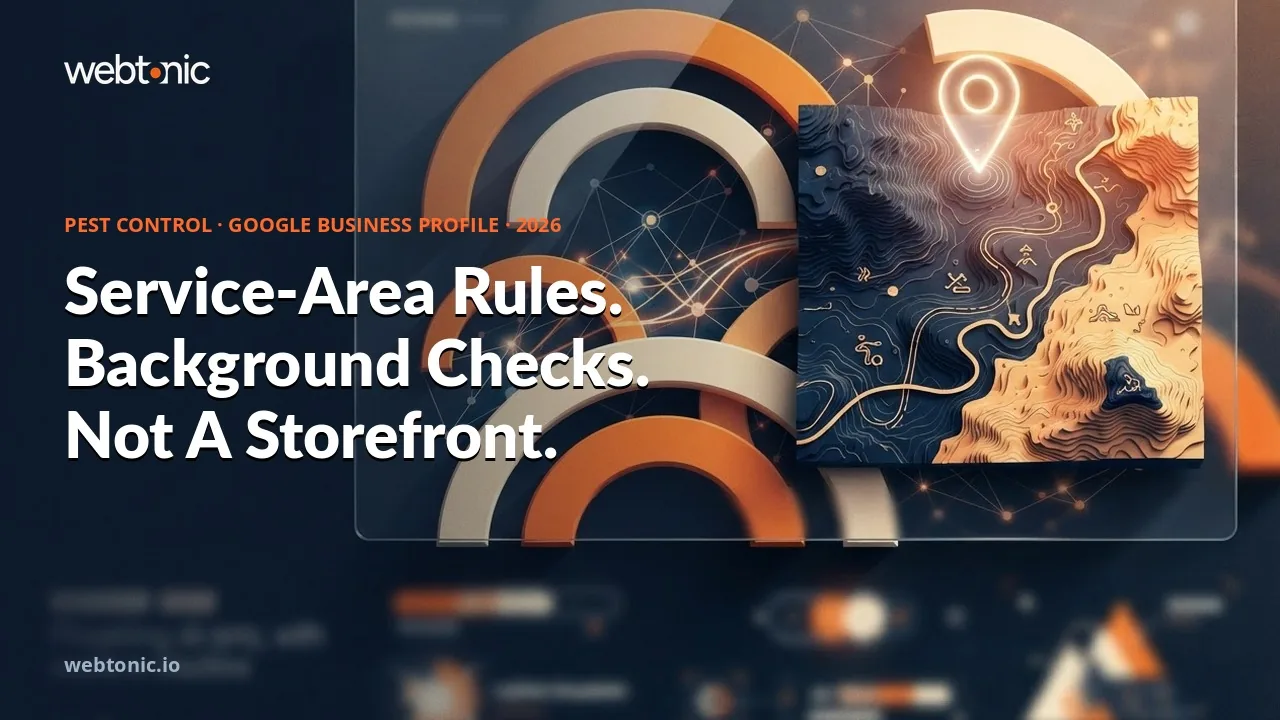
Most pest control companies manage a service-area profile, not a storefront listing, and Google screens the category more heavily than most - a business and owner background check through Local Services, on top of standard Business Profile verification. This page benchmarks both the structural rules and the ranking mechanics behind that profile.
Key Takeaways
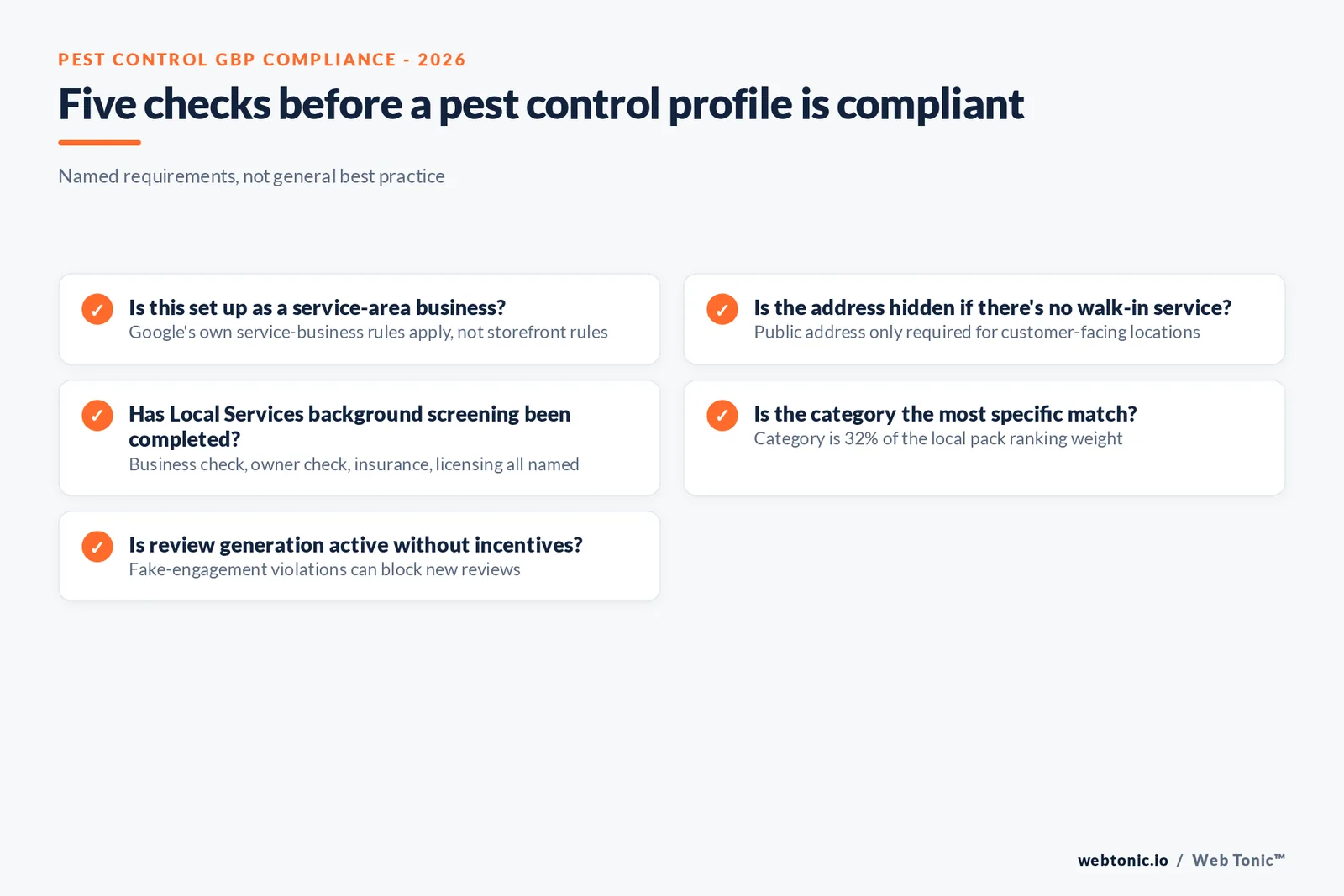
- Pest control is named in Google's Local Services background-check requirements, alongside plumbers and locksmiths.
- That screening covers a business check, an owner check and insurance requirements.
- Business and owner licensing must also be verified before running Local Services Ads.
- 52% of US homeowners used a licensed pest control professional in the past year.
- The US structural pest control market grew 6% in 2025.
- That figure comes from an 800-company owner and manager survey, the 26th edition of its kind.
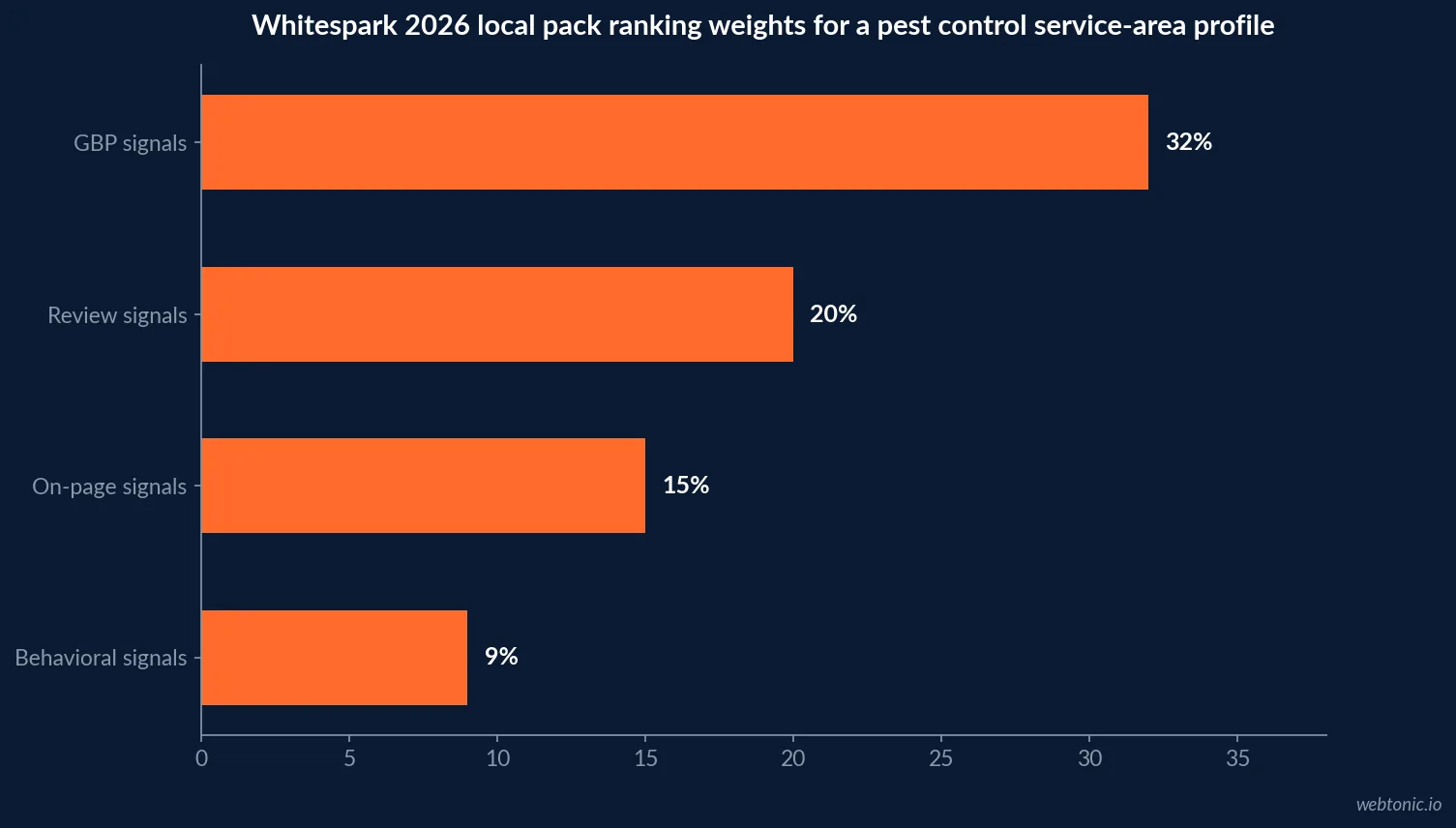
- Google Business Profile signals carry 32% of local pack ranking weight in 2026.
- Review signals are the second-heaviest bucket at 20%.
- Digital channels, referrals and word of mouth rank as top lead-generation channels industry-wide.
- 81% of pest control operators say they don't know which marketing channels drive results.
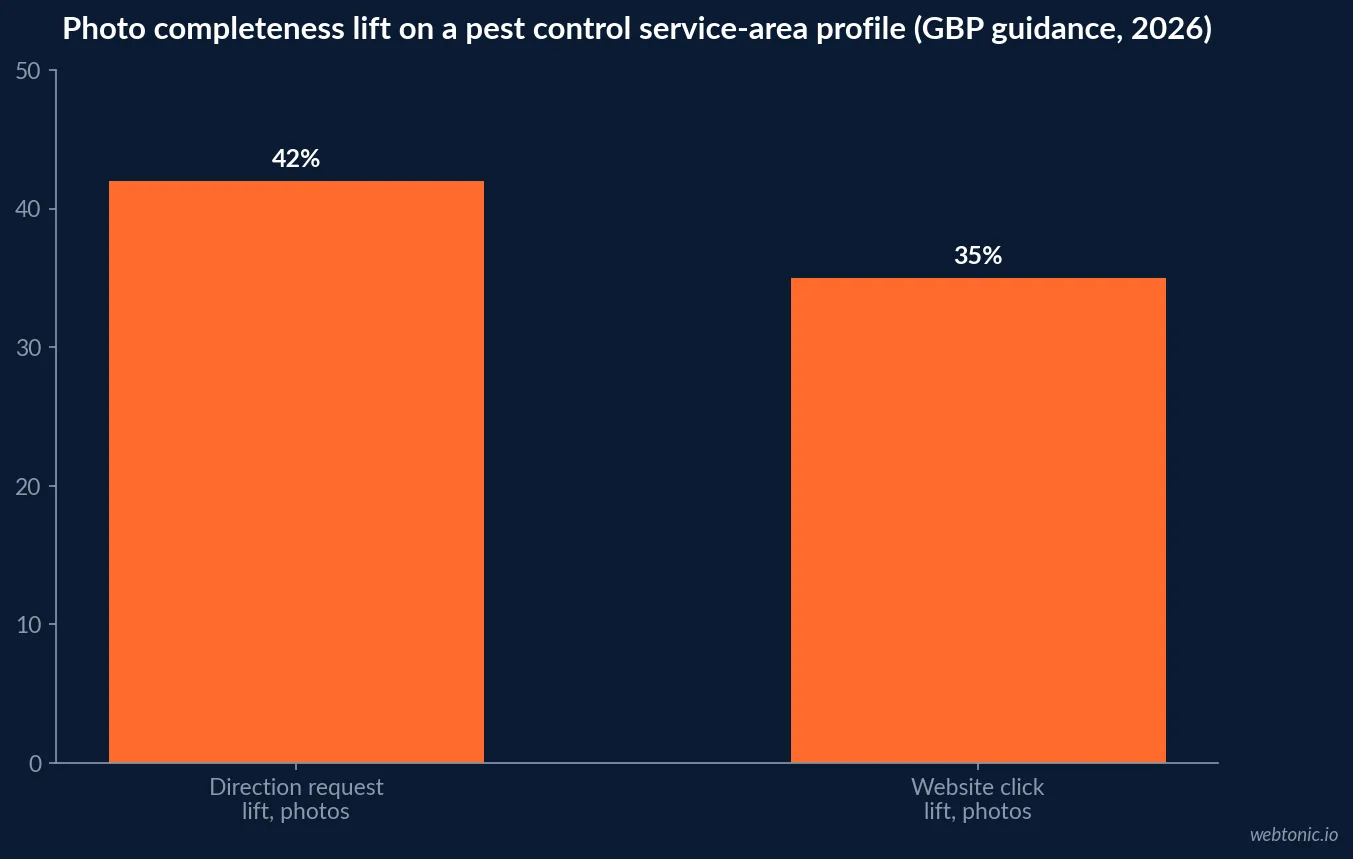
- Complete profiles with photos see 42% more direction requests across GBP management data generally.
- Photo-equipped listings also see 35% more website clicks.
- A service-area business can't show a public address for a location customers don't visit.
- Only one Business Profile is allowed per location under Google's guidelines.
- A fake-engagement violation can block new reviews for a set period, separate from a full suspension.
Service-area business rules are the first decision, not an afterthought
Google's own Business Profile for service businesses overview defines a service-area business as one that visits or delivers to customers directly but doesn't serve them at its business address - its own example is a plumber, and a pest control route business fits the identical pattern. Its companion guidance on managing service areas is explicit that a service-area business can choose not to show its address publicly and list a service area of cities or zip codes instead, while its guidelines for representing your business state service-area businesses should have one profile for the central office with a designated service area, and that they can't list a virtual office unless it is staffed during stated hours.
Getting this wrong - showing a warehouse address as if it were a public storefront, or running multiple profiles per technician - is a guideline violation before a single review or photo is even considered.
| Business Profile setup question | Service-area business rule | Common mistake |
|---|---|---|
| Public address? | Optional - can be hidden, service area shown instead | Publishing a warehouse address as a storefront |
| Number of profiles | One per central office/location | A profile per technician or per route |
| Virtual office as address | Not allowed unless staffed during stated hours | Using a registered-agent address |
| Category | Most specific match (e.g. Pest control service) | Generic 'Home services' catch-all |
The screening most storefronts never see
Google's Local Services business screening and verification requirements name pest control explicitly, in the same tier as locksmiths and plumbers, requiring a business check, an owner check, general liability insurance, and business and owner licensing before a company can run Local Services Ads at all - separate from and in addition to standard Business Profile verification. Google's broader Advanced Verification policies apply the same logic across verticals it considers higher-risk for consumers, reducing invalid activity and impersonation in categories where a bad actor entering someone's home is a real safety concern, not just a ranking problem.
The practical effect: a pest control company that has not completed this screening is not just ranking lower, it may not be eligible to run Local Services Ads in its market at all, which makes the screening step a gating item, not an optimization.
| Screening requirement | Applies to pest control? | What it verifies |
|---|---|---|
| Business check | Yes | The business entity itself |
| Owner check | Yes | The individual business owner |
| General liability insurance | Yes | Coverage for on-property work |
| Business license (region-level) | Yes | Legal authorization to operate |
| Owner license (region-level) | Yes | Individual licensing where required |
Where the ranking weight sits once the profile is compliant
Whitespark's 2026 Local Search Ranking Factors report, a survey of 47 local search practitioners, puts Google Business Profile signals at 32% of local pack ranking weight, ahead of review signals at 20% and on-page signals at 15%. That weighting is cross-industry, but it applies with extra force to a service-area business like pest control, where the profile itself - not a physical storefront a customer can walk past - is often the only visible surface a prospect ever sees before calling.
Photos still move the needle even without a storefront: complete profiles with photos are credited across GBP management guidance with 42% more direction requests and 35% more website clicks than photo-light listings, though for a service-area business "direction requests" reads more as a data artifact than a useful action - the real signals worth watching are calls and website clicks.
The demand backdrop this profile work sits inside
The National Pest Management Association's Harris Poll research puts the share of US homeowners who used a licensed pest control professional in the past year at 52% - meaning a near-even split between homes that hire out and homes that do not, a figure also carried on PestWorld's consumer-facing release for the same National Pest Management Month campaign. NPMA's 26th edition of A Strategic Analysis of the U.S. Structural Pest Control Industry, surveying 800 company owners and managers, reports the market grew 6% in 2025.
Separately, NPMA's 2026 Pest Control Industry Sales Operations Survey, produced with PestPac by WorkWave, found digital channels, referrals and word of mouth rank as the top lead generation channels industry-wide, with pricing and promotions the most commonly cited factor in winning new residential contracts. That lines up with a widely cited industry data point that 81% of pest control operators do not know which marketing channels are driving their results - a measurement gap the Business Profile's own Performance report exists to close, since it is one of the few channel-level views a company can pull for free.
| Pest control industry metric (2025-26) | Figure | Source |
|---|---|---|
| Homeowners using a licensed pro (past year) | 52% | Harris Poll for NPMA, National Pest Management Month |
| US structural pest control market growth, 2025 | 6% | NPMA 26th Strategic Analysis |
| Owners/managers surveyed for that figure | 800 | NPMA 26th Strategic Analysis |
| Top lead-gen channels (qualitative) | Digital, referral, word of mouth | NPMA 2026 Sales Operations Survey |
| Operators unsure which channel drives results | 81% | Industry marketing-channel survey data |
Reading the Performance report without a storefront to anchor it
Google's documentation on Business Profile performance and insights makes performance data available only to verified profiles and separates what customers saw (search and map views) from what they did next (calls, website clicks, direction requests). For a route-based pest control business, calls and website clicks are the metrics that map to real pipeline; direction requests are largely noise unless the company also runs a retail counter for DIY products.
A company that reads its Performance report the same way a storefront retailer would - chasing direction requests - is optimizing for the wrong number. Calls first, website clicks second, views as context, is the order that matches how a service-area business actually gets hired.
What management costs against doing it manually
Published vendor pricing, not an agency's private rate card, puts dedicated GBP management tools at roughly USD 49 to USD 89 a month for single-to-small-multi-location tiers (GBPcentral), rising to USD 349 a month for its agency tier. Broader local-listing platforms built for regional and national pest control chains price similarly at scale: Vendasta starts at USD 99 a month, and GatherUp lists USD 99 a month for one location, falling to about USD 60 a month per location across a 2-to-10-location account. For a company already carrying the Local Services screening burden described above, the management-tool spend is small relative to what a lapsed license or a screening failure costs in lost Local Services Ads eligibility.
If a pest control operator needs the service-area setup, screening documentation and profile cadence built and maintained rather than pieced together internally, our growth marketing practice runs local visibility programs for route-based businesses, and our team can scope a specific market.
What reviews add once the profile itself is compliant
BrightLocal's 2026 Local Consumer Review Survey found 47% of consumers won't use a business with fewer than 20 reviews, 68% expect at least a 4-star average, 74% only weight reviews from the last three months as relevant, and 89% expect a business to reply, with reply-speed expectations tiered at 19% within a day, 32% within three days and 81% within a week. For a pest control company, review recency matters more than most categories: a five-star review from a treatment two years ago says little about whether this month's technician handled a bed bug callback well.
BrightLocal's 2025 edition separately found 96% of consumers are open to writing a review when asked and 40% now check two or more review sites before deciding - both arguments for asking every completed job for a review rather than hoping reviews accumulate on their own.
| BrightLocal review benchmark | Figure | Edition |
|---|---|---|
| Won't use a business with fewer than 20 reviews | 47% | 2026 |
| Expect at least a 4-star average | 68% | 2026 |
| Only weight reviews from the last 3 months | 74% | 2026 |
| Expect a business to reply to reviews | 89% | 2026 |
| Open to writing a review when asked | 96% | 2025 |
Q&A, messaging and posts on a route-based profile
Google's Edit your Business Profile guidance confirms owners and managers can answer public questions in the profile's Q&A section, and its Chat with customers from your Business Profile page documents that a claimed and verified profile can add text or WhatsApp messaging. For pest control, unanswered pre-service questions ("do you treat bed bugs," "is the spray pet-safe") sitting in public Q&A read as unresponsiveness to every future searcher who sees them, not just the original asker.
Posts are the lower-effort surface here: a seasonal note about termite swarm season or a mosquito treatment offer keeps the profile looking active between review cycles, which matters more for a service-area business with no storefront to signal activity on its own.
| Interactive surface | What it's for on a pest control profile | Risk if left unmanaged |
|---|---|---|
| Q&A section | Pre-service questions (pet safety, target pests) | Wrong answers from strangers stand uncorrected |
| Messaging (text/WhatsApp) | Scheduling and urgent-callback contact | Missed messages read as unresponsiveness |
| Posts | Seasonal pest alerts and treatment offers | A stale post signals an inactive business |
Multi-location and franchise pest control chains
Google's Import and update Business Profiles in bulk guidance and its companion Verify Business Profiles in bulk page cover the spreadsheet workflow available once an operator manages 10 or more locations - the mechanism a regional or franchised pest control brand uses to keep service areas, categories and hours consistent across every branch rather than editing dozens of profiles by hand. That bulk tooling does not replace the branch-level screening requirements covered above; each location still needs its own compliant setup, bulk management just keeps the day-to-day fields consistent once compliance is in place.
Where this fits against the paid and reputation side
Our own pest control Google Ads statistics page covers paid search cost and conversion benchmarks in more depth, our pest control digital marketing statistics page covers the broader channel mix, and our reputation and review management statistics page goes deeper on the review-reply economics touched on above. Read together with this page, they cover the free lever (the profile and its screening), the review layer on top of it, and the paid layer a company adds once both are in place.
Frequently Asked Questions
Is a pest control company's Google Business Profile a storefront listing or a service-area listing?
Almost always service-area. Google's own guidance on Business Profile for service businesses distinguishes a service-area business, which visits or delivers to customers directly but doesn't serve them at its business address, from a hybrid business that does both. A pest control company with a warehouse and no walk-in customers should hide its exact address and list a service area instead - showing a public address for a location customers cannot visit is itself a guideline violation risk.
Does pest control face extra verification requirements Google doesn't apply to every industry?
Yes, through Local Services Ads rather than the base Business Profile. Google's Local Services screening requirements for Canada name pest control explicitly, alongside plumbers and locksmiths, as categories requiring a business check, an owner check, general liability insurance and business and owner licensing before a provider can run Local Services Ads at all. That is separate from, and in addition to, standard Business Profile verification.
What share of US homeowners actually hire a licensed pest control company?
52%, according to a Harris Poll conducted on behalf of the National Pest Management Association and reported for National Pest Management Month. That means nearly half of US homeowners went through an entire year without professional pest control, which is either an addressable market gap or a signal that DIY and inaction remain the real competition, not just other pest control companies.
How much does the industry itself say it's growing?
NPMA's 26th edition of A Strategic Analysis of the U.S. Structural Pest Control Industry, surveying 800 pest control company owners and managers (more than half NPMA members), reports the US structural pest control market grew 6% in 2025. That is company-level revenue growth, not a lead-volume or digital-visibility figure, and it says nothing directly about any single company's Business Profile performance.
What happens if a technician's vehicle photo or a fake review shows up on the profile?
Two separate risks, two separate remedies. A vehicle or signage photo is generally fine as supporting imagery as long as the profile's core information (category, address handling for a service-area business, hours) stays accurate. Fake or incentivized reviews fall under Google's Fake Engagement policy, which can restrict a profile from receiving new reviews or unpublish existing ones for a set period - a pest control company running a "leave a review for a discount" line at the end of a service call is the most common way this gets triggered.
Sources
Google Business Profile Help - Business Profile for service businesses overview
Google Business Profile Help - Manage your service areas
Google Business Profile Help - Guidelines for representing your business on Google
Google Local Services Help - Business screening and verification requirements
Google Advertising Policies Help - Advanced Verification policies
Google Business Profile Help - Understand your performance & insights
Whitespark - 2026 Local Search Ranking Factors report
BrightLocal - Local Consumer Review Survey
GBPcentral - GBP Management Software Pricing
Vendasta - Pricing
GatherUp - Review Software Pricing
NPMA / Harris Poll - National Pest Management Month release
PestWorld - National Pest Management Month is Here
NPMA - 26th edition, A Strategic Analysis of the U.S. Structural Pest Control Industry
NPMA - 2026 Pest Control Industry Sales Operations Survey