Table of contents
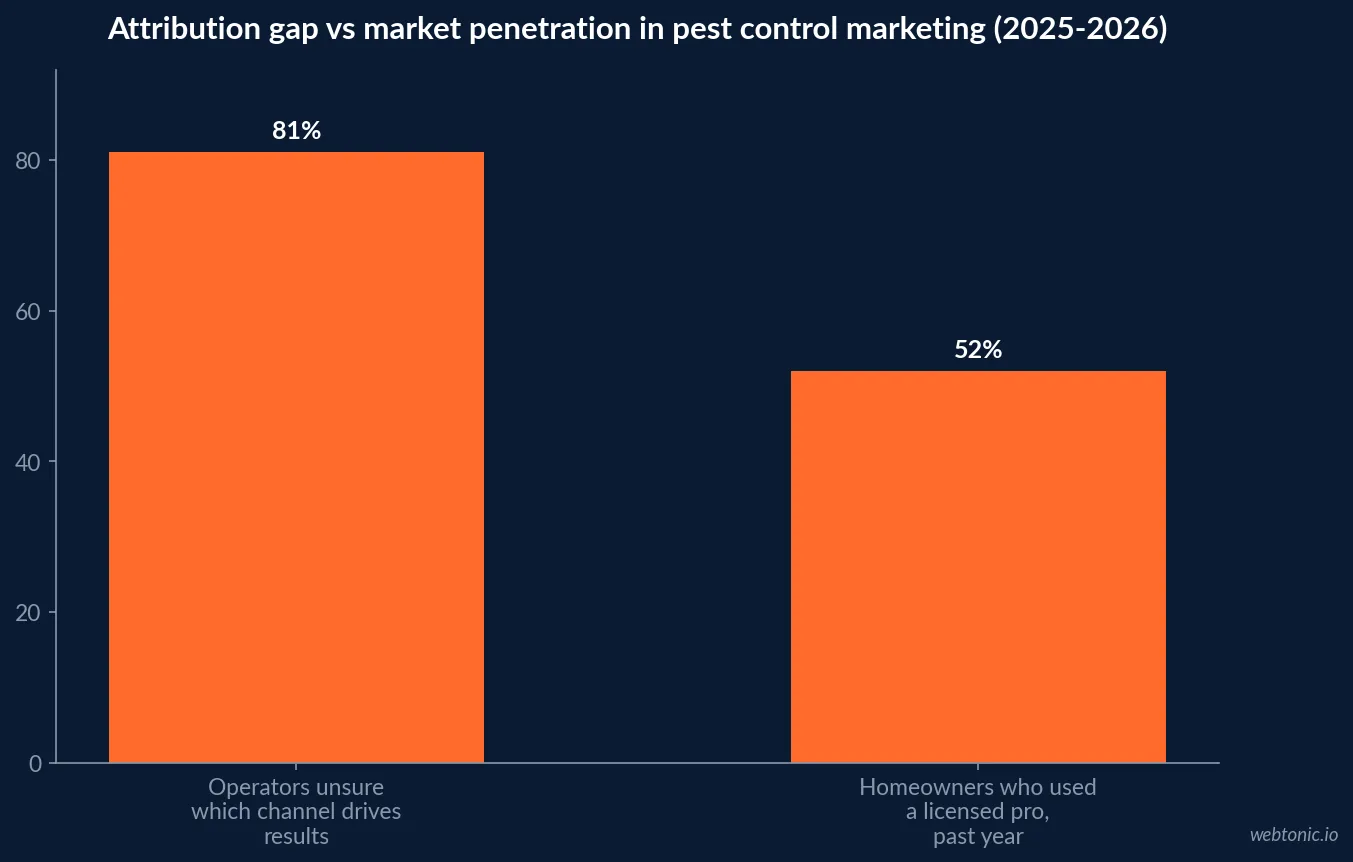
Most pest control companies cannot actually answer "PPC vs SEO" today, because 81% of operators report not knowing which marketing channel drives their results. This page prices what is published for each channel and treats the attribution gap as the real finding, not a footnote.
Key Takeaways
- 81% of pest control operators don't know which channel drives their results.
- Digital channels, referrals and word of mouth rank as the top lead-gen channels industry-wide, per NPMA's 2026 survey.
- 52% of US homeowners used a licensed pest control professional in the past year.
- The US structural pest control market grew 6% in 2025.
- That growth figure comes from an 800-company owner and manager survey.
- Pest control has no standalone category in WordStream/LocaliQ's 2026 benchmarks; the closest proxy is Home and Home Improvement.
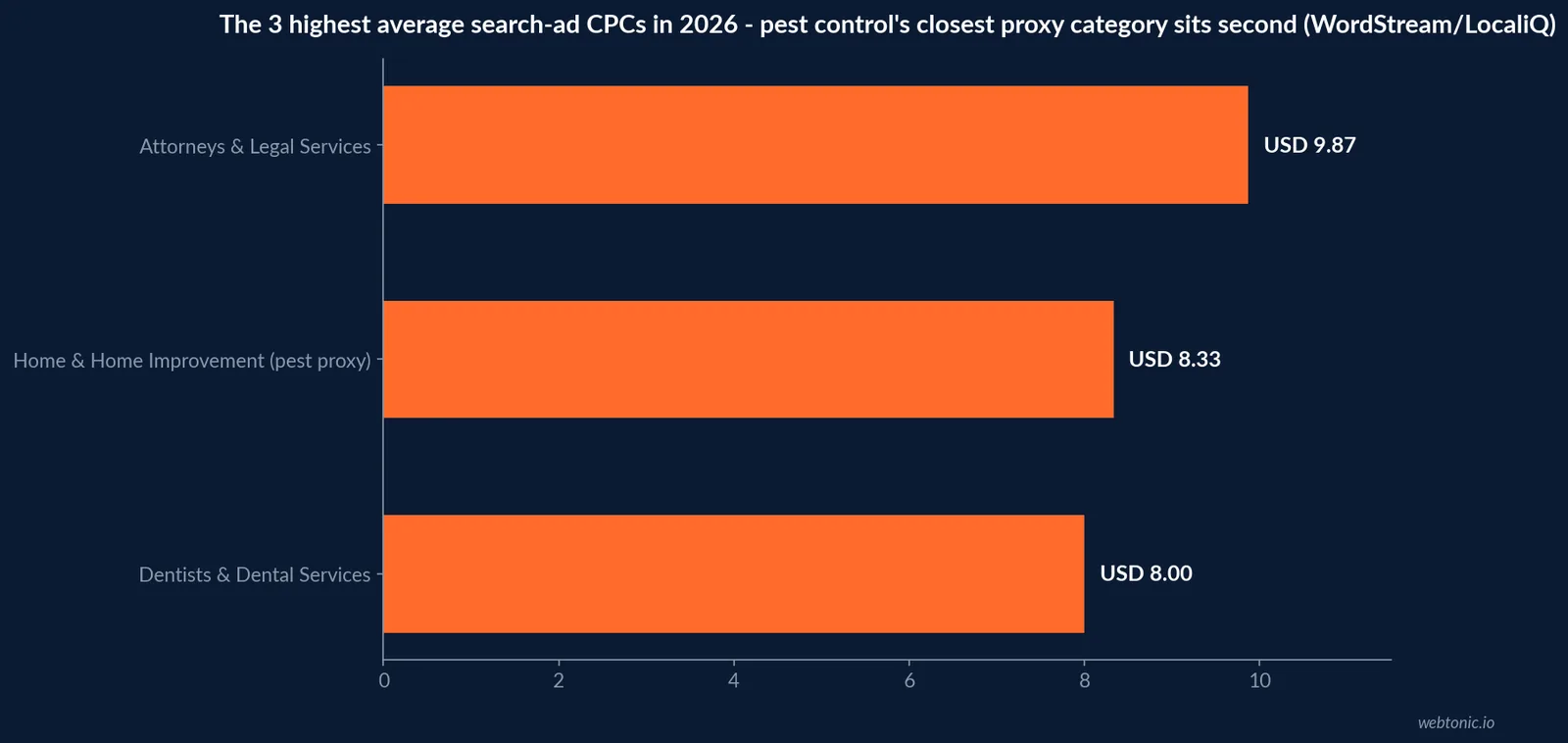
- That proxy category posted one of the three highest average costs per click, at USD 8.33 in 2026.
- Google Business Profile signals carry 32% of local pack ranking weight, the largest organic-discovery lever.
- Review signals are the second-heaviest bucket at 20%.
- Pricing and promotions are the most commonly cited factor in winning new residential contracts.
- Pest control faces named Local Services background-check screening before it can run Local Services Ads at all.
- B2B buying committees average 13 internal plus 9 external stakeholders - a contrast figure, not a residential pest control number.
- Only 5%, on average, of B2B buyers are in-market at any moment, per the 95:5 rule - again, not a homeowner statistic.
The real finding is a measurement gap, not a channel preference
A widely cited pest control marketing data point puts 81% of operators unable to say which marketing channel is actually driving their results. That figure reframes the entire "PPC vs SEO" question: a company running both channels without call tracking or CRM source tagging cannot honestly compare them, no matter how the two are priced individually. Any demand-generation plan for this industry has to fix attribution before it reallocates a single dollar of budget.
NPMA's 2026 Pest Control Industry Sales Operations Survey, produced with PestPac by WorkWave, names digital channels, referrals and word of mouth as the top lead-generation channels industry-wide - a ranked list, not a percentage split - and reports pricing and promotions as the most commonly cited factor in winning new residential contracts, ahead of service quality.
| What operators actually reported | Detail | Source |
|---|---|---|
| Top lead-gen channels (ranked, not split) | Digital, referral, word of mouth | NPMA 2026 Sales Operations Survey |
| Most-cited factor in winning residential contracts | Pricing and promotions | NPMA 2026 Sales Operations Survey |
| Operators unable to attribute results by channel | 81% | Industry marketing-channel data |
| Sales driven mainly by | Technicians and ownership, not dedicated sales teams | NPMA 2026 Sales Operations Survey |
What paid search costs, without a dedicated pest control benchmark
WordStream/LocaliQ's 2026 Search Advertising Benchmarks by Industry report tracks 23 categories built from over 13,000 campaigns, and pest control is not one of the 23 broken out on its own. The closest published proxy is Home and Home Improvement, which the same report lists among the three highest average costs per click of any tracked category in 2026, at roughly USD 8.33. That is an honest limitation worth stating plainly: a pest control company benchmarking its paid search cost against this figure is comparing itself to a broader trades category, not to peers in its own vertical.
Google's Local Services Ads, where pest control does appear as a named category subject to background-check screening, is the more targeted paid channel for this industry, but Google does not publish a standalone cost benchmark for it either - operators have to read their own account data rather than an industry table.
| Paid channel | Pest-control-specific published figure? | Closest available data point |
|---|---|---|
| Google Search Ads | No standalone category | Home & Home Improvement CPC ~USD 8.33 (2026) |
| Google Local Services Ads | Named for screening, not for cost | Requires background-check screening to run |
| Organic / Business Profile | Yes, via ranking-factor research | GBP signals = 32% of local pack weight |
SEO's actual lever: the Business Profile, not blog content
Whitespark's 2026 Local Search Ranking Factors report, a survey of 47 local search practitioners, credits Google Business Profile signals with 32% of local pack ranking weight and review signals with 20% - together more than half the ranking model. For a service- area business like pest control, that means the highest-leverage "SEO" work is service-area setup, category precision and review generation, not the long-form content strategy the term usually implies for other industries.
This is also the free channel: once a profile is complete and compliant, its marginal cost per additional call is zero, unlike the per-click cost that a paid campaign never sheds.
The demand backdrop: a market that's growing and still under-penetrated
A Harris Poll conducted for the National Pest Management Association found 52% of US homeowners used a licensed pest control professional in the past year, meaning close to half did not - a figure also carried on PestWorld's consumer-facing release for the same campaign. NPMA's 26th edition of A Strategic Analysis of the U.S. Structural Pest Control Industry, surveying 800 company owners and managers, reports the market grew 6% in 2025 regardless. Read together, this is not a saturated category fighting over a fixed pool of customers - it is a growing market where the bigger opportunity may be converting the unserved half of homeowners, not just out-competing rivals for the served half.
That reframes demand generation again: a channel mix built only to win switchers from a competitor is ignoring the larger, currently-unserved side of the market.
| Pest control market metric (2025-26) | Figure | Source |
|---|---|---|
| Homeowners using a licensed pro (past year) | 52% | Harris Poll for NPMA |
| Homeowners NOT using a licensed pro | 48% | Harris Poll for NPMA (derived) |
| US structural pest control market growth, 2025 | 6% | NPMA 26th Strategic Analysis |
| Owners/managers surveyed for that figure | 800 | NPMA 26th Strategic Analysis |
What a B2B buyer-journey contrast is (and isn't) useful for here
Research on B2B buying committees - Forrester's reporting that business purchases now often involve double-digit numbers of internal and external stakeholders, and the Ehrenberg-Bass Institute's 95:5 rule holding that only about 5% of B2B buyers are in-market at any given time - describes a completely different buying motion than a homeowner calling about an ant trail. Labeling it clearly matters: this page cites it only to show that a residential pest control decision is fast, single-decision-maker and problem-triggered, the opposite of a long, committee-driven B2B evaluation, not to suggest fitness-style nurture campaigns belong in pest control marketing.
The actionable takeaway is the reverse of a B2B playbook: build for speed-to-lead and same-day response, since the buying window here is measured in hours after a pest sighting, not months after a procurement process opens.
Building the mix without guessing
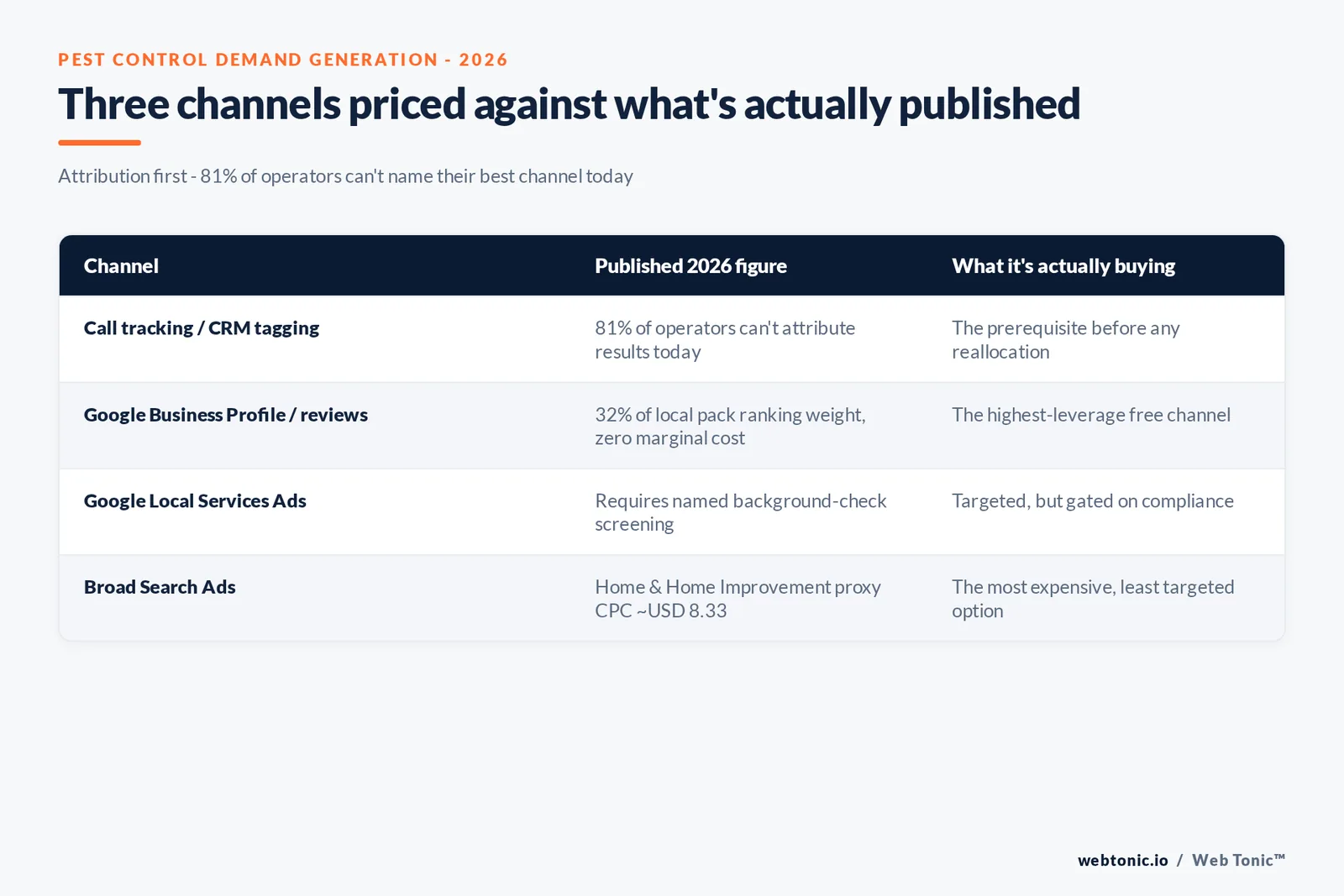
Given the 81% attribution gap, the first budget line for any pest control demand-generation plan should be call tracking and CRM source tagging, not a new channel. Once that is in place, the workable starting split leans on Google Business Profile and review generation for its 32% ranking weight and zero marginal cost, layers in Local Services Ads once screening is complete, and treats broad Search campaigns against the Home & Home Improvement cost ceiling as the most expensive, least targeted option of the three.
If a pest control operator needs that attribution and channel mix built and reported on rather than estimated, our growth marketing practice runs full-funnel local acquisition programs, and our team can scope a specific service area.
Seasonality: pest control demand is not flat across the year
Pest pressure follows the season - termite swarms in spring, mosquitoes and stinging insects through summer, rodents moving indoors in fall - and NPMA's industry data on structural pest control growth reflects a business whose lead volume genuinely spikes and troughs by pest type and region, not a steady monthly run rate. A demand-generation plan priced on an annual average cost per lead misses the months where paid search competition (and cost) rises alongside consumer search volume, and the slower months where organic and maintenance-contract renewals should carry more of the volume.
The practical implication: budget paid search capacity to flex with regional pest pressure rather than holding a flat monthly spend, and use the slower season to build the Business Profile and review base that the peak season then draws on for free.
| Seasonal driver | Typical peak window | Channel implication |
|---|---|---|
| Termite swarms | Spring | Paid search demand and competition both rise |
| Mosquitoes / stinging insects | Summer | Recurring service contracts, not just one-off calls |
| Rodents moving indoors | Fall | Urgent, high-intent search volume |
| General maintenance contracts | Winter (slower season) | Organic and profile work, lower paid pressure |
Speed to lead: the leak before the channel-mix question
Invoca's 2026 Home Services Lead Conversion Benchmarks Report, built from over 70 million calls across nine home-services sub-industries, found only 52% of inbound calls are answered by a live person, 38% of digital-marketing-driven calls qualify as leads, and 55% of businesses never explicitly ask the caller to book. That data set covers home services broadly, not pest control specifically, but the structural risk is identical for a phone-first, technician-led pest control business: a missed call after an ant sighting is a lead the company already paid to generate, lost to an unanswered phone rather than to a competitor's cheaper ad.
Given that pest control sales are, per NPMA's own survey, driven by technicians and ownership rather than a dedicated sales team, a missed-call problem here is even more structural than in businesses that route calls through a call center - there is often no backup answering the phone at all.
| Invoca 2026 home-services call benchmark | Figure | Read-across for pest control |
|---|---|---|
| Inbound calls answered by a live person | 52% | Roughly half of after-hours sighting calls may be lost |
| Digital-marketing-driven calls that qualify as leads | 38% | The rest are wasted media spend |
| Businesses that never ask the caller to book | 55% | A trained ask-to-book script closes this gap |
Where this fits against the paid and profile side
Our own pest control Google Ads statistics page covers paid search cost and conversion data in more depth, and our cost-per-lead benchmarks by industry page places the Home & Home Improvement proxy figure used above against other verticals for context. If a company needs its own call and channel data actually tied together before choosing a split, our data and analytics practice builds that attribution layer first.
Frequently Asked Questions
Is PPC or SEO the better demand-generation channel for a pest control company?
The honest answer is that the industry's own survey data can't settle this the way the question is usually asked. NPMA's 2026 Sales Operations Survey names digital channels, referrals and word of mouth as the top lead-generation channels industry-wide without breaking out PPC against SEO specifically, and separately, 81% of pest control operators report they don't know which marketing channels are driving their results. Before choosing a split, a company needs the attribution in place to test one - guessing the ratio is not a strategy.
What does pest control paid search actually cost, since there's no dedicated published benchmark?
WordStream/LocaliQ's 2026 industry benchmarks track 23 categories and don't break out pest control on its own; the closest published proxy is the Home and Home Improvement category, which posted one of the three highest average costs per click in the 2026 report at USD 8.33. That is a broader-category figure, not a pest-control-specific one, and should be treated as a directional ceiling rather than an exact benchmark.
How big is the addressable market pest control demand generation is actually chasing?
A Harris Poll conducted for the National Pest Management Association found 52% of US homeowners used a licensed pest control professional in the past year - meaning close to half of US households did not. NPMA separately reports the US structural pest control market grew 6% in 2025, based on an 800-company owner and manager survey. Read together, the market is both growing and still under-penetrated, which is a demand-creation opportunity as much as a demand-capture one.
Does the B2B buying-committee research (13 stakeholders, long sales cycles) apply to a homeowner calling about ants?
No, and this page does not use it that way. Forrester and 6sense-style B2B buyer research describes company software and services purchases with formal buying committees; a residential pest control decision is typically one homeowner responding to a visible problem (an ant trail, a bed bug sighting) on a compressed timeline, often same-week. The only reason to mention B2B research here is to show how different the two buying motions are, not to import B2B nurture timelines into a residential funnel.
Why do so many operators say they can't attribute their marketing results?
The 81% figure describing operators who don't know which channel drives results points to a call-tracking and CRM gap more than a strategy gap - phone-first businesses routinely lose the marketing source the moment a call is answered by a technician instead of a tracked line. Fixing attribution before reallocating budget is the higher-leverage move than debating PPC against SEO in the abstract.
Sources
NPMA - 2026 Pest Control Industry Sales Operations Survey
PestWorld - National Pest Management Month is Here
NPMA / Harris Poll - National Pest Management Month release
NPMA - 26th edition, A Strategic Analysis of the U.S. Structural Pest Control Industry
WordStream/LocaliQ - 2026 Search Advertising Benchmarks by Industry
Whitespark - 2026 Local Search Ranking Factors report
Invoca - 2026 Home Services Lead Conversion Benchmarks Report
Google Local Services Help - Business screening and verification requirements
Forrester - B2B Buyers Make Zero-Click Buying Number One
LinkedIn B2B Institute - Why You Should Follow the 95-5 Rule