Table of contents

The data does not show that texting alone drives injury-firm growth - it shows that firms which reply to a lead fast convert more of them, and SMS is the fastest channel available. This page tracks the intake-speed studies, per-segment SMS pricing and the current consent rules that decide whether a firm can text a lead at all.
Key Takeaways
- Only 31.4% of injury firms reply to a new lead within five minutes (High10 Digital Intake Gap Study - agency data, mystery shop of 35 Kentucky firms).
- 14.3% of firms never respond within 72 hours to a tracked inquiry.
- 25.7% take longer than 30 minutes to send a first reply.
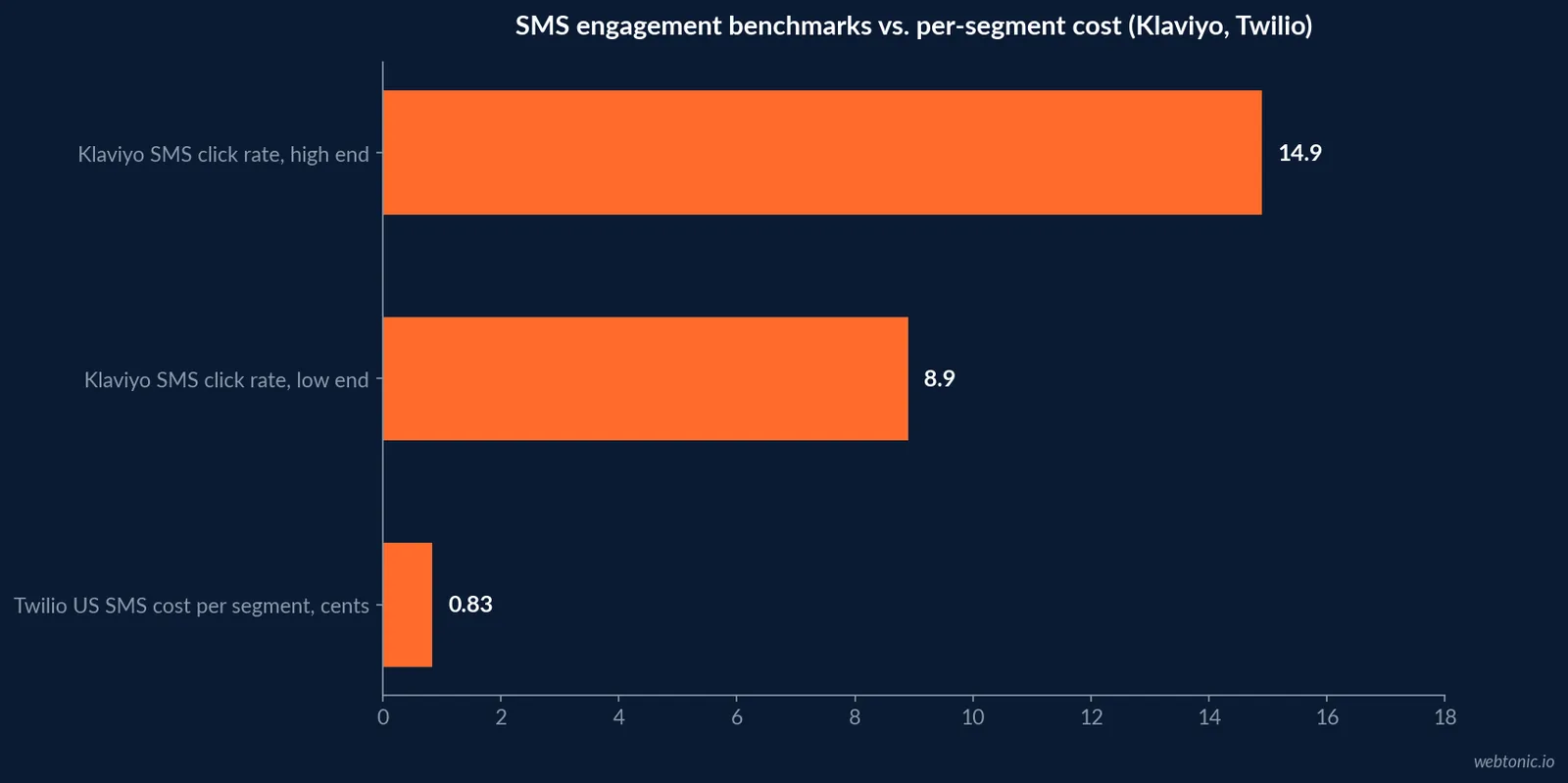
- US SMS costs USD 0.0083 per segment, sent or received, on Twilio's own pricing page.
- A2P 10DLC brand registration costs USD 4.50 for a for-profit entity, per The Campaign Registry's fee schedule.
- A Marketing-use-case campaign vet costs USD 10.00 one time, same source.
- Klaviyo's benchmarks put SMS click rates at 8.9% to 14.9% depending on message type.
- SMS conversion rate benchmarks run 1.2% to 2.2% per Klaviyo's own published bands.
- Telemarketing texts are barred before 8 a.m. or after 9 p.m. local time under 47 CFR 64.1200.
- The FCC's 2023 one-to-one consent rule was vacated by the Eleventh Circuit on Jan. 24, 2025 and is not currently in force.
- STOP-based opt-out is a carrier requirement, not only a legal one, under CTIA's Messaging Principles.
- Attorney solicitation rules vary by state under each bar's version of ABA Model Rule 7.3.
- Podium's texting-first plan starts at USD 399 a month for a Core tier, its own pricing page shows.
- EZ Texting's Launch plan starts at USD 25 a month before overage.
- A failed message costs an extra USD 0.001 on Twilio when a send terminates as Failed.
The gap SMS is built to close
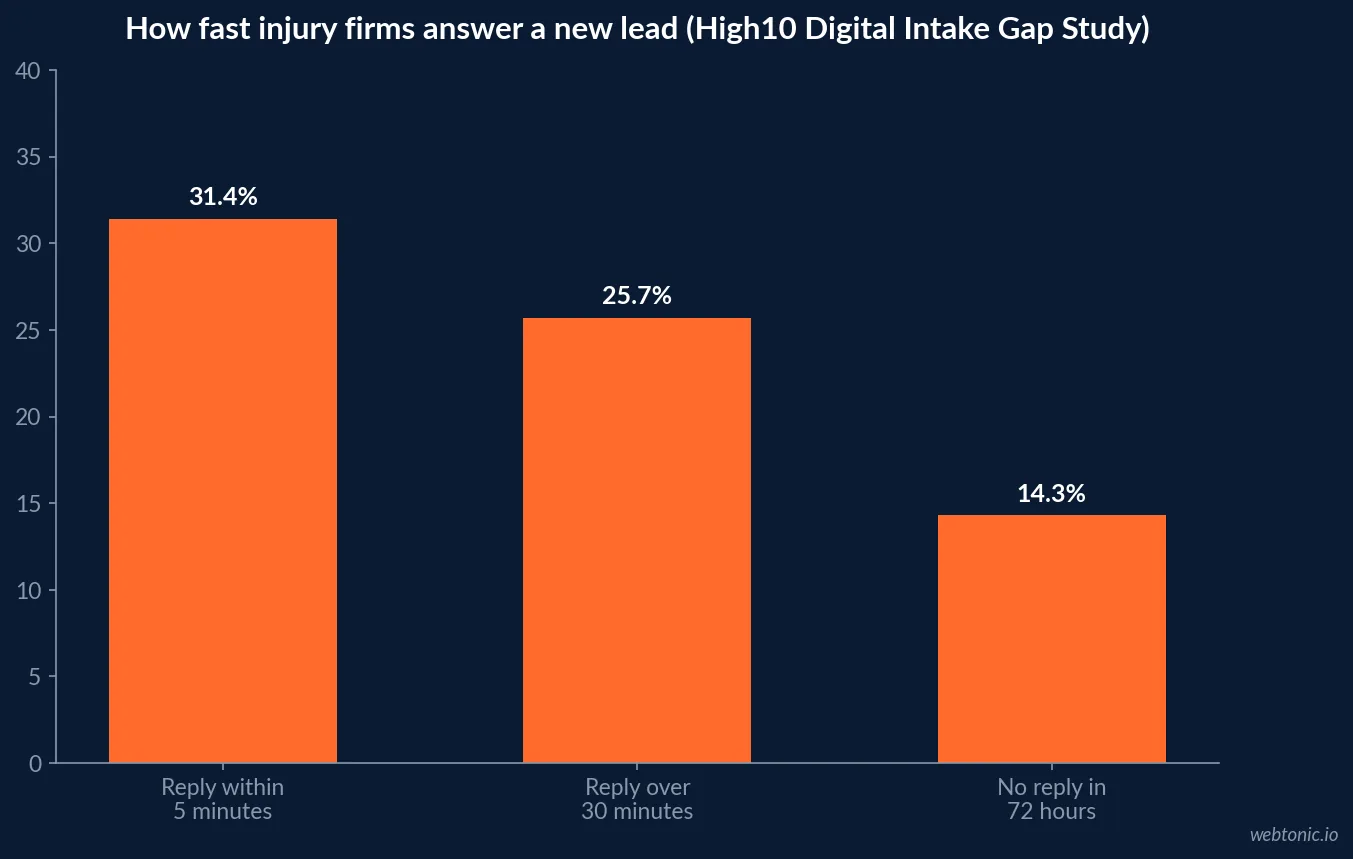
High10 Digital's Intake Gap study - agency data from a mystery shop in which identical web contact forms were submitted to 35 personal injury firms in Louisville, Lexington and Northern Kentucky (page undated, live in 2026) - tracked how those firms responded over a 72-hour window. It found 31.4% responded within five minutes, 25.7% took longer than 30 minutes, and 14.3% never responded at all during the full tracking period. That distribution is the argument for an SMS-based intake workflow: a text triggers a native notification a phone user sees, where a missed call or an unopened email does not.
None of this proves texting itself converts more injury leads into signed clients - no public study isolates SMS as the variable for this industry. What it shows is that speed of first reply is uneven across firms, and SMS is a channel firms can use to close that gap faster than a callback queue.
| Response window | Share of firms | What it means for intake | Source |
|---|---|---|---|
| Within 5 minutes | 31.4% | Best-practice band most firms miss | High10 Digital Intake Gap Study |
| 5 to 30 minutes | roughly a third | Still competitive if the lead hasn't gone elsewhere | High10 Digital |
| Over 30 minutes | 25.7% | Lead is likely contacting a competitor | High10 Digital |
| No response in 72 hours | 14.3% | Lead is effectively lost | High10 Digital |
What SMS costs per intake thread
Twilio's own US SMS pricing page lists USD 0.0083 per segment for both outbound and inbound messages, plus a phone number fee starting at USD 1.15 a month and a USD 0.001 surcharge on any message that terminates as Failed. A typical intake thread of six to ten segments (initial contact, a few replies, a booking confirmation) costs a firm well under ten cents in raw carrier fees - the real spend is the platform subscription and the paralegal or intake staff answering the thread.
Text-first platforms built for small business bundle that carrier cost into a monthly plan. EZ Texting's Launch tier starts at USD 25 a month for up to 500 contacts, with overage falling from USD 0.04 to USD 0.01 a credit as plans scale to Enterprise at USD 3,000 a month. SimpleTexting's published tiers start near USD 29 a month for 500 credits and run to USD 899 at 50,000 credits, with a one-time carrier registration fee layered on top. Podium, which bundles texting with a review and payments inbox many firms already use, prices its Core plan at USD 399 a month and Pro at USD 599.
| Vendor | Entry plan | Monthly price | What it includes | Source |
|---|---|---|---|---|
| Twilio (raw API) | Pay-per-segment | USD 0.0083/segment | No UI, build your own intake bot | Twilio pricing |
| EZ Texting | Launch | USD 25/mo | 500 contacts, 500 credits, overage USD 0.04 | EZ Texting pricing |
| SimpleTexting | Entry tier | USD 29-39/mo | 500 credits plus one-time carrier fee | SimpleTexting pricing |
| Podium | Core | USD 399/mo | Texting, reviews, payments inbox | Podium pricing page |
| Podium | Pro | USD 599/mo | Adds AI concierge and lead routing | Podium pricing page |
Engagement benchmarks worth borrowing (and where they don't transfer)
No SMS vendor publishes a personal-injury-specific benchmark set, so the honest move is to cite the broad vendor data and flag that it comes from retail and consumer verticals. Klaviyo's own SMS click-rate benchmarks run 8.9% to 14.9% depending on message type, and its conversion-rate benchmarks run 1.2% to 2.2%. Those figures are built from ecommerce sending, not legal intake, so use them as a ceiling reference for reply engagement rather than a target. Viral claims of 98% SMS open rates or 45% response rates circulate widely online but trace to no methodology either vendor publishes; this page does not repeat them as fact.
Consent and solicitation rules a firm has to clear
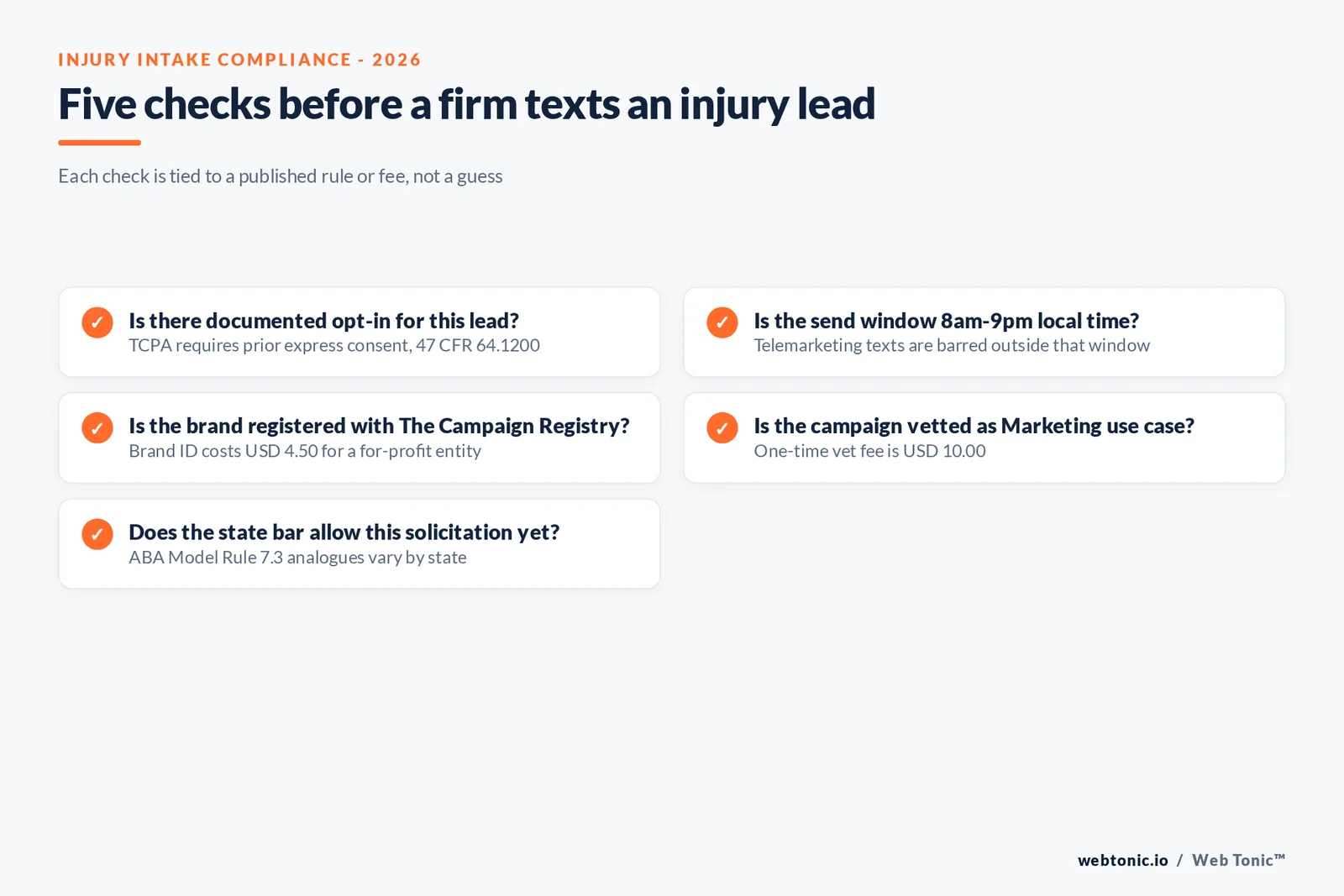
The Telephone Consumer Protection Act and its implementing rule at 47 CFR 64.1200 require prior express consent for autodialed or prerecorded marketing calls and texts, and bar telephone solicitation before 8 a.m. or after 9 p.m. local time at the called party's location. The FCC's 2023 order would have added a one-to-one consent requirement - one opt-in per advertiser rather than a shared lead-gen consent - but the Eleventh Circuit vacated that provision in Insurance Marketing Coalition Ltd. v. FCC on January 24, 2025, so it is not currently in force. Firms buying leads from shared consent pools should still document their own opt-in given the litigation history on this exact issue.
CTIA's Messaging Principles and Best Practices require message senders to provide a clear, conspicuous call-to-action for consent and an easy opt-out - typically a reply of STOP - and carriers enforce this independently of the TCPA. On the bar-rules side, attorney solicitation of an unrepresented accident victim is governed by each state's version of ABA Model Rule 7.3, and several states impose a waiting period after an accident before any direct solicitation is allowed - check the specific state bar's rule, not a national default.
| Rule | What it requires | Status | Source |
|---|---|---|---|
| TCPA, 47 U.S.C. 227 | Prior express consent for autodialed/prerecorded marketing calls & texts | In force | Cornell LII |
| 47 CFR 64.1200(c) | No solicitation before 8 a.m. or after 9 p.m. local time | In force | eCFR |
| FCC 2023 one-to-one consent | One opt-in per advertiser, no shared lead-gen consent | Vacated Jan. 24, 2025 | Insurance Marketing Coalition v. FCC |
| CTIA Messaging Principles | Clear opt-in CTA and STOP-based opt-out | Carrier-enforced | CTIA |
| State bar Rule 7.3 analogues | Limits and waiting periods on solicitation of accident victims | Varies by state | State bar / Cornell LII |
A2P 10DLC registration costs a firm should budget for
Carriers require US businesses sending application-to-person texts to register through The Campaign Registry. Its own fee schedule (last updated Aug. 13, 2026) lists brand identity registration at USD 4.50 for a private or public for-profit entity, a one-time USD 10.00 vetting cost for a Marketing-use-case campaign, and a recurring monthly campaign fee that varies by use case. Skipping registration does not save money - unregistered 10DLC traffic gets throttled or filtered by carriers, which quietly kills the exact intake speed this page opened with.
| 10DLC line item | Cost | Frequency | Source |
|---|---|---|---|
| Brand identity registration (for-profit) | USD 4.50 | One time | The Campaign Registry fee schedule |
| Marketing use case campaign vet | USD 10.00 | One time per campaign | The Campaign Registry fee schedule |
| CSP account setup | USD 200.00 | One time (if firm is its own CSP) | The Campaign Registry fee schedule |
| Failed standard vet retry | USD 5.00 | Per failed attempt | The Campaign Registry fee schedule |
Where SMS fits in the intake stack
The most defensible use of SMS in a personal injury pipeline is not cold marketing but consented, fast-turnaround replies to inbound leads: a text confirming receipt of a form submission, a scheduling link for a free consult, and a reminder ahead of a signed intake call. That use case sidesteps most of the TCPA's marketing-specific consent burden because it responds to an action the lead already took, and it directly targets the 68.6% of firms in the High10 study that were not replying inside five minutes.
Our growth marketing practice builds intake workflows around exactly this kind of response-time data rather than headline open-rate claims.
Why speed compounds: the lead-decay evidence
The intake-speed argument is not new. Harvard Business Review's 2011 study, "The Short Life of Online Sales Leads," found that a company's odds of successfully making contact with a lead fell sharply after the first five minutes and dropped further after each subsequent delay, based on more than 15,000 tracked leads across industries. That finding predates SMS as a mainstream intake channel, but it is the reason firms are moving replies to whichever channel loads fastest on a phone screen - which for most injury leads texting on a mobile browser is SMS, not a callback queue.
Applied to the High10 data above, the 14.3% of firms with no reply in 72 hours are not just slow - per the HBR decay curve, they are likely contacting a lead that has already retained someone else.
| Delay after lead submission | Effect on contact odds (HBR 2011 finding) | Relevance to injury intake |
|---|---|---|
| Under 5 minutes | Highest odds of successful contact | Matches the 31.4% best-practice band |
| 5 to 30 minutes | Odds fall measurably with each interval | The middle band most firms fall into |
| Over 30 minutes | Odds continue to decline | The 25.7% of slow-reply firms |
| Never contacted | Lead effectively lost | The 14.3% no-response group |
Building the intake message without tripping consent rules
A compliant first text to a new lead states who is texting, why, and how to opt out - it does not need to read like a marketing blast to be effective. Firms commonly structure the first three messages as: (1) confirmation the form was received with an estimated callback window, (2) a scheduling link once an intake specialist is assigned, and (3) a day-before reminder for the consult itself. Each message ties to an action the lead initiated, which keeps the thread inside a service-communication frame rather than a cold marketing frame under the TCPA.
For firms that also run SMS on established client files (case-status updates, document requests), the same 8 a.m.-9 p.m. quiet-hours rule and STOP opt-out apply regardless of whether the recipient is a new lead or a signed client.
| Message step | Trigger | Consent frame | Sent within |
|---|---|---|---|
| Receipt confirmation | Form submitted | Responds to lead's own action | Under 5 minutes (target) |
| Scheduling link | Intake specialist assigned | Responds to lead's own action | Same business day |
| Consult reminder | Appointment booked | Transactional, not marketing | 24 hours before |
| Case-status update | File milestone reached | Existing client relationship | As needed, 8am-9pm only |
Related reading on response-driven marketing channels
Firms weighing SMS against other fast-response channels can compare cost and reply-speed data across channels in our breakdowns of what paid social lead ads cost and the live cross-industry SMS marketing statistics hub for benchmarks outside the legal vertical. Firms building a broader intake stack can also read our Google Ads strategy guide for how paid search leads feed the same response-time problem this page documents.
Frequently Asked Questions
Do high response rates really drive personal injury SMS marketing results?
The evidence supports a correlation, not a guarantee. High10 Digital's intake-gap study (agency data, 35 Kentucky firms, web-form mystery shop) found firms that replied within five minutes were the minority (31.4%); it does not publish a controlled test linking reply speed to signed cases. Separately, Club OS/ASF data (a different industry, fitness) puts texting lead-to-customer conversion at 7-8% against under 7% for phone and 4% for email - directionally consistent with texting outperforming slower channels, but not a personal injury-specific figure. Treat 'high response rates drive results' as what the data supports: faster, SMS-based replies correlate with more consults booked, not as a guaranteed multiplier.
How fast do personal injury firms actually respond to a text lead?
High10 Digital's Intake Gap study (agency data: a web-form mystery shop of 35 Kentucky personal injury firms) tracked inquiries for 72 hours and found 31.4% responded within five minutes, 25.7% took longer than 30 minutes, and 14.3% never responded in the full window. That gap is the case an SMS or live-chat intake workflow is built to close.
What does SMS cost per lead thread for a law firm?
Twilio prices outbound and inbound SMS at USD 0.0083 per segment in the US, plus a phone number fee starting at USD 1.15 a month and A2P 10DLC registration costs. The Campaign Registry's own fee schedule lists brand registration at USD 4.50 for a for-profit entity and a USD 10.00 one-time vetting cost for a Marketing use case campaign. A firm running a few hundred intake threads a month is spending single-digit dollars on the messages themselves; the line items that add up are the platform subscription and staffing to answer fast.
Is texting injury leads before they consent legal?
It depends on consent, and the rules moved in 2025. The Telephone Consumer Protection Act (47 U.S.C. 227) and its FCC rules (47 CFR 64.1200) require prior express consent for autodialed or prerecorded marketing texts and ban solicitation calls or texts before 8 a.m. or after 9 p.m. local time. The FCC's 2023 rule that would have required a separate one-to-one consent per advertiser was vacated by the Eleventh Circuit in Insurance Marketing Coalition v. FCC (Jan. 24, 2025) and is not in force; firms should still document a clear opt-in per sender rather than rely on a shared lead-gen consent. Attorney solicitation rules vary by state bar, so check the specific state's version of ABA Model Rule 7.3 before texting an unrepresented accident victim.
What compliance line items does a firm actually pay for?
A2P 10DLC registration through The Campaign Registry: USD 4.50 for a private or public for-profit brand identity check, plus a one-time USD 10.00 vetting fee for a Marketing-use-case campaign and a recurring monthly campaign fee that varies by use case (published on the same fee schedule). CTIA's Messaging Principles and Best Practices require a clear opt-in call-to-action and an easy STOP-based opt-out on every campaign - both are enforced by carriers, not just by law.
Sources
High10 Digital - The Intake Gap: How PI Law Firms Lose Leads Within Minutes
Twilio - US SMS pricing
EZ Texting - pricing
SimpleTexting - pricing
Podium - Pricing
Klaviyo Help Center - SMS click rate benchmarks
Klaviyo Help Center - SMS conversion rate benchmarks
Cornell LII - 47 U.S.C. 227, Telephone Consumer Protection Act
eCFR - 47 CFR 64.1200
The Campaign Registry - TCR Fees and Pricing
CTIA - Messaging Principles and Best Practices