



Table of contents
No published dataset shows native ads outperforming paid search for personal injury firms - or the reverse. What exists is a well-measured search side and an unmeasured native side. Legal search leads cost a median USD 131.63 in WordStream's 2026 benchmarks, the highest of any industry, while no network, bar or trade group publishes an injury-law native cost per lead. This page lays the measured figures side by side and says plainly where the comparison stops.
Key Takeaways
- Legal search clicks cost a median USD 9.87 in 2026, the highest of 23 industries.
- Legal search leads cost USD 131.63, against USD 66.69 for all industries.
- Legal search converts at 5.55%, below the 8.18% all-industry median.
- Attorney Facebook lead campaigns cost USD 18.17 a lead in 2025, at a 10.53% conversion rate.
- ATRA estimates USD 2.5 billion-plus on 26.9 million legal ads in 2024.
- Legal ad spending rose about 39% from 2020 to 2024 while ad counts fell 4%.
- Digital legal ad spend rose 84% as the number of digital ads fell by more than half.
- AI Overviews correlate with a 58% lower top-result click-through rate (Ahrefs, Dec 2025 data).
- Pew saw clicks on 8% of visits with an AI summary against 15% without (March 2025).
- 58.5% of US Google searches ended without a click in 2024 (SparkToro/Datos).
- No personal injury native-ad CTR, CPL or conversion rate is published.
What the claim in the title can and cannot mean
A fair "native versus search" comparison needs both channels measured the same way for the same kind of advertiser. For injury law only one half exists. WordStream's 2026 Google Ads benchmarks cover more than 13,000 search campaigns between April 2025 and March 2026 and report medians by industry. There is no native equivalent: Taboola and Teads report in aggregate, and the IAB/PwC 2025 revenue report has no native line.
So this is a comparison of evidence, not of performance. Where the search figure is measured, it is quoted; where the native figure would sit, the page says it is missing rather than filling the cell.
| Metric | Paid search, legal (2026) | Native, personal injury | Status of the native figure |
|---|---|---|---|
| Cost per click | USD 9.87 | Not published | No PI or legal native benchmark |
| Click-through rate | 5.87% | Not published | Network figures are cross-industry only |
| Conversion rate | 5.55% | Not published | Depends on the firm's own landing page |
| Cost per lead | USD 131.63 | Not published | Only a tracked test can produce it |
| Intent at the click | Active query | Content reader | Structural difference, not a metric |
The search side, measured
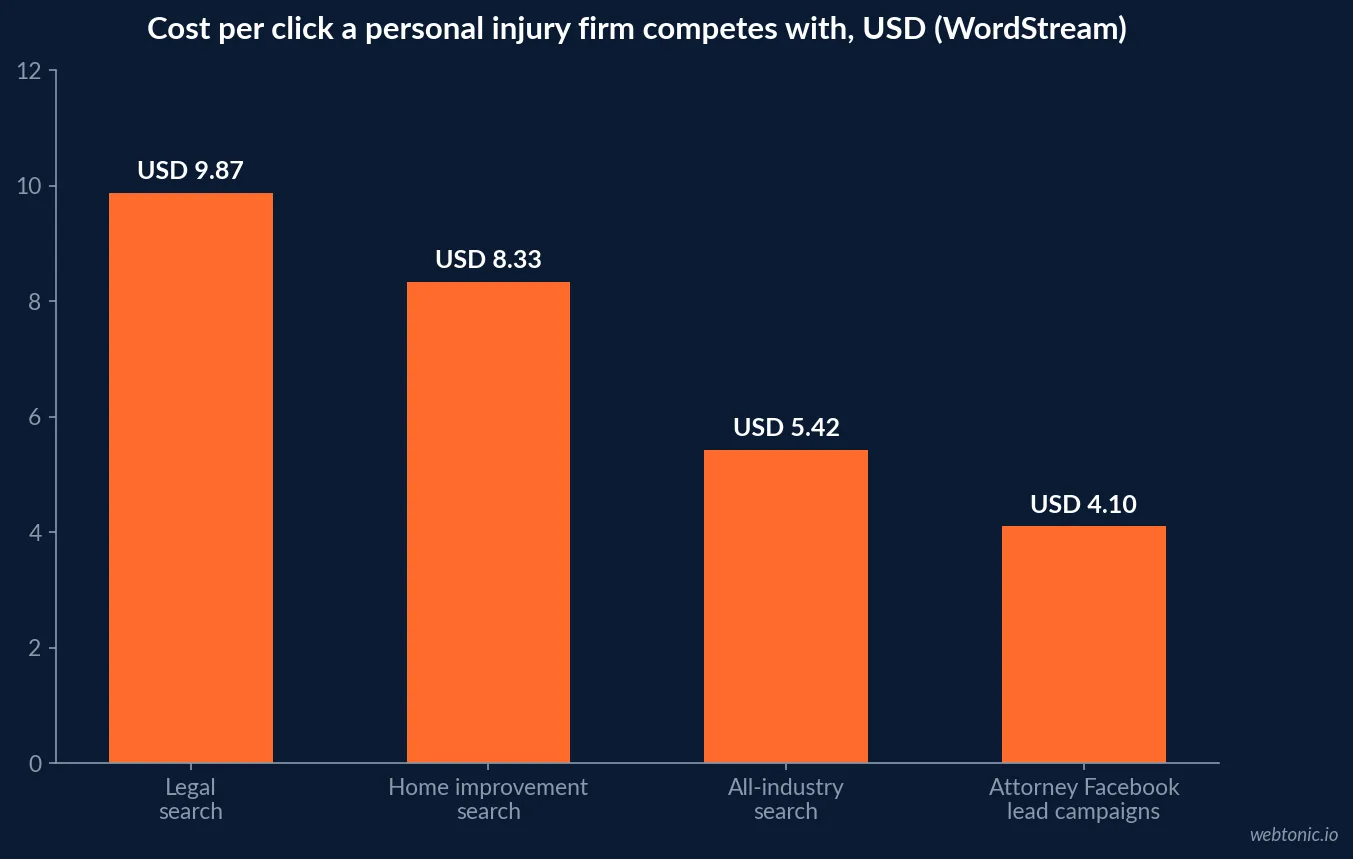
In WordStream's 2026 data, Attorneys and Legal Services post a 5.87% click-through rate, a USD 9.87 cost per click and a 5.55% conversion rate, which produce the USD 131.63 cost per lead. WordStream names legal as the highest-CPC industry, ahead of Home and Home Improvement at USD 8.33 and Dentists at USD 8.00, and as the highest-CPL industry, ahead of Furniture at USD 106.70.
Against the all-industry medians - 6.64% click-through, USD 5.42 per click, 8.18% conversion and USD 66.69 per lead - a legal search lead costs roughly twice the average. That premium is the bar any alternative has to clear on signed cases, not on clicks.
| Search metric, 2026 median | Attorneys and Legal Services | All industries | Gap |
|---|---|---|---|
| Click-through rate | 5.87% | 6.64% | 0.77 points lower |
| Cost per click | USD 9.87 | USD 5.42 | 1.8x higher |
| Conversion rate | 5.55% | 8.18% | 2.63 points lower |
| Cost per lead | USD 131.63 | USD 66.69 | About 2x higher |
Why search clicks are getting harder to win
Paid listings sit inside results pages that send fewer clicks out. Ahrefs' February 2026 update found that an AI Overview now correlates with a 58% lower average click-through rate for the top-ranking page, using December 2025 data, up from 34.5% in its April 2025 study. The Pew Research Center browsing panel (March 2025) found users clicked a traditional result on 8% of visits with an AI summary against 15% without one, and the SparkToro and Datos 2024 study put US zero-click searches at 58.5%.
These are organic-result studies, not paid-search studies, and none is legal-specific. They describe the page legal ads compete on; they do not prove that ad clicks fell for injury firms.
| Search-page study | Figure | Period | Scope |
|---|---|---|---|
| Ahrefs AI Overviews update | -58% top-result CTR | December 2025 data | Organic, cross-industry |
| Ahrefs original study | -34.5% top-result CTR | April 2025 | Organic, cross-industry |
| Pew Research Center | 8% vs 15% click rate | March 2025 | US adult browsing panel |
| SparkToro / Datos | 58.5% zero-click | 2024 | US Google searches |
Where legal ad money went, 2020 to 2024
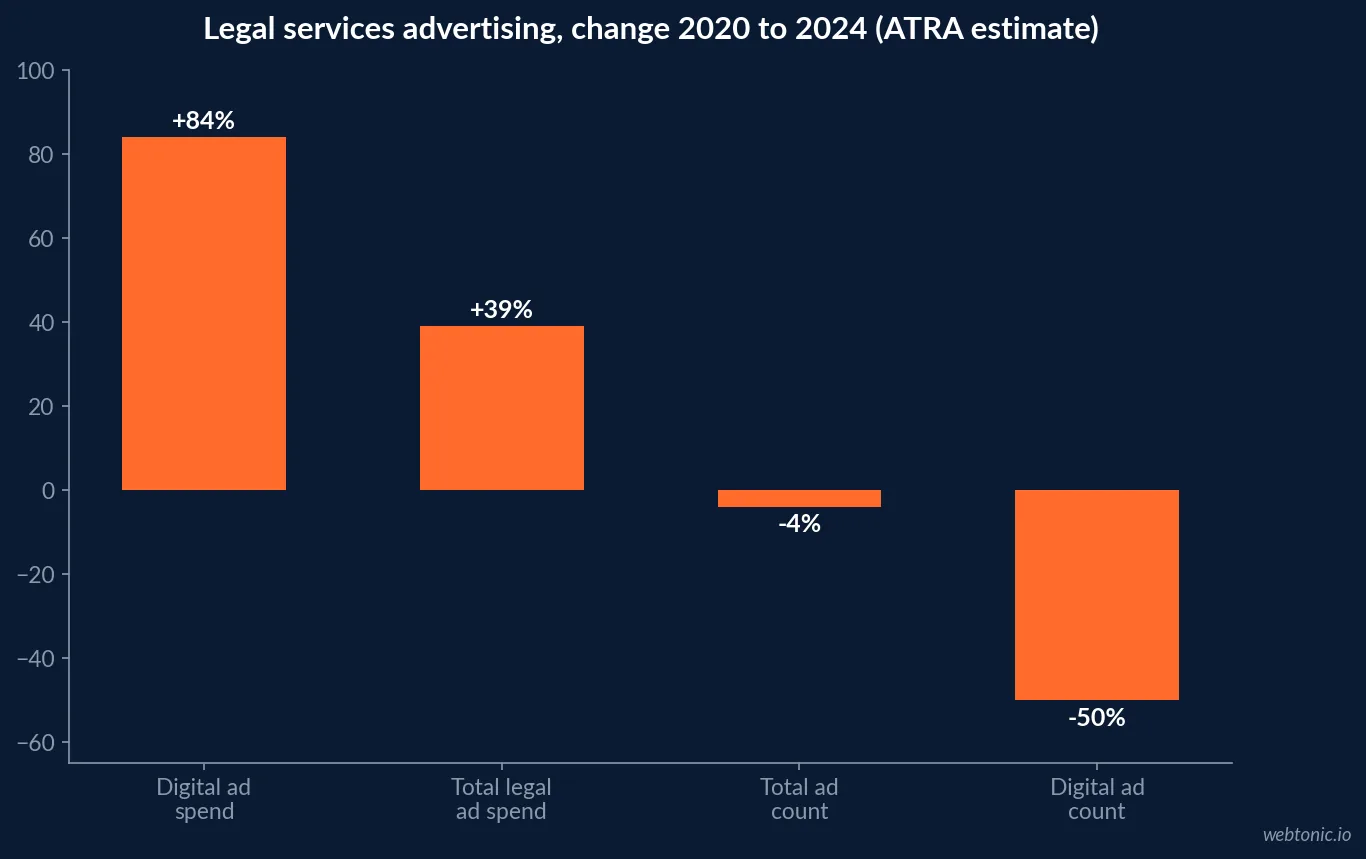
The American Tort Reform Association - a tort-reform advocacy group, which is worth stating - publishes the only market-wide estimate. Its March 2025 2020-2024 legal services advertising report, built on Vivvix ad-tracking data, estimates that more than USD 2.5 billion was spent on more than 26.9 million legal ads in 2024. Spending rose about 39% from 2020 while the number of ads fell about 4%, "due in large part to the increased cost of digital advertising, which led to a more than 50% reduction in the quantity of digital ads for legal services, while spending on those ads increased 84%."
The report does not split digital into search, social and native, so it shows rising digital unit costs, not a shift between those formats. Television ad counts peaked in 2023 at more than 16.4 million and radio peaked in 2024 at more than 6.8 million.
| Legal advertising, ATRA estimate | Figure | Comparison point |
|---|---|---|
| Total spend, 2024 | More than USD 2.5 billion | Pizza restaurants: USD 1.1 billion |
| Ads placed, 2024 | More than 26.9 million | Pizza restaurants: 4.1 million |
| Total spend change | About +39% | 2020 to 2024 |
| Digital spend change | +84% | 2020 to 2024 |
| Digital ad count change | More than -50% | 2020 to 2024 |
| Radio ads, 2024 peak | More than 6.8 million | 1.8 million in 2017 |
The social comparator nobody expects
The one paid channel with a measured legal lead cost below search is Meta. WordStream's 2025 Facebook ads benchmarks report attorney lead campaigns at a 2.11% click-through rate, USD 4.10 per click, a 10.53% conversion rate and USD 18.17 per lead. A Facebook lead form is not a signed case, and lead quality is the usual objection, but it is a measured number. Native has none, which is why a native test should be judged against both lines. Our personal injury Google Ads statistics cover the search line in more depth.
Cost per lead is not cost per case
Search benchmarks stop at the form fill or the call. For an injury firm the number that matters sits two steps later: the share of leads intake accepts and the share of those that sign. Neither is published for the industry, so the arithmetic has to start from the measured part. At the 2026 legal medians, 100 search clicks cost about USD 987 and, at a 5.55% conversion rate, produce roughly 5.5 leads. Whatever share of those becomes a signed case divides that spend again.
The same chain applies to native, with one more unknown at the front: the click-to-lead rate on a content reader who was not searching. That is why a native test that looks cheap per click can still lose on cost per case, and why the only fair scoreboard is the intake log, not the ad dashboard. Firms that run both channels should record the source of every signed case for at least one full intake cycle before moving money.
What the native networks do publish
Taboola's own Realize budget guidance recommends a daily budget of 10 times the CPA goal, or at least USD 50. Teads reported USD 529.7 million of 2025 ex-TAC gross profit, up 124% mainly because of the Outbrain-Teads combination, and a 40.7% ex-TAC gross margin. Taboola reported USD 713.5 million of ex-TAC gross profit. None of these filings gives a legal or injury result.
Applied to legal search economics, the 10x rule is stark: a CPA goal at the USD 131.63 legal search median implies about USD 1,316 a day for a fully conversion-optimised campaign. That is arithmetic from two published numbers, not a benchmark.
| Native network figure | Value | Source type |
|---|---|---|
| Realize daily budget rule | 10x CPA goal or at least USD 50 | Taboola help centre |
| Taboola ex-TAC gross profit, 2025 | USD 713.5 million | Taboola results release |
| Teads ex-TAC gross profit, 2025 | USD 529.7 million | Teads results release |
| Teads ex-TAC gross margin, 2025 | 40.7% (26.5% in 2024) | Teads results release |
| Implied daily budget at legal search CPL | About USD 1,316 | Arithmetic, not a benchmark |
Ethics rules that apply on both channels
Lawyer advertising is governed state by state, mostly on the ABA model. Pennsylvania's version of Rule 7.2, via Cornell LII, says a lawyer shall not give anything of value for a recommendation except that a lawyer may "pay the reasonable costs of advertisements or communications permitted by this Rule", and claims must not be false or misleading under Rule 7.1. The FTC's native advertising guide adds the format rule: content must be identifiable as an ad, using terms such as "Ad" or "Sponsored Advertising Content", not "Promoted Stories".
Advertorials about settlements are where firms get into trouble: results language that implies an outcome reads as a guarantee. Check your state bar's rule before the creative goes live.
How to run the comparison yourself
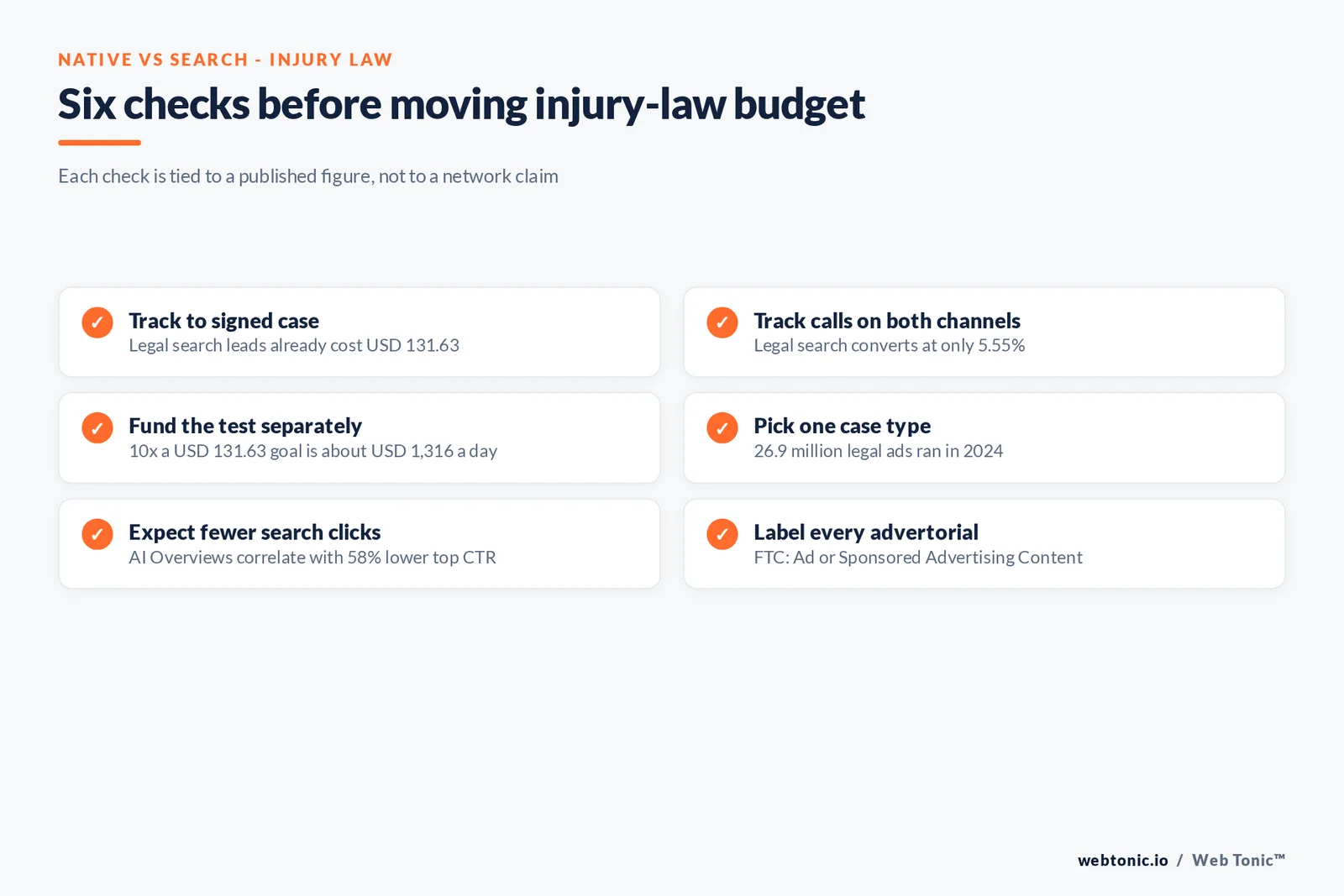
- Track to signed case, not lead. Search and native leads differ in quality; only intake data settles it.
- Use call tracking on both. Injury intake is phone-heavy; form-only tracking undercounts.
- Fund native separately. Do not starve search to pay for a test.
- Pick one case type. Motor-vehicle and premises cases read differently in a content feed.
- Hold the test long enough. Native assists more than it closes; give it a full intake cycle.
- Label every advertorial. FTC terms plus your state bar's disclaimer language.
For the wider channel see our native advertising statistics, and for the organic side our personal injury enterprise SEO statistics.
What the data cannot tell you yet
There is no published injury-law native click-through rate, no native cost per signed case and no survey of how firms split budgets between search and native. Figures circulating in agency posts do not name a sample, so they are not repeated here. Until a network or a bar-association survey publishes one, the only defensible "native versus search" number for a firm is its own.
Frequently Asked Questions
Are native ads cheaper than paid search for personal injury firms?
Per click, almost certainly, but that is not the comparison that matters and no study measures it for injury law. WordStream's 2026 data puts the legal search median at USD 9.87 a click and USD 131.63 a lead. No network or association publishes a personal injury native cost per lead, so a firm can only find out with its own tracked test.
Why is legal search so expensive?
Attorneys and Legal Services carry the highest cost per click and the highest cost per lead of the 23 industries in WordStream's 2026 search benchmarks, at USD 9.87 and USD 131.63, while converting at 5.55% against an 8.18% all-industry median. High case values let firms bid more, and every competing firm does the same.
Is legal ad money moving out of search?
The only market-wide series is ATRA's, which estimates more than USD 2.5 billion spent on 26.9 million legal ads in 2024, with digital spend up 84% since 2020 while the number of digital ads fell by more than half. ATRA is a tort-reform advocacy group and its report does not separate search from native, so it cannot show a shift from one to the other.
What ethics rules apply to a sponsored article from a law firm?
State versions of ABA Model Rule 7.2 allow a lawyer to pay the reasonable costs of advertisements, and Rule 7.1 bars false or misleading communications. The FTC's 2015 guidance adds that the content must be identifiable as advertising, with labels such as 'Ad' or 'Sponsored Advertising Content'.
Should a firm move search budget into native?
The data does not support a move. It supports a test: keep search funded where it produces signed cases, and fund native separately at the network's stated floor, judged on calls and intake quality rather than clicks.
Sources
WordStream - Google Ads benchmarks 2026
WordStream - Facebook ads benchmarks 2025
ATRA - Legal services advertising in the US 2020-2024
Ahrefs - AI Overviews reduce clicks (update)
Pew Research Center - AI summaries and clicks
SparkToro - 2024 zero-click search study
Taboola Realize - Budget and pacing
Teads - Q4 and full year 2025 results
Cornell LII - 204 Pa. Code r. 7.2
FTC - Native advertising guide
IAB/PwC - Internet Advertising Revenue Report FY2025


