Table of contents
Legal services pay one of the highest costs per click on LinkedIn — $6.75–$7.95 against a $5.74 platform average — and almost no car-accident victim is on the platform when they need a lawyer. The channel earns its budget in personal injury only when it is aimed at referral sources and commercial matters.
Key Takeaways
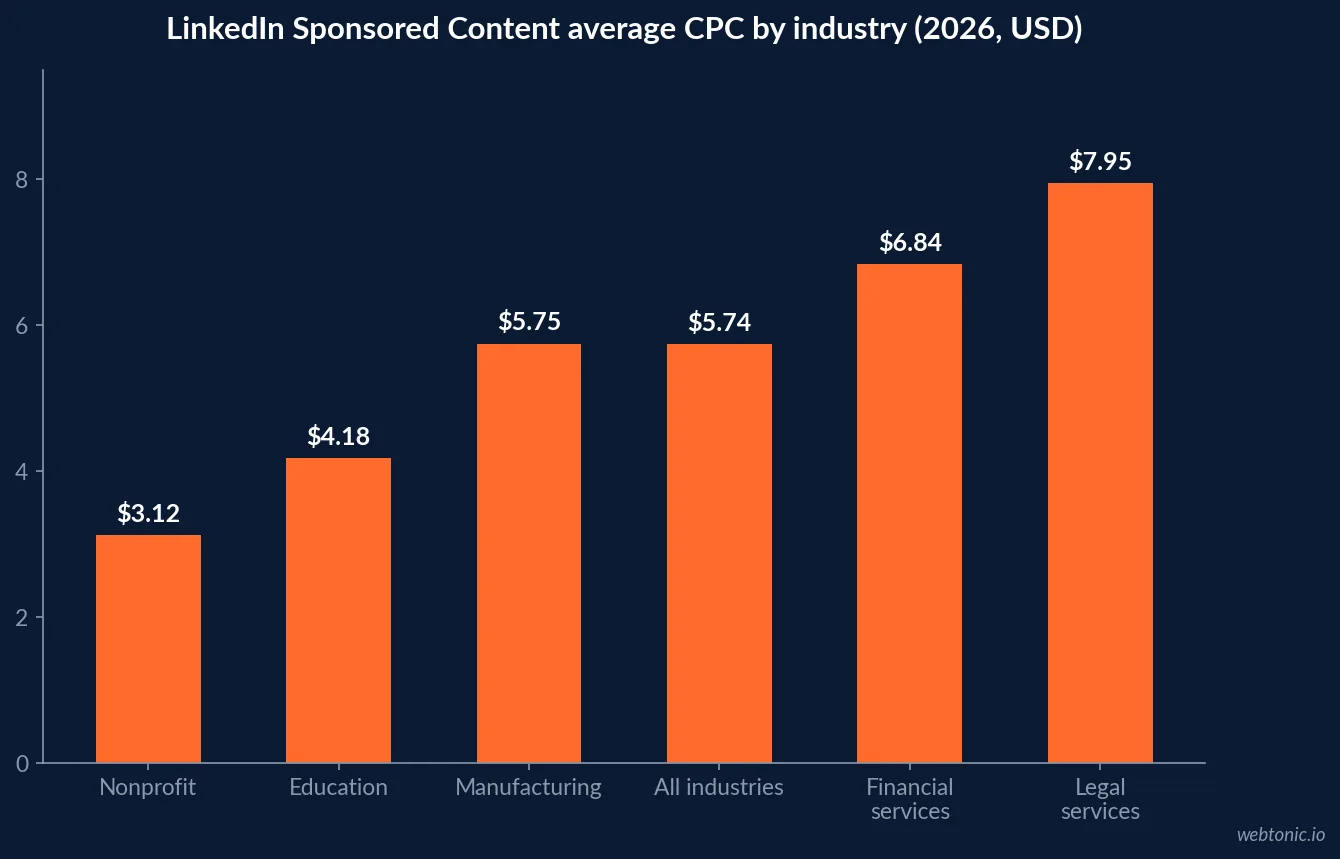
- Legal services average $6.75 LinkedIn CPC in legal-industry data and $7.95 in cross-industry data.
- The all-industry LinkedIn Sponsored Content CPC average is $5.74, up 9% year over year.
- Legal median CPM runs $31–$38, reaching $50–$100 in competitive segments.
- Legal ads targeting decision-makers average a 0.55% CTR; single-image ads run 0.50–0.60%.
- Cost per lead for well-targeted legal campaigns lands near $100–$175.
- Cross-industry LinkedIn CPLs span $68–$200 depending on vertical and targeting.
- Legal-services paid conversion rate averages 5.09%; LinkedIn B2B campaigns sit at 4.0–5.5%.
- Lead Gen Forms convert at 8–12% versus 3–5% for landing pages.
- Lead Gen Forms cut cost per lead by 25–40% and reduce drop-off to 28% from 65%.
- Legal and professional services convert LinkedIn leads to clients at about 7.1%.
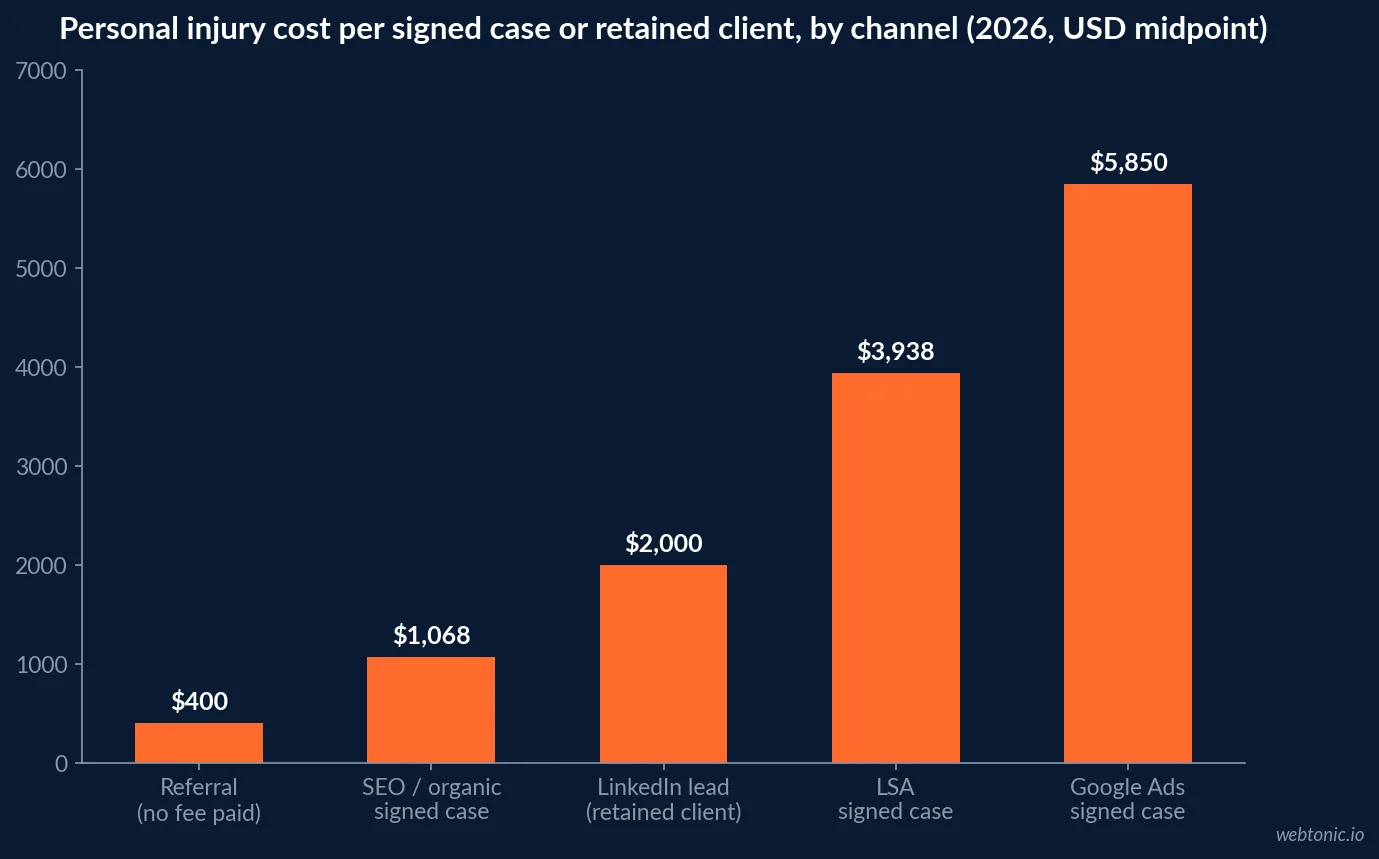
- Implied cost per retained client is $1,500–$2,500 — versus $2,900–$8,800 on PI Google Ads.
- LinkedIn has 1.3 billion members and roughly 65 million decision-makers.
- 82% of lawyers use LinkedIn as their primary professional network; 87% of firms have a page.
- The typical law firm grew LinkedIn followers 21% in the past year (median 19%).
- Attorney referral fees typically run 25–33% of the contingency fee.
- Referral leads convert about 3.5x more often than cold leads.
LinkedIn Ads Benchmarks for Legal in 2026
Legal-industry benchmark analysis published in January 2026 reports CPCs rising 8–12% against Q4 2024 while CTRs hold flat — the classic signature of a channel getting more crowded rather than more effective.
| Metric | Legal benchmark | Platform context | Read |
|---|---|---|---|
| CPC | $6.75 | $5.74 all-industry average | Legal pays a ~18% premium |
| CPC (cross-industry study) | $7.95 | Financial services $6.84, education $4.18 | Legal is the top-cost vertical |
| CPM (median) | $31–$38 | $50–$100 in high competition | Reach is expensive, not impossible |
| CTR | 0.55% | 0.50–0.60% single-image average | In line, not above |
| Conversion rate | 5.09% | 4.0–5.5% B2B band | Healthy when the offer is educational |
| Lead Gen Form fill rate | 9.25% | Above 10% is good | Native forms beat landing pages |
| Cost per retained client | $1,500–$2,500 | 7.1% lead-to-client rate | Competitive with paid search cases |
The Audience Mismatch, Stated Plainly
LinkedIn reports 1.3 billion members across 200 countries, roughly 65 million decision-makers and 10 million C-level executives, with an audience the platform claims has 2x the buying power of the average web user. In the US, over half of users live in households earning above $100,000.
None of that describes someone who was rear-ended forty minutes ago. Personal injury demand is event-triggered and searched: Google Search is the first discovery route for 36% of clients and personal referrals for 33%, while social media accounts for about 3%. Treating LinkedIn as a victim-acquisition channel produces the outcome its cost structure predicts. The realistic LinkedIn audiences for a PI firm are different people entirely.
| LinkedIn audience | Why they matter to a PI firm | Best offer |
|---|---|---|
| Plaintiff and general-practice attorneys | Referral fees of 25–33% of the fee | Co-counsel capability one-pager |
| Insurance defence and adjuster networks | Case intelligence and lateral hiring | Thought-leadership content |
| Treating physicians, chiropractors, PT clinics | Highest-quality inbound referrals | Lien and records-handling guide |
| Safety, HR and risk managers | Workplace-injury and comp matters | Compliance webinar |
| Trucking and logistics operations leaders | Commercial trucking case flow | Fleet-incident briefing |
| Law students and paralegals | Recruiting, not case flow | Careers content |
Referral Economics: The Only Math That Justifies the CPC
Attorney referral fees are the reason a $150 lead can be cheap. Published guidance on California referral-fee practice under Rule 1.5.1 puts forwarding fees at 20–25% and active co-counsel splits at 40–50% of the underlying contingency (33.33% pre-suit, 40–45% in litigation, 45–50% at trial). Referral-marketing guidance reports the common range as 25–33%.
| Scenario | Recovery | Attorney fee | Referral fee at 25% | Net to handling firm |
|---|---|---|---|---|
| Minor soft-tissue claim | $25,000 | $8,333 | $2,083 | $6,250 |
| Typical auto claim | $100,000 | $33,000 | $8,250 | $24,750 |
| Serious injury, litigated | $500,000 | $200,000 | $50,000 | $150,000 |
| Commercial trucking | $1,500,000 | $600,000 | $150,000 | $450,000 |
Read the bottom two rows against a $100–$175 cost per lead. One referral relationship that sends two litigated cases a year returns the entire annual LinkedIn budget of a mid-sized firm several times over. That is also why referral leads convert about 3.5x more often than cold leads — the trust transfer arrives with the case.
Lead Gen Forms vs Landing Pages
Format choice moves LinkedIn economics more than bid strategy. 2026 benchmark analysis puts native Lead Gen Form conversion at about 6.1% on average — roughly 5x the rate of off-platform landing pages — with drop-off falling to 28% from 65% when traffic is sent off-site. Managed-spend data across 17 B2B verticals reports forms cutting CPL by 25–40% at 6–10% conversion against 3–5% for landing pages.
| Format | Conversion rate | CPL effect | When a PI firm should use it |
|---|---|---|---|
| Native Lead Gen Form | 8–12% | 25–40% lower CPL | Referral-guide and webinar registration |
| Landing page | 3–5% | Baseline | When qualification matters more than volume |
| Conversation ads | Varies | Higher CPL, higher intent | Direct attorney-to-attorney outreach |
| Document ads | Strong for gated assets | Mid | Case-referral capability decks |
| Video ads | Awareness-weighted | Higher CPM | Trial-result storytelling |
The caveat published alongside those numbers matters in legal: form leads are cheaper but often less qualified, because pre-filled profile data removes the friction that filters casual interest. For a firm chasing referral relationships that is acceptable; for one chasing signed cases it is not — the same trade-off documented in our personal injury law landing page statistics is why intake capacity should set the format.
LinkedIn Against the Rest of the PI Media Mix
Channel comparison only works on a common unit. Below, everything is expressed as cost to acquire one client, using PI cost-per-lead research and the 7.1% legal LinkedIn lead-to-client rate.
| Channel | Cost per lead | Lead-to-client rate | Cost per client | Volume ceiling |
|---|---|---|---|---|
| Referrals | $0–$100 | 15–20%+ | $0–$667 | Very low |
| SEO / organic | $183 | 15–20% | $915–$1,220 | Medium, slow to build |
| LinkedIn Ads | $100–$175 | 7.1% | $1,500–$2,500 | Low for victims, medium for referrals |
| Local Services Ads | $378 | 8–12% | $3,150–$4,725 | Medium |
| Google Ads | $442 | 5–15% | $2,900–$8,800 | High |
LinkedIn lands second-cheapest per acquired client on paper. The honest asterisk is volume: at a 0.55% CTR against a narrow professional audience in one metro, a PI firm will exhaust its addressable referral market in weeks, not months. Budget it as a relationship channel with a ceiling, and keep the harvest budget in search — see our personal injury law Google Ads statistics and personal injury law Facebook Ads statistics for those channels.
Organic LinkedIn: The Cheaper Half of the Strategy
Adoption among lawyers is near-universal: 82% use LinkedIn as their primary professional networking tool, 87% of firms maintain a page, and 83% of firms are on social media at all with LinkedIn the most-used platform. Law firm marketing research also finds 43% of firms rank networking as their highest-ROI marketing activity — higher than any paid channel.
- Typical law firms grew followers 21% last year (median 19%); legal and professional services average a 2.6% organic engagement rate against 0.5–1.0% for paid.
- Attorney personal profiles outperform firm pages — fund the named partner’s presence, then amplify the best posts as Sponsored Content.
- Educational assets (compliance guides, webinars, case-referral criteria) convert better than consultation offers, per the 2026 legal benchmark data.
- Track DMs that become referral conversations, not impressions — the metric practitioners consistently name as the real ROI signal.
- Feed the same content library to search and email so the CPM is amortised, as in our personal injury law social media marketing statistics.
How to Structure a PI LinkedIn Test
Given legal CPCs, a test needs enough budget to leave learning and a narrow enough audience to be exhausted deliberately. The structure below reflects the benchmark data rather than platform defaults.
| Element | Recommendation | Why |
|---|---|---|
| Monthly test budget | $3,000–$6,000 | At $6.75–$7.95 CPC, less than this yields no signal |
| Audience size | 8,000–30,000 members | Job-title and company-size targeting beats broad |
| Primary objective | Lead Gen Form conversion | 8–12% fill rate, 25–40% lower CPL |
| Primary offer | Referral or compliance guide | Educational offers outperform consultations |
| Success metric | Cost per referral conversation | Not CPL, not CTR |
| Kill criteria | No conversation under $600 | Above that, search or SEO buys cases cheaper |
Firms without in-house tracking should wire this into the attribution stack first; a channel whose value is a relationship six months later is the easiest one to mis-measure, as covered in our personal injury law analytics statistics.
What the Rising-Cost Trend Means for 2027 Planning
Three trends in the 2026 legal benchmark set point the same way. CPCs rose 8–12% against Q4 2024 while CTRs stayed flat, meaning more firms are bidding for the same professional attention. Educational offers now convert better than direct consultation offers, because in-house counsel and corporate decision-makers engage with content that teaches before it sells. And broad targeting is underperforming outright: campaigns refined by job title, company size and industry consistently produce lower CPLs.
| Trend | 2026 evidence | Planning response |
|---|---|---|
| Rising CPCs | +8–12% vs Q4 2024, CTR flat | Cap audience size, raise creative quality |
| Educational offers win | Webinars and guides beat consult offers | Build one referral-criteria asset per quarter |
| Broad targeting fails | Refined segments show lower CPL | Job title + firm size + geography only |
| Form-first capture | 8–12% vs 3–5% on landing pages | Default to Lead Gen Forms |
| Organic outperforms paid engagement | 2.6% organic vs 0.5–1.0% paid | Fund partner profiles, amplify winners |
The strategic conclusion for a personal injury firm has not changed with the costs: LinkedIn is a referral-development and recruiting channel with a hard volume ceiling and unusually good unit economics inside that ceiling. Firms that budget it as a substitute for search will conclude the channel does not work; firms that budget it as the paid layer under an attorney-relationship strategy will find a $150 lead is the cheapest introduction available in a market where a click can cost $300.
Frequently Asked Questions
Do LinkedIn Ads work for personal injury law firms?
Not for reaching accident victims. They work for reaching the people who refer accident victims: other attorneys, in-house counsel, insurance and medical professionals, safety managers and HR leaders. Legal services pay one of the highest LinkedIn CPCs at $6.75–$7.95, so the economics only clear when the target is a referral relationship or a commercial matter, not a single auto claim.
How much do LinkedIn Ads cost for a law firm in 2026?
Legal services average $6.75 CPC in one legal-industry benchmark set and $7.95 in a cross-industry study, against a $5.74 all-industry average. Legal CPMs run $31–$38 at the median, rising to $50–$100 in high-competition segments, and cost per lead lands around $100–$175 for well-targeted campaigns.
What is a good LinkedIn conversion rate for legal campaigns?
Legal-services paid campaigns average about 5.09% conversion, with LinkedIn B2B campaigns sitting in a 4.0–5.5% band. Native Lead Gen Forms complete at 8–12% against 3–5% for the same offer sent to a landing page, and cut cost per lead by 25–40%.
What does a LinkedIn-sourced client actually cost a PI firm?
Legal and professional services convert LinkedIn leads to clients at roughly 7.1%. At a $100–$175 cost per lead, that implies $1,500–$2,500 per retained client — competitive with a $2,900–$8,800 Google Ads cost per signed PI case, and the reason the channel survives scrutiny.
Why does referral targeting change LinkedIn's economics for PI firms?
Because one referral relationship is worth many cases. Attorney referral fees typically run 25–33% of the contingency fee, so a $100,000 recovery at a 33% fee produces roughly $8,250 to the referring lawyer. A firm on the receiving end of that relationship keeps the remainder — which makes a $150 LinkedIn lead a rounding error if it opens a repeat referral source.
Sources
LinkedIn for Law Firms: 2026 legal advertising benchmarks
LinkedIn for Law Firms: 2026 legal organic benchmarks
LinkedIn Ads benchmarks 2026: CPC, CTR, CVR by industry
LinkedIn Ads CPC and CPL benchmarks by industry 2026
LinkedIn Ads benchmarks: CPA, CVR and form rates
LinkedIn demographics 2026
LinkedIn cost per lead: 2026 benchmarks by method
Law firm marketing statistics 2026
Law firm statistics 2026
California attorney referral fees: Rule 1.5.1 guide
Lawyer referral marketing guide
PI cost per lead benchmarks 2026