



Table of contents

Personal injury law firms generate leads across a dozen channels but most have no reliable system for connecting marketing spend to signed cases. These 30+ statistics quantify how tracking infrastructure, attribution models, call analytics, and CRM systems determine which firms scale profitably and which burn budget in the dark.
Key Takeaways
- Law firms using call tracking technology report 30–50% improvement in marketing ROI measurement accuracy, identifying which channels drive phone inquiries that convert to retained cases.
- Multi-touch attribution models reveal that the average personal injury case touches 4–7 marketing channels before the client signs a retainer agreement.
- Firms with integrated CRM and intake tracking see 25–35% higher case conversion rates compared to those relying on manual lead management processes.
- Only 23% of law firms track marketing performance beyond basic lead counts, creating a competitive advantage for data-driven practices that measure cost per signed case.
Call Tracking and Phone Lead Attribution
Phone calls remain the dominant intake channel for personal injury firms, yet most practices cannot connect a ringing phone to the marketing campaign that triggered it. Call tracking technology closes that visibility gap.
Law firms using call tracking report 30–50% improvement in marketing ROI measurement accuracy, according to CallRail and Invoca benchmarks for the legal vertical. Dynamic number insertion assigns unique phone numbers to each marketing channel, enabling precise source attribution for every incoming call.
Personal injury firms receive 60–75% of their leads via phone calls rather than form submissions, making call-level data essential for accurate marketing measurement. Firms that only track form completions miss the majority of their conversion data — a blindspot that distorts budget allocation decisions. Implementing robust data intelligence infrastructure corrects this measurement gap.
Table 1. Call Tracking Performance Metrics for PI Law Firms
| Metric | Without Call Tracking | With Call Tracking | Improvement |
|---|---|---|---|
| Attributed Leads | 30–40% of total | 85–95% of total | +55 percentage points |
| Channel ROI Accuracy | ±40–60% variance | ±5–10% variance | 6× more precise |
| Response Time (Avg.) | Unknown | Measured per call | Full visibility |
| Missed Call Rate | Unmeasured | 12–18% identified | Recovery opportunity |
| Cost Per Qualified Call | Estimated only | Exact by channel | Budget optimization |
Sources: CallRail legal vertical data, Invoca call intelligence benchmarks.
Marketing Attribution Models and Channel Mapping
Personal injury cases involve long consideration periods, with prospective clients researching attorneys across multiple touchpoints before committing. This journey complexity makes attribution model selection a strategic decision.
The average personal injury case touches 4–7 marketing channels before the client signs a retainer, according to My Legal Academy's attribution research. A typical journey might include a Google search, a retargeting display ad, a review site visit, a social media profile check, and finally a direct phone call. Last-click attribution — the default in most platforms — credits only the final touchpoint, dramatically undervaluing awareness channels. For firms running Meta advertising campaigns, multi-touch models reveal the true contribution of social placements in the conversion path.
U-shaped attribution models assign 40% credit to the first touch, 40% to the converting touch, and 20% distributed across middle interactions. My Legal Academy identifies this as the most appropriate model for personal injury firms because it properly weights both the channel that brought the prospect in and the channel that closed them.
Table 2. Attribution Model Comparison for PI Law Marketing
| Attribution Model | Credit Distribution | Best For | Limitation |
|---|---|---|---|
| Last Click | 100% to final touch | Simple reporting | Undervalues awareness |
| First Click | 100% to first touch | Brand campaigns | Ignores conversion path |
| Linear | Equal across all touches | Balanced view | Over-credits low-impact |
| U-Shaped | 40/20/40 (first/mid/last) | PI law recommended | Requires multi-touch data |
| Time Decay | More to recent touches | Short sales cycles | Underweights discovery |
| Data-Driven | ML-optimized | High-volume firms | Needs 600+ conversions/mo |
Source: My Legal Academy — Marketing Attribution Guide.
CRM Integration and Intake Conversion Tracking
The gap between a marketing-qualified lead and a signed case is where most personal injury firms lose visibility. CRM systems bridge that gap by connecting upstream marketing data to downstream case outcomes.
Firms with integrated CRM and intake tracking see 25–35% higher case conversion rates compared to practices relying on manual processes, according to Filevine and Clio data. The improvement comes from automated follow-up sequences, lead scoring, and intake stage tracking that prevent qualified leads from falling through the cracks.
Clio's client intake insights reveal that firms tracking source-to-signed-case data can identify their best potential clients by referral channel, enabling strategic reinvestment in top-performing sources. The platform's reporting connects intake volume, conversion rates, and revenue attribution into a single dashboard. This level of measurement precision aligns with how growth marketing programs close the loop between ad spend and revenue.
Analytics Adoption Rates Among Law Firms
Despite the availability of mature tracking tools, analytics adoption in the legal industry remains surprisingly low — creating a significant competitive advantage for data-literate firms.
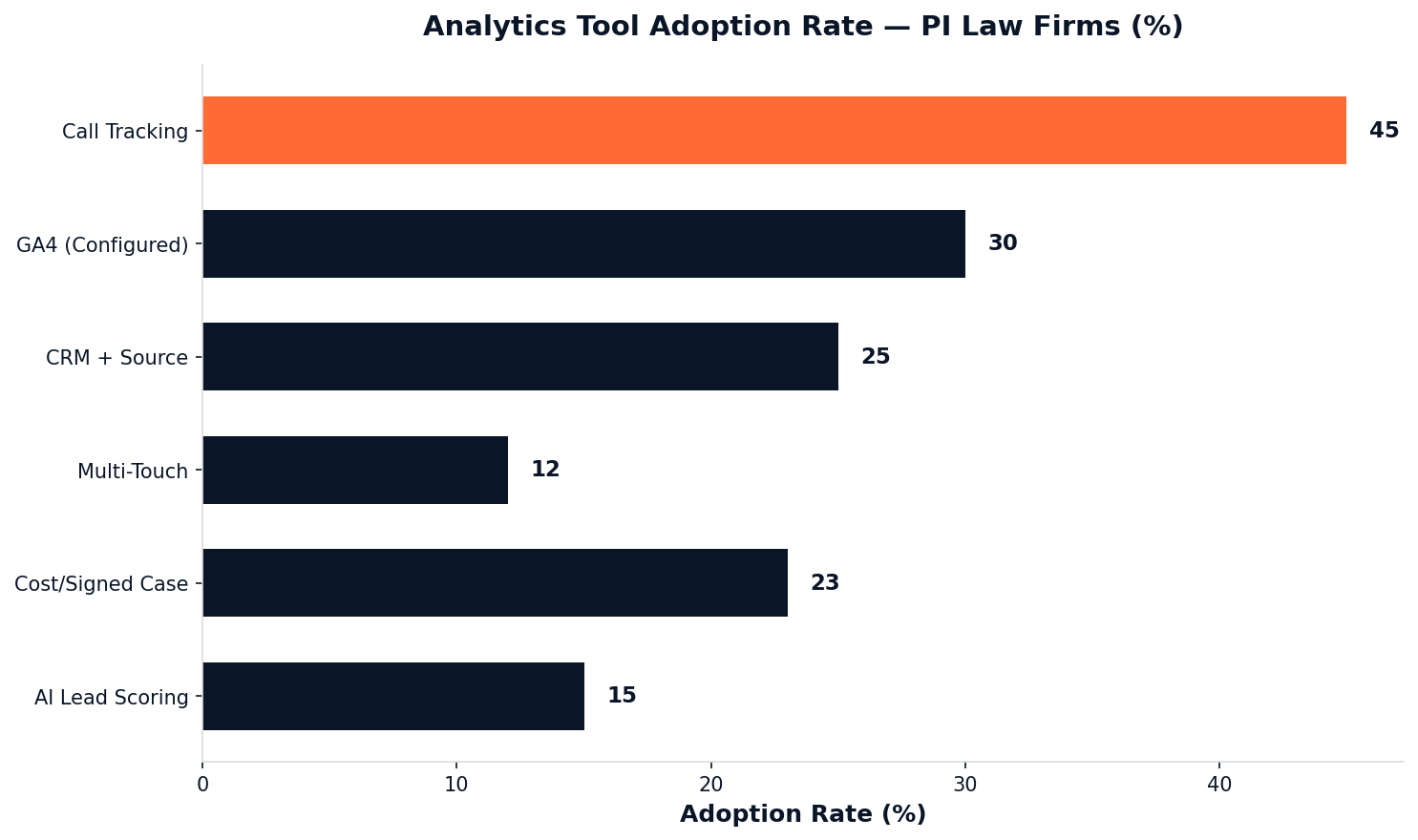
Only 23% of law firms track marketing performance beyond basic lead counts, according to Clio Legal Trends data. The majority measure success by total leads generated without connecting that number to cost per acquisition, channel efficiency, or downstream case value. SearchLab's 2026 legal marketing statistics confirm that fewer than 30% of law firm websites have properly configured Google Analytics 4, meaning most practices lack even basic traffic and behavior data.
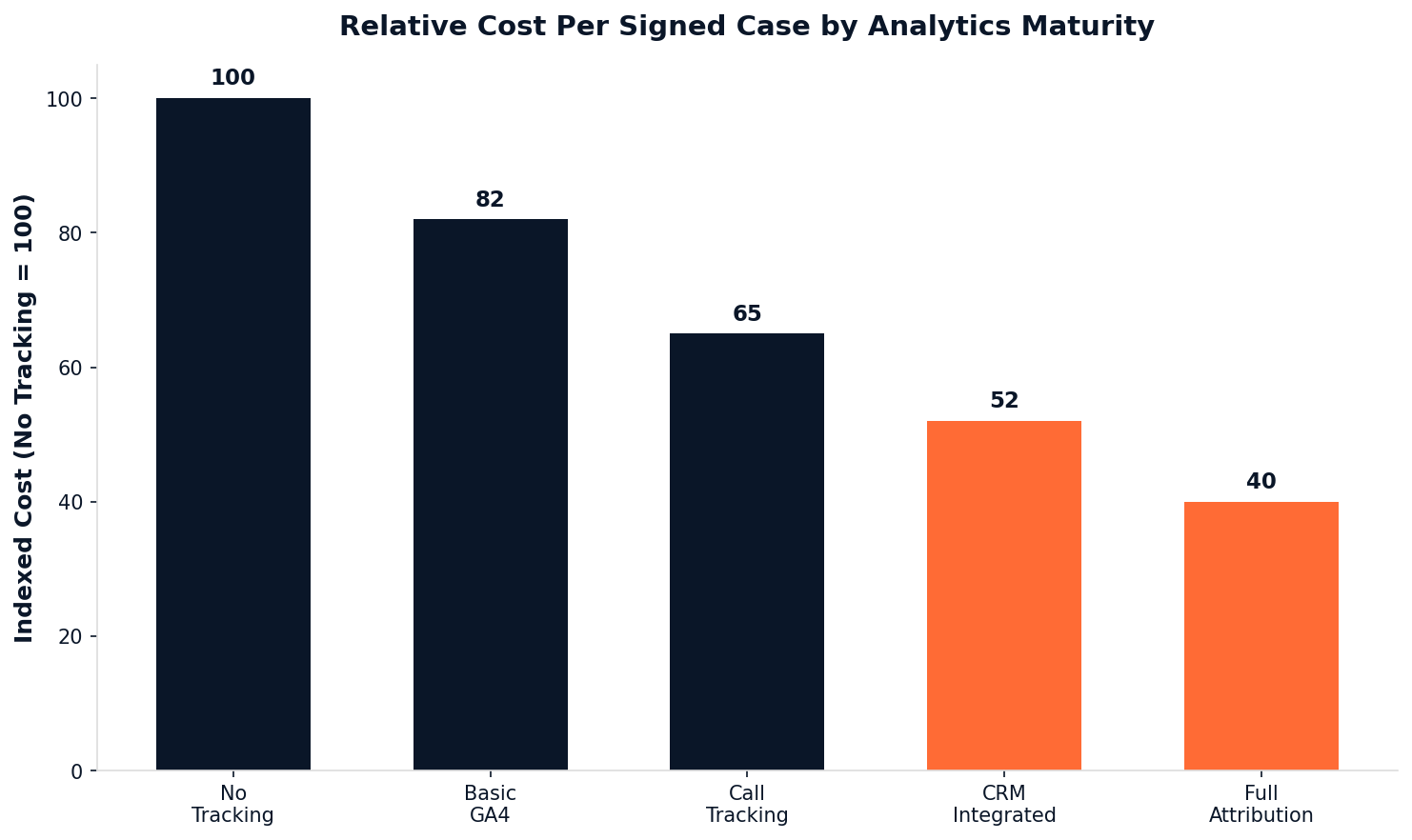
Firms that implement full-funnel tracking — from impression to signed case — report marketing costs 35–50% lower than comparable practices operating without measurement infrastructure. The savings come not from spending less but from reallocating budget away from underperforming channels with confidence. For context, Google Ads strategy optimization depends entirely on the quality of conversion data feeding the bidding algorithms.
Table 3. Analytics Tool Adoption Among PI Law Firms
| Analytics Capability | Adoption Rate | Impact When Implemented |
|---|---|---|
| Google Analytics 4 (properly configured) | ~30% | Baseline traffic + behavior data |
| Call tracking with source attribution | 25–35% | 30–50% ROI measurement improvement |
| CRM with marketing source tracking | 20–30% | 25–35% higher conversion rates |
| Multi-touch attribution modeling | 10–15% | 4–7 channel journey mapping |
| Cost per signed case tracking | ~23% | 35–50% lower effective marketing costs |
| Automated intake + lead scoring | 15–20% | 40% faster response times |
Sources: SearchLab Legal Statistics 2026, Clio Legal Trends.
Critical KPIs for Personal Injury Marketing Analytics
The metrics that matter most for personal injury firms differ from those in other industries because of the high case values, long sales cycles, and variable case quality inherent in legal services.
Cost per signed case — not cost per lead — is the north star metric for personal injury marketing. A firm might generate leads at $100 each, but if only 8% convert to signed cases and the average case value exceeds $15,000, the true acquisition cost is $1,250 per signed case against a lifetime value many multiples higher.
Intake-to-retention conversion rate is the most actionable internal metric, typically ranging from 15–30% for personal injury firms. Practices tracking this number can identify bottlenecks in their intake process — slow response times, poor phone scripts, or inadequate follow-up — and measure the impact of improvements directly. These operational insights complement the agency-level campaign management happening upstream.
Marketing Spend and Budget Optimization Data
Personal injury firms operate in one of the most expensive digital advertising verticals, making budget efficiency a survival metric rather than a nice-to-have.
Personal injury law firms spend an average of $5,000–$15,000 per month on digital marketing, with aggressive practices in competitive markets investing $25,000–$75,000 monthly. The wide range reflects market size, competition density, and case value differences across geographies.
Firms with mature measurement systems achieve 2–4× higher marketing ROI than comparable practices without tracking infrastructure, according to aggregated legal marketing data. The compounding effect is significant — better data produces better decisions, which produce better results, which generate more data. For firms exploring broader advertising channels, Facebook Ads agency partnerships require the same measurement rigor to deliver accountable results.
Emerging Analytics Technologies for Legal Marketing
The next generation of legal marketing analytics is moving beyond channel attribution toward predictive case value modeling and AI-powered lead scoring.
AI-powered call scoring can categorize and qualify inbound calls in real time, identifying high-value cases before the intake team begins their evaluation. Firms using conversation intelligence platforms report that automated call scoring reduces intake team workload by 20–30% while improving lead quality classification accuracy.
Predictive analytics models that combine marketing source data with case outcome history can forecast the likely value of new leads by channel. This capability enables firms to bid differently for leads from high-value sources — paying more for channels that historically produce larger settlements. The integration of these systems with full-service marketing teams creates a feedback loop that continuously improves acquisition efficiency.
Reporting Frameworks and Dashboard Design
The way analytics data is structured and presented determines whether a personal injury firm acts on insights or drowns in numbers. Effective reporting frameworks focus on actionable metrics rather than vanity indicators.
Weekly marketing dashboards for personal injury firms should track five core metrics: total qualified leads by channel, cost per qualified lead, intake-to-retention conversion rate, cost per signed case, and estimated case pipeline value. Monthly reports should add channel-level ROI comparisons, creative performance breakdowns, and competitive positioning changes.
Automated reporting eliminates the 3–5 hours per week that marketing managers spend manually pulling data from multiple platforms. Integrating Google Ads, Meta Ads, call tracking, and CRM data into a single dashboard requires initial setup investment but delivers ongoing time savings and faster decision-making. This reporting infrastructure pairs naturally with advertising cost analysis that demands multi-platform visibility.
The most effective legal marketing dashboards segment leads by quality tier — separating information seekers from qualified prospects from ready-to-sign clients. This segmentation prevents the common mistake of optimizing campaigns for total lead volume rather than lead quality, a distinction that can mean the difference between profitability and waste at personal injury cost-per-click rates.
Competitive Intelligence and Benchmarking Through Analytics
Analytics infrastructure does not only measure internal performance — it provides a framework for understanding competitive positioning within a local personal injury market.
Auction insight reports in Google Ads reveal which competing firms appear alongside yours in search results, including their impression share, overlap rate, and position-above rate. Tracking these metrics monthly identifies when competitors increase spending or improve their ad quality, enabling proactive budget adjustments rather than reactive responses to declining performance.
SEMrush and SpyFu data show that the average personal injury law firm in a mid-size market competes against 8–15 other advertisers for the same high-intent keywords. Firms with superior analytics can identify underserved keyword segments where competition is lower and cost-per-click rates drop 30–50% below primary terms. This competitive mapping capability enhances the return on Google Ads management investments by focusing spend where it converts most efficiently.
Review monitoring and sentiment analytics track competitor reputation changes in real time. A competing firm receiving negative reviews creates an opportunity to capture displaced leads — but only if the analytics system surfaces this signal and marketing teams can respond with adjusted messaging within days rather than weeks.
Data Privacy and Compliance in Legal Analytics
Personal injury law firms face unique data handling obligations that affect how analytics systems can be configured and what information can be tracked across marketing platforms.
HIPAA-adjacent concerns arise when personal injury marketing data intersects with medical information — firms must ensure that intake forms, call recordings, and CRM records are stored in compliant systems. Standard marketing analytics platforms are generally safe for channel attribution data, but care is required when connecting marketing sources to case-specific medical details.
Google's consent mode and Meta's Conversions API both require explicit configuration for legal services advertisers to maintain conversion tracking accuracy while respecting user privacy preferences. Firms that fail to configure these systems properly see 15–30% data loss in their conversion reporting, degrading the quality of automated bidding signals. Comprehensive marketing technology consulting addresses these configuration gaps before they compound into budget waste.
Server-side tracking implementation reduces data loss from ad blockers and browser privacy restrictions by 20–35%. As client-side cookies become increasingly unreliable, personal injury firms that invest in server-side conversion tracking maintain a data advantage over competitors still relying on pixel-based measurement alone. The implementation cost of $2,000–$5,000 pays for itself within weeks through improved bidding algorithm performance.
Frequently Asked Questions
What is the most important analytics tool for a personal injury law firm?
Call tracking with source attribution is the single most impactful analytics tool for personal injury firms, since 60–75% of leads arrive by phone. Without call tracking, firms cannot attribute the majority of their conversions to specific marketing channels.
Which attribution model should PI law firms use?
A U-shaped attribution model (40% credit to first touch, 40% to last touch, 20% distributed across middle interactions) is recommended because it properly values both the discovery channel and the converting channel in the typical 4–7 touchpoint journey.
How much does call tracking cost for a law firm?
Call tracking platforms for law firms typically cost $45–$200 per month depending on call volume and feature requirements. The investment typically pays for itself within the first month through improved budget allocation based on accurate channel attribution.
Sources
CallRail — Legal Call Tracking Data
Invoca — Call Intelligence Benchmarks
My Legal Academy — Marketing Attribution Guide
SearchLab — Legal Sector Marketing Statistics 2026
Clio — Legal Trends Report
Filevine — Data-Driven Decision Case Study
Smith.ai — Law Firm KPIs


