Table of contents
A personal injury UGC budget is mostly a rate-card question plus a compliance question: marketplace data puts a typical creator piece at a few hundred dollars, while state bar rules decide which of those pieces a firm may legally pay for. No published study benchmarks influencer spend for injury firms, so every figure below is cross-industry and labelled as such.
Key Takeaways
- 80% of Collabstr collaborations cost under USD 300 in its 2026 report.
- 18% land between USD 301 and 1,000, and only 2% exceed USD 1,000.
- The average UGC campaign costs USD 197, down 5.7% from USD 209.
- Entrepreneur and business creators average USD 295 per engagement.
- Education creators average USD 307, the closest niche to legal explainers.
- YouTube pays the highest average payout at USD 255 per engagement.
- About 55% of nano-creator price answers sit under USD 500 (Influencer Marketing Hub 2026).
- Mid-tier creators cluster at USD 2,000 to 10,000, about 22.2% in each band.
- Rising creator costs are the top challenge at 35.4% of selections.
- 87.49% of buyers expect bigger influencer budgets; 5.55% expect cuts.
- 62% of enterprise marketers are raising budgets (Linqia 2026, 200+ respondents).
- Florida bars paying anything of value for a testimonial.
- Texas says a disclaimer does not cure an incomplete past-results claim.
- There is no injury-law influencer benchmark; treat all rates as cross-industry.
Why there is no personal injury influencer benchmark
Creator-marketing surveys segment by platform, creator tier and consumer niche. None of the 2026 datasets we reviewed publishes a legal-services or personal injury cut, and none reports a cost per signed case from creator content. That matters because injury firms buy on case value, not on product margin, so a DTC benchmark for return on ad spend tells them almost nothing.
What does exist is price evidence. Collabstr's 2026 Influencer Marketing Report is built from more than 21,000 collaborations, over 200,000 creators and more than 472,000 pricing packages on its own marketplace. The Influencer Marketing Hub 2026 Benchmark Report surveys 600+ marketers. Both are cross-industry, and this page uses them only to size a line item.
The rate card: what one creator engagement costs
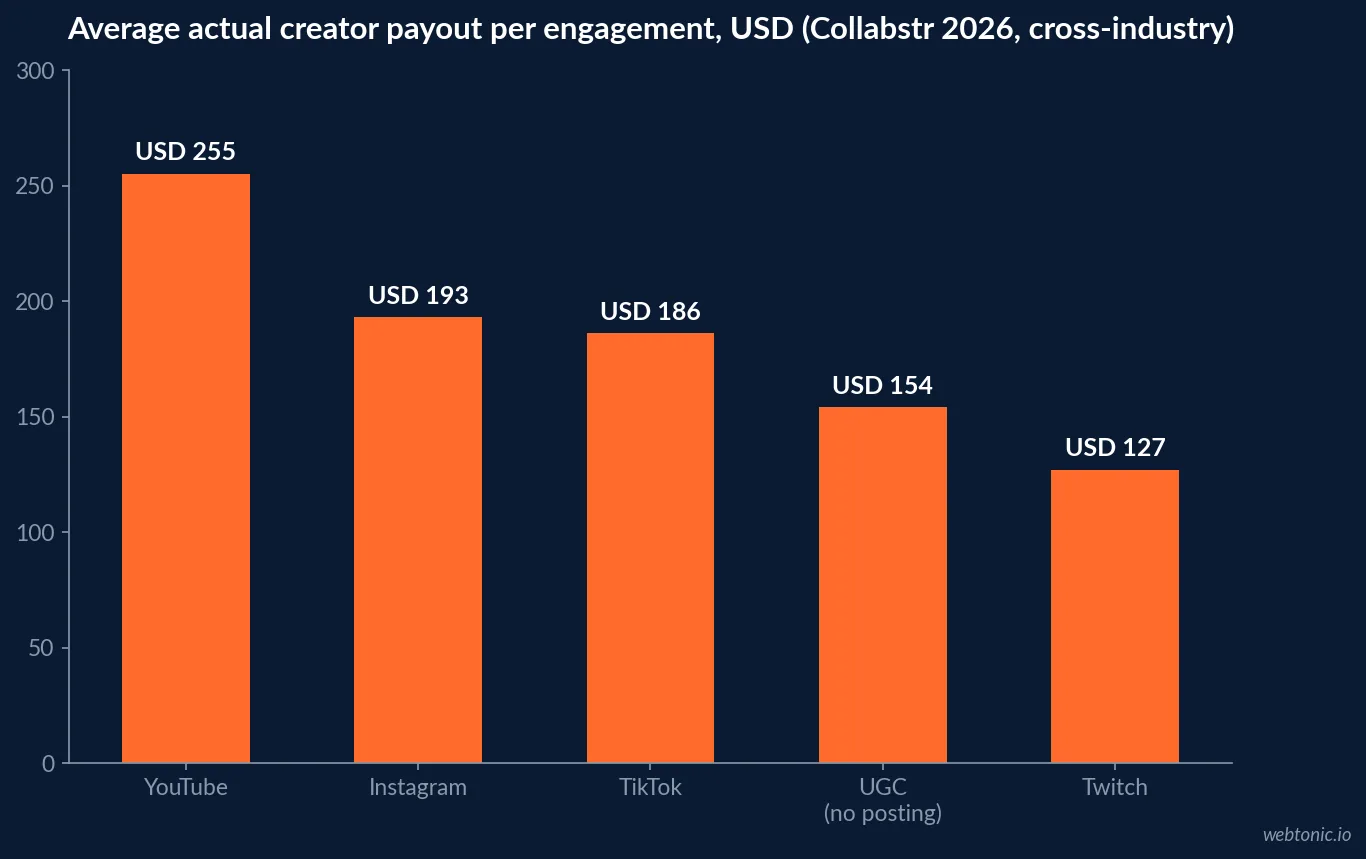
Collabstr separates what creators ask from what brands actually pay. On its platform the average ask is USD 311 on YouTube, USD 214 on Instagram, USD 182 on TikTok and USD 180 for platform-agnostic UGC, while average payouts are USD 255, USD 193, USD 186 and USD 154 respectively. For a law firm the UGC row is the one to watch: it buys a video asset the firm can run from its own accounts, rather than a post that lives on a stranger's feed.
| Format (Collabstr 2026) | Average creator ask | Average actual payout | Fit for an injury firm |
|---|---|---|---|
| YouTube | USD 311 | USD 255 | Long explainers on claims and timelines |
| USD 214 | USD 193 | Local reach in the firm's metro | |
| TikTok | USD 182 | USD 186 | Short what-to-do-after-a-crash clips |
| UGC (no posting) | USD 180 | USD 154 | Firm-owned asset for paid social |
| Twitch | USD 398 | USD 127 | Rarely relevant to legal intake |
How the total spend is distributed
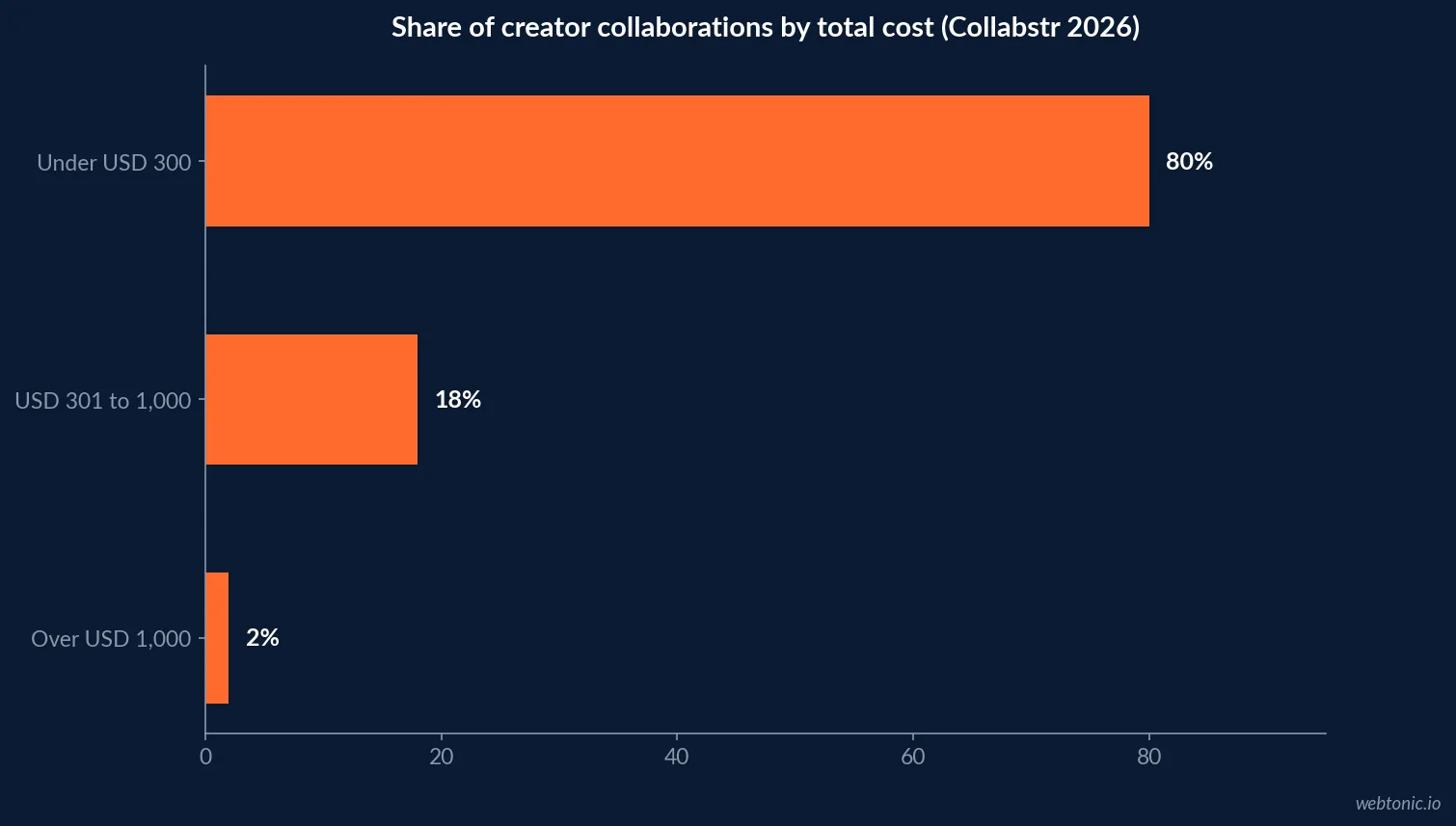
The same report shows how small most deals are: 80% of collaborations cost under USD 300, 18% fall between USD 301 and 1,000, and only 2% exceed USD 1,000. UGC campaigns averaged USD 197, down 5.7% from USD 209 a year earlier, and more than 40% of UGC campaigns came from companies spending under USD 5,000 in total. A local injury practice testing creators is therefore buying in the same band as most small businesses, not in the celebrity tier that dominates press coverage.
Niche pricing: where a legal explainer sits
Collabstr has no legal niche, but it does price expertise. Its most expensive categories are Skilled Trades at USD 309, Education at USD 307 and Entrepreneur and Business at USD 295, against Beauty at USD 210 at the cheap end. The report's own reading is that audiences seeking guidance command a premium. A creator explaining insurance claims or medical liens is closer to an education creator than to a lifestyle one, so budget near the upper band.
| Collabstr niche (2026) | Average price per engagement | Why it is a useful proxy | Budget read |
|---|---|---|---|
| Education | USD 307 | Explains a process step by step | Closest to legal explainers |
| Entrepreneur and Business | USD 295 | Advice-led, trust-dependent audience | Upper-band assumption |
| Comedy and Entertainment | USD 292 | Reach without topic authority | Awareness only |
| Beauty | USD 210 | Cheapest niche, high supply | Not comparable to legal intent |
| Athlete and Sports | USD 233 | Large affordable pool | Sponsorships, not intake |
Creator tiers and the price bands buyers report
The Influencer Marketing Hub survey asks buyers to price each tier. About 55% of nano-creator answers fall under USD 500, and about 45.5% of micro-creator answers do the same. Mid-tier creators most often land in the USD 2,000 to 5,000 and USD 5,000 to 10,000 bands, at about 22.2% each, while macro pricing is spread across every band. Nano and micro tiers also carry the most expansion intent: 51.43% and 52.83% of respondents plan to grow them.
| Creator tier (IMH 2026) | Most common price answer | Planned expansion | Where it fits in a firm's plan |
|---|---|---|---|
| Nano | Under USD 500 (about 55%) | 51.43% | Neighbourhood and community reach |
| Micro | Under USD 500 (about 45.5%) | 52.83% | Metro-level explainers |
| UGC creators | Lowest share of cost selections | 50.00% | Firm-owned ad creative |
| Mid-tier | USD 2,000-10,000 (22.2% per band) | 42.42% | Regional campaigns |
| Macro | Spread across all bands | 20.59% | Rarely justified for local intake |
What the bar rules let a firm pay for
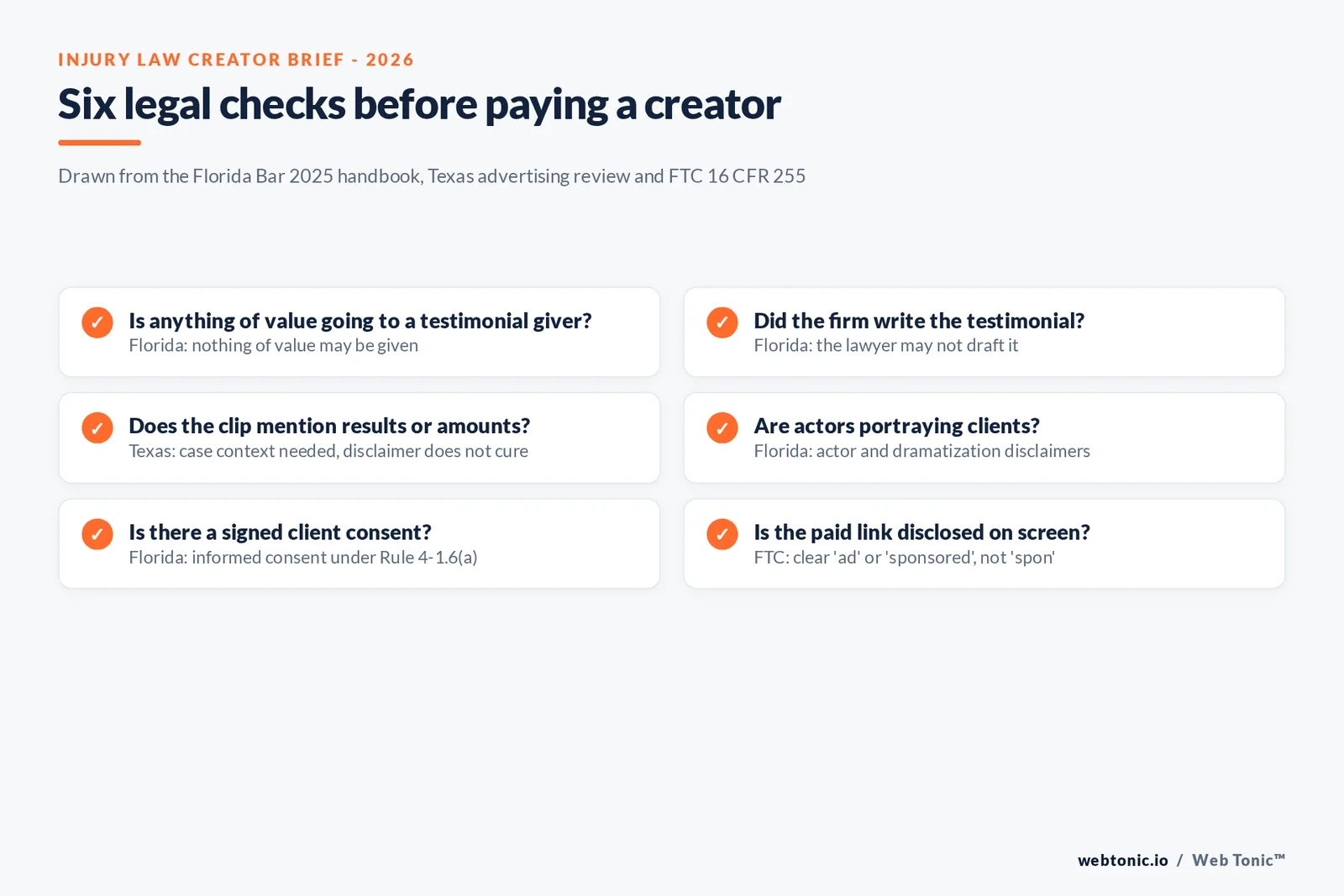
This is where injury marketing departs from every other industry on this site. The Florida Bar's 2025 Advertising Handbook permits testimonials only when the person is qualified to evaluate the lawyer, describes an actual experience that is representative of what clients generally experience, did not have the lawyer draft it, and receives nothing of value in exchange. Results-based testimonials also need a clear disclaimer that others may not obtain the same result, and the client's informed consent is required. Florida's lawyer advertising FAQ adds separate dramatization and actor disclaimers.
The State Bar of Texas advertising review is just as specific on results: an ad citing past successes must explain the nature of the case, and a disclaimer does not cure the violation. At the model level, ABA Model Rule 7.2(b) bars giving anything of value for recommending a lawyer's services, apart from paying the reasonable cost of advertising and a few other exceptions. The practical effect is that a paid UGC budget should buy explainers and dramatized, clearly disclosed ads, not paid client stories.
| Rule (as published) | Florida Bar 2025 handbook | Texas advertising review | Budget consequence |
|---|---|---|---|
| Paid testimonial | Nothing of value may be given | Governed by Part VII rules | Budget content, not endorsements |
| Lawyer-written testimonial | Not allowed | Must not mislead | Creator scripts need care |
| Results or verdict amounts | Disclaimer required | Case context required; disclaimer does not cure | Legal review hours per asset |
| Actors portraying clients | Actor and dramatization disclaimers | Must not mislead | On-screen text in every cut |
| Client consent | Informed consent needed | Confidentiality rules apply | Release forms before filming |
The federal disclosure floor
State bar rules sit on top of federal advertising law, not instead of it. The FTC Endorsement Guides at 16 CFR Part 255 require clear and conspicuous disclosure of any material connection between an advertiser and an endorser, and the FTC's Disclosures 101 guidance says words like 'ad' and 'sponsored' work when placed with the message itself, while tags such as 'sp', 'spon' or 'collab' are too vague. There is no budget threshold: a USD 154 UGC payout carries the same duty as a six-figure program.
Where budgets are heading across industries
Buyers are expanding the channel. Influencer Marketing Hub reports 87.49% of respondents expecting a budget increase and 5.55% a decrease, with 72.2% expecting a rise of 50% or more. Linqia's 2026 survey of more than 200 enterprise marketers finds 62% increasing budgets, 33% planning to spend over USD 5 million and 49% working with specialist influencer agencies. At market level, Goldman Sachs Research estimated in 2023 that the creator economy could grow from about USD 250 billion to USD 480 billion by 2027.
None of those buyers are law firms specifically. Read them as the price-pressure signal: more demand for the same creators is why rising costs are the top challenge at 35.4%.
| Budget signal (2026) | Figure | Source and sample | What it means for a firm |
|---|---|---|---|
| Expect higher influencer budgets | 87.49% | Influencer Marketing Hub, 600+ marketers | Competition for creators |
| Expect a rise of 50% or more | 72.2% | Same survey | Rates are unlikely to fall |
| Enterprise marketers increasing | 62% | Linqia, 200+ enterprise marketers | Big brands bid for the same talent |
| Rising creator costs as top challenge | 35.4% | Influencer Marketing Hub | Lock rates into longer briefs |
| ROI and attribution as challenges | 15.84% combined | Influencer Marketing Hub | Plan intake tracking first |
Why injury prospects check more than one source
The Bazaarvoice Shopper Experience Index 2026 found 97% of consumers consult multiple sources before buying. That is retail data, but the behaviour carries over to a high-stakes hire: a creator video may start the search, and reviews, the firm's site and a phone call finish it. Budget the creator line as the first touch, and keep reviews and intake response funded alongside it. Our personal injury SMS marketing data covers the follow-up side of that journey.
Building the budget line by line
- Content fees: five to ten UGC or micro-creator explainers at the Collabstr averages above, with Education-niche pricing as the planning rate.
- Usage rights: negotiate paid-ad rights up front; the organic post price rarely covers running the clip as an ad.
- Legal review: attorney time for every script and every cut, because bar rules apply per advertisement, not per campaign.
- Paid distribution: the media budget that turns a clip into local reach, priced separately from the content.
- Tracking: call tracking and intake tags so a signed case can be traced to the creative.
Our performance creative team builds creator briefs with the review step inside them, and the broader influencer and UGC marketing statistics page covers the cross-industry picture in more depth.
What to measure before scaling
Measure cost per qualified call and cost per signed case from creator-led ads against the firm's existing search and referral channels over the same period. Engagement rates are a weak proxy for a contingency practice, where one signed case can outweigh thousands of views. If the creator line cannot be tied to intake records, it is an awareness expense and should be budgeted as one. When you are ready to scope a test, talk to our team.
Frequently Asked Questions
How much should a personal injury firm budget for a UGC test?
No published study reports what injury firms spend on creators, so the answer comes from cross-industry rate cards. Collabstr's 2026 marketplace data puts the average UGC campaign at USD 197 and shows 80% of all collaborations costing under USD 300. A test of five to ten explainer or educational pieces therefore sits in the low thousands of dollars in content fees, before any paid media and before legal review time, which is the cost line injury firms most often forget.
Can a law firm pay a client or influencer for a testimonial?
Often not. The Florida Bar's 2025 Advertising Handbook states that the person giving a testimonial may receive nothing of value for it, may not have it drafted by the lawyer, and must be describing a real experience that is representative of what clients generally experience. ABA Model Rule 7.2(b) separately bars giving anything of value for recommending a lawyer's services, with narrow exceptions such as paying the reasonable cost of an advertisement. Rules vary by state, so check your own bar before any creator brief.
What can a law firm legally buy from a creator?
Content and advertising, not endorsements that pose as client experiences. Paying for a creator to explain what to do after a crash, how contingency fees work or how long a claim takes is paying for an advertisement, which the rules generally allow. Paying for a stranger to say the firm won them money is the risky purchase. Florida also requires dramatization and actor disclaimers when actors portray clients.
Do FTC disclosure rules apply to legal marketing creators?
Yes. The FTC Endorsement Guides at 16 CFR Part 255 require any material connection between an advertiser and an endorser to be disclosed clearly and conspicuously. The FTC's Disclosures 101 guidance says terms such as 'ad' or 'sponsored' work when they are hard to miss, and warns against vague tags like 'sp', 'spon' or 'collab'. Bar rules sit on top of that federal floor, not in place of it.
Is influencer marketing worth it for personal injury law?
There is no injury-law ROI benchmark to answer that honestly. What the 2026 data shows is that buyers across industries are adding budget: 87.49% of Influencer Marketing Hub respondents expect an increase, while 15.84% of challenge selections relate to measuring ROI or attribution. For a firm, the test is whether creator content lowers the cost of a signed case against its existing channels, measured on its own intake data.
Sources
Collabstr - 2026 Influencer Marketing Report
Influencer Marketing Hub - Influencer Marketing Benchmark Report 2026
Linqia - 2026 State of Influencer Marketing
The Florida Bar - Advertising Handbook, 2025 edition
The Florida Bar - Lawyer advertising FAQ
State Bar of Texas - Advertising review rules and comments
eCFR - 16 CFR Part 255, FTC Endorsement Guides
FTC - Disclosures 101 for social media influencers
Goldman Sachs Research - The creator economy could approach half a trillion dollars by 2027
Bazaarvoice - Shopper Experience Index 2026 press release