Table of contents

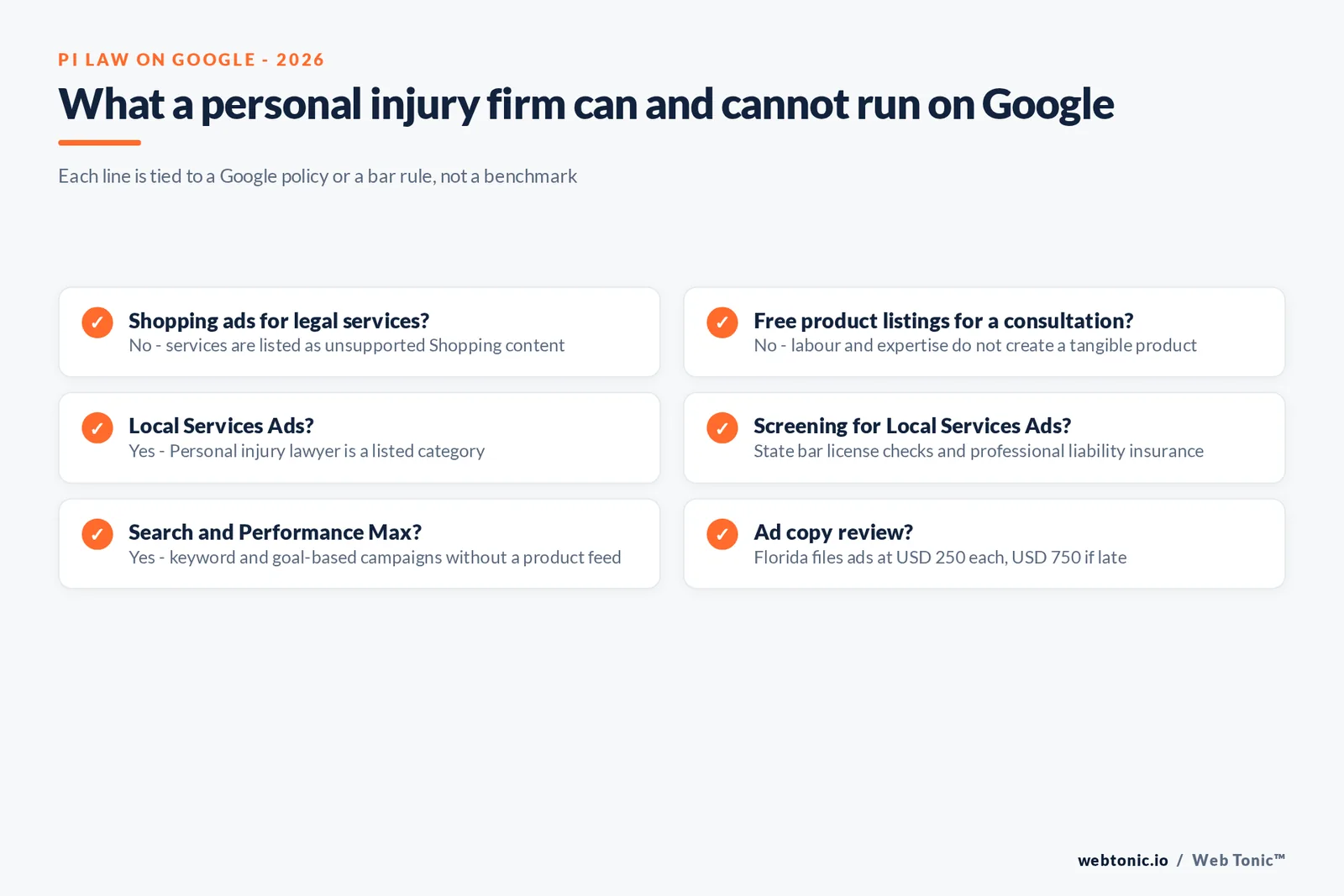
Personal injury firms cannot use Google Shopping for their services: Google lists services as unsupported Shopping content. This 2026 report quotes that policy, then measures the Google formats an injury practice can actually buy and the bar rules that follow every ad.
Key Takeaways
- 0 legal services are eligible for Shopping ads or free listings under Google's policy.
- Google issues a warning at least 7 days before suspending an account for unsupported content.
- Google's list of Local Services lawyer categories includes Personal injury lawyer services.
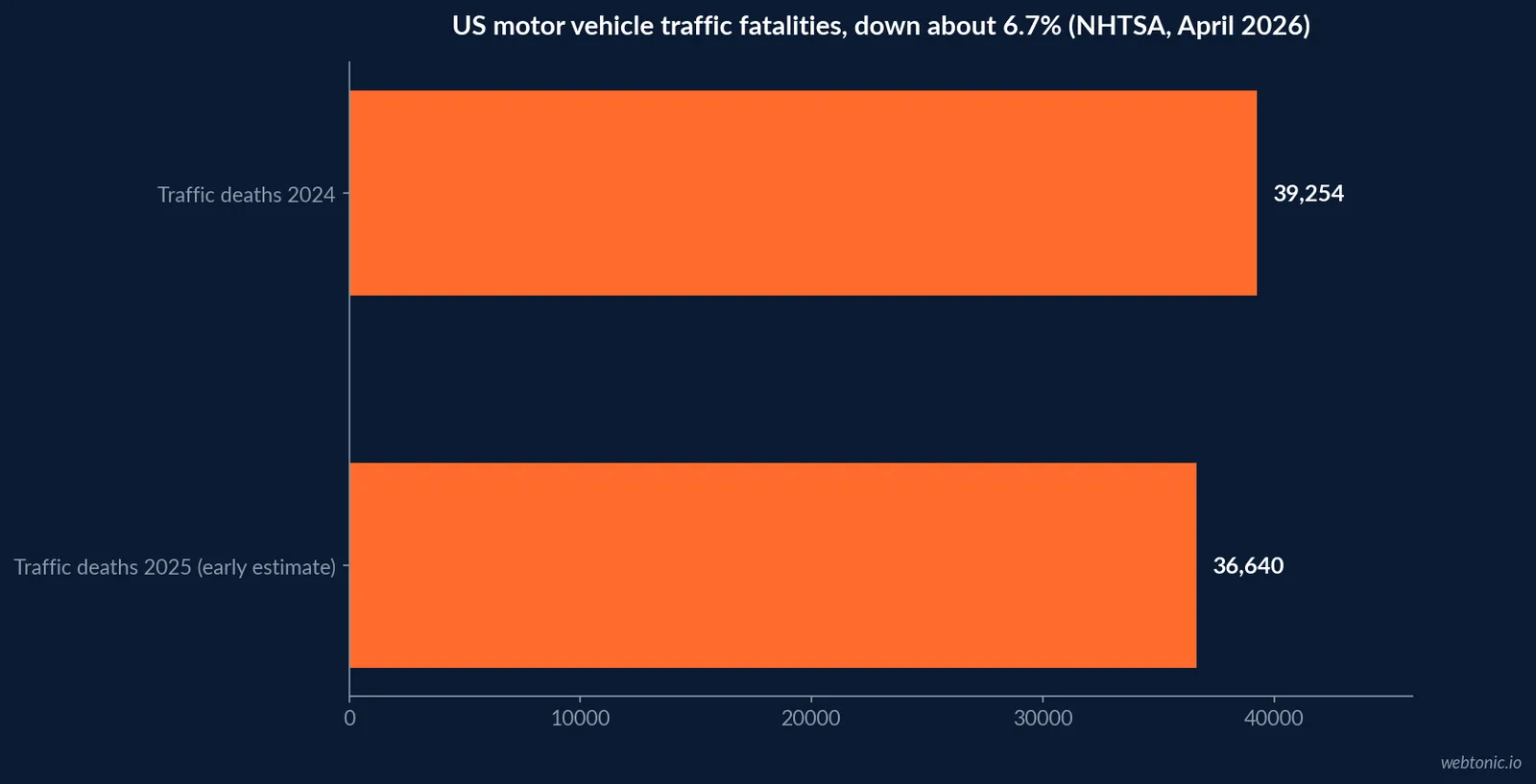
- US traffic deaths fell to an estimated 36,640 in 2025, down about 6.7%.
- That was the 15th consecutive quarterly decline reported by NHTSA.
- Clio puts the average personal injury lawyer rate at USD 335 an hour in 2025.
- The blended personal injury firm rate is USD 284; non-lawyer staff bill USD 163.
- Google search ad spending rose 13% year over year in Q4 2025 (Tinuiti).
- Google shopping ad spending rose 16%, but that is retail product data, not legal.
- The Florida Bar charges USD 250 per filed ad, or USD 750 if late.
- New York requires ads to be retained for at least 3 years.
What Google's policy actually says about services
Google's Unsupported Shopping content page is explicit. It states that "labor, time, effort, expertise, or actions, which do not result in ownership of a tangible product are not allowed," adds that this "includes any services sold bundled with physical goods," and gives maintenance, repair, accounting and financial planning services as examples. Legal representation is expertise and action; the client owns an outcome, not an object.
The same page says violations "will not lead to immediate account suspension without prior warning" and that a warning is issued at least 7 days before any suspension. That grace period is for fixing a mistake, not for testing whether a consultation offer slips through. A Merchant Center account built around a law firm's services has nothing eligible to list.
| Content type | Shopping status | Wording on Google's policy page | What it means for a PI firm |
|---|---|---|---|
| Services | Not allowed | Labor, time, effort, expertise, or actions | Case representation cannot be listed |
| Services bundled with goods | Not allowed | Includes any services sold bundled with physical goods | A book plus a consultation is still a service |
| Financial products | Not allowed | Insurance policies, credit cards, investment products | Litigation funding offers are out as well |
| Immovable property | Not allowed | Real estate, non-portable homes, plots of land | Office space or settlements are not products |
| Enforcement | Warning first | Warning at least 7 days before suspension | Time to remove, not to test |
Why a feed-management page still matters to injury firms
Feed management is the discipline of keeping the structured data Google reads accurate. For retailers that data is a product file. For a personal injury practice it is the business profile, the Local Services category, the service area and the landing pages that Search and Performance Max point to. The mechanics differ, the failure mode does not: stale or inconsistent data costs impressions and trust.
That is the honest scope of this report. Every figure below comes from Google's own documentation, a government dataset, a bar regulator or a named research report, and none of them is a personal injury Shopping benchmark, because such a benchmark cannot exist.
The format Google built for lawyers: Local Services Ads
Google's Local Services help centre lists the categories it supports, and the lawyer set includes bankruptcy, business, contract, criminal, disability, DUI, estate, family and Personal injury lawyer services, among others. The same page describes the model plainly: businesses "only pay when a customer gets in touch from your ad."
Google's screening and verification requirements describe personal injury work as advice on assault and battery, auto, bicycle and motorcycle accidents, dog bites, injury from DUI, product liability and wrongful death, and list professional liability insurance plus state bar license checks among the requirements for legal categories. The verification is the entry ticket; there is no feed to upload.
| Google format | Open to PI legal services? | What Google needs from the firm | Billing model per Google |
|---|---|---|---|
| Shopping ads | No | A physical product feed | Not applicable |
| Free product listings | No | A physical product feed | Not applicable |
| Local Services Ads | Yes, listed category | Licensing, insurance, verification | Pay when a customer gets in touch |
| Search campaigns | Yes | Keywords, ads, landing pages | Auction, per click |
| Performance Max | Yes | Goals, assets, audience signals | Goal-based, across Google inventory |
Search and Performance Max without a product feed
Google describes Performance Max as a goal-based campaign type that reaches "all Google Ads inventory, including YouTube, Display, Search, Discover, Gmail, and Maps, from a single campaign," and positions it as a complement to keyword-based Search. For a retailer it usually runs on a Merchant Center feed; for a law firm it runs on assets, goals and conversion tracking instead.
Paid search demand was rising across the board at the end of 2025. Tinuiti's Q4 2025 Digital Ads Benchmark Report, built on its own client data, reports Google search ad spending up 13% year over year and Google click growth of 13%, the strongest since early 2021. That is a cross-industry figure from a vendor's client base, not a legal-sector measurement.
The retail Shopping numbers injury firms will see quoted
Tinuiti's same report puts Google shopping ad spending up 16% year over year in Q4 2025, shopping CPC down 1%, and Performance Max at 62% of retailer spending on Google shopping listings. It also notes Amazon stopped running nearly all US paid shopping listings with Google in July 2025. These are real numbers about retailers, which is precisely why they do not transfer to a law firm.
The retail context is large: the US Census Bureau estimates Q2 2026 e-commerce sales at USD 340.2 billion, 17.1% of total retail and up 12.2% year over year. None of it is legal services revenue.
| Metric | Figure | Period | Source | Applies to PI firms? |
|---|---|---|---|---|
| Google search ad spend growth | 13% YoY | Q4 2025 | Tinuiti client data | Indirectly, as auction context |
| Google shopping ad spend growth | 16% YoY | Q4 2025 | Tinuiti client data | No, retail only |
| Google shopping CPC change | -1% YoY | Q4 2025 | Tinuiti client data | No, retail only |
| Performance Max share of retail shopping spend | 62% | Q4 2025 | Tinuiti client data | No, retail only |
| US e-commerce sales | USD 340.2 billion | Q2 2026 | US Census Bureau | No, retail only |
Demand signal: the crash data behind injury searches
NHTSA's April 2026 early estimate projects 36,640 people died in motor vehicle traffic crashes in 2025, a decrease of about 6.7% from the 39,254 fatalities reported in 2024. The fourth quarter of 2025 was the 15th consecutive quarterly decline since the second quarter of 2022.
Fatalities are a floor on the injury caseload, not a measure of it, and this page does not claim that fewer deaths mean fewer searches. The figure is here because it is the one national number for the underlying events that personal injury marketing competes over.
What an hour of injury work is worth
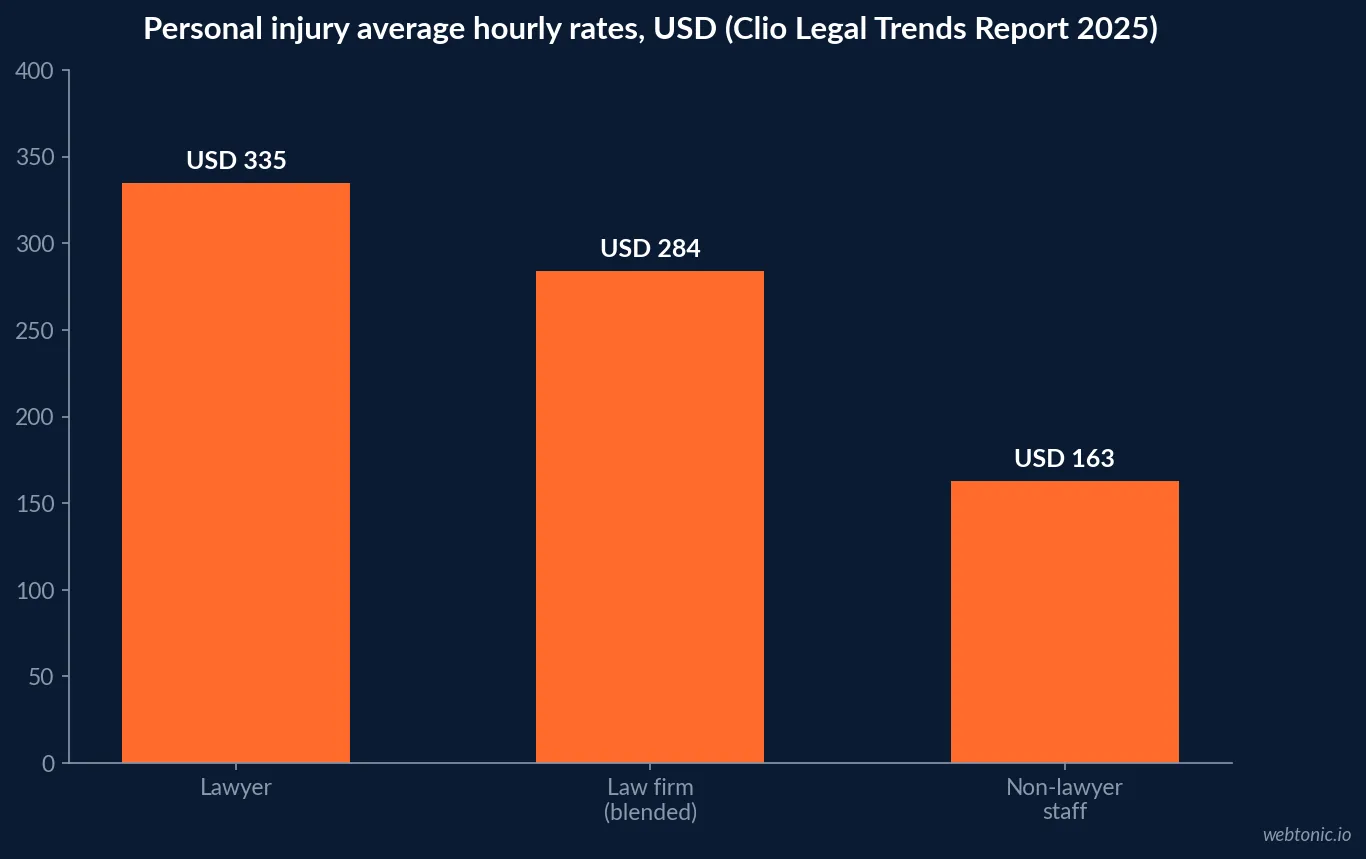
The Clio 2025 Legal Trends Report lists personal injury average hourly rates of USD 335 for lawyers, USD 163 for non-lawyer staff and USD 284 blended at firm level. Clio's revenue analysis counts hourly, flat and contingency fees, and injury clients often pay on contingency, so the rate is a proxy for the value of time rather than the price a client sees.
That proxy is useful when judging lead channels: the time spent screening poor-fit enquiries has a cost that tighter targeting, clear intake questions and negative keywords are meant to reduce.
| Personal injury rate (2025) | Average hourly rate | Source | Why it matters for ad spend |
|---|---|---|---|
| Lawyer | USD 335 | Clio Legal Trends Report 2025 | Cost of attorney time spent on intake |
| Non-lawyer staff | USD 163 | Clio Legal Trends Report 2025 | Cost of screening by an intake team |
| Law firm, blended | USD 284 | Clio Legal Trends Report 2025 | Average value of an hour of firm time |
Bar rules that travel with every Google ad
Whatever the format, a lawyer's ad is still a lawyer's communication. Cornell's Wex entry on legal advertising notes it spans print, mail, television and online media. California's Rule 7.1 says a lawyer "shall not make a false or misleading communication about the lawyer or the lawyer's services."
New York's 22 NYCRR 1200.7.1 requires advertisements to be pre-approved and retained for at least three years, and computer-accessed ones for at least one year. The Florida Bar sets a filing fee of USD 250 for timely filed ads and USD 750 for late ones. Rotating responsive ad assets multiply the number of variants a compliance log has to hold.
| Jurisdiction | Rule or fee | Figure | Effect on Google campaigns |
|---|---|---|---|
| California | Rule 7.1, false or misleading communications | Applies to all media | Every headline asset is a communication |
| New York | 22 NYCRR 1200.7.1 retention | At least 3 years | Archive each ad variant served |
| New York | Computer-accessed ads | At least 1 year | Covers search and display assets |
| Florida | Advertisement filing fee | USD 250 per ad | Budget per creative, not per campaign |
| Florida | Late filing fee | USD 750 per ad | File before assets go live |
Where "feed thinking" does apply inside a law firm
- Category accuracy: pick the Local Services category that matches the work; Google lists personal injury separately from disability, DUI and estate categories.
- Consistent facts: keep office addresses, hours and phone numbers identical across the business profile, Local Services and landing pages.
- Asset hygiene: treat Performance Max headlines and descriptions like feed attributes, reviewed against bar rules before upload.
- Measurement: Performance Max optimises to the conversions you import, so a phone call and a signed case need to be told apart.
- No workarounds: do not list a book, a guide or a "case review" as a product to reach Shopping; the policy covers services bundled with goods.
For budget context before you commit a channel, read our breakdown of what Google Ads costs in 2026 and how firms build a Google Ads strategy.
How this channel compares with others injury firms buy
Because Shopping is closed, the realistic comparison is between Local Services, Search, Performance Max and the offline and streaming channels injury firms already use. Our personal injury CTV report covers the television side, and the advertising statistics hub puts channel budgets in context. If you want the Google side measured properly, our Google Ads team starts with call and case tracking before any spend decision.
Frequently Asked Questions
Can a personal injury law firm run Google Shopping ads?
No. Google's Unsupported Shopping content policy says labour, time, effort, expertise or actions that do not result in ownership of a tangible product are not allowed, and it names accounting and financial planning services among its examples. Legal representation falls in the same bucket, so a free consultation or a contingency-fee case cannot be submitted as a product in Merchant Center.
What is the Google alternative to Shopping for injury lawyers?
Local Services Ads, Search and Performance Max. Google's Local Services help centre lists Personal injury lawyer services as a category, and the screening page lists state bar license checks and professional liability insurance for legal categories. Search and Performance Max run from keywords, goals and assets rather than a product feed.
Does feed management matter at all for a law firm?
Only in a narrow sense. There is no product feed to manage, but the same discipline applies to the data Google does use: the business profile, the Local Services category and service area, and the landing pages Search and Performance Max send clicks to. Keeping that information consistent is the law-firm version of feed hygiene.
How do bar advertising rules affect Google ads for injury firms?
They apply to every format. California Rule 7.1 bans false or misleading communications about a lawyer's services, New York 22 NYCRR 1200.7.1 requires advertisements to be retained for at least three years (computer-accessed ones for at least one year), and the Florida Bar charges USD 250 per filed advertisement, or USD 750 when it is filed late.
Is there a Google Shopping benchmark for personal injury law?
No, and any page quoting a personal injury Shopping click-through or conversion rate is inventing it, because the format is closed to legal services. The Shopping data that exists, such as Tinuiti's Q4 2025 benchmark, measures retailers selling physical goods.
Sources
Google Merchant Center Help - Unsupported Shopping content
Google Local Services Help - Supported categories
Google Local Services Help - Screening and verification requirements
Google Ads Help - About Performance Max campaigns
Tinuiti - Digital Ads Benchmark Report Q4 2025
US Census Bureau - Quarterly Retail E-Commerce Sales, Q2 2026
NHTSA - Early Estimate of Traffic Fatalities in 2025 (DOT HS 813 800)
Clio - 2025 Legal Trends Report
Cornell LII Wex - Legal advertising
Cornell LII - 22 NYCRR 1200.7.1
State Bar of California - Rules 7.1 to 7.5
The Florida Bar - Advertising FAQ