Table of contents
Snapchat sells the cheapest attention in social media to the cohort that has been most thoroughly priced out of home buying. Awareness CPM runs $5.84, local-services CPA runs $42.80, and 82% of the audience is under 35 while the median first-time buyer is now 40. That gap defines what the channel can and cannot do for a lender.
Key Takeaways
- Median Snapchat CPM is $5.84 for awareness and $27.10 for conversions — a 4.6x spread across the funnel.
- Lead-generation CPM averages $24.80, close to the conversion objective and far from cheap.
- Median CPC across objectives is $0.84, versus roughly $1.10–$2.00 on comparable Meta placements.
- Median CTR is 1.04%, about 22% above matched Meta inventory; Spotlight placement reaches 1.36%.
- Median CPA for US local services is $42.80, with the lower quartile above $71.30.
- Awareness inventory is 30–40% cheaper than Meta; conversion inventory is roughly at parity.
- Vertical video under 7 seconds delivers a 1.42% median CTR — 3.5x the CTR of repurposed landscape images.
- Video over 30 seconds costs about 60% more per impression and converts roughly half as well.
- Snapchat reached 483 million daily and 956 million monthly active users in Q1 2026, both up 5% year over year.
- Quarterly revenue was $1.53 billion (up 12%), but advertising revenue grew only 3% to $1.24 billion.
- The largest age group is 18–24 at 35.4% of the ad audience; 25–34 follows at 25.2%.
- More than 82% of Snapchat users are under 35 years old.
- First-time buyers fell to a record-low 21% of US purchases, with a median age of 40.
- Gen Z accounted for just 4% of home buyers, while Baby Boomers made up 42%.
- Yet Gen Z hit a record 1 in 5 purchase mortgage locks — the cohort is entering, just early and thin.
- 1 in 5 Gen Z buyers used a family gift (13%) or family loan (8%) for the down payment.
- Belief that a home is a good investment fell from 88% in 2021 to 41% in 2026 among next-generation buyers.
- Housing, credit and employment ads must be declared at the account level and face restricted targeting on Snapchat.
What Snapchat Ads Cost a Lender in 2026
The clearest current dataset comes from 2,431 campaigns across 412 advertisers and $11.4M of Snapchat spend, reported as medians because ad-spend distributions are badly skewed. The pattern is the one an experienced buyer expects, but the spread is unusually wide.
| Objective | Median CPM | 25th–75th percentile | What it means for a lender |
|---|---|---|---|
| Awareness | $5.84 | $3.20–$9.40 | Cheapest reach in social; the only true arbitrage |
| Engagement | $9.10 | $5.40–$13.60 | Awareness with a quality filter |
| Traffic | $11.20 | $6.80–$16.90 | Viable for calculator and guide traffic |
| Catalog sales | $19.40 | $11.20–$28.90 | Not applicable to lending |
| Lead generation | $24.80 | $15.10–$39.40 | Priced like Meta with weaker lead quality |
| Conversions | $27.10 | $17.40–$41.80 | No cost advantage over Meta |
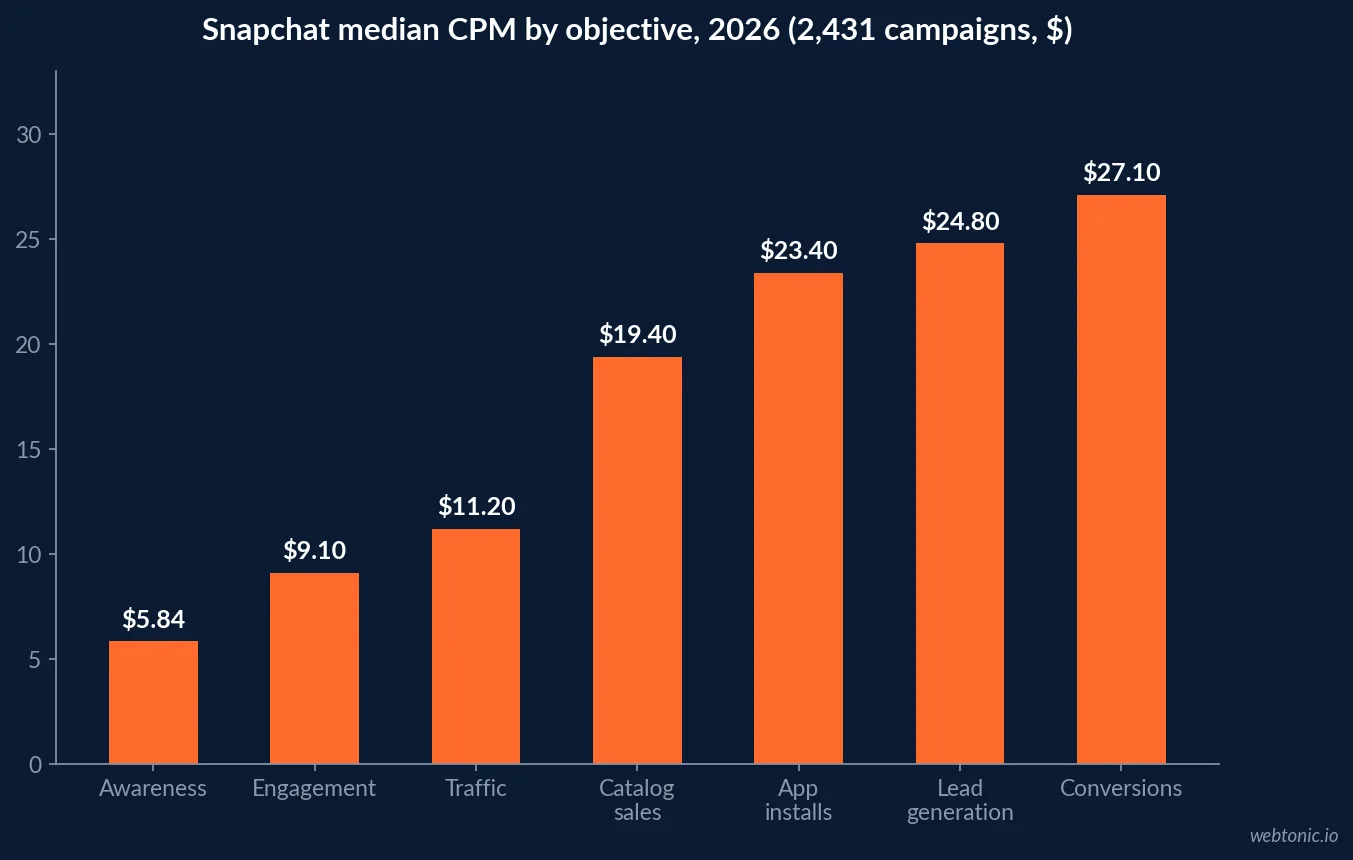
Two numbers decide the strategy. Awareness inventory is 30–40% cheaper than equivalent Meta reach, and conversion inventory is at parity or slightly above. A lender that buys Snapchat for leads is paying Meta prices for a younger audience; a lender that buys Snapchat for reach is getting a genuine discount. Our mortgage Facebook Ads statistics cover the comparison channel in detail.
The CPA Table That Should Set Expectations
Snap’s vertical CPA data is unusually honest about where the platform struggles, and mortgage sits squarely in the difficult column. Local services in the US carry a median CPA of $42.80, with the bottom quartile above $71.30 — and the stated reason is that the younger Snap audience is a poor fit for many local service categories.
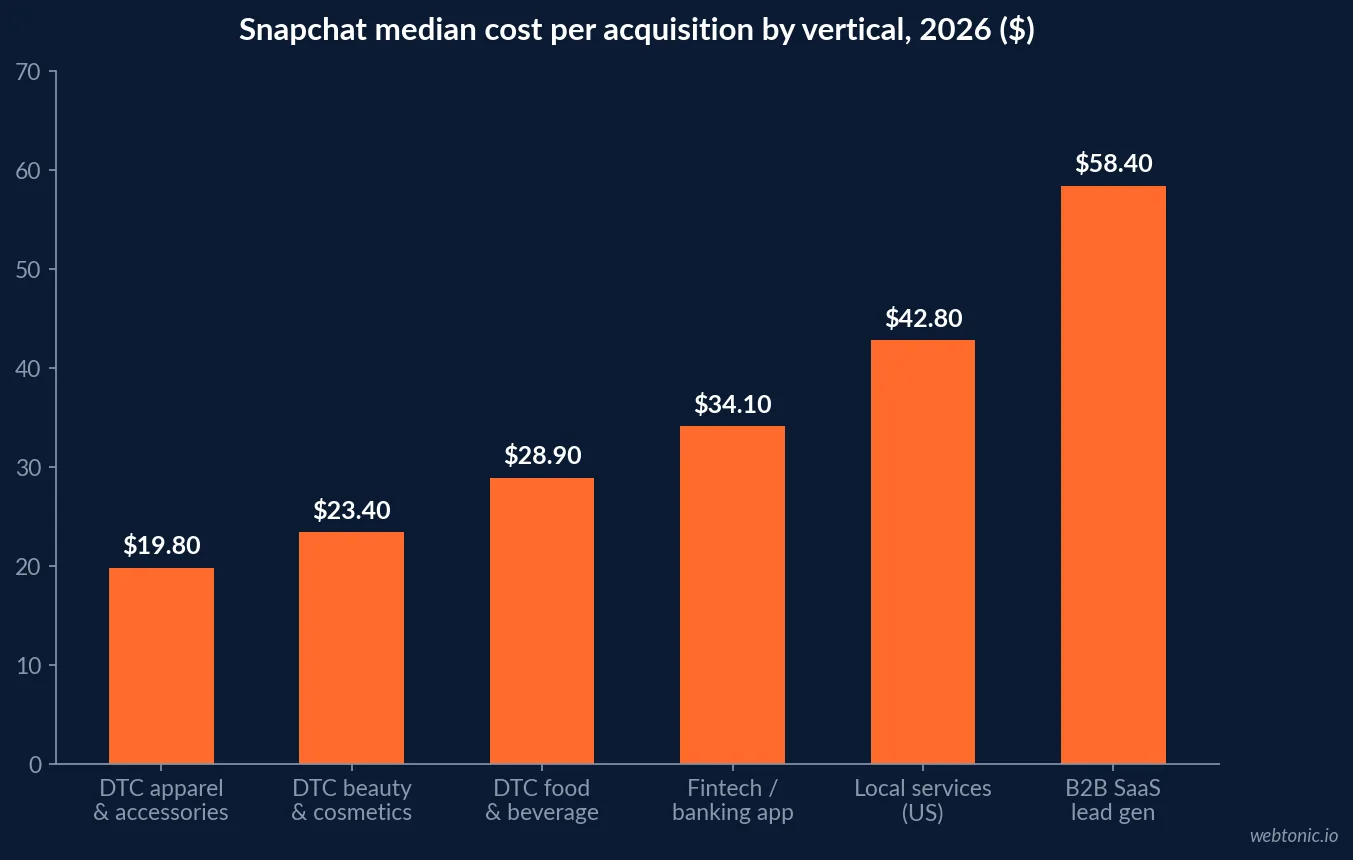
Read $42.80 as a floor rather than a forecast for a mortgage lead. Local services in that dataset means categories with a same-week purchase decision. A mortgage application has a research window measured in months, a credit qualification gate, and a median buyer age well outside Snap’s core. Any lender modelling Snapchat leads should assume a materially higher cost per qualified application than the local-services median, and should compare it to the $15–$45 Meta band and $25–$70 Reddit band before committing budget.
The Audience-Age Problem, Quantified
This is the central fact of Snapchat for mortgage, and it is worth stating in both directions. Snapchat’s largest age group is 18–24 at 35.4% of the ad audience, with 25–34 at 25.2% and more than 82% of users under 35. Meanwhile NAR’s 2026 generational data puts the first-time buyer share at a record-low 21%, the median first-time buyer age at 40, Gen Z at 4% of buyers and Baby Boomers at 42%.
| Cohort | Share of Snapchat ad audience | Share of US home buyers | Mortgage relevance |
|---|---|---|---|
| Under 18 | ~9.5% | 0% | None — exclude |
| 18–24 | 35.4% | Part of Gen Z’s 4% | Pre-market; brand only |
| 25–34 | 25.2% | Younger millennial buyers | Real but credit-thin demand |
| 35–49 | Smaller share | Peak first-time buyer age (median 40) | Under-served on this platform |
| 50+ | Smallest share | Boomers at 42% of buyers | Effectively unreachable here |
The counterweight is real, though. Lock-level data shows Gen Z reaching a record 1 in 5 purchase mortgage locks, with Gen Z buyers putting down a median 9% and one in five relying on a family gift (13%) or family loan (8%). A cohort that is 4% of closed buyers but 20% of purchase locks is entering the market faster than the closed-transaction data suggests — which is exactly the population Snapchat reaches cheaply.
Sentiment: Why the Snap Cohort Is Not Simply “Early”
Cheap reach against a future buyer only pays if the buyer is still coming. The 2026 NextGen Homebuyer Report found that 8 in 10 next-generation respondents still consider homeownership essential to “making it,” but belief that a home is a good investment collapsed from 88% in 2021 to 41% in 2026 — a 47-point decline. Separately, 33% of Gen Z renters say owning is very likely for them, ahead of millennials at 31%, and more than half of millennials who delayed a purchase have delayed it by three years or more.
The marketing implication is unusually specific: the objection this audience carries is not “which lender” but “is this even worth doing.” Rate-and-payment creative answers a question they have not reached yet. Content that addresses down-payment sourcing, gift-fund rules, credit-building timelines and rent-versus-buy math matches where they actually are, and Snapchat is the cheapest place to say it at scale.
Snapchat Against the Rest of the Mortgage Mix
Placed beside the channels lenders already run, Snapchat is not competing for the same job. It is the cheapest reach and the weakest intent in the set, which is a coherent role as long as nobody expects leads from it.
| Channel | Typical mortgage CPL | Relative CPM | Audience fit for a 40-year-old buyer |
|---|---|---|---|
| Snapchat | Above $42.80 local-services floor | Cheapest awareness | Poor — 82% of users under 35 |
| Meta / Facebook | $15–$45 | Mid | Strong across 30–60 |
| $25–$70 | Low to mid | Good — research-phase buyers | |
| Google Search | ~$105 | Not comparable | Strongest — active intent |
| $60–$200 | Most expensive | Partners and recruiting, not borrowers |
The honest conclusion is that Snapchat belongs in a mortgage plan only after search, Meta and referral infrastructure are funded properly — the priority order we walk through in our mortgage local SEO statistics.
Platform Scale and the Ad-Revenue Warning Sign
Snap remains enormous and is no longer growing quickly. Q1 2026 brought 483 million daily active users and 956 million monthly actives, each up 5% year over year, on $1.53 billion of quarterly revenue. The detail that matters for advertisers: advertising revenue grew only 3% to $1.24 billion while “other revenue” — largely Snapchat+ subscriptions — surged 87% to $285 million.
Flat ad revenue against growing users is the profile of a platform where auction density is not rising, which is precisely why awareness CPMs remain 30–40% below Meta. Independent measurement supports the reach claim rather than the buying claim: Pew found 55% of US teens use Snapchat and 46% use it daily in April 2026. Attention is there; commercial intent is thin. Treat cheap CPM as the product.
Housing and Credit Ad Restrictions You Must Declare
Mortgage advertising falls inside Snapchat’s housing, credit and employment (HCE) framework, and the declaration happens when the ad account is created, not when a campaign launches.
- Account-level declaration. When creating an ad account you must state whether you will run housing, credit or employment ads; agencies declare on behalf of the advertiser.
- Restricted targeting. HCE campaigns face limits on demographic and interest targeting, removing several levers a lender would otherwise use.
- Protected-characteristic prohibition. Snap’s commercial content rules bar targeting or exclusion based on race, ethnicity, religion, national origin, age, gender identity, disability or other protected classes.
- Material-terms disclosure. Snap’s financial products policy requires clear and prominent disclosure of all material terms before an application is submitted.
- Adult-audience minimum. Financial products intended for adults must be targeted to users over 18, which alone removes roughly the platform’s under-18 share.
None of this is disqualifying, but it changes the plan. With age and demographic precision reduced, geography, custom audiences and creative become the only real targeting levers — and that pushes the channel further toward brand and away from prospecting.
Creative: The Format Data Is Unambiguous
Across the same 2,431-campaign dataset, creative format explains more variance than targeting does. The pattern is clean enough to treat as a rule.
| Creative format | Median CPM | Median CTR | Median DTC CPA |
|---|---|---|---|
| Vertical video, under 7s | $9.40 | 1.42% | $19.80 |
| Vertical video, 7–15s | $10.20 | 1.04% | $22.10 |
| Vertical video, 15–30s | $12.80 | 0.78% | $28.40 |
| Vertical video, over 30s | $16.40 | 0.52% | $39.20 |
| Story ad (multi-snap) | $10.40 | 1.18% | $22.30 |
| Single image (native vertical) | $11.20 | 0.62% | $31.40 |
| Single image (landscape repurpose) | $15.10 | 0.41% | $43.80 |
Under-7-second vertical video delivers 3.5x the CTR of a repurposed landscape image, and anything over 30 seconds is a tax: roughly 60% more per impression for about half the conversion. Snap also reports that campaigns including AR experiences saw 2.4x ad-awareness lift, 1.8x brand-awareness lift and 1.4x brand-association lift versus campaigns without — relevant for a lender building recognition rather than chasing forms. Creative discipline of this kind is exactly what our performance creative work is built around.
The Three Snapchat Plays That Survive Mortgage Math
Given $5.84 awareness CPMs, restricted targeting and a 40-year-old median buyer, three uses hold up and everything else is a science experiment.
- Pre-market brand at reach prices. Buy awareness only, cap frequency, and measure branded search lift and direct traffic rather than leads. At a 30–40% discount to Meta reach, a lender can own recognition in a metro among 25–34s for a fraction of conversion-campaign cost.
- Gen Z acquisition against real lock volume. Gen Z is 1 in 5 purchase locks with a median 9% down payment and heavy family-gift reliance. Down-payment-assistance, gift-fund and credit-readiness offers match that reality; rate creative does not.
- Recruiting and support-staff hiring. Snap’s 18–34 concentration is a labour-market asset, not a liability, for processing and support roles — and recruiting spend gets measured against cost-to-hire (roughly $12,500 for a loan officer) rather than cost per lead. Note that employment ads sit inside the same HCE declaration.
What to avoid is equally clear: conversion-objective campaigns pointed at a generic apply-now page, landscape creative recycled from other channels, and any plan that judges Snapchat on last-click lead volume. If Snap is in the mix, it should be funded from the brand budget and evaluated with the same lens as the rest of your mortgage digital marketing reporting.
Frequently Asked Questions
Do Snapchat ads work for mortgage lenders?
Not for direct lead generation in most footprints. Snapchat's median CPA for local services is $42.80, with the bottom quartile above $71.30, and the platform's own vertical data flags local services and B2B as its two weakest categories precisely because the audience skews young. With 82% of Snapchat users under 35 and the median first-time homebuyer now 40 years old, most impressions land on people who are years from an application. Snap earns its place in a mortgage plan as cheap upper-funnel reach, as a Gen Z acquisition play, and as a recruiting channel — not as a lead engine.
What do Snapchat ads cost in 2026?
Median CPM is $5.84 for awareness, $11.20 for traffic, $24.80 for lead generation and $27.10 for conversions, based on 2,431 campaigns and $11.4M of spend. Median CPC across objectives is $0.84 with an interquartile range of $0.51–$1.34, and median CTR is 1.04% — roughly 22% above comparable Meta placements. Awareness inventory is about 30–40% cheaper than Meta; conversion inventory is roughly at parity. The arbitrage is at the top of the funnel only.
Are mortgage ads restricted on Snapchat?
Yes. Snapchat requires advertisers to declare at the ad-account level whether they intend to run housing, credit or employment (HCE) ads, and those campaigns face restricted targeting and additional compliance review. Snap's financial products policy separately requires that all material terms and conditions be clearly disclosed before a user submits an application, and prohibits targeting based on protected characteristics. In practice a lender loses age, some demographic and some interest-based levers on exactly the campaigns where they would matter most — which is another reason Snap works better as reach than as prospecting.
Which mortgage audience is actually on Snapchat?
The pre-market one, plus a growing sliver of real buyers. Gen Z accounted for just 4% of home buyers in the past year while Baby Boomers made up 42%, and first-time buyers fell to a record-low 21% of purchases. But lock-level data tells a more optimistic story: Gen Z reached a record 1 in 5 purchase mortgage locks, and Gen Z buyers put down a median 9% versus 13% for younger millennials. So the Snapchat audience is not irrelevant — it is early, credit-thin, and heavily reliant on family gifts (13%) or family loans (8%) for a down payment.
What creative works best for mortgage on Snapchat?
Short native vertical video, and nothing else. Video under 7 seconds delivers a median 1.42% CTR and $19.80 DTC CPA, while video over 30 seconds costs roughly 60% more per impression and converts about half as well. Landscape images repurposed from Meta or Google are the single most common unforced error, with a median CTR of 0.41% against 0.62% for native vertical stills. For a lender that means one clear idea per snap — a payment number, a program name, a myth corrected — not a rate table.
Sources
AdLiftr — Snapchat Ads Cost Benchmarks 2026 (2,431 campaigns)
Snap Inc. — First Quarter 2026 Financial Results
Sprout Social — Snapchat Statistics for 2026
Digital Applied — Snapchat Statistics 2026: Users, Revenue, Ad Data
Searchlab — Snapchat Statistics 2026
NAR — 2026 Home Buyers and Sellers Generational Trends
ICE Mortgage Monitor — Gen Z Reaches Record 1 in 5 Purchase Locks
NextGen Homebuyer Report 2026
Snap — Financial Products and Services Ad Requirements
Snapchat Business Help — Housing, Credit and Employment Ad Declaration
Snapchat for Business — Attention on Interactive Brand Experiences
Rently — 2026 Renting by Generation Report