



Table of contents
Meta's advertising platform — spanning Facebook, Instagram, Messenger, and the Audience Network — remains the highest-volume paid social channel for mortgage professionals in 2026. With a typical cost per lead of $15–$45 and an average ROAS of 2.4×, the platform offers mortgage brokers a scalable top-of-funnel engine that aggregator leads cannot match on cost or exclusivity. This report compiles the most current performance benchmarks from industry studies published in 2025–2026.
Key Takeaways
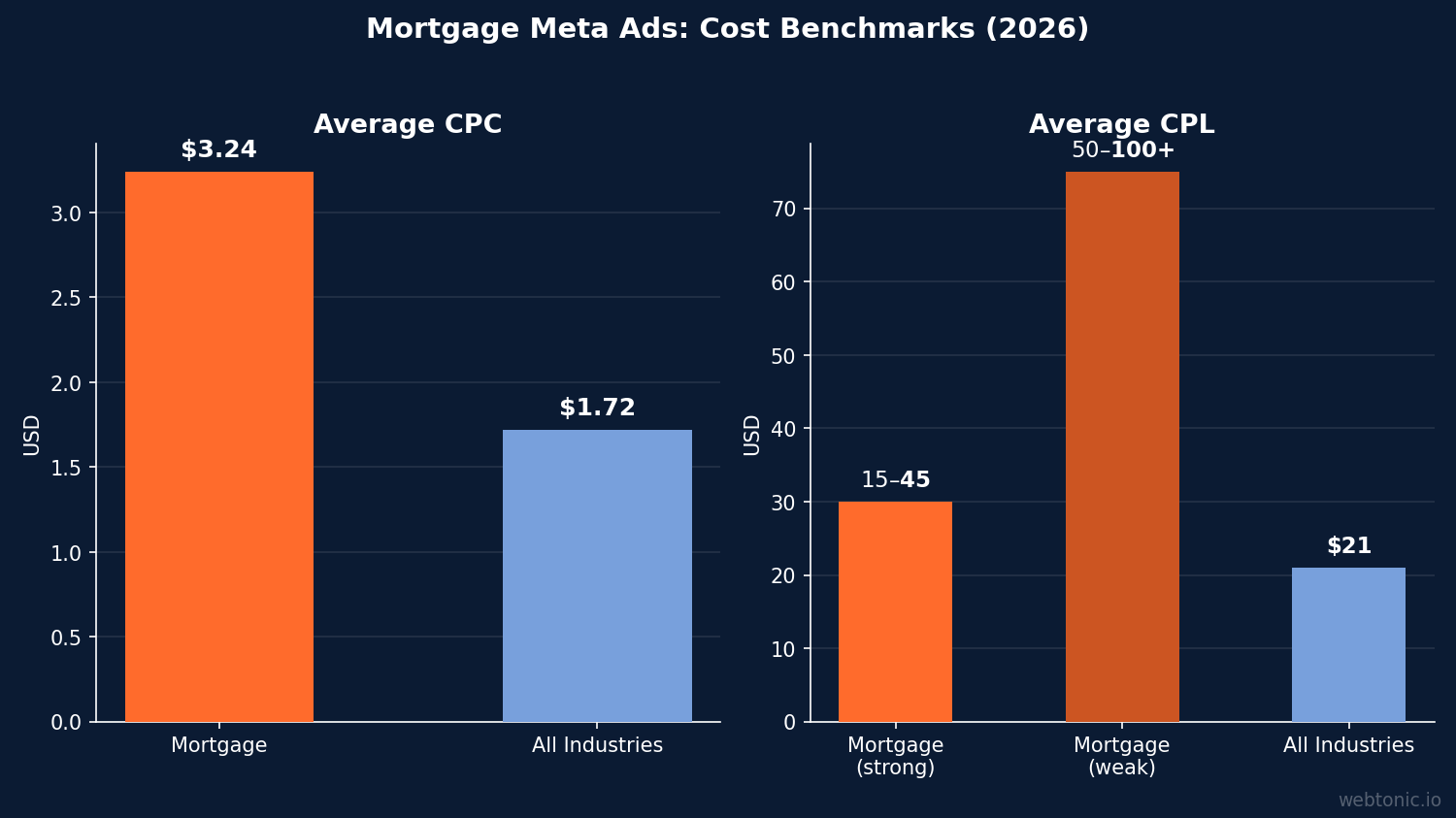
- $3.24 average CPC for mortgage Meta Ads — less than half the Google Ads equivalent.
- 0.74% average CTR, rising to 1.5–3.0% with video and carousel formats.
- $15–$45 CPL with strong targeting; $50+ when creative or audience selection is weak.
- 2.4× ROAS average for mortgage advertisers on Meta's platform.
- Lead-form ads deliver $30–$100 CPL with lower intent; landing-page funnels convert 12–20% of clicks.
- Fair Housing Act Special Ad Category restrictions limit radius targeting to 15+ miles and remove age/gender/ZIP exclusions.
| Metric | Mortgage / Lending | All Industries |
|---|---|---|
| CPC | $3.24 | $1.72 |
| CTR | 0.74% | 1.49% |
| ROAS | 2.4× | 2.0× |
| CPL (strong targeting) | $15–$45 | $21 |
| CPL (weak targeting) | $50–$100+ | $40+ |
| Landing Page CVR | 12–20% | 9.2% |
| CPM | $22–$38 | $14.40 |
Sources: Benchmarketing, BNTouch, AdLibrary.
Cost Per Lead by Ad Format and Funnel Type
The CPL range for mortgage Meta Ads varies dramatically depending on the funnel design. On-platform lead forms (Instant Forms) deliver the lowest friction and highest volume — but leads tend to have lower intent. Landing-page funnels that pre-qualify borrowers produce fewer but higher-quality leads.
| Ad Format / Funnel | Avg CPL | Lead Quality | Best For |
|---|---|---|---|
| Instant Lead Form | $15–$35 | Low–Medium | Volume, retargeting lists |
| Landing Page (short form) | $25–$50 | Medium | Pre-qualification, nurturing |
| Landing Page (long form) | $40–$80 | High | Application-ready leads |
| Video + Landing Page | $20–$45 | Medium–High | Brand + lead gen hybrid |
| Carousel (multi-product) | $18–$40 | Medium | Loan type comparison |
LeadPops reports that mortgage loan officers using dedicated landing pages with a single CTA achieve CPL 30–40% lower than those sending traffic to their main website. The landing page acts as a rate-specific micro-funnel that filters out non-serious browsers.
Audience Targeting Under Special Ad Category Rules
Mortgage ads on Meta fall under Special Ad Category: Credit, which imposes significant targeting restrictions. Advertisers cannot target by age, gender, ZIP code, or use detailed exclusions based on demographics. Radius targeting must be 15 miles minimum.
Despite these limitations, top-performing mortgage advertisers leverage lookalike audiences from funded-loan customer lists (1–3% lookalike) and interest-based targeting around homeownership, real estate, and financial planning topics. Retargeting website visitors and email list custom audiences remains permitted and delivers the strongest ROAS.
Meta's Advantage+ Audience (broad targeting with algorithmic optimization) is gaining traction among mortgage advertisers. Early adopters report 15–25% lower CPL compared to interest-stacked audiences, as Meta's algorithm identifies high-intent borrowers from behavioral signals beyond declared interests.
Creative Performance by Format
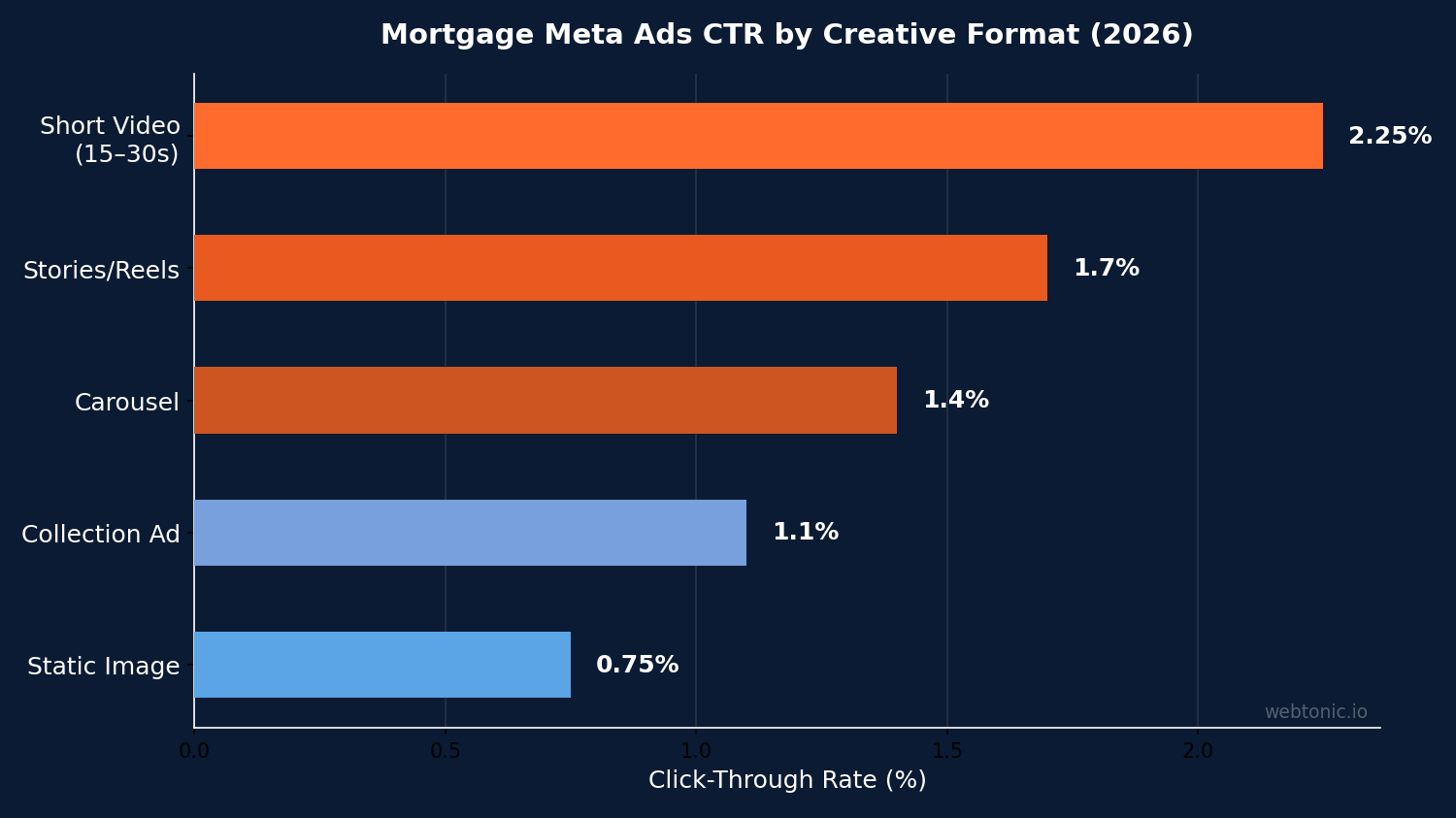
Video ads dominate mortgage Meta performance in 2026. Short-form video (15–30 seconds) featuring a loan officer explaining current rates achieves 1.5–3.0% CTR — double the static image average of 0.74%. The authenticity of a face-to-camera format builds trust in a category where borrowers are skeptical of anonymous lenders.
| Creative Format | Avg CTR | Avg CPL | Engagement Rate |
|---|---|---|---|
| Static Image | 0.6–0.9% | $30–$55 | 1.2% |
| Short Video (15–30s) | 1.5–3.0% | $15–$35 | 3.8% |
| Carousel | 1.0–1.8% | $18–$40 | 2.5% |
| Stories / Reels | 1.2–2.2% | $20–$42 | 4.1% |
| Collection Ad | 0.8–1.4% | $25–$50 | 2.0% |
Carousel ads perform well for lenders offering multiple loan products (conventional, FHA, VA, jumbo) — borrowers swipe through options and self-select, which pre-qualifies the click. Mortgage advertisers should maintain a creative library of at least 5–8 active ad variants across formats to sustain performance through the rapid creative fatigue cycles characteristic of the lending vertical.
Retargeting and Funnel Strategy on Meta
Retargeting is where mortgage Meta Ads generate the highest ROAS. Website visitors who viewed rate pages but did not submit an application convert at 4–8× the rate of cold audiences when served retargeting ads within 7 days. The most effective retargeting creative combines social proof (client testimonials, review counts) with a rate-specific CTA.
A proven mortgage Meta funnel follows three stages: awareness (video content about the home-buying process or rate environment, optimized for ThruPlay), consideration (carousel or single-image ads with specific rate offers, targeting video viewers and website visitors), and conversion (lead form or landing page ads targeting high-intent retargeting pools). This three-stage approach typically delivers a blended CPL 25–35% lower than running conversion campaigns alone.
Lookalike audiences built from funded-loan customer lists (1% lookalike) consistently outperform interest-based audiences by 20–30% on CPL. However, Special Ad Category restrictions limit lookalike precision — advertisers should test 1%, 3%, and 5% lookalike sizes to find the optimal balance between reach and quality.
Seasonal and Rate-Driven Performance Patterns
Mortgage Meta Ads performance fluctuates with seasonal buying patterns and interest rate movements. Spring (March–May) sees the highest search volume and competition, pushing CPMs up 15–25% but also delivering the highest lead volume. Winter (December–February) offers lower CPMs but smaller audience pools.
Rate drops create immediate demand surges on the platform. When the Federal Reserve signals rate cuts, mortgage ad impressions spike within 24–48 hours. Lenders who pre-build "rate drop" ad sets and activate them immediately capture leads at 30–40% lower CPL than those who build campaigns reactively. Conversely, rate increases suppress engagement and push CPL higher, making retargeting and email nurturing more cost-effective during rising-rate periods.
The Andromeda algorithm update in 2026 has shifted Meta's ad delivery toward broader audience discovery. Industry analysis shows that mortgage advertisers now need a minimum $100/day budget to generate enough conversion signals for effective optimization — up from the $50/day threshold that worked in 2024–2025. This volume floor is particularly important for performance creative testing, where each variant needs sufficient impressions to reach statistical significance within a reasonable timeframe.
Instagram and Reels Performance for Mortgage Advertisers
Instagram placements — particularly Reels — are emerging as a high-performance channel within the Meta ecosystem for mortgage content. Reels ads achieve 1.2–2.2% CTR, outperforming in-feed static posts, and the format favors the short, educational content that mortgage professionals produce naturally (rate updates, myth-busting, first-time buyer tips).
The demographic skew of Instagram users (heavily 25–44 age range) aligns perfectly with first-time homebuyer audiences. Mortgage advertisers who allocate 20–30% of Meta budget specifically to Instagram placements report higher engagement and comparable CPL to Facebook-only campaigns.
User-generated content (UGC) style ads — filmed on smartphones, featuring real clients or loan officers in casual settings — outperform polished studio creative by 35–50% on engagement rate across Instagram placements. This authenticity resonates in a category where trust is the primary conversion driver.
Meta Ads vs. Google Ads for Mortgage Lead Generation
The two platforms serve different roles in a mortgage marketing funnel. Google Ads captures active intent — borrowers searching "mortgage rates near me" — with a $30–$70 CPL and 3–8% conversion rate. Meta Ads generates demand among passive audiences at a lower $15–$45 CPL but with 1–3% lead-to-close rate (LeadPops).
The most effective mortgage advertisers run both channels, using Meta for top-of-funnel awareness and list building and Google for bottom-of-funnel conversion. The blended cost per funded loan (CPFL) for this approach ranges $1,200–$2,000 — significantly below the $5,000–$15,000 typical of aggregator-only strategies. Mortgage professionals who integrate their Meta and Google Ads funnels with a unified CRM see 20–30% higher overall close rates because leads receive consistent follow-up regardless of origination channel.
Measurement and Attribution for Mortgage Meta Ads
Accurate measurement is one of the biggest challenges for mortgage Meta advertisers. The 45–90 day lag between lead capture and funded loan means that standard 7-day click attribution windows miss the majority of conversion value. Savvy advertisers use 28-day click / 1-day view attribution combined with CRM integration to capture the full funnel.
The Conversions API (CAPI) is now essential for mortgage Meta advertisers. Server-side event tracking recovers 15–30% of conversion data lost to iOS privacy changes and browser ad blockers. Mortgage advertisers with CAPI properly implemented report Event Match Quality scores of 7.5–8.5 (out of 10), compared to 4–5 for pixel-only setups.
UTM parameter discipline matters enormously in mortgage marketing. Best-practice UTM structures include campaign type, audience segment, creative variant, and loan type in the UTM parameters, enabling CRM-side analysis of which specific ad creative drives the highest-quality applications — not just the most form fills.
Budget Allocation and Scaling Benchmarks
Mortgage advertisers spending $3,000–$5,000 per month on Meta typically generate 60–150 leads. Scaling beyond $10,000/month requires creative refresh cycles every 2–3 weeks to combat ad fatigue, which sets in faster in the mortgage niche due to narrow audience pools under Special Ad Category restrictions.
Sona's 2025 setup guide recommends starting with a $50–$100/day budget to exit learning phase within 7 days and accumulate enough conversion data for Meta's algorithm to optimize effectively.
Best Practices for Mortgage Meta Advertising
- Always select Special Ad Category: Credit — non-compliance risks account suspension and legal liability.
- Lead with video — face-to-camera rate updates and explainers outperform static images by 2–3× on CTR.
- Use landing pages over Instant Forms for quality — accept higher CPL in exchange for leads that actually close.
- Refresh creative every 2–3 weeks — mortgage audience pools are small; frequency fatigue hits fast.
- Retarget website visitors with testimonials — social proof converts skeptical borrowers who abandoned the first visit.
- Track to funded loan, not just CPL — a $40 lead that closes is worth more than a $10 lead that ghosts.
Key Facebook Ads Statistics Every Mortgage Broker Should Track
Beyond the headline benchmarks, mortgage professionals should monitor several granular Facebook advertising statistics to optimize their campaigns. Frequency — the average number of times a user sees your mortgage ad — should stay below 3.0 per week. Above that threshold, click-through rates drop 15–20% and cost per lead increases as ad fatigue sets in with the narrow mortgage audience pool.
Relevance Score (now called Quality Ranking, Engagement Rate Ranking, and Conversion Rate Ranking) directly impacts how much mortgage brokers pay per impression. Ads scoring in the top 35% of engagement ranking receive CPM discounts of 20–40% compared to below-average performers. The fastest way to improve relevance: match creative messaging to a single loan type and audience segment rather than running generic mortgage ads.
Link click-to-lead conversion rate reveals landing page effectiveness. The mortgage industry benchmark sits at 12–20% for dedicated landing pages but drops to 3–5% when traffic lands on a general mortgage company homepage. Tracking this statistic separately from platform-level metrics ensures mortgage advertisers catch landing page issues before they waste significant ad budget on clicks that never convert into applications.
Lifetime Value and CPL Economics for Mortgage Facebook Ads
Understanding the relationship between CPL and LTV (lifetime value) is essential for evaluating Facebook ads ROI in the mortgage vertical. A single funded mortgage generates $3,000–$8,000 in originator revenue, with lifetime customer value — including refinances, HELOCs, and referrals — reaching $12,000–$25,000. This high LTV means that even a $50–$80 CPL from Facebook ads campaigns can deliver outstanding returns when measured over the full customer lifecycle.
The CPL-to-LTV ratio separates profitable mortgage Facebook advertisers from those who abandon the channel prematurely. A 30:1 LTV-to-CPL ratio (e.g., $15,000 LTV ÷ $500 cost per funded lead) is achievable with well-optimized Facebook campaigns. Mortgage brokers who track LTV alongside CPL, CPC, and CPA make significantly better budget allocation decisions than those focused solely on front-end cost per lead metrics.
CTR optimization directly impacts both CPL and CPA economics. Every 0.5% CTR improvement on mortgage Facebook ads translates to approximately 15–20% lower CPM costs through Meta's quality-based auction, which rewards high-engagement creative with cheaper impressions. This is why UGC (user-generated content) style ads — despite looking less polished — consistently deliver lower CPA than studio-produced creative: the authenticity drives higher engagement rates that reduce delivery costs.
Facebook Ads vs PPC and Multi-Channel Conversion Tracking
Mortgage brokers running both Facebook ads and PPC campaigns (primarily Google Ads) need unified conversion tracking to avoid double-counting leads and to attribute revenue accurately. The standard approach uses UTM parameters combined with a CRM-based attribution model that tracks each lead from first touch (Facebook ad click or PPC click) through to funded loan.
CVR (conversion rate) benchmarks differ significantly between the two channels. Facebook ads deliver a 1–3% CVR from lead to application for mortgage campaigns in the USA, while Google Ads PPC produces 3–8% CVR due to higher search intent. However, Facebook's lower CPC ($3.24 vs $7.84 for Google Ads) means the cost per application is often comparable when accounting for volume.
Best-in-class mortgage advertisers in the USA implement cross-channel CTA strategies — using Facebook ads to drive initial engagement and email capture, then retargeting those contacts with Google Ads when they search for mortgage-related terms. This cross-channel approach reduces the blended CPA by 20–35% compared to running either channel in isolation. GTM (Google Tag Manager) setup is critical for this tracking architecture, ensuring that Facebook pixel events and Google conversion tags fire correctly without conflicts.
FAQ
How much do Facebook ads cost for mortgage brokers?
Mortgage brokers can expect to pay $3.24 CPC and $15–$45 per lead with well-targeted campaigns. Weak targeting or poor creative can push CPL above $50–$100. Monthly budgets of $3,000–$5,000 are typical for local loan officers.
What is a good ROAS for mortgage Facebook ads?
The average ROAS for mortgage Meta Ads is 2.4×. Given the high lifetime value of a funded loan ($3,000–$8,000 in originator revenue), even a 1.5× ROAS can be profitable when measured against the full customer lifecycle including referrals and repeat business.
Do Facebook lead form ads work for mortgage companies?
Yes, but with caveats. Instant lead forms generate high volume at $15–$35 CPL, but lead quality is lower than landing-page funnels. Speed-to-contact is critical — lenders who call within 5 minutes convert form leads at 3–5× the rate of those who wait 24+ hours.
How does Special Ad Category affect mortgage ad targeting?
Special Ad Category: Credit removes age, gender, ZIP code, and detailed demographic targeting. Radius targeting must be 15+ miles. Advertisers must rely on interest-based, lookalike, and retargeting audiences. Despite these limits, strong creative and broad targeting often outperform narrow demographic segments.
Should mortgage brokers use Facebook or Google Ads?
Both, ideally. Google Ads captures active searchers at higher CPL ($30–$70) but with stronger intent. Meta Ads builds awareness at lower CPL ($15–$45) but with longer conversion timelines. The blended approach delivers a cost per funded loan of $1,200–$2,000.
Sources
https://www.benchmarketing.org/benchmarks/industries/mortgage
https://bntouch.com/mortgage-blog/social-media-ads-mortgage-loan-officers/
https://leadpops.com/blog/facebook-ads-mortgage-loan-officers
https://leadpops.com/blog/mortgage-leads-cost-2026
https://adlibrary.com/posts/meta-ad-benchmarks-real-estate-2026
https://www.sona.com/blog/meta-ads-for-mortgage-brokers-a-comprehensive-setup-guide


