Table of contents
Most mental health TikTok "ad" budgets are not really ad budgets at all - TikTok's own policy prohibits most healthcare and pharmaceutical advertising outright. This page prices the narrow lane that stays open (certified, restricted-category ads), the certification cost that gates it, and the organic Gen-Z reach that, for this category specifically, matters more than the ad account does.
Key Takeaways
- TikTok's Branded Content Policy lists healthcare and pharmaceuticals as a Prohibited Industry, naming medical institutions, treatments, and telehealth providers explicitly.
- LegitScript Healthcare Certification is recognized across five major platforms: TikTok, Google, Meta, Microsoft Bing and LinkedIn.
- Google's own policy classifies mental health counseling as a sensitive Health interest category by name.
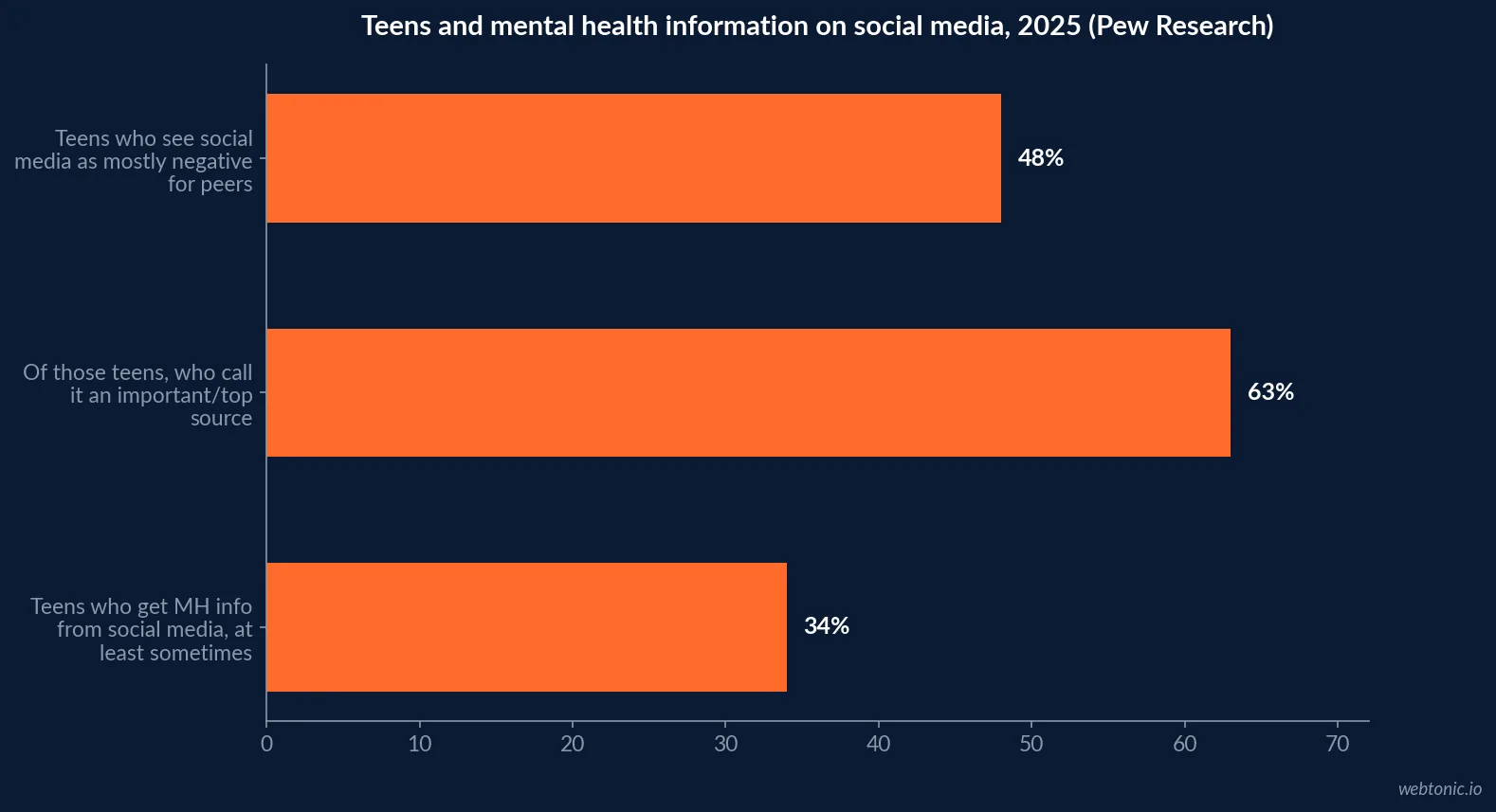
- 34% of teens get mental health information from social media at least sometimes, per Pew's 2025 survey.
- Of those teens, 63% call it an important or the single most important source.
- 48% of teens say social media has a mostly negative effect on people their age, up from 32% in 2022.
- Only a minority of teens say social media hurts them personally, a smaller share than say it hurts peers.
- TikTok's Safety Center mental health guides serve more than 500,000 people every day, per its WHO partnership announcement.
- A field experiment reached 105 creators and 16.9 million-plus viewers testing mental health messaging toolkits on the platform.
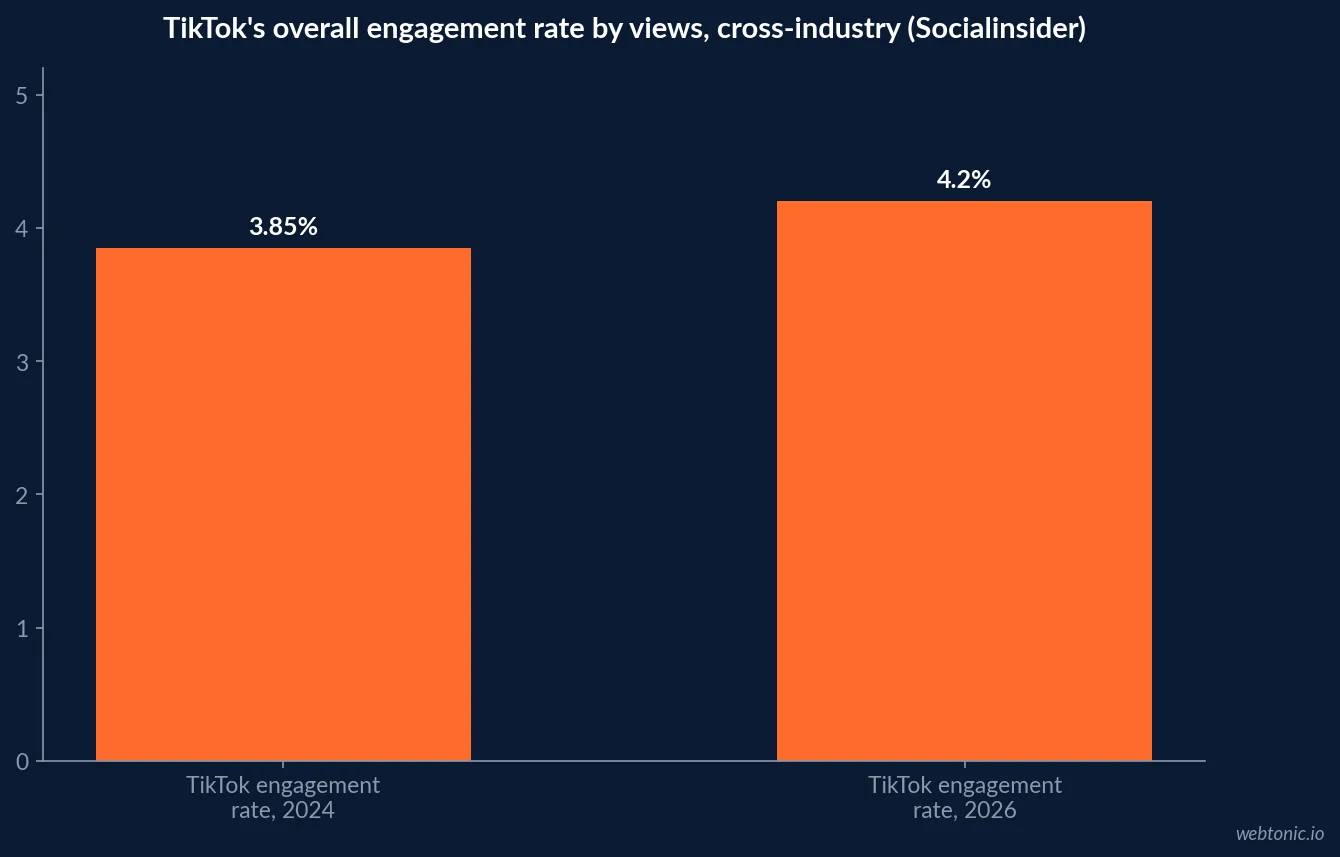
- TikTok's overall 2026 engagement rate by views is 4.20%, up from 3.85% in 2024, per Socialinsider.
- Emplifi found TikTok brand follower counts grew 200% year over year in 2025.
- TikTok's median engagement rate hit 27.6% in Q4 2025 per Emplifi, twice Instagram's and 20 times Facebook's.
- The FTC fined BetterHelp USD 7.8 million over sensitive mental health data reaching ad platforms.
- Cerebral paid more than USD 7 million in a related 2024 FTC order.
What TikTok's policy actually prohibits
Start with the rule, not the workaround. TikTok's Branded Content Policy lists "pharmaceuticals, healthcare and medicine products" as a Prohibited Industry, and its own examples name medical institutions, treatments or devices, nutritionists, online pharmacies and telehealth providers specifically. Counseling and therapy services sit squarely inside "medical institutions" and "treatments" by any reasonable reading, which is why most mental health brands cannot run a standard branded-content or in-feed ad the way a retail or consumer brand can.
What is not prohibited outright is narrower: general mental wellness content that avoids clinical claims, and healthcare advertising run by a business that has gone through third-party certification. Of the 3 major sensitive-category regimes covered on this page - TikTok, Google and Meta - all three name counseling or mental health treatment specifically rather than leaving it to a general "healthcare" bucket.
| What TikTok restricts (Branded Content Policy) | Status for mental health brands |
|---|---|
| Medical institutions, treatments or devices | Prohibited |
| Telehealth providers | Named as prohibited example |
| Online pharmacies | Prohibited unless certified |
| General wellness / mental wellness content (non-clinical) | Generally permitted, reviewed case by case |
| Certified healthcare advertisers (LegitScript) | Limited eligibility, platform review still applies |
The certification path, and why it is a cross-platform decision
LegitScript's Healthcare Certification is recognized by Google, Meta, Microsoft Bing, LinkedIn, TikTok, Netflix, Nextdoor and Yahoo - 8 separate ad and content platforms covered by one certification process. That matters for budgeting: it is a single, one-time certification process that determines eligibility across most of the platforms a mental health practice would otherwise want to advertise on, not a TikTok-specific fee. Addiction Treatment Certification is a separate, stricter track required specifically for recovery-oriented drug and alcohol services on Google, and the same logic of shared, cross-platform recognition applies.
Google's own Healthcare and medicines policy confirms LegitScript charges a processing and monitoring fee, with waivers available in some cases - the clearest publicly stated cost detail available, since neither TikTok nor LegitScript publish a flat certification price.
| Certification track | Platforms that recognize it | Who it is for |
|---|---|---|
| Healthcare Certification | Google, Meta, Microsoft Bing, LinkedIn, TikTok, Netflix, Nextdoor, Yahoo | Licensed healthcare providers and services |
| Addiction Treatment Certification | Google (required); other platforms vary | Recovery-oriented drug and alcohol services specifically |
Cross-platform, the same category gets flagged
TikTok is not unusual in treating mental health as sensitive. Google's Health in personalized advertising policy explicitly lists "counseling services for mental health issues like depression, anxiety, and addiction" as a sensitive interest category subject to restricted personalized targeting - the same classification logic that shapes TikTok's, Meta's and LinkedIn's health advertising rules. A practice building a TikTok media plan should expect the same restrictions to recur on every platform it advertises on, not treat TikTok as an unusually strict outlier.
| Platform | Mental health / counseling ad treatment |
|---|---|
| Sensitive Health interest category; restricted personalized targeting | |
| TikTok | Prohibited Industry (healthcare/pharma) unless certified |
| Meta | Health & Wellness sensitive category; restricted data sharing since 2025 |
| Not a Prohibited Industry, but B2B-oriented; patient-facing ads are rare |
The practical takeaway is that a compliance review built for one platform mostly transfers to the others. A practice that has already gone through LegitScript certification and written a clinical-claims policy for its Google account is 80% of the way to a TikTok-compliant policy too - the remaining work is TikTok's specific prohibited-industry list and its region-by-region variation, which LegitScript's own certification primer documents platform by platform.
Where the real Gen-Z reach comes from
The honest budget conversation is less about a media buy and more about organic presence. Pew Research's 2025 teens and social media report found 34% of teens say they at least sometimes get information about mental health on social media, including 9% who do so extremely or fairly often, and among those teens, 63% say it is an important or the single most important way they get that information. The same report found 48% of teens think social media has a mostly negative effect on people their age, up from 32% in 2022 - a caution that the same channel driving information access is also viewed warily by its own users.
TikTok has built organic infrastructure specifically for this: its Mental Health Education Fund and a World Health Organization partnership feed Safety Center guides that the company says serve more than 500,000 people every day. A peer-reviewed field study published in Scientific Reports tested whether equipping creators with messaging toolkits changed how they discussed mental health, reaching 105 creators and more than 16.9 million viewers across 3,465 videos in a single randomized intervention - evidence that organic creator reach on this exact topic is large enough to study at scale, independent of any ad account.
| Organic signal (not paid media) | Figure | Source |
|---|---|---|
| Teens who get MH info from social media, at least sometimes | 34% | Pew Research 2025 |
| Of those, who call it an important/top source | 63% | Pew Research 2025 |
| Teens who see social media as mostly negative for peers | 48% (up from 32% in 2022) | Pew Research 2025 |
| People reached by TikTok's Safety Center MH guides, daily | 500,000+ | TikTok / WHO partnership |
| Viewers reached in one field study of creator MH messaging | 16.9 million+ | Scientific Reports, field experiment |
What a "TikTok mental health ad" usually is in practice
Where paid budget does legitimately move on TikTok in this category, it is rarely a direct-to- patient offer. It is more often one of three narrower plays: a certified provider running a limited, policy-compliant awareness campaign; a wellness or self-care product adjacent to clinical care (a meditation app, a journaling tool) that sits outside the strict "medical treatment" definition; or a recruiting and employer-brand campaign aimed at clinicians rather than patients, which mirrors the B2B logic that also applies to LinkedIn for this category. None of these three is what a marketer picturing a typical consumer TikTok ad has in mind, and budgeting as if the platform behaves like an open consumer-health ad channel will produce disapproved campaigns rather than results.
| Plan type | What it actually is | Typical constraint |
|---|---|---|
| Certified provider awareness campaign | Limited paid reach after LegitScript review | Platform review per campaign, not guaranteed |
| Adjacent wellness product ad | Meditation, journaling or self-care tools, not clinical treatment | Must avoid clinical claims |
| Clinician recruiting / employer brand | Organic-led, small paid boost | Audience is professional, not patient |
What this means for a 2026 media plan
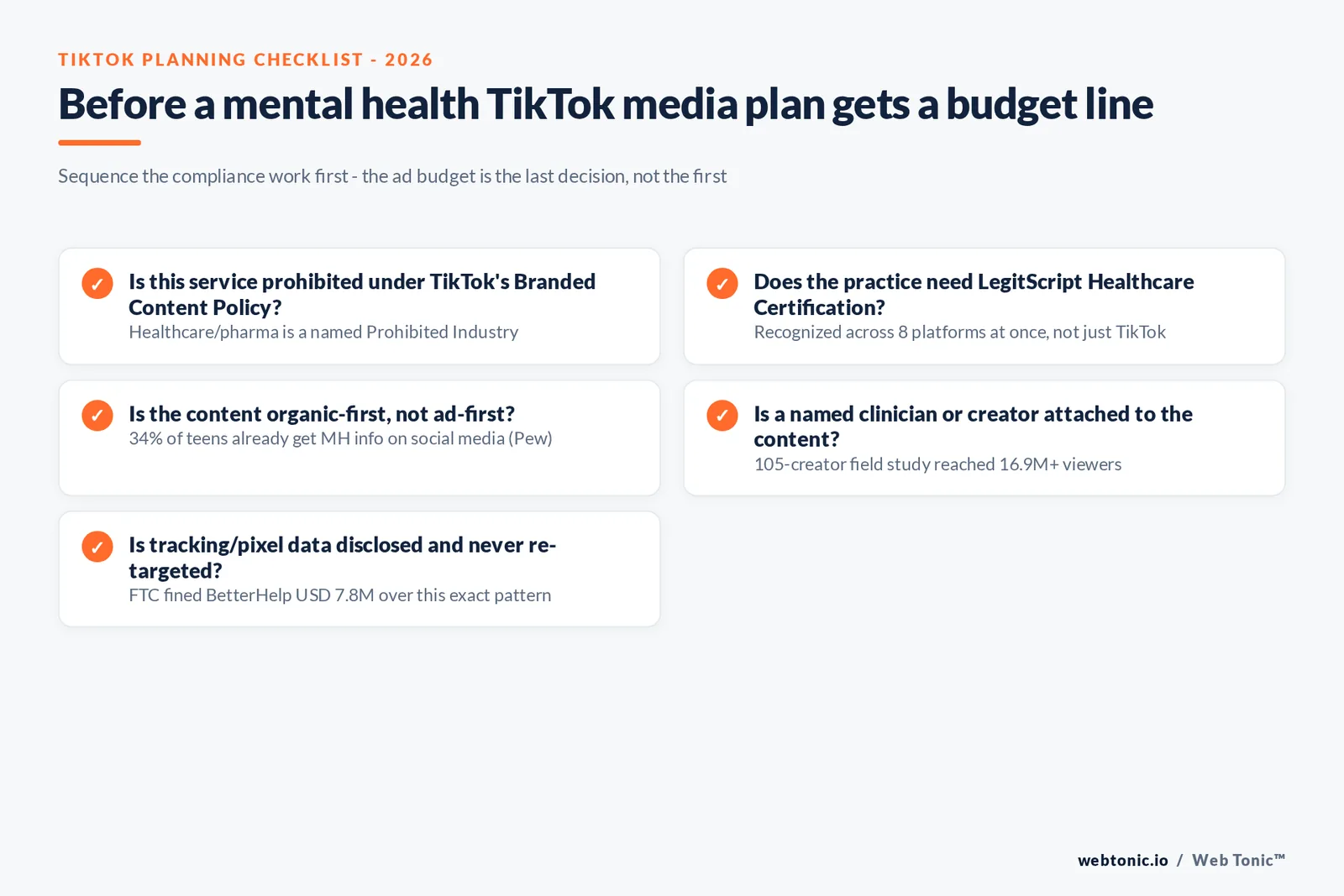
Sequence the work rather than starting with an ad budget line. Confirm what, if anything, is eligible to run under TikTok's current policy for the specific service being advertised. If paid healthcare eligibility genuinely matters to the plan, budget for LegitScript certification once, since it is recognized across TikTok, Google, Meta, Bing and LinkedIn rather than being a platform-specific cost. Build the organic content plan first regardless, since the Pew and TikTok data both point to organic reach, not paid reach, as where this audience already is. And treat any pixel or tracking setup with the same disclosure discipline the FTC's BetterHelp and Cerebral orders demand, since a compliant ad account does not protect a practice from a non-compliant tracking pixel running underneath it.
Our performance creative team can help scope what is actually eligible to run before any spend commits, and our Meta ads practice can advise on the closely related Meta health-and-wellness restrictions that shape the adjacent platform. For the certification cost this category shares with paid search, see our guide to what Google Ads costs in 2026.
Frequently Asked Questions
Can a mental health or counseling practice run paid TikTok ads at all?
Only within a narrow lane. TikTok's Branded Content Policy lists pharmaceuticals, healthcare and medicine products as a Prohibited Industry, explicitly naming medical institutions, treatments, devices, nutritionists, online pharmacies and telehealth providers. LegitScript's Healthcare Certification, recognized across TikTok, Google, Meta, Microsoft Bing and LinkedIn, is the path some licensed providers use to unlock limited advertising access, but certification itself does not guarantee eligibility for every ad type or region - each platform's policy team still reviews the specific campaign.
What does LegitScript Healthcare Certification cost and require?
LegitScript charges a processing and monitoring fee, with fee waivers available in some cases, according to Google's own healthcare and medicines policy documentation. The certification is a prerequisite for running healthcare ads on Google, and TikTok, Meta, Microsoft Bing and LinkedIn recognize the same credential, which means one certification process can unlock (or fail to unlock) advertising eligibility across all five platforms at once.
Is there a TikTok-specific cost benchmark for mental health ad campaigns?
No. No major benchmark publisher breaks out TikTok cost-per-click or cost-per-mille for mental health or behavioral health specifically, and the category's ad eligibility is restricted enough that the sample sizes behind any such benchmark would likely be small and skewed toward adjacent wellness products rather than clinical counseling services. The honest planning approach is to budget for certification and organic content first, and treat any paid spend as a small, tightly scoped test once policy eligibility is confirmed.
If paid ads are this restricted, why does TikTok matter for mental health marketing at all?
Because the audience is there and actively looking for mental health information, even without paid reach. Pew Research's 2025 teen survey found 34% of teens say they at least sometimes get information about mental health on social media, and of those, 63% say it is an important or the single most important way they get that information. TikTok has also built organic infrastructure for this - its Mental Health Education Fund and a WHO partnership - which matters more here than the ad platform does.
What does the compliance risk actually look like if a practice ignores this?
It mirrors the pattern regulators have already punished elsewhere in mental health marketing. Google's own advertising policy explicitly classifies 'counseling services for mental health issues like depression, anxiety and addiction' as a sensitive Health interest category, and the FTC's 2023 BetterHelp and 2024 Cerebral orders both involved sensitive mental health data reaching ad platforms including social networks through tracking pixels - not through a legitimate ad account, but through the same kind of unexamined pixel most small practices still run.
Sources
TikTok - Branded Content Policy
LegitScript - Healthcare Certification
LegitScript - Addiction Treatment Certification
Google Ads - Healthcare and medicines policy
Google Ads - Health in personalized advertising policy
Pew Research Center - Teens, Social Media and Mental Health, 2025
TikTok Newsroom - Mental Health Education Fund
TikTok Newsroom - WHO mental wellbeing partnership
Socialinsider - 2026 TikTok Benchmarks
Emplifi - 2026 Social Media Benchmarks Report
Federal Trade Commission - BetterHelp order, 2023