Table of contents

Meta remains one of the few paid channels where a counseling practice can build awareness cheaply, but it is the most policy-constrained channel in this comparison. This page benchmarks what a page can expect to spend and earn on Meta, then walks through why 2025's health-and-wellness event limits and two federal settlements now shape every campaign setup decision.
Key Takeaways
- Meta removed health-condition ad targeting in January 2022 and has not restored it.
- Meta added new health-and-wellness event-data limits in January 2025, expanded in July 2025.
- The FTC fined BetterHelp USD 7.8 million in 2023 for sharing mental-health data with ad platforms.
- The FTC fined Cerebral more than USD 7 million in 2024 for the same category of conduct.
- Roughly 3.2 million Cerebral consumers' data reached LinkedIn, Snapchat and TikTok via tracking pixels.
- A federal court vacated part of HHS OCR's tracking guidance in June 2024, with no replacement issued since.
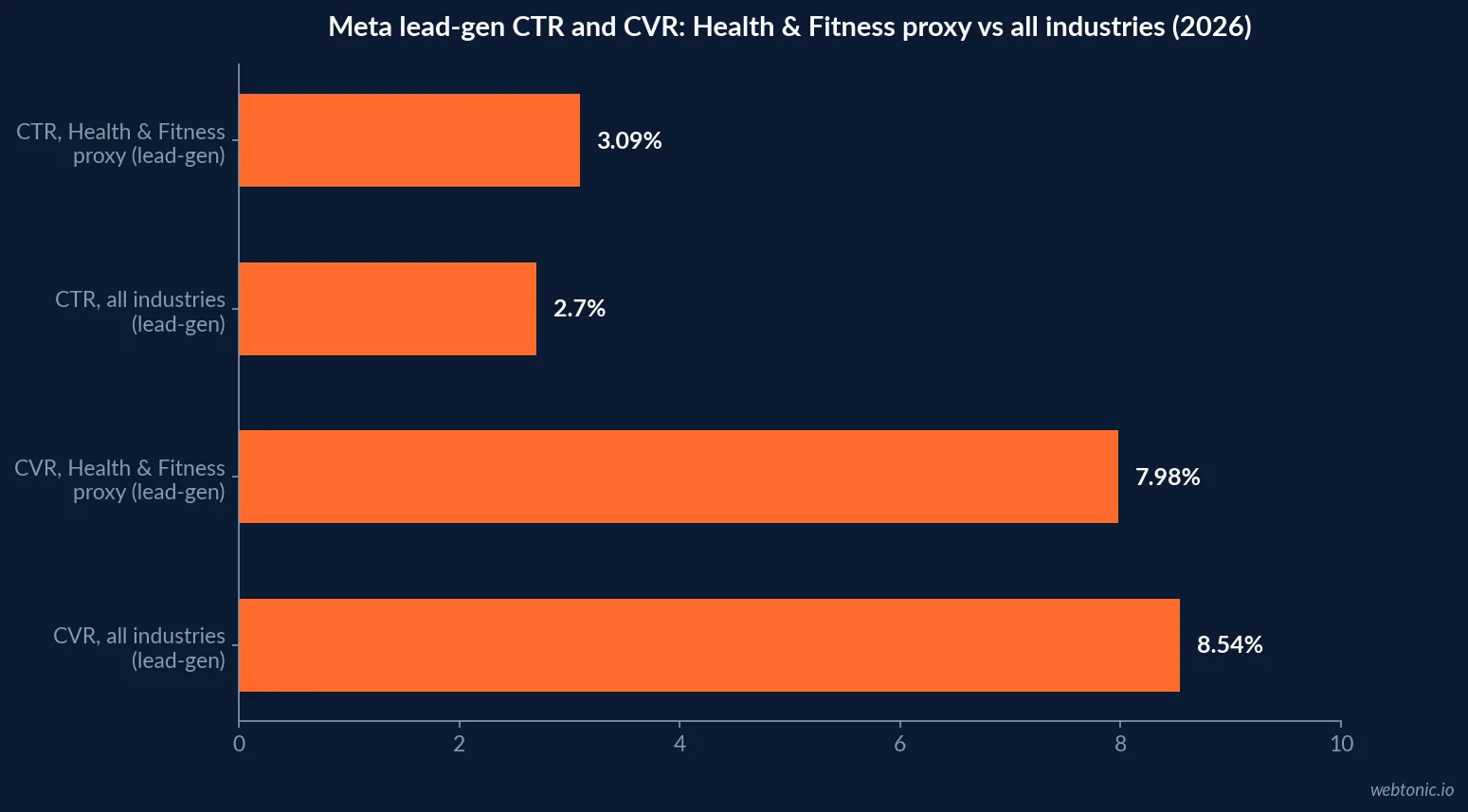
- Cross-industry Meta lead-gen CTR sits at 3.09% for the closest tracked category, Health & Fitness.
- Meta lead-gen CPC runs USD 1.84 for that same proxy category.
- Meta lead-gen conversion rate is 7.98% for Health & Fitness.
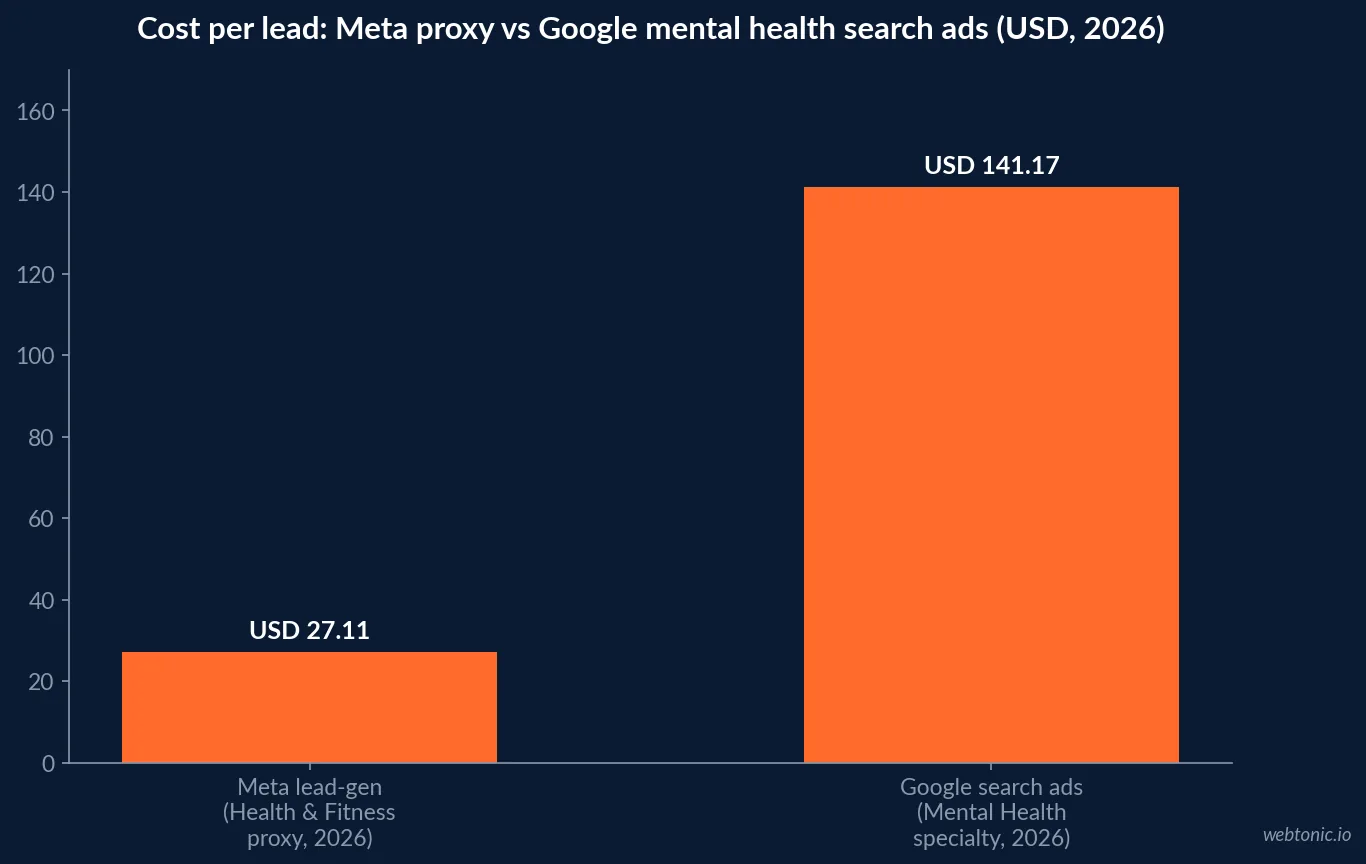
- Meta lead-gen cost per lead is USD 27.11 for Health & Fitness
- against USD 141.17 per lead on Google search ads for the Mental Health specialty directly.
- All-industries Meta lead-gen CTR is 2.70% and CPC is USD 1.80.
- 23.1% of US adults (59.3 million people) live with a diagnosable mental illness.
- 56% of psychologists reported no openings for new patients in APA's 2023 survey.
- 69% of psychologists with a waitlist reported an average wait of up to three months.
- Google requires LegitScript Certification to advertise addiction-recovery services at all.
Meta Ads benchmarks for counseling practices, read through the closest proxy category
No public benchmark study breaks Meta ad data out for "mental health and counseling" the way Google-search benchmarks do. The closest tracked category in LocaliQ by WordStream's 2026 Facebook Ads Benchmarks (roughly 1,800 US campaigns across 20 industries) is Health & Fitness, and every figure below is that cross-industry proxy, not a mental-health-specific number -- label it that way in any report you build from it.
| Meta ads metric (2026, lead-gen objective) | Health & Fitness proxy | All industries | Source |
|---|---|---|---|
| Click-through rate | 3.09% | 2.70% | LocaliQ / WordStream 2026 |
| Cost per click | USD 1.84 | USD 1.80 | LocaliQ / WordStream 2026 |
| Conversion rate | 7.98% | 8.54% | LocaliQ / WordStream 2026 |
| Cost per lead | USD 27.11 | USD 27.39 | LocaliQ / WordStream 2026 |
| Traffic-objective CTR | 1.86% | 1.93% | LocaliQ / WordStream 2026 |
| Traffic-objective CPC | USD 0.64 | USD 0.60 | LocaliQ / WordStream 2026 |
Why the proxy still beats Google on cost per lead
The one place a hard mental-health-specific number exists is Google search, and it is not flattering: LocaliQ's 2026 Healthcare Search Ads Benchmarks (3,500+ healthcare campaigns) puts Mental Health search-ads cost per lead at USD 141.17, the highest of 16 healthcare specialties tracked, up 146% year over year, alongside the lowest conversion rate in the set at 1.85%. Meta's Health & Fitness proxy at roughly a fifth of that cost per lead is the reason most practices still run both channels rather than picking one.
| Google search vs Meta proxy (2026) | Google Ads, Mental Health specialty | Meta, Health & Fitness proxy |
|---|---|---|
| Click-through rate | 4.46% | 3.09% (lead-gen) |
| Conversion rate | 1.85% | 7.98% (lead-gen) |
| Cost per lead | USD 141.17 | USD 27.11 (lead-gen) |
| Year-over-year CPC move | +42% | Not broken out by category |
What Meta will not let you target, and has not since 2022
Meta's privacy and personal-attributes policy bars ads that assert or imply someone has a health condition, and Meta removed the ability to target ads by sensitive topics -- health, sexual orientation, religion, political affiliation -- for all advertisers starting January 19, 2022. A counseling practice can build audiences on geography, age, and broad interest categories such as self-improvement or wellness, but cannot build an audience of "people likely depressed" or similar, and copy implying a viewer has a diagnosis is a policy violation, not just poor practice.
The 2025 event-data limits that now shape every setup
Meta introduced new restrictions on standard conversion events for health-adjacent advertisers in January 2025 and widened them again in July 2025. The change limits how bottom-of-funnel events -- leads, purchases, an "appointment booked" event -- can be used for optimization and reporting, because combining a named health-adjacent event with Meta's own user signals could reconstruct information that counts as protected health information even when no clinical data is sent directly. In practice a counseling practice now optimizes toward broader, less clinically specific events (page view, form start) more than it optimizes toward the exact conversion it cares about.
Our performance creative team treats this as a measurement-architecture problem first: decide which events are safe to send before deciding which creative to run against them.
| Meta policy milestone | Date | What it restricts |
|---|---|---|
| Sensitive-topic targeting removed | Jan 19, 2022 | Ad audiences built on health, religion, political and sexual-orientation signals |
| Health & Wellness ad-standards policy | Ongoing | Claims and age-gating for dietary, health and weight-related ads |
| Health-and-wellness event-data limits, phase 1 | Jan 2025 | Bottom-of-funnel event optimization for health-adjacent advertisers |
| Health-and-wellness event-data limits, phase 2 | Jul 2025 | Further restriction of custom parameters and event detail |
Two settlements that made the 2025 limits inevitable
Meta's tightening did not happen in a vacuum. The FTC's March 2023 order against BetterHelp required the telehealth counseling brand to pay USD 7.8 million to consumers after it shared email addresses, IP addresses and mental-health questionnaire answers with Facebook and other platforms from 2013 through December 2020. The FTC's April 2024 order against Cerebral went further, with a penalty of more than USD 7 million after roughly 3.2 million consumers' data reached LinkedIn, Snapchat and TikTok through website tracking tools for advertising and analytics. Neither company is a small solo practice, but the tracking mechanism the FTC objected to -- a pixel sending identifiable, health-adjacent events to an ad platform -- is the same mechanism every practice running Meta Ads has installed on its site.
Where HIPAA guidance stands, in one paragraph
There is no bright-line tracking-technology safe harbor to lean on. A federal court in the Northern District of Texas vacated part of HHS OCR's online-tracking guidance in June 2024 in American Hospital Association v. Becerra, and OCR withdrew its appeal that September without publishing replacement guidance -- a gap that, per legal trackers following the case, still has not been filled. That means a practice's Meta Pixel and Conversions API configuration is governed by ordinary HIPAA Privacy Rule and FTC Act exposure rather than by settled tracking-specific rules, which is exactly why the safest working rule is still: never send a clinical identifier, diagnosis, or service-type label as a named event parameter to Meta.
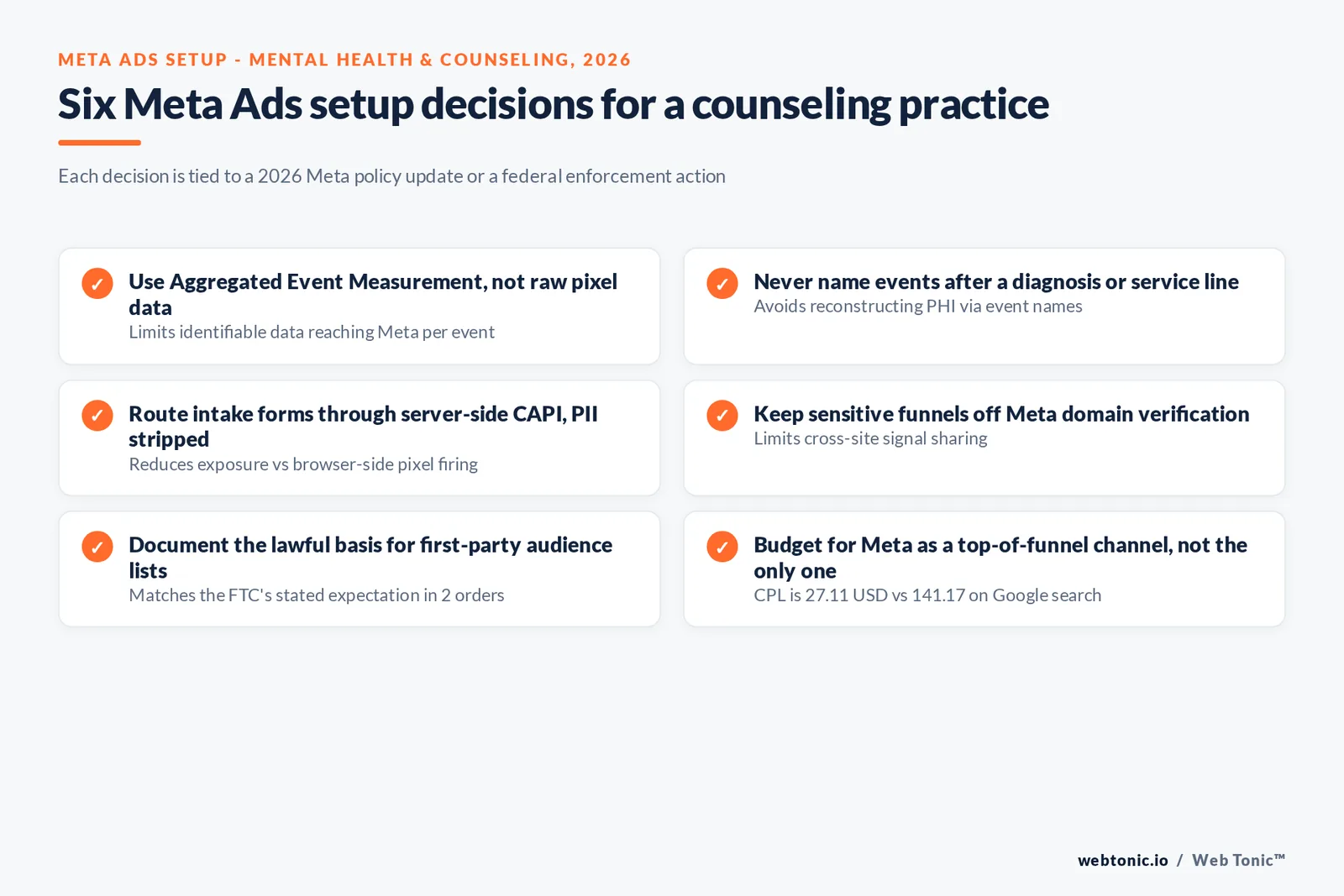
| Setup decision | Why it matters for counseling advertisers |
|---|---|
| Use Aggregated Event Measurement, not raw pixel data, for conversions | Limits what identifiable data reaches Meta per event |
| Never name events after a diagnosis or service line | Avoids reconstructing protected health information via event names |
| Route intake forms through server-side CAPI with PII stripped | Reduces exposure versus browser-side pixel firing |
| Keep landing pages off the Meta domain verification for sensitive funnels | Limits cross-site signal sharing |
| Document the lawful basis for any first-party audience list | Matches FTC's stated expectation in both settlements |
Creative and copy constraints that follow from the targeting policy
Because Meta bars ads that assert or imply a health condition, the safest and most compliant creative pattern for this category speaks to the service and the outcome rather than to a diagnosis. "Talk to someone this week" performs the same job as "struggling with anxiety?" without tripping the personal-attributes rule, and it also reads better to a broad interest-based audience that was never segmented by condition in the first place. Practices that lean on outcome-and-access language consistently avoid the disapproval cycle that condition-specific hooks tend to trigger in review.
| Ad copy pattern | Meta policy risk | Better alternative |
|---|---|---|
| "Do you have depression?" | Implies a health condition about the viewer | "Feeling stuck lately? Talk to someone." |
| "For people with anxiety disorders" | Condition-based audience implication | "For anyone who wants a calmer week" |
| Testimonial naming a diagnosis | Health-condition disclosure risk + ethics concern | Outcome-focused testimonial, no diagnosis named |
| "We treat [specific disorder]" in headline | Fine on its own, risky paired with narrow targeting | Pair broad targeting with a services page, not a condition-matched ad set |
Retargeting after the 2025 event limits
The event-data restrictions do not eliminate retargeting; they change what a practice retargets on. Page-view and content-engagement events remain available for custom audiences, which means a practice can still build a warm-audience retargeting pool from people who visited a services page, without naming that page's specific condition inside the event itself. The audience is built from behavior (visited, scrolled, watched a video) rather than from inference about diagnosis, which keeps the setup inside both Meta's policy and the conservative HIPAA posture described above.
| Retargeting event (post-2025 limits) | Still usable for custom audiences? | Note |
|---|---|---|
| Page view on a general services page | Yes | Behavior-based, no condition named |
| Video view, 50%+ watched | Yes | Strong warm-audience signal |
| "Appointment booked" named event | Restricted for optimization in health-adjacent accounts | Use for reporting only where allowed |
| Lead form completion with health fields | Avoid sending health-field content as event data | Strip PII/health fields before firing |
A short setup checklist before launch
Confirm domain verification and Aggregated Event Measurement are configured before spending a dollar, confirm every custom event name is behavior-based rather than diagnosis-based, and confirm the practice's own privacy policy discloses what data (if any) reaches Meta. Our Facebook Ads pricing breakdown and our page on choosing a Facebook Ads agency both cover the operational side of this in more depth than a benchmark page can, and our Meta Ads service page outlines how our team handles the health-and-wellness event-mapping work specifically.
How this differs from the local SEO and search picture
Meta is a discovery and retargeting channel; it is not where most therapy-seekers start their search. The Google-side data on this same industry -- reviewed in detail on this series' local SEO page -- shows search intent concentrated on map-pack listings, directories, and organic results first, with Meta more often catching someone earlier in the funnel, before they have typed a specific search query. Budgeting Meta as an awareness-and-retargeting layer rather than a primary lead source matches both the cost data above and this funnel logic.
What this means for budget allocation
The practical read: Meta is the cheaper acquisition channel on a per-lead basis using the closest available proxy data, but it carries more measurement risk and less targeting precision than search. A practice that wants both efficiency and compliance typically runs Meta for top-of-funnel awareness and retargets warm visitors with search ads once intent is clearer, rather than optimizing Meta itself toward the exact clinical conversion. If you want that measurement architecture built correctly the first time, our growth marketing practice can walk through the event map before a single dollar is spent, and our breakdown of whether Facebook ads are worth it covers the ROI math for a broader set of industries.
Frequently Asked Questions
Can a counseling practice target people who show interest in mental health on Meta?
Not by health condition. Meta removed ad targeting based on sensitive topics, including health, in January 2022 and has not restored it. A practice can target by geography, age, and broad interest categories like wellness or self-improvement, but not by inferred diagnosis or condition, and claims implying someone or their family has a mental health condition are against Meta's privacy and personal-attributes policy.
What changed with Meta's 2025 health-and-wellness event limits?
Starting in January 2025 and expanded again in July 2025, Meta restricted the use of standard bottom-of-funnel conversion events -- leads, purchases, appointment sign-ups -- for advertisers in health-adjacent categories, because pairing a named event like "intake form submitted" with Meta's user-level signals could reconstruct protected health information. Counseling practices lose some optimization and reporting precision as a direct result, even when they have never had a data incident of their own.
Why do FTC settlements against BetterHelp and Cerebral matter for a private practice's Meta pixel?
Both cases show the exposure is real, not theoretical. The FTC's 2023 order against BetterHelp followed the company sharing email addresses, IP addresses, and mental-health questionnaire answers with Facebook and other ad platforms for six years, and its 2024 order against Cerebral followed roughly 3.2 million consumers' data reaching LinkedIn, Snapchat, and TikTok through website tracking tools. A solo practice's Meta Pixel and CAPI setup sit on the same legal footing.
Does HIPAA guidance protect a practice that installs the Meta Pixel on its site?
No settled floor exists. A federal court in Texas vacated part of HHS OCR's online-tracking guidance in June 2024, and OCR withdrew its appeal months later without issuing a replacement. That leaves a practice's Meta Pixel and Conversions API configuration governed by ordinary HIPAA and FTC Act exposure, not by a specific tracking-technology safe harbor, so the safest posture is still to keep clinical identifiers out of any event sent to Meta.
Is Meta worth the budget for a counseling practice compared with search ads?
The lead-generation numbers argue for testing it carefully rather than skipping it. Cross-industry Meta lead-campaign benchmarks for the closest tracked category, Health & Fitness, show a cost per lead near USD 27, well under Google's mental-health search benchmark of USD 141 per lead. The trade-off is precision: Meta cannot target by condition, so creative and landing-page qualification have to do the work that condition-based targeting would have done on almost any other channel.
Sources
LocaliQ / WordStream - 2026 Facebook Ads Benchmarks
LocaliQ - Healthcare Search Ads Benchmarks for 16 Specialties, 2026
Meta Transparency Center - Privacy violations and personal attributes policy
Federal Trade Commission - FTC order against BetterHelp, 2023
Federal Trade Commission - FTC order against Cerebral, 2024
eCFR - 45 CFR Part 164, HIPAA Privacy Rule (definition of protected health information)
American Psychological Association - 2023 Practitioner Pulse Survey press release
National Institute of Mental Health - Mental Illness statistics