Table of contents
No one buys a therapy session from a LinkedIn ad. The honest audience is an employer deciding on an Employee Assistance Program or benefits package, and a practice trying to recruit licensed clinicians in a tight labor market. Both budgets moved since 2024, and this page tracks what actually shifted rather than pretending LinkedIn is a patient-acquisition channel for this category.
Key Takeaways
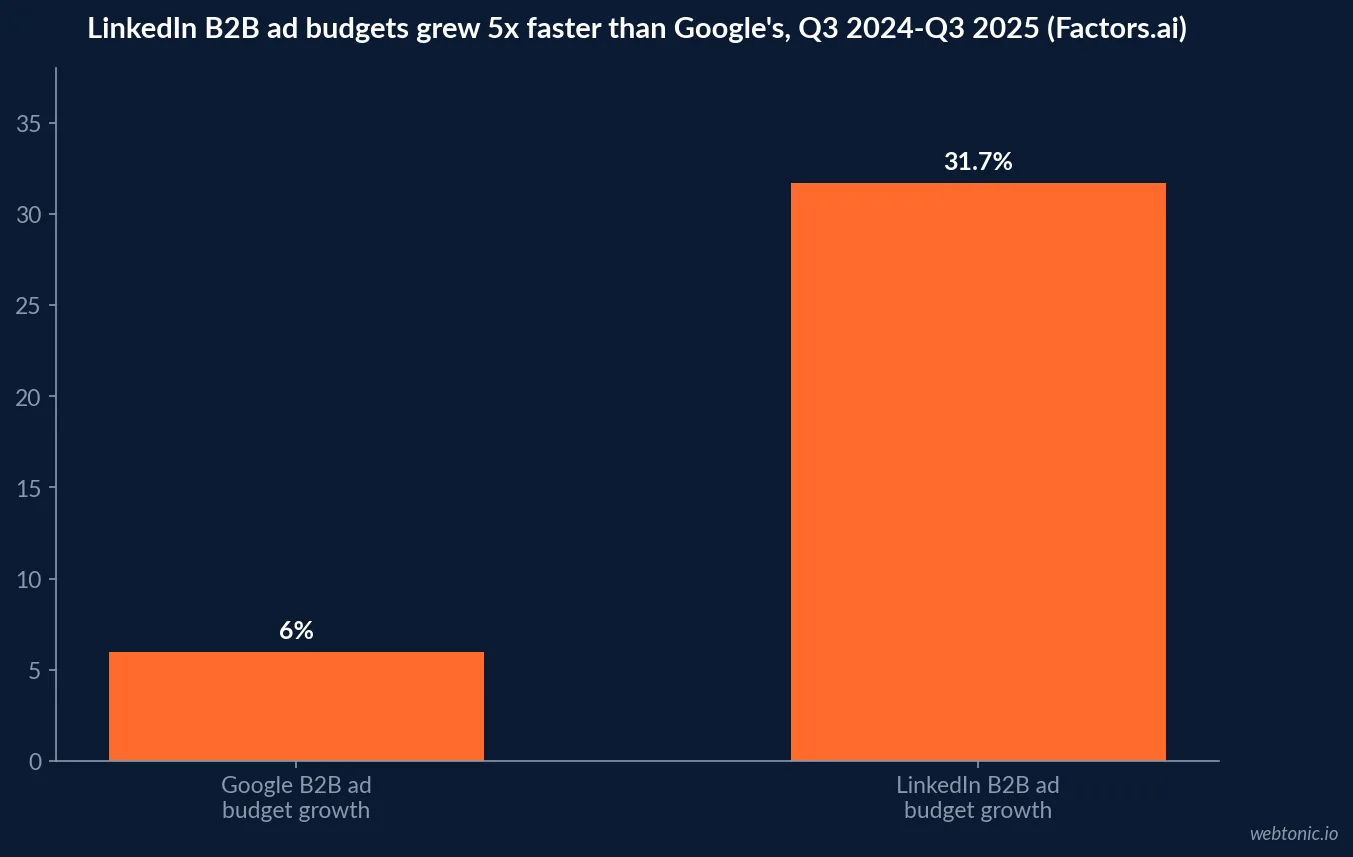
- LinkedIn B2B ad budgets grew 31.7% between Q3 2024 and Q3 2025, per Factors.ai.
- Google ad budgets grew just 6% over the same period, a 5x gap in growth rate.
- Brand awareness and engagement campaigns rose from 17.5% to 31.3% of LinkedIn spend in a year.
- 72% of employers offer an Employee Assistance Program, per EBRI's 2025 survey.
- 54% of employers offer a wellness program alongside it.
- Clinical talent on LinkedIn grew 34% to more than 8.4 million members over five years.
- LinkedIn turned USD 1 of lead-gen spend into USD 10.20 of pipeline, Metadata's 2026 report found.
- Average LinkedIn cost per lead runs USD 202, against USD 138 for Instagram and USD 145 for Facebook.
- LinkedIn lead-gen forms cost USD 193 a lead versus USD 346 for a landing page click.
- Document ads produce the cheapest LinkedIn lead at USD 142, ahead of image ads at USD 200.
- Dreamdata's tracked LinkedIn ROAS rose from 113% in 2025 to 121% in 2026.
- Metadata's 2026 dataset spans USD 57.6 million in tracked ad spend across 153 advertisers.
- 52.1% of adults with a mental illness received treatment in 2024, the demand context behind employer benefit decisions.
The budget shift: LinkedIn grew five times faster than Google
The clearest evidence that something changed since 2024 comes from Factors.ai's 2026 benchmark report, which tracked B2B ad spend directly: LinkedIn advertising budgets increased by 31.7% between Q3 2024 and Q3 2025, while Google ad spend grew by just 6% over the same window - a five-times gap in growth rate for the two channels a B2B buyer, including an HR benefits buyer, is most likely to see an ad on.
The same report found a shift in what those LinkedIn budgets bought: the share of campaigns classified as Brand Awareness and Engagement, rather than direct lead generation, rose from 17.5% to 31.3% of LinkedIn spend over the trailing 12 months. For an employer-benefits sale - a considered purchase with a procurement cycle, not an impulse click - that shift toward top-of-funnel trust-building matches how the actual buying process works better than a lead-form push does.
| Metric | Prior period | Current period | Source |
|---|---|---|---|
| LinkedIn B2B ad budget growth | - | +31.7% (Q3 2024-Q3 2025) | Factors.ai 2026 |
| Google B2B ad budget growth | - | +6% (same period) | Factors.ai 2026 |
| LinkedIn brand awareness/engagement share of spend | 17.5% | 31.3% | Factors.ai 2026 |
| Dreamdata-tracked LinkedIn ROAS | 113% (2025) | 121% (2026) | Dreamdata |
Buyer one: the employer deciding on an EAP
EBRI's 2025 Employer Mental Health Survey found Employee Assistance Programs are offered by 72% of employers surveyed, with wellness programs offered by 54% - both already common enough that the LinkedIn sales conversation is usually about switching or expanding a benefit, not introducing the category from scratch. That is a fundamentally different message than "book a session," and it explains why the Factors.ai shift toward brand and engagement content fits this audience: an HR leader evaluating benefit vendors is building a shortlist over weeks, not clicking a single ad to convert.
The demand context behind that buying decision is real: SAMHSA's 2024 NSDUH data found 52.1% of adults with any mental illness received treatment in the past year, which means an employer's benefit choice is not a hypothetical perk - for roughly half of employees who would need it, it is the difference between reaching care and not.
| Employer benefit (EBRI 2025) | Share of employers offering it |
|---|---|
| Employee Assistance Program (EAP) | 72% |
| General wellness program | 54% |
Buyer two: the practice recruiting clinicians
LinkedIn's own hiring data shows clinical talent on the platform has increased 34% to more than 8.4 million members over the past five years. LinkedIn's healthcare talent research frames this as a supply story: even amid widely reported staffing shortages, the pool of clinical professionals actively present on the platform keeps growing year over year, which is a larger and more specific candidate audience than a general job board search reaches.
For a mental health practice competing for licensed counselors, psychologists and therapists in a market where the APA's 2025 Practitioner Pulse Survey found 46% of psychologists still report no openings for new patients, a recruiting ad is arguably the more defensible LinkedIn spend of the two - it targets a documented, named professional audience rather than trying to reach patients on a platform they are not using for that purpose.
The cross-industry cost floor, honestly labeled
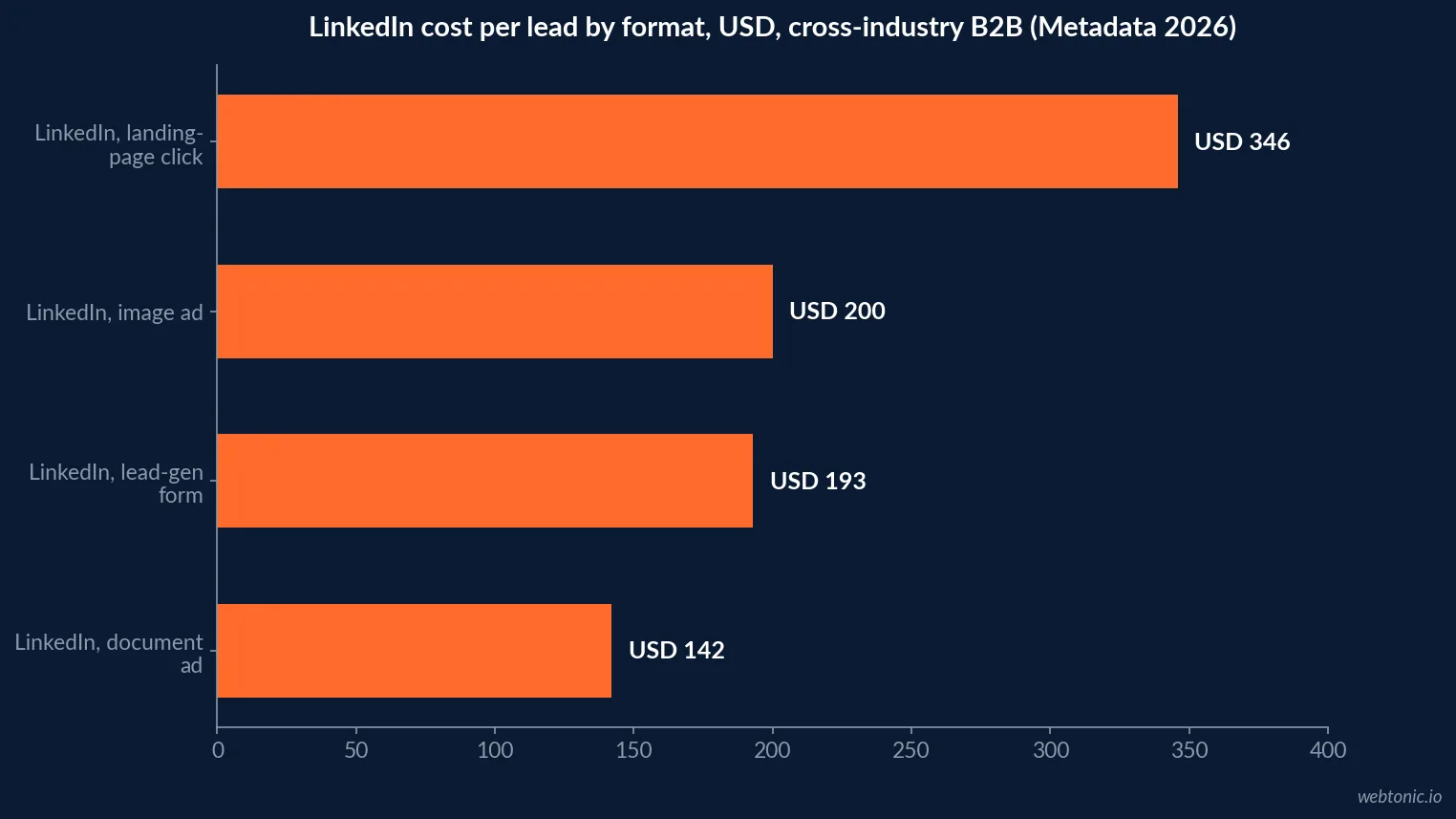
No benchmark publisher breaks LinkedIn costs out for mental health or behavioral health specifically. Metadata's 2026 B2B Paid Media Benchmark Report, built from USD 57.6 million in tracked ad spend across 153 advertisers with results joined to CRM data, is the clearest available cross-industry floor: LinkedIn turned USD 1 of lead-gen spend into USD 10.20 of pipeline, and average LinkedIn cost per lead ran USD 202, against USD 138 for Instagram and USD 145 for Facebook. Within LinkedIn's own formats, lead-gen forms cost USD 193 a lead against USD 346 for a full landing-page click, and document ads produced the cheapest lead of any format at USD 142.
| Channel or format | Cost per lead (USD) | Scope |
|---|---|---|
| LinkedIn, average across formats | 202 | Cross-industry B2B |
| Instagram, average | 138 | Cross-industry B2B |
| Facebook, average | 145 | Cross-industry B2B |
| LinkedIn lead-gen form | 193 | Cross-industry B2B, LinkedIn-native format |
| LinkedIn landing-page click | 346 | Cross-industry B2B, off-platform format |
| LinkedIn document ad | 142 | Cross-industry B2B, cheapest LinkedIn format tracked |
Source: Metadata, 2026 B2B Paid Media Benchmark Report (n=153 advertisers, USD 57.6 million tracked spend). Cross-industry B2B figures, not specific to mental health or healthcare.
Reading the shift alongside the access data
The budget and format numbers only matter if they connect back to why an employer or a practice would spend at all. The APA's 2025 Practitioner Pulse Survey found 46% of psychologists still report no openings for new patients, even as that figure improves - which is exactly the capacity problem an employer's EAP vendor decision and a practice's recruiting budget are both trying to solve from opposite ends. An employer buying more EAP capacity and a practice hiring more clinicians are, in effect, both bidding against the same shortage, just through different LinkedIn campaigns.
That is also why the shift toward brand and engagement content noted above makes structural sense: a shortage market rewards being known and trusted before the RFP or the job posting goes out, not just being present with a lead form when it does.
| Shortage signal | Figure | Source |
|---|---|---|
| Psychologists with no new-patient openings, 2025 | 46% | APA Practitioner Pulse 2025 |
| Adults with any mental illness who received treatment, 2024 | 52.1% | SAMHSA 2024 NSDUH |
| Clinical talent growth on LinkedIn, past 5 years | +34% to 8.4M+ members | LinkedIn Talent Solutions |
A useful test for whether a LinkedIn campaign is aimed correctly: if the ad copy could be read aloud to an HR director or a hiring manager without sounding like it was misdirected, it is probably targeting the right audience. If it reads like a patient-facing offer, it is very likely wasting spend on a platform where that buyer does not go looking for care.
| Wrong audience signal | Right audience fix |
|---|---|
| Ad copy addresses "you" as someone in distress | Address a benefits decision-maker or hiring manager instead |
| CTA is "Book a session" | CTA is "Download the benefits brief" or "See open roles" |
| Targeting is broad / interest-based | Targeting is job title, seniority and company size |
| Success metric is patient leads | Success metric is SQLs (employer) or applications (recruiting) |
What to actually run on LinkedIn in 2026
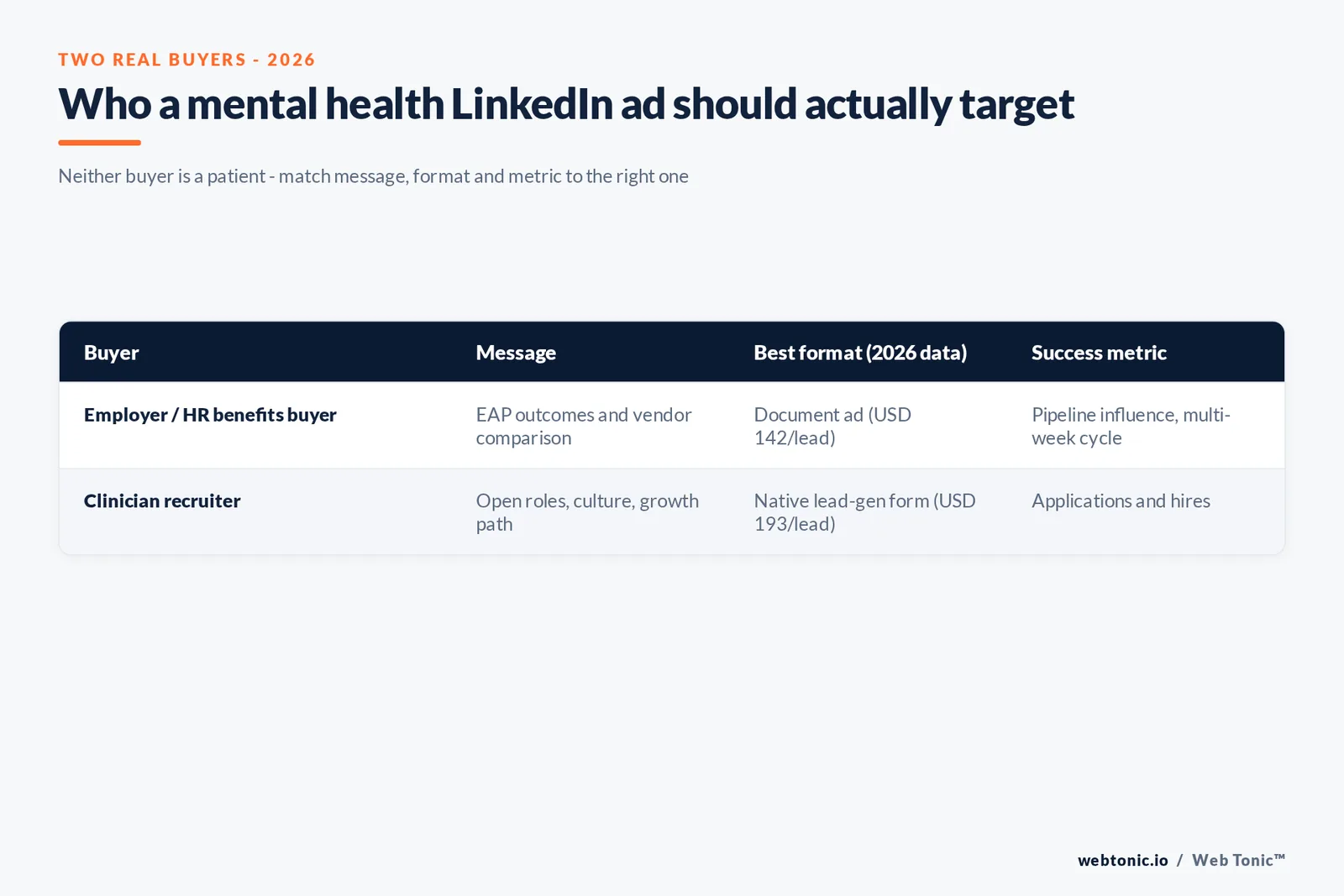
Split the account into two campaigns with two audiences and two success metrics, rather than one generic "mental health LinkedIn ads" campaign. Target HR and benefits titles with brand and engagement content - a document ad summarizing outcomes data performs cheapest per the 2026 format data - and judge it on pipeline influence over a multi-week sales cycle, not last-click leads. Target clinical job titles and recent graduates separately with a recruiting campaign, and judge that one on applications and hires, using LinkedIn's own 8.4 million-member clinical talent pool as the reason the channel is worth the spend at all.
Our growth marketing team can help scope which of the two campaigns matters more for a given practice's growth stage, and our cost-per-lead benchmarks by industry put LinkedIn's cross-industry numbers above in wider context. For the video assets both campaign types lean on, see our data on performance creative work.
Frequently Asked Questions
Who is actually the buyer for a mental health LinkedIn ad?
Almost never the patient. LinkedIn is a professional network, and two buyers make sense there: an employer or HR/benefits leader deciding whether to add or expand an Employee Assistance Program, and a practice or health system trying to recruit clinicians. EBRI's 2025 Employer Mental Health Survey found EAPs are offered by 72% of employers surveyed and wellness programs by 54%, which is the audience a LinkedIn campaign should target with message and creative, not a general consumer audience.
What changed in LinkedIn ad economics since 2024?
Budget mix moved decisively toward LinkedIn. Factors.ai's 2026 benchmark report found B2B marketing budgets on LinkedIn grew 31.7% between Q3 2024 and Q3 2025, against just 6% growth in Google ad spend over the same period - a five-times difference in growth rate. The same report found the share of LinkedIn campaigns dedicated to brand awareness and engagement, rather than direct lead generation, jumped from 17.5% to 31.3% over the trailing 12 months, a shift toward top-of-funnel trust-building that matches the employer-benefits sales cycle better than a lead form does.
Is there a mental-health-specific LinkedIn cost benchmark?
No, and none of the major B2B benchmark reports break healthcare or mental health out as its own line. Metadata's 2026 B2B Paid Media Benchmark Report, built from USD 57.6 million of tracked ad spend across 153 advertisers, found LinkedIn turned every dollar of lead-gen spend into USD 10.20 of pipeline and put average LinkedIn cost per lead at USD 202, against USD 138 for Instagram and USD 145 for Facebook. Those are cross-industry B2B figures, not healthcare-specific, and should be used as a planning floor rather than a mental-health benchmark.
Does clinician recruiting actually work on LinkedIn?
The volume argument is strong. LinkedIn's own hiring data shows clinical talent on the platform grew 34% to more than 8.4 million members over five years, and LinkedIn's talent solutions team has published case studies of health systems using the platform specifically to fill clinical roles at scale. For a mental health practice competing for licensed counselors and therapists in a documented shortage, that is a larger and more specific candidate pool than a general job board offers.
What ad format works best for the EAP/employer audience?
Format data from Metadata's 2026 B2B Benchmark report, again cross-industry rather than mental-health-specific, shows LinkedIn document ads producing the cheapest leads at USD 142, ahead of image ads at USD 200, and LinkedIn's native lead-gen forms costing USD 193 per lead against USD 346 for driving traffic to a full landing page. For an employer-benefits pitch, a document ad - a short benefits one-pager or case study - fits the format that already performs best on the platform and fits how HR buyers actually evaluate a vendor.
Sources
Factors.ai - From Uncertainty to Opportunity: LinkedIn Benchmarks for B2B Success, 2026
Metadata - 2026 B2B Advertising Benchmark, document ad and lead-gen form costs
Dreamdata - LinkedIn Ads Benchmarks Report 2026
Metadata - 2026 B2B Paid Media Benchmark Report
Employee Benefit Research Institute - 2025 Employer Mental Health Survey
LinkedIn Talent Solutions - Hiring healthcare talent
LinkedIn Talent Blog - Recruiting healthcare workers
SAMHSA - 2024 National Survey on Drug Use and Health, highlights
American Psychological Association - 2025 Practitioner Pulse Survey