Table of contents
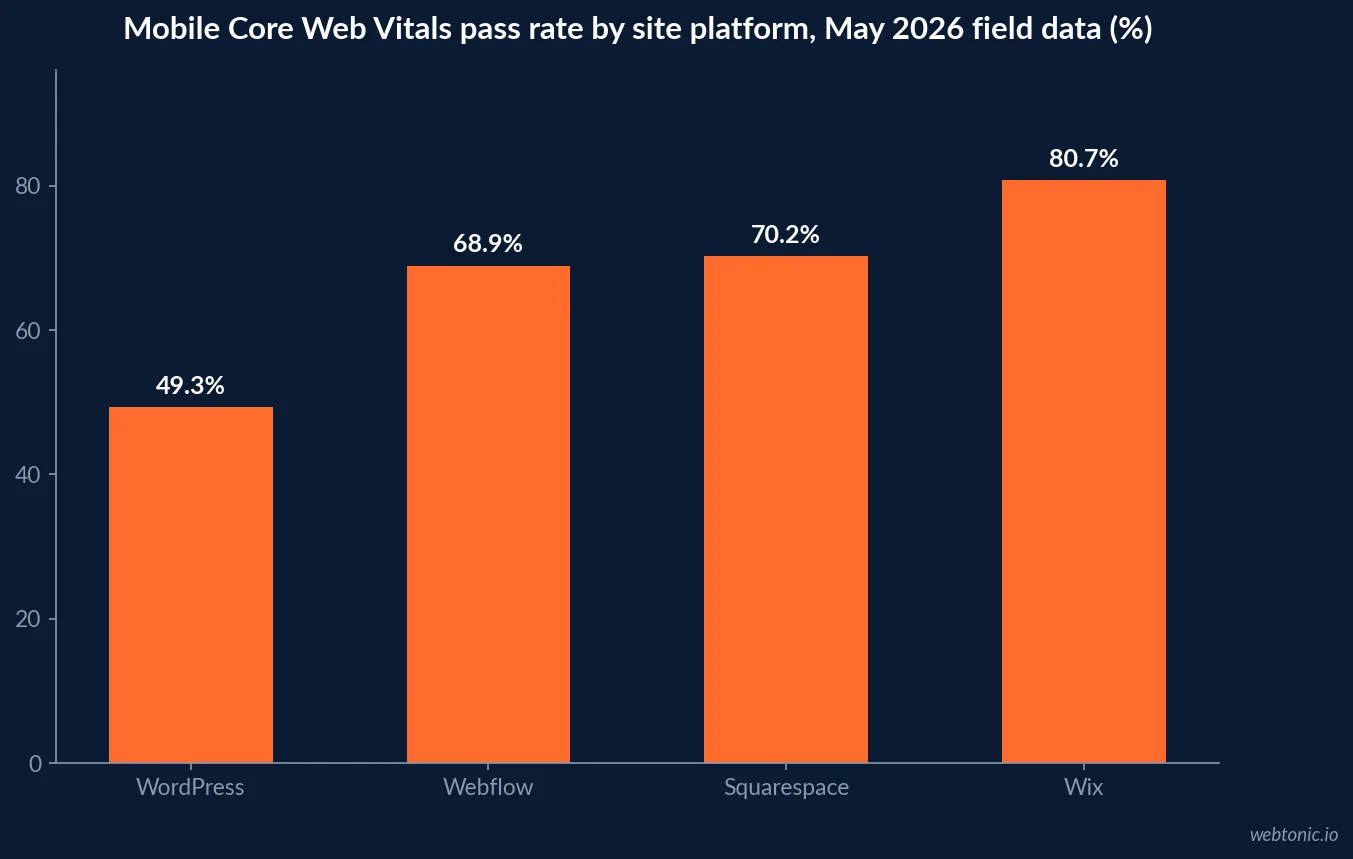
Webflow origins pass mobile Core Web Vitals at 68.9% against 49.3% for WordPress, and ship the lightest combined image-and-script payload of the major site builders. Webflow also does not sign a Business Associate Agreement. For a medical spa, those two facts define the entire platform decision.
Key Takeaways
- Webflow origins pass all three mobile Core Web Vitals at 68.9%, against 49.3% for WordPress, 70.2% for Squarespace and 80.7% for Wix (May 2026 CrUX via HTTP Archive).
- 55.5% of Webflow origins hit good mobile TTFB versus 24.8% of WordPress origins — the single widest platform gap in the field data.
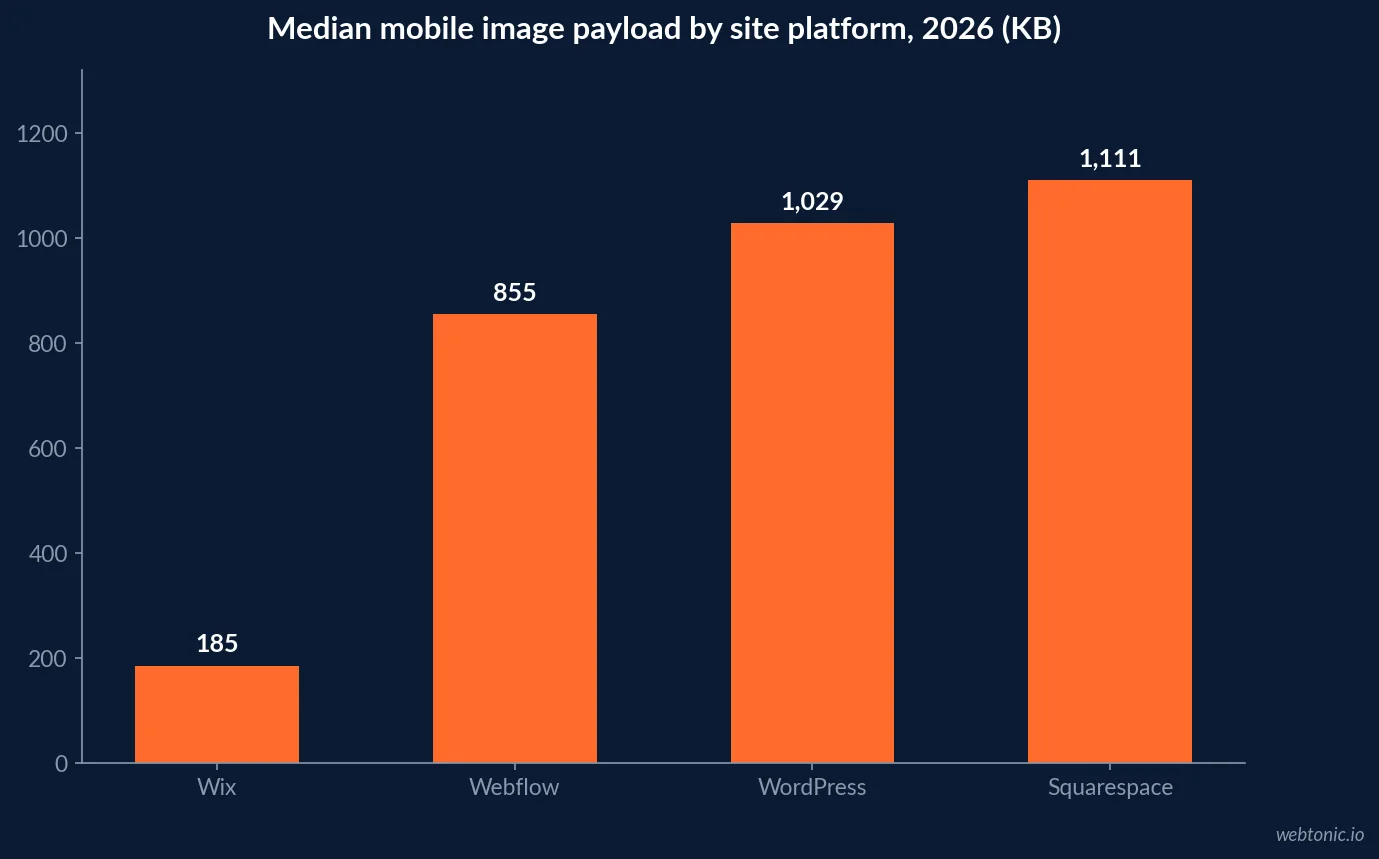
- Webflow has the lightest combined mobile payload: 855 KB median images plus 918 KB median JavaScript.
- The 2026 Web Almanac measured Webflow ahead of WordPress by roughly 410 ms on median LCP and 0.03 on median CLS.
- A 47-site agency sample recorded average LCP of 2.1s on Webflow versus 2.8s on WordPress, INP of 190 ms versus 280 ms, and mobile Lighthouse of 68 versus 42.
- Webflow is not HIPAA compliant and provides no BAA; its native analytics collect IP addresses and form interaction data.
- A BAA-signed embedded form vendor covers roughly 90% of practice use cases without a reverse proxy.
- Webflow powers about 0.8% of all websites and 1.2% of sites with an identifiable CMS — roughly 822,550 live sites, up from 544,053 two years earlier.
- Webflow appeared on 2.1% of analyzed home pages in the 2026 Web Almanac, up from 1.4% in 2025.
- Enterprise CMS limits now exceed one million items per site with up to 100 fields and 20 reference fields per collection.
- 95% of marketing leaders say current website governance practices hurt their ability to manage sites, and 52% will prioritise AI-search optimisation in 2026.
- Average med spa website conversion sits at 2–3% while top performers reach 8–12%; a second benchmark set puts the average at 3–5% and top performers at 6–10%.
- Before-and-after galleries convert at about 2.3x the rate of pages without them — and they are the heaviest asset on the page.
- 65–75% of med spa organic search traffic arrives on mobile, which is where the payload gap is decided.
- Webflow revenue reached $213M in 2024, up 66% from $128M, at a $4B valuation on $334.9M of funding.
- US adoption leads at 160,696 sites, ahead of the UK (14,891), Germany (14,510), Australia (8,233) and Canada (8,106).
- Webflow e-commerce stores grew 647.81% over three years to 12,501 active stores — relevant to practices selling skincare alongside treatments.
The Platform Performance Numbers
The cleanest read on platform speed is field data rather than lab tests, because it captures how a stack is actually deployed. PageSpeed Matters analysed every origin on each major builder using Chrome UX Report data from the May 2026 HTTP Archive crawl. The result is not the ranking most agencies quote.
| Metric (mobile field data) | Webflow | WordPress | Squarespace | Wix |
|---|---|---|---|---|
| Passing all three Core Web Vitals | 68.9% | 49.3% | 70.2% | 80.7% |
| Good TTFB share | 55.5% | 24.8% | 80.8% | 66.9% |
| Median JavaScript weight | 918 KB | 692 KB | 1,571 KB | 1,707 KB |
| Median image weight | 855 KB | 1,029 KB | 1,111 KB | 185 KB |
| Combined median payload | 1,773 KB | 1,721 KB | 2,682 KB | 1,892 KB |
| Optimisation ceiling | Medium-high | Very high | Low | Low |
Two things in that table matter for an aesthetic practice. First, Webflow does not win the pass-rate race — Wix does, on the back of an aggressive image CDN that ships a 185 KB median image payload. Second, Webflow wins the race that a med spa actually runs, because Webflow combines a competitive pass rate with a 855 KB median image payload and real design control. A med spa site is an image-heavy artefact by definition; a platform that constrains creative to hit its numbers is not a viable option when the before-and-after gallery is the highest-converting element on the page.
The TTFB spread deserves its own note. Only 24.8% of WordPress origins reach good mobile TTFB against 55.5% on Webflow, and that is a hosting-quality artefact rather than a software one — WordPress runs on everything from $3 shared plans to enterprise clusters. A practice that chooses WordPress is implicitly choosing to buy and maintain hosting, caching and image optimisation as separate line items. On Webflow those come bundled with a Fastly-backed CDN, automatic srcset generation and WebP conversion.
Where The Webflow Advantage Actually Comes From
A 47-site sample tracked over 12 months puts numbers on the mechanism: average LCP of 2.1s on Webflow against 2.8s on WordPress, INP of 190 ms against 280 ms, CLS of 0.06 against 0.12, and 67% of Webflow sites passing all Core Web Vitals against 38% of the WordPress cohort. Mobile Lighthouse averaged 68 versus 42.
The reason is constraint, not superior engineering. You cannot install a slider plugin on Webflow that quietly adds 400 KB of render-blocking JavaScript, because there are no plugins. The average WordPress install carries 20–30 active plugins and page builders can push DOM size past 3,000 nodes on a simple landing page. Webflow removes that failure mode by removing the option.
The same constraint cuts the other way. Custom code embeds — the booking widget, the financing calculator, the review carousel, the chat bubble — are how anything non-trivial reaches a Webflow page, and they are the most common cause of poor INP on Webflow sites. Web Almanac analysis of Webflow builds found the platform ahead of WordPress by roughly 410 ms on median LCP and 0.03 on median CLS while appearing on 2.1% of analysed home pages, up from 1.4% the year before. Platform-level averages are earned by default builds; a med spa site with four embeds and a full-screen video hero can sit well below them.
The HIPAA Wall
This is the part that gets skipped in platform comparisons and then discovered during a compliance review. Webflow is not HIPAA compliant out of the box and does not offer Business Associate Agreements. Three distinct exposures follow from that.
| Exposure | What Webflow does | Practice consequence |
|---|---|---|
| Native forms | Processes and stores submissions without BAA coverage | No symptom, medication or treatment-reason fields |
| Built-in analytics | Collects IP, device, form interaction and session data | Treatment-specific page data can become identifiable |
| Hosting and storage | Distributed servers, limited customer visibility | Cannot document where data resides for an audit |
| Third-party embeds | Scheduling, chat, marketing automation widgets | Each integration needs its own BAA assessment |
| Cookie and pixel tracking | Deployed by default | Ad-platform pixels on treatment pages are the classic violation |
The accepted remedy is architectural. The recommended pattern is a split site: Webflow serves the marketing layer with zero PHI, and a HIPAA-eligible platform handles anything clinical — intake, portals, records, appointment reasons. Practitioners who build these regularly report that a BAA-signed embedded form vendor covers roughly 90% of use cases, with a reverse proxy needed only in the remaining edge cases.
For a med spa the line is finer than for a hospital, because much of what a practice collects is genuinely non-clinical: name, email, "I’d like to book a consultation". The moment the form asks which treatment, or offers a "describe your concern" box, or the thank-you page fires an ad pixel, the data has crossed into territory where a BAA is the difference between a marketing asset and a liability. Build the booking flow assuming it will cross that line, because patients will put clinical detail into any open text field you give them.
Adoption And Vendor Stability
Platform risk is a fair question for an asset a practice will run for five years. The 2026 adoption data shows a small but fast-compounding base.
| Webflow indicator | 2026 figure | Direction |
|---|---|---|
| Share of all websites | 0.8% | Up from about 0.4% in 2021 |
| Share of sites with an identifiable CMS | 1.2% | Rising |
| Live sites detected | About 822,550 | Up from 544,053 two years earlier |
| Share of analysed home pages (Web Almanac) | 2.1% | Up from 1.4% in 2025 |
| Annual revenue | $213M (2024) | Up 66% from $128M |
| Valuation and funding | $4B on $334.9M raised | Stable |
| Active e-commerce stores | 12,501 | Up 647.81% over three years |
Geographic concentration is heavily US-weighted: 160,696 Webflow sites in the United States against 14,891 in the UK, 14,510 in Germany, 8,233 in Australia and 8,106 in Canada. For a US practice that means a deep local agency and freelance market — the practical difference between a platform you can staff and one you cannot.
The governance data is the underrated argument. Webflow’s own 2026 research reports 95% of marketing leaders saying current website governance practices hurt their ability to manage sites, and 52% planning to prioritise optimisation for AI-driven search. For a practice where the office manager updates pricing and the injector wants a new treatment page live before a launch weekend, the ability to publish without a developer is not a nice-to-have; it is the reason the site stays accurate.
What The Speed Gap Is Worth In Bookings
Platform metrics only matter if they convert. Aesthetic-practice conversion data puts the average med spa website at 2–3% of visitors converting to booked appointments, with top performers at 8–12%. A second 2026 benchmark set reads slightly tighter — 3–5% average, 6–10% for high performers with clear calls to action, online booking and strong social proof — and flags anything under 3% as a structural problem rather than a copy problem. Both sets agree on the shape: the spread between an average and a good aesthetic website is roughly 3x.
| Site tier | Conversion rate | Monthly bookings at 5,000 visits | Typical profile |
|---|---|---|---|
| Below benchmark | Under 2% | Under 100 | Slow mobile load, no gallery, phone-only contact |
| Average practice | 2–5% | 100–250 | Works, unoptimised booking path |
| Strong | 6–8% | 300–400 | Fast mobile, gallery, visible pricing band |
| Top performers | 8–12% | 400–600 | All of the above plus same-day booking and proof |
Two mechanisms connect the platform to that table. First, 65–75% of med spa organic search traffic arrives on mobile according to benchmarks drawn from 34 aesthetic practices, so a mobile payload advantage is not a marginal technical win. Second, the highest-converting element on an aesthetic page — the before-and-after gallery, worth about 2.3x the conversion rate of pages without one — is also the heaviest. Webflow’s automatic responsive image pipeline is precisely the feature that lets a practice ship that gallery without paying for it in LCP. Our med spa landing page statistics break the element-by-element conversion data down further.
Multi-Location Groups And The CMS Question
Single-location practices rarely stress a CMS. Groups do, and this is where Webflow separates from the drag-and-drop builders. Location pages, treatment pages, provider bios and pricing become collection items driven by one template, so a nineteen-market group maintains one design and nineteen rows of data instead of nineteen hand-built pages that drift apart within a year.
Webflow’s next-generation CMS raised enterprise ceilings to over one million CMS items per site, up to 100 fields per collection and 20 reference or multi-reference fields per collection. In practical modelling terms that is enough to relate treatments to providers to locations to price bands, and to generate the treatment-by-city pages that carry local search for a group. Native localization then handles multilingual markets with per-locale metadata rather than a translation plugin.
| Group requirement | Webflow capability | Watch-out |
|---|---|---|
| Location page templates | CMS collection with reference fields | Thin duplicate pages still rank poorly |
| Treatment catalogue | Up to 100 fields per collection | Pricing fields need an owner or they go stale |
| Provider bios by site | Multi-reference to locations | Credential accuracy is a compliance issue |
| Multilingual markets | Native localization with per-locale SEO | Machine translation of clinical copy is a risk |
| Per-location booking | Embedded BAA-covered scheduler | Each embed adds INP cost |
| Retail skincare | 12,501 stores on Webflow e-commerce | Product images inflate mobile payload fast |
The failure mode for groups is not technical capacity — it is content. A CMS makes it trivial to publish forty near-identical location pages, and near-identical location pages are exactly what search engines discount. The template should generate structure; the practice still has to supply market-specific proof, providers and pricing. Our med spa SEO statistics cover how that plays out in rankings.
The Measurement Layer Under A Compliant Build
Once PHI-bearing forms move off Webflow, analytics gets harder in a way most practices discover after the fact: the conversion event now fires on someone else’s domain. That breaks naive last-click attribution, and it is why a compliant med spa stack needs deliberate measurement design rather than default tags.
Three habits keep it honest. Route every booking path through parameters the practice controls, so the scheduler can report source back. Keep treatment-level intent out of URLs and event names that reach ad platforms. And reconcile platform-reported conversions against the practice management system monthly rather than trusting either alone. Our med spa analytics statistics cover the reconciliation gap in detail, and our data intelligence team builds these stacks HIPAA-first.
A Webflow Build Checklist For An Aesthetic Practice
- Decide the PHI boundary before design starts — Webflow provides no BAA, so every clinical field must have a named external home.
- Use a BAA-signed embedded form vendor; it covers roughly 90% of practice use cases without a reverse proxy.
- Remove ad pixels from treatment and thank-you pages — the most common HIPAA marketing violation in aesthetics.
- Budget the gallery in kilobytes: before-and-after content converts at about 2.3x and is your heaviest asset.
- Cap custom code embeds, the leading cause of poor INP on Webflow sites, and measure INP after each one.
- Test on mobile field data, not desktop lab scores — 65–75% of organic traffic is mobile.
- Model locations and treatments as related collections, using the 100-field and 20-reference-field headroom.
- Assign an owner to pricing fields; stale prices in a CMS scale as fast as accurate ones.
- Keep a conversion target of 6% or better — the 2–3% average is a structural problem, not a ceiling.
- Reconcile bookings monthly against the practice management system once forms live off-platform.
Webflow is the right answer for most aesthetic practices for an unglamorous reason: it removes the failure modes a practice cannot staff — hosting, caching, image optimisation, plugin rot — and leaves the two problems only the practice can solve, which are compliance architecture and content quality. If you want that build reviewed against these benchmarks, talk to our team.
Frequently Asked Questions
Is Webflow a good platform for a medical spa website?
For the marketing site, the performance data says yes. Webflow origins pass mobile Core Web Vitals at 68.9% against 49.3% for WordPress, hit good TTFB on 55.5% of origins against 24.8%, and ship the lightest combined mobile image-plus-JavaScript payload of the four major builders at 855 KB of images and 918 KB of scripts. Since 65–75% of med spa organic traffic is mobile, that gap lands directly on booking rate. The limit is compliance: Webflow does not sign Business Associate Agreements, so anything collecting protected health information has to live somewhere else.
Is Webflow HIPAA compliant?
No. Webflow is not HIPAA compliant out of the box and does not provide a Business Associate Agreement, which means protected health information cannot be stored in Webflow forms or its CMS. Its native analytics also collect IP addresses, form interactions and behavioural data that can become identifiable health information when a visitor requests a specific treatment. The standard remediation is a split architecture: Webflow serves the marketing pages with no PHI, and a BAA-covered form vendor or scheduling platform handles everything clinical. Practitioners report that a BAA-signed embedded form covers roughly 90% of practice use cases without needing a reverse proxy.
How much faster is Webflow than WordPress for a med spa site?
In field data from the May 2026 HTTP Archive crawl, Webflow origins pass all three Core Web Vitals on mobile at 68.9% versus 49.3% for WordPress — a 19.6-point gap — and the 2026 Web Almanac measured Webflow ahead of WordPress by roughly 410 ms on median LCP and 0.03 on median CLS. One agency's 47-site sample found average LCP of 2.1s versus 2.8s, INP of 190 ms versus 280 ms and mobile Lighthouse scores of 68 versus 42. The caveat is real: a lean WordPress build on good hosting beats a Webflow site loaded with custom embeds and heavy animation.
Can Webflow handle a multi-location med spa group?
Yes, and this is where its CMS earns its keep. Location and treatment pages are collection items rather than duplicated static pages, so a group can maintain one template and dozens of markets. Webflow's next-generation CMS raised enterprise limits to over one million CMS items per site, up to 100 fields per collection and 20 reference or multi-reference fields, which is enough to model treatments, providers, locations and pricing as related collections. Native localization handles multilingual markets with per-locale SEO metadata.
What does a med spa lose by choosing Webflow?
Three things, in order of practical impact. First, a BAA — which forces a second vendor into the stack for any clinical form. Second, plugin-scale extensibility: complex integrations arrive as custom code embeds, and those embeds are the most common cause of poor INP scores on Webflow sites. Third, platform-level control — when Webflow's own CDN degrades, LCP moves for every site on it and there is no local remedy. For most single-location practices the performance and governance upside still outweighs those constraints.
Sources
PageSpeed Matters — WordPress vs Webflow vs Squarespace vs Wix: CWV Field Data (May 2026 crawl)
Social Animal — WordPress vs Webflow SEO: 2026 Real Performance Data (47 sites)
Pravin Kumar — 2026 Web Almanac Findings and Webflow Site Audits
Popupsmart — 50+ Webflow Statistics for Business Growth (2026)
Webflow — Next-Gen CMS Now Available for Enterprise
Curve Compliance — Is Webflow HIPAA Compliant? Tracking Risks for Medical Practice Sites
Saddle — Building a HIPAA-Compliant Website With Webflow
LoudFace — Webflow for Healthcare 2026: HIPAA and the Architecture Split
Aesthetix Media — Med Spa Website Design: What Makes a High-Converting Site
Sky Highway Marketing — Med Spa Marketing Benchmarks 2026
Authority Specialist — Medical Spa SEO Benchmarks: 2026 Data From 34 Aesthetic Practices