Table of contents
Technical SEO for a medical spa is mostly a fight with your own photography. Only 49.1% of the mobile web passes all three Core Web Vitals, and one benchmark of aesthetic treatment websites measured an average Largest Contentful Paint of 15.4 seconds against Google’s 2.5-second Good threshold. Before-and-after galleries are the asset that sells the treatment and the asset that breaks the page.
Key Takeaways
- 49.1% of the mobile web and 58.0% of the desktop web passed all three Core Web Vitals in May 2026, measured across 13.75 million origins of Chrome UX Report data.
- Mobile pass rates climbed from 28.6% (2022) to 49.1% (2026) — a 20-point gain, meaning the bar keeps rising for laggards.
- Across roughly 200,000 sites with complete field data, 81.7% pass LCP and 91.9% pass INP — so a failing site is almost always failing on LCP.
- The average aesthetic treatment website measured an LCP of 15.4 seconds, more than 6x the Good threshold.
- The average web page is 2.3 MB in 2026, up 18% versus 2023, and images are 48% of page weight.
- WebP and AVIF cut file size 30–50% against JPEG/PNG with no visible quality loss — the single biggest lever on a gallery-heavy site.
- 53% of mobile visitors abandon a page that takes longer than three seconds; bounce probability rises 32% as load time moves from 1s to 3s.
- 65–75% of organic traffic to aesthetic practices arrives on mobile, so mobile field data is the only scoreboard that matters.
- Globally only 45.9% of crawler requests return a usable 200; 20.6% are 403 blocks, 12.6% are redirect hops and 7.8% are 404s.
- Verified AI crawlers get a 200 back 73.0% of the time — the cleanest client type on the web — while non-AI bots succeed only 33.3% of the time.
- 71% of audited sites deploy schema but only 22% pass the Rich Results Test cleanly across every detected type; valid schema correlates with AI citations at r = +0.34.
- 54.7% of local sites carry any schema, and only 31.6% of those use LocalBusiness — the type that actually powers local rich results.
- A ten-week controlled test found LocalBusiness schema moved neither SERP rank nor Maps rank — the payoff is eligibility and AI readability, not ranking.
- 18% of sites using FAQPage schema sit outside the eligible gov/health categories; licensed med spas are inside them.
- 42% of JavaScript-rendered content never gets indexed in one 6,000-site study, and client-side rendered sites rank materially lower than server-rendered equivalents.
- 67% of sites have an XML sitemap but only 48% have a correct one; 19% ship one with errors.
- 95.6% of Google top-10 pages use HTTPS, and 100% of sites are on mobile-first indexing — both are now table stakes, not wins.
Core Web Vitals Benchmarks At A Glance
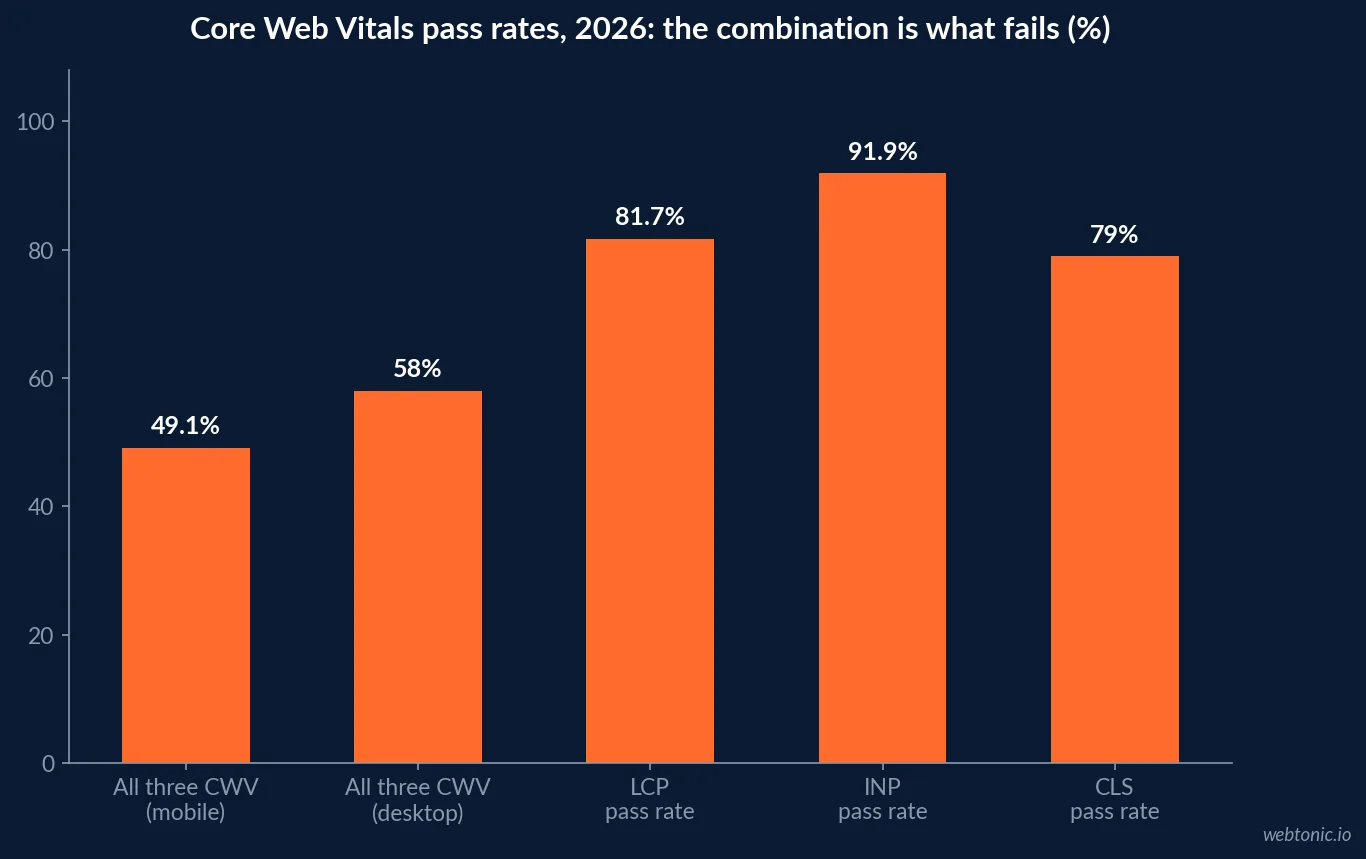
Two independent 2026 datasets frame the target. The May 2026 CrUX analysis of 13.75 million origins gives the web-wide pass rate; The State of Web Vitals Q2 2026 breaks it down per metric across roughly 200,000 sites with complete field data. Read them together and the diagnosis is obvious: individual metrics pass at high rates, but the combination is where sites fail — and LCP is the metric doing the failing.
| Metric | Good threshold | Share of sites passing | What breaks it on a med spa site |
|---|---|---|---|
| All three CWV (mobile) | — | 49.1% | One weak metric fails the whole set |
| All three CWV (desktop) | — | 58.0% | Desktop hides mobile problems from owners |
| LCP | Under 2.5s | 81.7% | Unoptimised hero image or gallery thumbnail |
| INP | Under 200ms | 91.9% | Booking widgets and chat scripts |
| CLS | Under 0.1 | Roughly 79–82% | Images without width/height, late-loading banners |
The practical read: 81.7% of sites pass LCP and 91.9% pass INP, yet fewer than half pass all three on mobile. A miss is usually a needs improvement score rather than a catastrophic one — 14.1% of sites land between 2.5s and 4s on LCP and only 4.2% are above 4s. Most failing med spa sites are one image pipeline away from passing.
Why Aesthetic Websites Fail On Speed Specifically
The aesthetics vertical has a structural handicap. Every persuasive asset on the site is a large raster image, and practices rarely process them: gallery uploads come straight off a clinic camera or phone at full resolution. Borah Labs’ benchmark of aesthetic treatment websites measured an average LCP of 15.4 seconds — a number that only happens when multi-megabyte images sit above the fold.
Web-wide context from Searchlab’s 2026 technical SEO dataset confirms where the weight lives: the average page is 2.3 MB, up 18% since 2023, with images at 48% of total page weight. Serving those same images as WebP or AVIF cuts 30–50% of the bytes, and a CDN reduces average TTFB by 52% while improving LCP by about 33%.
The revenue math is what makes this a business conversation rather than a developer ticket. Skyhighway’s med spa speed analysis frames it bluntly: a practice spending $4,000 a month on paid search with a five-second mobile site and a 40% pre-render bounce rate is burning roughly $1,600 per month on clicks that never see the page. Speed work is budget recovery, not vanity.
The Mobile Reality: 65–75% Of Organic Traffic
Authority Specialist’s 2026 med spa benchmark set puts mobile at 65–75% of organic traffic depending on market and service mix. That number should decide how every technical decision gets prioritised, because desktop pass rates run 9 points higher — which is exactly why owners browsing their own site on a laptop never see the problem their patients experience.
| Speed condition | Documented effect | Source of the effect |
|---|---|---|
| Over 3s mobile load | 53% of visitors abandon | Mobile abandonment research |
| 1s → 3s load time | Bounce probability +32% | Google mobile speed data |
| 100ms improvement | Roughly +1% conversion | Deloitte speed study |
| LCP 4.8s → 2.2s (single med spa) | +45% organic visits, +30% booked consults in 3 months | Reported practice case study |
Treat that last row as directional rather than a guarantee — it is a single reported practice, not a controlled study. It is included because the direction matches everything the field data says, and because it quantifies the thing owners actually care about: consultations, not scores.
Crawl Waste: Where Med Spa Sites Leak Budget
SEOmator’s 2026 crawl waste report, built on Cloudflare Radar data, found only 45.9% of crawler requests across the web return a usable 200. The breakdown inverts a common assumption: verified AI crawlers are the best-treated clients at a 73.0% success rate, while non-AI bots — SEO tools, scrapers, monitors — get content back just 33.3% of the time and are refused with a 403 in 29.2% of requests.
| Response | Share of crawler requests | Typical med spa cause |
|---|---|---|
| 200 OK | 45.9% | The goal |
| 403 Forbidden | 20.6% | Over-aggressive WAF or bot rules |
| 301 / 302 hops | 12.6% combined | Old booking URLs, past site migrations |
| 404 Not Found | 7.8% | Retired promos, deleted treatment pages |
| 429 Too Many Requests | 6.3% | Rate limiting on shared hosting |
| 304 Not Modified | 1.2% | Missing validators — re-downloads unchanged bytes |
For a practice site under about 1,000 URLs, crawl budget is not the ceiling — Google generally crawls small sites fully. Waste still costs, because 403s and redirect chains delay indexing of the pages you just paid to have written. Searchlab’s dataset also notes indexation gaps by site size: about 4% of pages on small sites are not indexed, rising to 26% on enterprise sites, and 67% of sites have an XML sitemap while only 48% have a correct one. Sitemap hygiene is a fifteen-minute job most practices have never done.
JavaScript, Booking Widgets And The Indexation Tax
Med spa sites lean heavily on third-party booking and consultation widgets, and those widgets are usually where rendering problems begin. Onely’s study of 6,000 websites found 42% of JavaScript-rendered content never gets indexed, with client-side rendered sites ranking materially lower than server-rendered equivalents. Every URL on a JS-dependent site must pass through Google’s rendering queue before it can be indexed, and that queue is the bottleneck.
The rule for aesthetics is simple: treatment descriptions, pricing context, provider credentials and location details must exist in the server-rendered HTML. The booking widget can hydrate afterwards. If your service copy only appears after a script executes, you are gambling your most commercial pages on a render budget measured in single-digit seconds.
Structured Data: The 71% / 22% Gap
The most valuable technical SEO statistic of 2026 for aesthetics is a gap, not a total. DigitalApplied’s 5,000-site audit found 71% of sites deploy schema markup (3,550 of 5,000) while only 22% pass the Rich Results Test cleanly across every detected type (1,100 of 5,000). Valid schema correlates with AI-search citations at a Pearson r of +0.34 — which reframes structured data as a discovery asset rather than a ranking trick.
Atlantis Digital’s local schema gap analysis adds the local layer: 54.7% of local sites carry schema, but of those, WebSite markup dominates at 69.8% while only 31.6% implement LocalBusiness — the type that powers local rich results. Meanwhile a ten-week controlled test found LocalBusiness schema did not change SERP rank or Maps rank at all. Both findings are true and compatible: schema buys eligibility and machine readability, not position.
| Schema state | Share of sites | What it earns you |
|---|---|---|
| Any schema deployed | 71% of audited sites | Baseline parity |
| Fully valid across all types | 22% of audited sites | Rich-result eligibility + AI citation lift (r = +0.34) |
| LocalBusiness present (local sites) | 31.6% of schema users | Local rich-result eligibility |
| FAQPage outside gov/health | 18% of FAQPage users | Manual-action risk — avoid |
| MedicalBusiness / FAQPage on a licensed practice | Rare | Eligible category — legitimate SERP real estate |
That last row is the aesthetics-specific opportunity. FAQPage rich results were narrowed to government and health sites, and 18% of sites still using the markup are outside those categories. A licensed medical spa publishing real clinical FAQs is inside the eligible set — one of very few verticals where this markup is still a clean win.

AI Crawler Access Is Now A Technical SEO Setting
Aesthetic patients increasingly research treatments inside AI assistants, which makes robots.txt a discovery decision rather than an IT default. Presenc’s robots.txt tracker and Cloudflare-network analyses put GPTBot as the most-blocked AI crawler, disallowed by roughly 4.91% of the live web, with about 5.4% of sites blocking at least one AI crawler and 23% of the top 10,000 sites blocking at least one — up from 11% a year earlier. Roughly 89.4% of AI crawler traffic serves training or mixed purposes rather than answering a live user query.
Two practical failure modes hit practices. First, accidental blocking: some sites that disallow GPTBot also block ChatGPT’s retrieval crawler, making themselves invisible inside the assistant while gaining nothing. Second, over-blocking by a security plugin that a marketing team never audited. Check the file, decide deliberately, and remember that AI referral traffic is a tiny fraction of crawl volume — the value is being quotable, not the raw hits. Our data intelligence team treats this as a standing quarterly check.
Med Spa Technical SEO Priority Order
Ordered by expected return per hour on a typical single- or multi-location practice site:
- Compress and convert every gallery image to WebP/AVIF with explicit width and height attributes — attacks LCP and CLS at once, for 30–50% fewer bytes.
- Lazy-load below-the-fold media, preload the hero — the LCP element should never be lazy-loaded.
- Put a CDN in front of the site — about 52% lower TTFB and 33% better LCP on average.
- Server-render treatment copy and let booking widgets hydrate afterwards, given 42% of JS-rendered content goes unindexed.
- Defer chat and tracking scripts — the main INP offenders on practice sites.
- Flatten redirect chains to one hop and repoint internal links and the sitemap at final URLs.
- Fix the sitemap — only 48% of sites have a correct one.
- Validate schema, don’t just deploy it: MedicalBusiness/LocalBusiness plus genuine FAQPage on treatment pages, then test until clean.
- Audit robots.txt for AI crawler access deliberately, once a quarter.
- Measure in field data, not lab scores — mobile CrUX is the scoreboard.
How Aesthetics Compares To The Web Overall
| Signal | Web-wide 2026 | Aesthetics / med spa reality | Gap verdict |
|---|---|---|---|
| All-three CWV pass (mobile) | 49.1% | Structurally harder — gallery-driven pages | Behind |
| Average LCP | Most sites under 2.5s (81.7% pass) | 15.4s average on aesthetic treatment sites | Far behind |
| Images as share of page weight | 48% | Higher — galleries are the product | Behind |
| Mobile share of organic traffic | 63.4% of web traffic | 65–75% of med spa organic | Higher stakes |
| Valid schema | 22% of sites | Low, but FAQPage still eligible for health | Opportunity |
| HTTPS on top-10 pages | 95.6% | Effectively universal | Parity |
The pattern is consistent: aesthetics is not behind because practices are careless, but because the vertical’s core marketing asset is the heaviest thing you can put on a web page. Fix the image pipeline and most of the gap closes. For the ranking and content side of the same equation, see our med spa SEO statistics and local SEO benchmarks; for the conversion layer downstream of speed, our landing page statistics cover what happens once the page actually loads.
Frequently Asked Questions
What is a good page speed for a medical spa website in 2026?
Aim for a Largest Contentful Paint under 2.5 seconds on mobile, an Interaction to Next Paint under 200ms and a Cumulative Layout Shift under 0.1 — Google's Good thresholds. That target matters more for aesthetics than for most verticals: 65–75% of organic traffic to med spa sites arrives on mobile, 53% of mobile visitors abandon a page that takes longer than three seconds, and bounce probability rises 32% when load time goes from one second to three. For context, only 49.1% of the mobile web currently passes all three Core Web Vitals at all.
Why are aesthetic and med spa websites so slow?
Images. The average web page is 2.3 MB in 2026 and images account for 48% of total page weight — and a med spa site is almost entirely images: before-and-after galleries, treatment room photography, provider portraits and hero video. One benchmark of aesthetic treatment websites measured an average LCP of 15.4 seconds against Google's 2.5-second Good threshold. Next-generation formats are the single highest-leverage fix, cutting file size 30–50% versus JPEG or PNG with no visible quality loss.
Does structured data actually help a med spa rank?
Not directly, and that is the most misread finding of 2026. A ten-week controlled test found LocalBusiness schema did not move classic SERP rank or Google Maps rank. What it does move is eligibility and machine readability: schema-valid pages correlate with AI-search citations at a Pearson r of +0.34, and one 5,000-site audit found 71% of sites deploy schema while only 22% pass the Rich Results Test cleanly across every detected type. Validity, not presence, is the lever.
Can a medical spa still use FAQ schema in 2026?
Yes — and this is one of the rare places where being a healthcare business is an advantage. FAQPage rich results were narrowed to government and health sites, and a 2026 audit found 18% of sites still deploying FAQPage schema sit outside those eligible categories, carrying real manual-action risk. A licensed medical spa publishing genuine clinical FAQs on treatment pages is inside the eligible category, so the markup remains a legitimate SERP real-estate play rather than a liability.
How much crawl budget does a med spa site really need to worry about?
Crawl budget is rarely the ceiling for a site under roughly 1,000 URLs, which covers most single- and multi-location practices. Crawl waste still matters in a different form: globally only 45.9% of crawler requests return a usable 200, with 20.6% blocked as 403, 12.6% burned on redirect hops and 7.8% hitting 404s. On a med spa site that waste usually comes from old booking-system URLs, retired promo pages and migration-era redirect chains — cheap to fix, and worth fixing before adding content.
Sources
PageSpeed Matters — Core Web Vitals Pass Rate 2026 (13.75M origins, CrUX)
The State of Web Vitals — Q2 2026 (about 200,000 sites)
Borah Labs — Aesthetic Treatments Website Benchmarks
Searchlab — Technical SEO Statistics 2026 (80+ benchmarks)
SEOmator — Crawl Waste Report 2026 (Cloudflare Radar)
DigitalApplied — Schema Markup Adoption: 5,000-Site Audit 2026
Atlantis Digital — Local SEO Schema Markup Gap Analysis 2026
Evergrow Marketing — How Schema Affects Rank and AI (10-week test)
Presenc AI — State of Robots.txt for AI 2026
Authority Specialist — Medical Spa SEO Benchmarks 2026
Skyhighway Marketing — Med Spa Website Speed & Bookings
Onely — SEO for Dynamic Content and JavaScript Sites