



Table of contents
Key Takeaways
- 42% of all local searches result in a map pack click, making Google Maps the single most important visibility channel for medical spas targeting nearby patients. (BrightLocal)
- "Med spa near me" searches have grown over 200% in the past three years, reflecting a patient base that is ready to book and searching locally. (Google Trends)
- A Texas med spa group grew Map Pack top-3 rankings from 8 to 47 across five locations, resulting in a 268% increase in new-client bookings over 12 months. (Profit Labs)
- 83% of consumers use Google to research reviews before choosing a medical spa, and clinics with 50+ reviews gain a competitive edge in local pack positioning. (Aesthetic Marketing)
- Med spas with 26 optimized city pages generated 293,000+ local impressions and 1,792 clicks in a 12-month period from organic search alone. (MedSpa MarketPro)
Local SEO determines whether a medical spa appears in the map pack results that capture 42% of local search clicks — or gets buried below directories and competitors. For an industry where nearly all bookings are geographically constrained within 10–20 miles, ranking in the local pack is not a marketing bonus; it is the primary patient acquisition channel. These statistics quantify exactly how local search performance translates into consultations, calls, and revenue for aesthetic practices in 2026.
The data below draws from multi-source benchmarking studies, verified case studies with documented results, and platform-level click data to provide the most comprehensive view of local SEO performance specifically for medical spas and aesthetic practices. Whether you are a single-location clinic evaluating your first SEO investment or a multi-location group optimizing across markets, these benchmarks offer actionable targets calibrated to the aesthetics industry rather than generic local business averages.
Med Spa Local Search Volume and Growth
Patient demand for local aesthetic services continues accelerating. The "med spa near me" search query has grown over 200% since 2023 according to Google Trends data compiled by Sky Highway Marketing, making it one of the fastest-growing local health search categories. This growth mirrors the broader med spa industry trajectory — the U.S. med spa market is valued at $21.4 billion in 2026, growing at a 14.2% CAGR with over 9,500 active locations, according to ScaleHaven's 47-statistic industry compilation.
Across the 34 medical spa practices analyzed by Authority Specialist for their 2026 SEO benchmarks, organic search consistently accounted for the largest single source of new consultation requests in established markets, outperforming paid social in cost-per-booking after month five of active optimization.
| Metric | Value | Source |
|---|---|---|
| "Near me" search growth | 200%+ since 2023 | Google Trends / Sky Highway |
| U.S. med spa market size | $21.4 billion (2026) | Grand View Research / ScaleHaven |
| Industry CAGR | 14.2% since 2020 | Grand View Research |
| Active U.S. med spas | 9,500+ | AmSpa / ScaleHaven |
| Google searches with local intent | 46% of all queries | BrightLocal |
| Local mobile searches → offline purchase | 78% | BrightLocal / OwlClaw |
Map Pack Click-Through Rates and Local Rankings
The Google local pack — the three business listings shown with a map — dominates click distribution for geographically constrained queries. According to OwlClaw's Local SEO Benchmarks report (drawing from BrightLocal and Moz data), 42% of local searches result in a click on a map pack listing. Position matters enormously: the first map pack slot earns 17–24% CTR, while positions two and three capture progressively less.
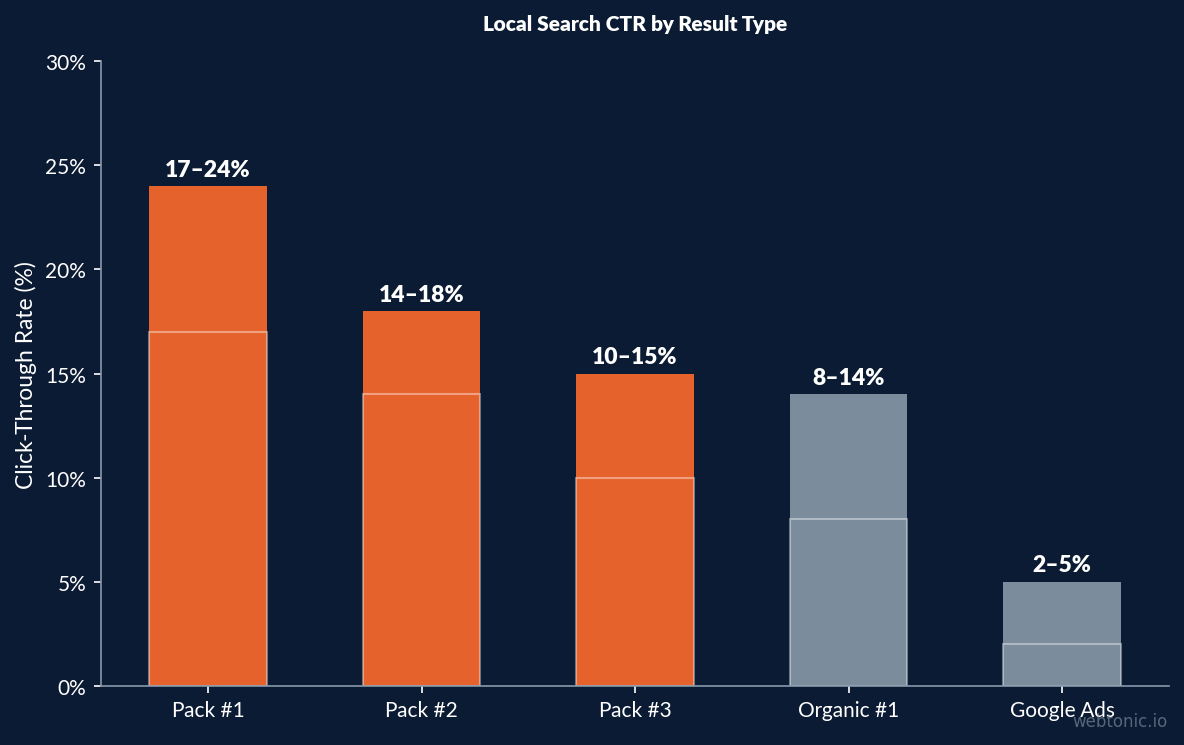
| Result Type | CTR Range | Notes |
|---|---|---|
| Local Pack Position 1 | 17–24% | Most clicks of any local result |
| Local Pack Position 2 | 14–18% | Strong secondary position |
| Local Pack Position 3 | 10–15% | Still outperforms organic #1 |
| Organic #1 (local query) | 8–14% | Below map pack on SERP |
| Google Ads (local) | 2–5% | Lowest local CTR |
For medical spas, this means that map pack visibility is disproportionately valuable compared to standard organic rankings. A practice ranking third in the map pack will typically outperform a practice ranking first in organic blue links for the same local query.
Google Business Profile Performance Benchmarks
Google Business Profile (GBP) is the control center for local pack visibility. The benchmark data from OwlClaw shows that actively managed GBP profiles receive 1,000 to 2,500 views per month, with 2–5% of those views converting to website clicks. The Aesthetic Marketing statistics compilation found that 83% of consumers use Google reviews to evaluate med spa providers before booking.
Review velocity is a critical differentiator. Competitive local pack positioning requires at least 50 reviews with an average rating of 4.2–4.5 stars, while top performers maintain 200+ reviews at 4.6–5.0 stars with a velocity of 15+ new reviews per month. For med spas specifically, 77% of patients research providers online before booking, according to Sky Highway Marketing's 2026 statistics analysis.
| GBP Metric | Minimum | Competitive | Top Performer |
|---|---|---|---|
| Review count | 10+ | 50–100 | 200+ |
| Star rating | 3.8+ | 4.2–4.5 | 4.6–5.0 |
| Profile completeness | 60% | 85% | 100% |
| Monthly review velocity | 1–2/mo | 5–10/mo | 15+/mo |
| GBP posts per month | 0 | 2–4 | 8+ |
| NAP citations | Basic | 50+ | 100+ |
Multi-Location Med Spa Case Studies
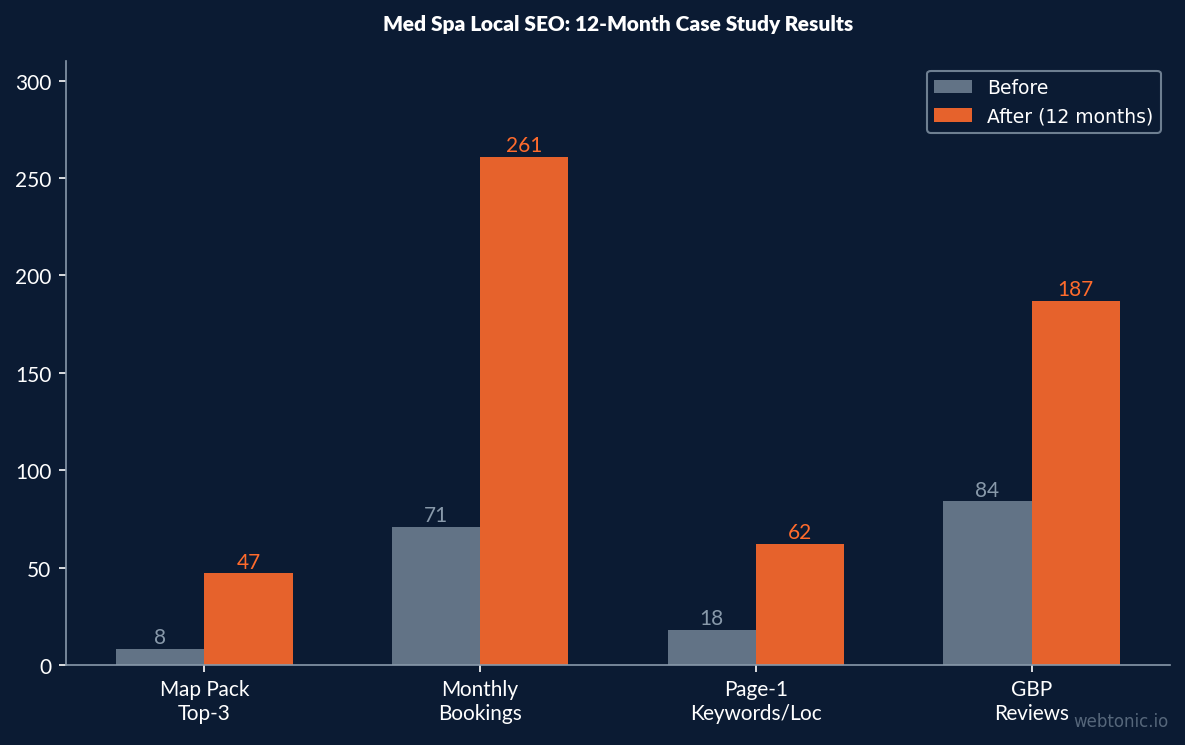
The most compelling local SEO evidence comes from documented multi-location campaigns. Profit Labs published a case study of a Texas med spa group with five locations that achieved Map Pack top-3 rankings across all locations for core service keywords within 12 months. The campaign produced remarkable results:
- Map Pack top-3 rankings grew from 8 to 47 across all five locations
- Organic new-client bookings increased from 71 to 261 per month — a 268% increase
- Page-1 keywords averaged 62 per location, up from 18
- Average GBP review count grew from 84 to 187
A second case study from MedSpa MarketPro documented a San Francisco Bay Area med spa (LaVieMD) that built 26 city-specific service pages optimized for treatment-plus-location queries. Over 12 months, those pages generated 293,000+ impressions and 1,792 clicks from local organic searches, with 15+ cities reaching page 1–2 positions.
Local SEO Investment and Timeline Benchmarks
According to Authority Specialist's analysis of 34 med spa practices, clinics in saturated metros like Miami, Los Angeles, and New York require significantly deeper content authority and citation volume to achieve equivalent map pack positions compared to mid-market cities. The typical timeline to stabilize Map Pack rankings in competitive markets is 6 to 12 months of sustained SEO effort.
The investment pays off substantially. Based on the Profit Labs case study data, the Texas med spa group's organic new-client bookings reached 261 per month — at an average first-visit transaction value of $350–$750 (per ScaleHaven's revenue benchmarks), that translates to $91,350–$195,750 in monthly first-visit revenue from local SEO alone. With a patient lifetime value of $1,800–$5,200, the long-term ROI is even more substantial.
Patient Search Behavior and Trust Signals
Understanding how patients search and evaluate med spas reveals why certain local SEO signals matter more than others. The Aesthetic Marketing statistics report provides critical behavioral data:
- 83% of consumers check Google reviews before choosing a medical spa provider
- 81% verify medical credentials and safety protocols online before booking
- 75% cite aesthetic enhancement as their primary motivation for visiting
- 72% of high-value patients prioritize clinical efficacy over introductory pricing
These behavioral patterns reinforce the importance of complete GBP profiles that showcase provider credentials, treatment specializations, and before-and-after results. Authority Specialist's research specifically noted that YMYL compliance gaps — particularly missing provider credentials on treatment pages — correlated with below-average organic click-through rates even when rankings were strong. Maintaining comprehensive growth marketing strategies that prioritize trust signals alongside ranking factors is essential for clinics looking to maximize patient acquisition.
Local SEO vs. Other Acquisition Channels
When compared to other data-driven marketing channels, local SEO delivers unique advantages for med spas. The local search-to-call rate is 28% according to OwlClaw's benchmarks, meaning more than one in four local searchers directly calls the business they find. This intent-to-action ratio far exceeds typical display advertising or social media conversion rates.
| Channel | Avg. CTR / Action Rate | Cost Efficiency |
|---|---|---|
| Local Pack (Position 1) | 17–24% CTR | Organic (no per-click cost) |
| GBP to Phone Call | 28% of local searches | Organic |
| Google Ads (local) | 2–5% CTR | $18–$42 CPL (med spa avg.) |
| Meta Ads (med spa) | 1.58% CTR | $0.77 CPC avg. |
| Organic (non-local #1) | 8–14% CTR | Organic |
After five months of active optimization, Authority Specialist's data shows that organic search outperforms paid social in cost-per-booking for established med spa markets. Combined with the strategic use of Google Ads for immediate visibility, local SEO creates a compounding acquisition engine that reduces paid media dependency over time.
Best Practices for Med Spa Local SEO in 2026
- Complete and optimize your Google Business Profile — 100% profile completeness correlates with top performer status. Include all services, photos, and provider credentials.
- Build review velocity systematically — target 5–10 new reviews per month. Automate post-appointment review requests with direct links.
- Create city-specific service pages — the MedSpa MarketPro case study shows 26 targeted pages generated 293K+ impressions. Use unique content per location.
- Prioritize treatment-plus-location keywords — "semaglutide [city]" and "botox near me" queries have stronger booking intent than generic brand terms.
- Maintain NAP consistency across 50+ citations — directory inconsistencies confuse search engines and weaken local ranking signals.
- Post to GBP 2–4 times monthly — regular GBP posts signal active business status and provide fresh content for local relevance.
- Display provider credentials prominently — YMYL compliance gaps hurt CTR even with strong rankings, per Authority Specialist's research.
- Track Map Pack position separately from organic — a practice can rank #1 locally but #12 organically (or vice versa), as they use separate algorithms.
Frequently Asked Questions
How long does it take for a med spa to rank in the local pack?
In mid-market cities, med spas can begin appearing in the map pack within 3–6 months of consistent optimization. In competitive metros like Miami, Los Angeles, or New York, 6–12 months of sustained effort is typical before rankings stabilize, according to Authority Specialist's analysis of 34 aesthetic practices.
How many Google reviews does a med spa need to rank locally?
A minimum of 10 reviews is needed for basic local pack consideration. However, competitive positioning requires 50–100 reviews with a 4.2+ star average, and top performers maintain 200+ reviews with a velocity of 15+ new reviews per month, per BrightLocal and OwlClaw benchmark data.
What is the ROI of local SEO for medical spas?
Based on the Profit Labs case study, a five-location Texas med spa generated 261 organic bookings per month after 12 months of SEO. At an average first-visit value of $350–$750, that represents $91,350–$195,750 in monthly first-visit revenue from organic search alone, before lifetime value compounding.
Is local SEO better than Google Ads for med spas?
They serve different timelines. Google Ads delivers immediate visibility with a 2–5% local CTR and $18–$42 CPL for med spas. Local SEO takes 3–12 months to build but produces 17–24% CTR in the top map pack position with no per-click cost. After month five, Authority Specialist's data shows organic search outperforms paid social in cost-per-booking.
How important are city-specific landing pages for med spa SEO?
City-specific pages are critical for multi-location or service-area businesses. The MedSpa MarketPro case study demonstrated that 26 city pages generated 293,000+ impressions and 1,792 clicks in 12 months. Without dedicated pages, Google typically ranks the homepage — which cannot compete against location-specific content in local results.
Sources
https://owlclaw.com/benchmarks/local-seo-benchmarks/
https://authorityspecialist.com/industry/health/medical-spa/seo-statistics
https://blog.skyhighwaymarketing.com/med-spa-marketing-statistics-2026/
https://scalehaven.io/blog/med-spa-industry-statistics/
https://aestheticmarketing.net/blog/medical-spa-marketing-statistics/
https://medspamarketpro.com/medspa-local-seo-case-study/
https://www.profitlabs.net/case-studies/texas-med-spa-group-ranked-all-5-locations-in-map-pack-top-3-for-the-same-services/
https://searchxpro.com/local-med-spa-seo-2026-winning-maps-ai-overviews-voice-search/


