



Table of contents
Key Takeaways
- Retail product sales account for 15–30% of total med spa revenue, with top-performing clinics targeting a 10–15% retail-to-service revenue ratio as a healthy benchmark. (Gitnux, Ward Advisory)
- The online beauty and personal care market is forecast to reach $162.9 billion by 2031, growing from $110.4 billion in 2026 at an 8.09% CAGR — and over 30% of skincare purchases now happen online. (Mordor Intelligence)
- Health and beauty Shopify stores achieve 3.3–3.8% conversion rates, significantly above the cross-industry median, with AOVs ranging from $60 to $164 depending on product mix. (eCommerceAgencies.org)
- Med spa membership programs increase patient lifetime value by 35–45%, and clinics that attach a $150 average skincare purchase to 40% of visits generate meaningful recurring e-commerce revenue. (AmSpa, Sprout Sage)
- The average med spa generates $1.6–$2.8 million in annual revenue, with injectables comprising 45–55% and skincare retail representing the fastest-growing ancillary revenue stream. (ScaleHaven)
Medical spas are increasingly turning to Shopify and e-commerce platforms to capture the $2.5 billion+ skincare product market that flows through aesthetic clinics annually. With the global online beauty market growing at 8.09% CAGR and consumer purchasing habits shifting decisively toward digital channels, med spas that sell only in-office are leaving significant revenue on the table. These statistics reveal the exact scale of the opportunity, the platform benchmarks that matter, and how leading clinics are building e-commerce into their revenue model.
The statistics in this report draw from industry financial benchmarks, e-commerce platform data, and documented med spa retail performance to quantify the exact scale of the skincare e-commerce opportunity. For clinic owners evaluating whether to launch a Shopify store, these numbers provide the conversion rates, order values, and revenue projections needed to build a business case — grounded in real performance data rather than vendor promises.
Med Spa Retail Revenue and Product Sales Statistics
Product retail is one of the most underutilized revenue streams in the med spa industry. According to Gitnux's 2026 Medical Spa Industry Statistics, retail product sales account for 15–20% of med spa gross revenue. A broader estimate from WorldMetrics places the figure at up to 30% for product-forward clinics, while Ward Advisory's P&L benchmark guide recommends a 10–15% retail-to-service revenue ratio as the healthy operational target.
| Revenue Metric | Value | Source |
|---|---|---|
| Average med spa annual revenue | $1.6M–$2.8M | AmSpa / ScaleHaven |
| Top-performing med spa revenue (top 25%) | $4.2M+ | AmSpa Benchmark Report |
| Retail product share of revenue | 15–30% | Gitnux / WorldMetrics |
| Skincare products sold through med spas | $2.5B (2023) | WorldMetrics |
| Healthy retail-to-service ratio target | 10–15% | Ward Advisory |
| Average first-visit transaction value | $350–$750 | ScaleHaven |
| Injectable share of total revenue | 45–55% | AmSpa / ScaleHaven |
The revenue upside is clear: a med spa generating $2 million in annual service revenue with a 15% retail ratio would add $300,000 in product sales — much of which can be fulfilled online through platforms like Shopify, reducing in-office inventory pressure and expanding the purchase window beyond appointment hours.
Online Beauty and Skincare Market Growth
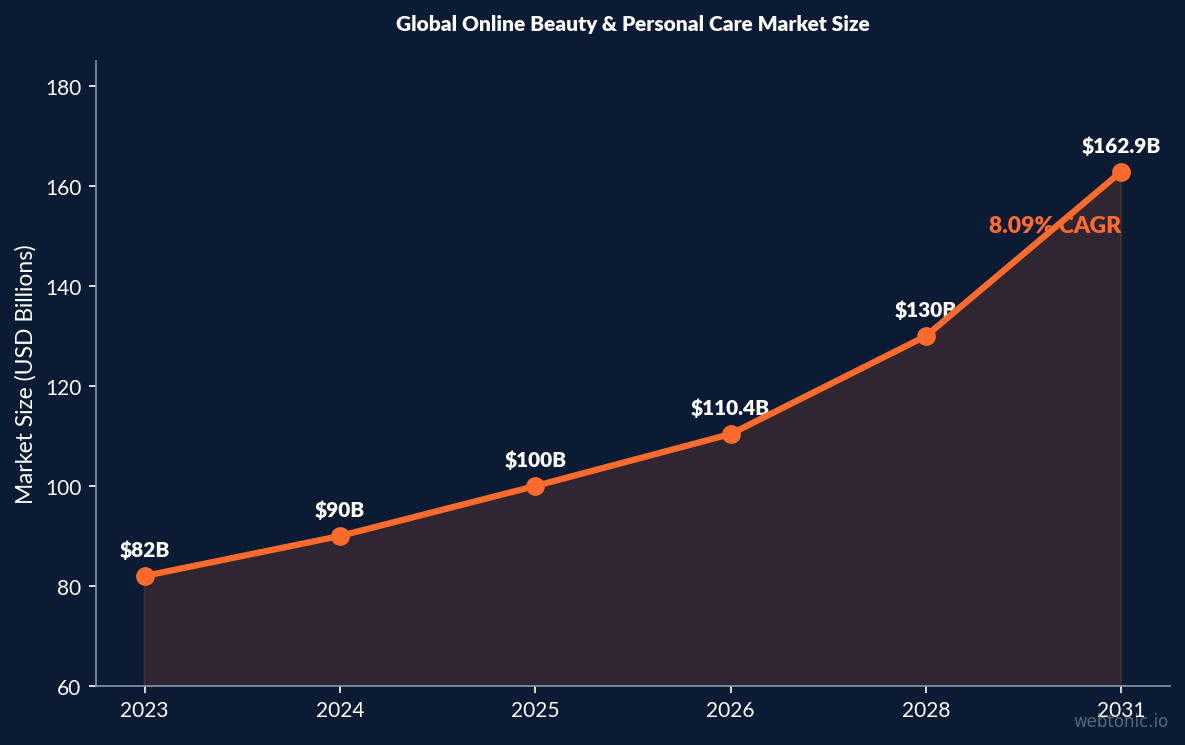
The shift toward online purchasing in beauty and skincare is not a pandemic anomaly — it is structural and accelerating. According to National Law Review's industry analysis, over 30% of all skincare purchases now occur online as of 2026. The broader online beauty and personal care market is valued at $110.4 billion in 2026 and projected to reach $162.9 billion by 2031 at an 8.09% CAGR, per Mordor Intelligence data.
NIQ (NielsenIQ) research confirms that digital-first and AI-influenced commerce is accelerating globally, with 49% of consumers now exploring AI-driven beauty recommendations and 53% willing to try products suggested by generative AI. For med spas, this means that data-intelligent e-commerce strategies aligned with these consumer shifts can capture demand that previously only existed in-office.
Shopify and E-Commerce Platform Benchmarks
Medical-grade skincare is a natural fit for Shopify's health and beauty vertical. According to the Health & Beauty Industry Report 2026 from eCommerceAgencies.org, the key performance benchmarks for this category are:
| E-Commerce Metric | Health & Beauty Benchmark | Notes |
|---|---|---|
| Conversion rate | 3.3–3.8% | Above cross-industry median |
| Average order value (AOV) | $60–$164 | Wide range by product mix |
| Cart abandonment rate | 68–72% | Industry average range |
| Email campaign open rate | 30.5% | Higher than e-commerce avg. |
| Email flow open rate | 46–54% | Automated sequences |
| Repeat purchase rate | High (retention-driven) | Key growth lever |
An individual med spa Shopify store provides a concrete benchmark. According to Grips Intelligence data, jeunessemedicalspa.com generated $12,582 in online sales in May 2026 with a 3.0–3.5% conversion rate, $150–$175 AOV, and 2,219 sessions. This demonstrates that even a single-location med spa can generate meaningful e-commerce revenue with a properly optimized Shopify store.
Med Spa Patient Demographics and Purchase Behavior
Understanding who buys — and how they buy — is critical for e-commerce strategy. ScaleHaven's 47-statistic compilation provides the demographic foundation:
- 85–88% of med spa patients are women; men represent 12–15% and growing (ASAPS)
- The largest patient age group is 35–54, representing 42% of all visits (AmSpa)
- Patients aged 25–34 are the fastest-growing segment, up 28% since 2022
- The average patient visits 3.2 times per year (AmSpa member data)
- Patient lifetime value ranges from $1,800 to $5,200 over 12 months
Sprout Sage's medical-grade skincare marketing analysis estimates that clinics attaching an average $150 skincare purchase to 40% of patient visits generate significant recurring revenue. Combined with targeted Meta advertising driving traffic to the Shopify storefront, this creates a dual-channel revenue engine.
Membership Programs and Lifetime Value Impact
Membership and subscription models amplify e-commerce potential dramatically. According to ScaleHaven's data (sourced from AmSpa), med spas with membership programs report 35–45% higher patient lifetime value than those without. When combined with an e-commerce storefront offering auto-ship skincare products, memberships create predictable recurring revenue.
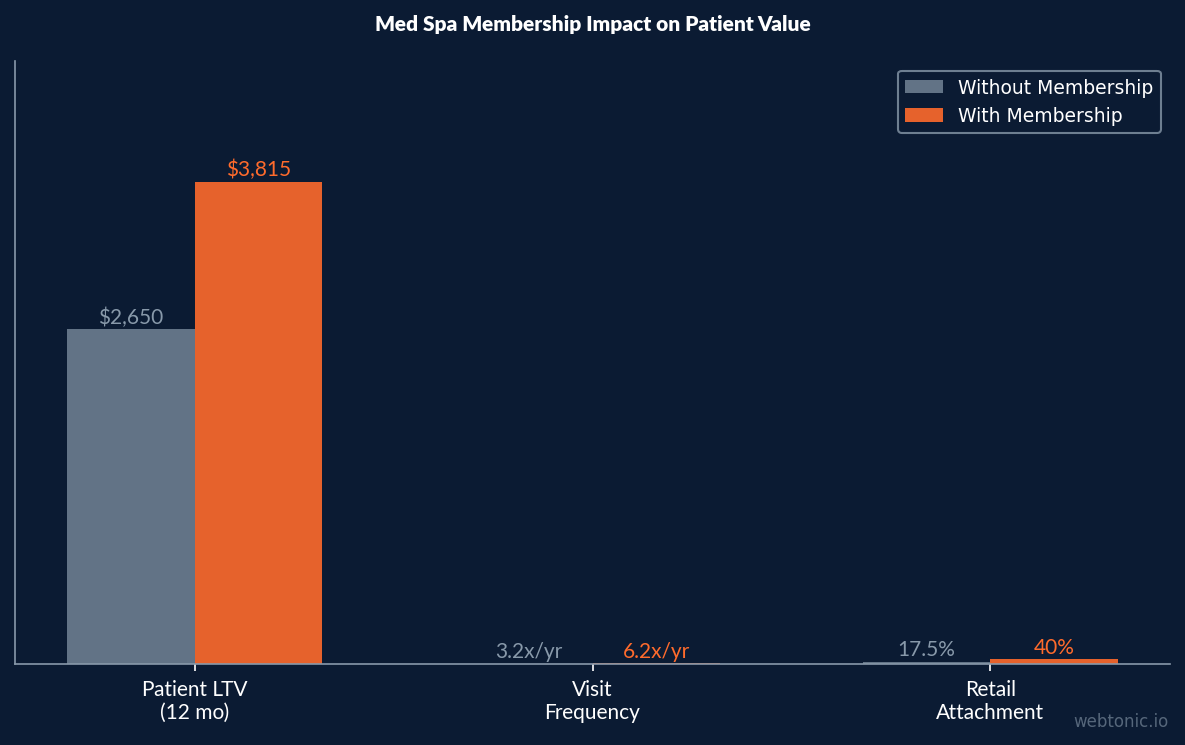
| Membership Impact Metric | Without Program | With Program |
|---|---|---|
| Patient lifetime value (12 mo) | $1,800–$3,500 | $2,430–$5,200 |
| Visit frequency (annual) | 3.2 visits | 5.5–6.8 visits |
| Retail attachment rate | 15–20% | 35–45% |
| Monthly recurring revenue | Variable | Predictable |
Best Practices for Med Spa E-Commerce in 2026
- Launch a Shopify store for medical-grade skincare — target the 3.3–3.8% health and beauty conversion rate benchmark with professional product photography and provider-backed descriptions.
- Set a 10–15% retail-to-service revenue target — track this ratio monthly in your P&L, as recommended by Ward Advisory's financial benchmarking framework.
- Implement membership with auto-ship — capture the 35–45% LTV uplift by bundling treatment memberships with recurring product deliveries.
- Leverage growth marketing to drive online traffic — combine Meta Ads retargeting with email flows (46–54% open rate for automations) to convert in-office patients to online buyers.
- Train staff on retail recommendations — Ward Advisory notes that clinics with below-10% retail ratios typically have weak team recommendation habits.
- Use post-appointment email sequences — the 30.5% campaign open rate in health and beauty is above e-commerce average, making follow-up product recommendations highly effective.
- Optimize for mobile checkout — the majority of med spa patient research happens on mobile devices, and checkout friction directly impacts conversion rates.
- Display provider endorsements on product pages — 72% of high-value patients prioritize clinical efficacy over pricing, making provider authority a conversion driver.
Medical-Grade Skincare E-Commerce Opportunity
Medical-grade skincare represents the highest-margin e-commerce category for med spas. Unlike injectable services that require in-office delivery, skincare products can be sold, shipped, and reordered entirely online. Sprout Sage's marketing analysis outlines why this category is especially powerful: patients already trust their provider's product recommendations, creating a built-in customer base with high purchase intent and low acquisition cost.
The economics are compelling. A med spa seeing 200 patients per month with a 40% retail attachment rate and $150 average product purchase generates $12,000 in monthly skincare revenue — or $144,000 annually. When that purchasing moves online via a Shopify storefront with auto-ship capabilities, the med spa captures reorders between appointments without requiring staff time or in-office inventory management.
According to National Law Review reporting, 54% of skincare consumers now purchase products online, and the percentage is climbing as digital-first behavior accelerates across demographics. For med spas, this means that patients who love the SkinCeuticals or ZO Skin Health products their provider recommended will increasingly expect to reorder online — with or without the clinic's own storefront. Building a branded Shopify store captures this demand rather than ceding it to Amazon or third-party retailers.
E-Commerce Technology and Platform Trends
The technology landscape for med spa e-commerce favors Shopify's ecosystem in 2026. Key platform advantages include native subscription support for email marketing automation, integration with Meta and Google advertising pixels, and Shopify's health and beauty-specific conversion optimization tools.
| Platform Feature | Impact on Med Spa E-Commerce | Benchmark |
|---|---|---|
| Subscription / auto-ship | Creates predictable recurring revenue | 35-45% LTV increase |
| Email flow automation | Post-purchase and replenishment sequences | 46-54% open rate |
| Review / social proof widgets | Builds trust for clinical products | 83% check reviews before buying |
| Meta Ads integration | Retarget in-office patients online | $0.77 avg CPC for med spa |
| Mobile-first checkout | Reduces cart abandonment | 68-72% abandonment rate |
The eCommerceAgencies.org Health & Beauty Report emphasizes that retention is the biggest growth lever in health and beauty e-commerce. Med spas have a structural advantage here — unlike pure-play e-commerce brands that must constantly acquire new customers, med spas already have an in-office patient base with high trust and repeat visit patterns (3.2 visits per year on average). Converting those patients to online buyers requires only the infrastructure, not the acquisition spend.
For med spas evaluating paid acquisition strategies to drive Shopify traffic, the health and beauty benchmarks provide clear targets: achieve a 3.3-3.8% conversion rate on the storefront, maintain a $100+ AOV through bundling and provider recommendations, and build email flows that capture the 46-54% automated sequence open rate that this vertical achieves.
Related reading
- Medical Spa WordPress Statistics (2026): Benchmarks & Trends
- Med Spa Landing Page Statistics: Conversion Rates & CRO Data (2026)
- Surrogacy & Fertility Shopify Statistics: E-Commerce Benchmarks & Revenue Data (2026)
- Custom Web Development services at Web Tonic
Frequently Asked Questions
What percentage of med spa revenue comes from product sales?
Retail product sales account for 15–30% of total med spa revenue, depending on the clinic's product focus. Gitnux reports 15–20% as the industry average, while WorldMetrics data shows product-forward clinics reaching 30%. Ward Advisory recommends targeting a 10–15% retail-to-service revenue ratio as a healthy operational benchmark.
What is the average conversion rate for health and beauty Shopify stores?
Health and beauty Shopify stores achieve a 3.3–3.8% conversion rate, significantly above the cross-industry median of approximately 1.4–2.0%. For individual med spa stores, the jeunessemedicalspa.com benchmark shows 3.0–3.5% CVR with a $150–$175 average order value.
How do membership programs affect med spa e-commerce?
Med spas with membership programs report 35–45% higher patient lifetime value (AmSpa data). When combined with e-commerce auto-ship for skincare products, memberships create predictable recurring revenue and increase the retail attachment rate from 15–20% to 35–45% of patient visits.
Is Shopify the right platform for a med spa?
Shopify is well-suited for med spa e-commerce because it serves the health and beauty vertical with above-average conversion rates (3.3–3.8%), supports subscription functionality for auto-ship, and integrates with major payment processors. The platform's beauty-specific ecosystem includes review widgets, product recommendation engines, and Meta Ads integration for retargeting.
How much online revenue can a single med spa generate?
A single-location med spa can generate meaningful e-commerce revenue — Grips Intelligence data shows jeunessemedicalspa.com producing $12,582 in monthly online sales. For a clinic with $2 million in annual service revenue, a 15% retail ratio adds $300,000 in product sales, much of which can be captured online.
Sources
https://scalehaven.io/blog/med-spa-industry-statistics/
https://gitnux.org/medical-spa-industry-statistics/
https://worldmetrics.org/aesthetics-med-spa-industry-statistics/
https://www.wardadvisory.co/blog/med-spa-profit-and-loss-statement-breakdown
https://ecommerceagencies.org/benchmarks/health-and-beauty-industry-report-2026-marketing-benchmarks-breakdown/
https://gripsintelligence.com/insights/retailers/jeunessemedicalspa.com
https://sproutsagesolutions.com/medical-grade-skincare-marketing/
https://natlawreview.com/press-releases/online-sales-reach-over-30-skin-care-purchases-2026-digital-beauty


