Table of contents
Marketing team structure and hiring advisory answers one question: what shape should this marketing function be, and in what order should the seats be filled. It exists because the alternative — hiring to fix a symptom — costs $157,000 to $221,000 in year one for a single manager, and fails often enough to be a real risk.
Key Takeaways
- A structure engagement produces four artefacts: a capacity baseline, an org design, a costed hiring sequence, and an in-house-versus-outsourced split.
- Median team size scales non-linearly — about 3 marketers at $1–10M revenue, 11 at $10–50M, and far more beyond — so "how many people" is a benchmark question, not an opinion.
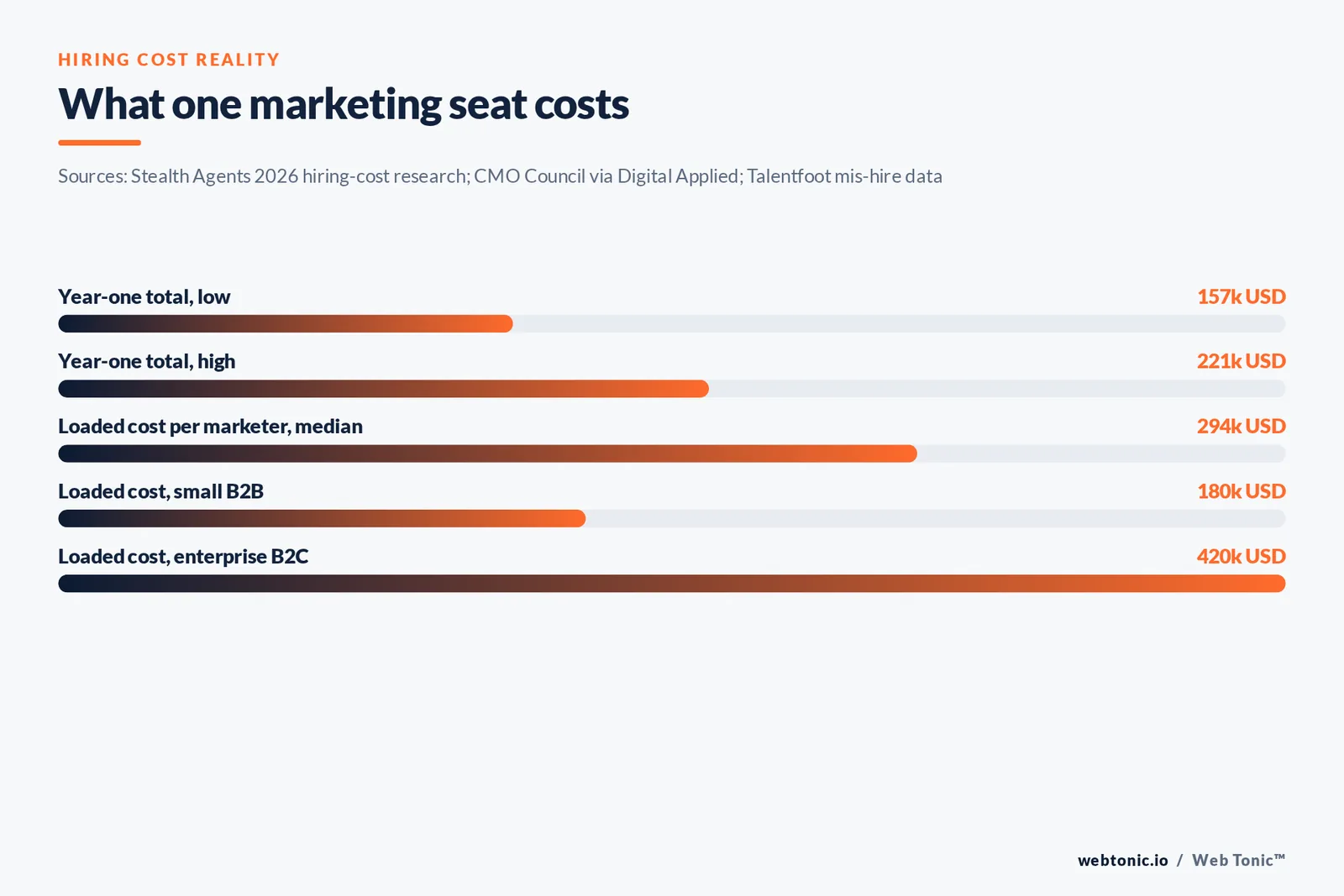
- Fully loaded cost per marketer runs $180K to $420K with a median of $294K, of which tools now absorb 14–18%, up from 9% in 2022.
- One marketing manager costs $157,000–$221,000 in year one once benefits (about 31.4% of total comp), recruiting fees of 15–25% of salary and a 6–12-month ramp are counted.
- Getting the seat wrong is expensive: a bad hire costs at least 30% of first-year earnings, and at executive level losses reach 213% of salary, with roughly 40% of executive hires failing inside 18 months.
- Structure is also a budget question — marketing budgets sit near 7.7% of company revenue, and the median mid-market function now runs about 70% in-house, 22% agency and 8% fractional.
- You need this advisory when headcount is being debated without a capacity baseline. You do not need it when the real problem is one unfilled, well-understood role.
What the engagement actually produces
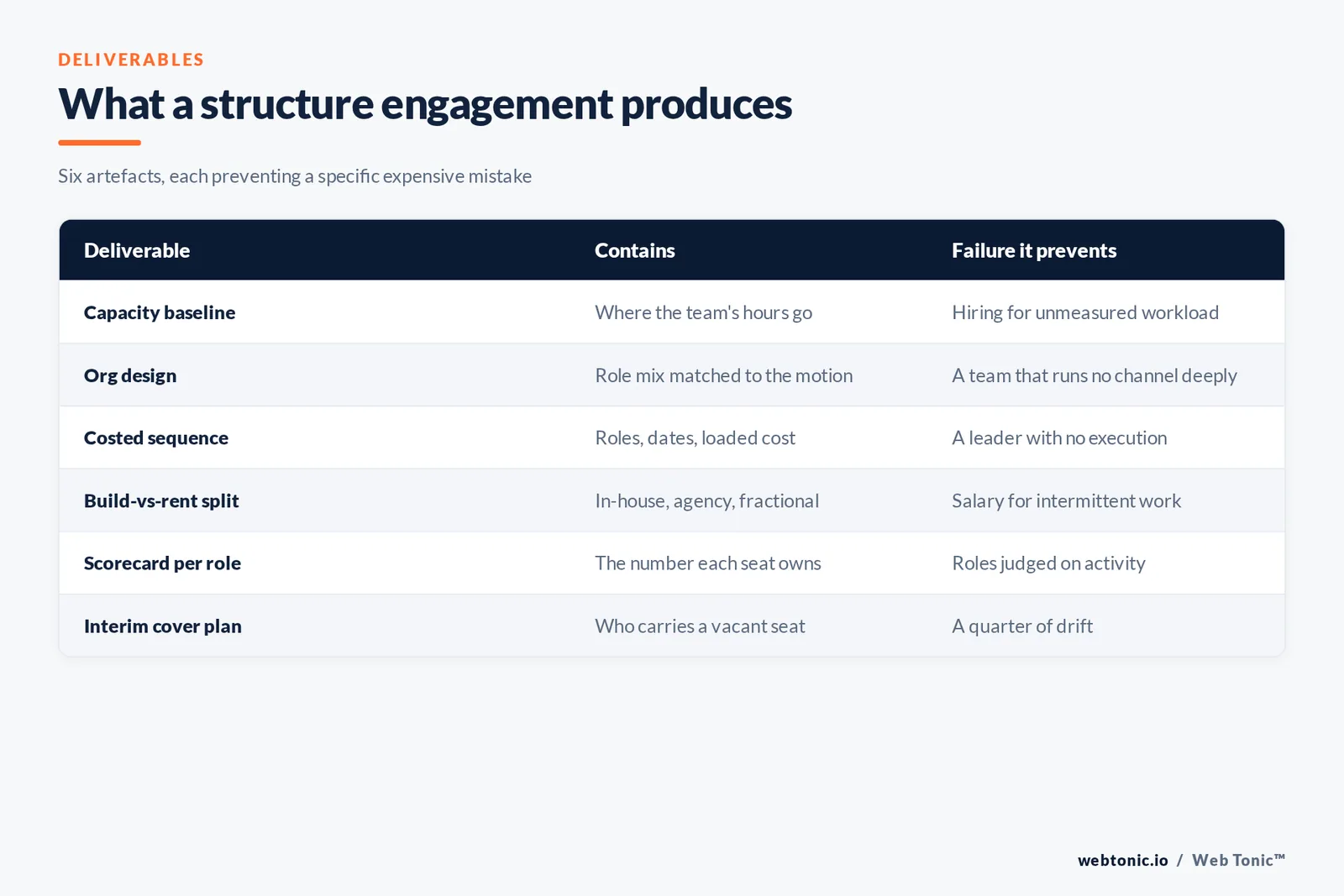
Structure advisory is often confused with recruiting. It is the step before it: deciding which work the company must own, which it should rent, and what sequence of hires gets there without stranded capacity. The output is deliberately unglamorous — a written picture of current capacity, a target org design tied to the company's motion, a hiring sequence with costs and start dates, and a decision on what stays with agencies or fractional specialists.
The reason it pays is that each of those decisions has a published benchmark to be checked against, and most internal debates never reach them. 2026 headcount benchmarks put median marketing headcount at 3 marketers in the $1–10M revenue band and 11 at $10–50M, with a standardised role mix — roughly 25% demand generation, 20% content, 15% operations, 15% brand, 15% product marketing and 10% leadership — and note that product-led SaaS pushes product marketing to 22–25% while DTC pushes performance and lifecycle to 38–42%.
| Deliverable | What it contains | The failure it prevents |
|---|---|---|
| Capacity baseline | Where the current team's hours actually go | Hiring for a workload nobody has measured |
| Org design | Role mix matched to the go-to-market motion | A generalist team that cannot run any channel deeply |
| Costed hiring sequence | Roles, order, start dates, loaded cost per seat | A senior hire with nobody to execute the plan |
| Build-versus-rent split | What stays in-house, agency or fractional | Paying salary for work that is intermittent |
| Scorecard per role | The number each seat owns and by when | Roles judged on activity instead of outcomes |
| Interim cover plan | Who carries the work during a 4–7 month search | A quarter of drift while a seat sits empty |
Why the hiring decision deserves its own diagnosis
The cost of a seat is consistently underestimated because most of it is not salary. 2026 hiring-cost research builds the year-one total for a marketing manager at $157,000 to $221,000: a median base near $108,000 in recent market data, benefits and required contributions averaging 31.4% of total compensation for management roles, contingency recruiting fees of 15–25% of first-year base (a median of 22% for manager placements), onboarding and provisioning of $2,500–$5,000, and a productivity ramp where new managers take 6–12 months to reach full output.
Then there is the failure rate. Mis-hire benchmark data puts the floor for any bad hire at 30% of first-year earnings and executive-level losses as high as 213% of salary, with roughly 40% of executive hires failing within 18 months and 74% of employers who made a bad hire reporting meaningful financial loss. Multiply the loaded cost by that risk and the arithmetic in favour of a few weeks of structure work before the job description is written becomes obvious.
Six signals you need this now
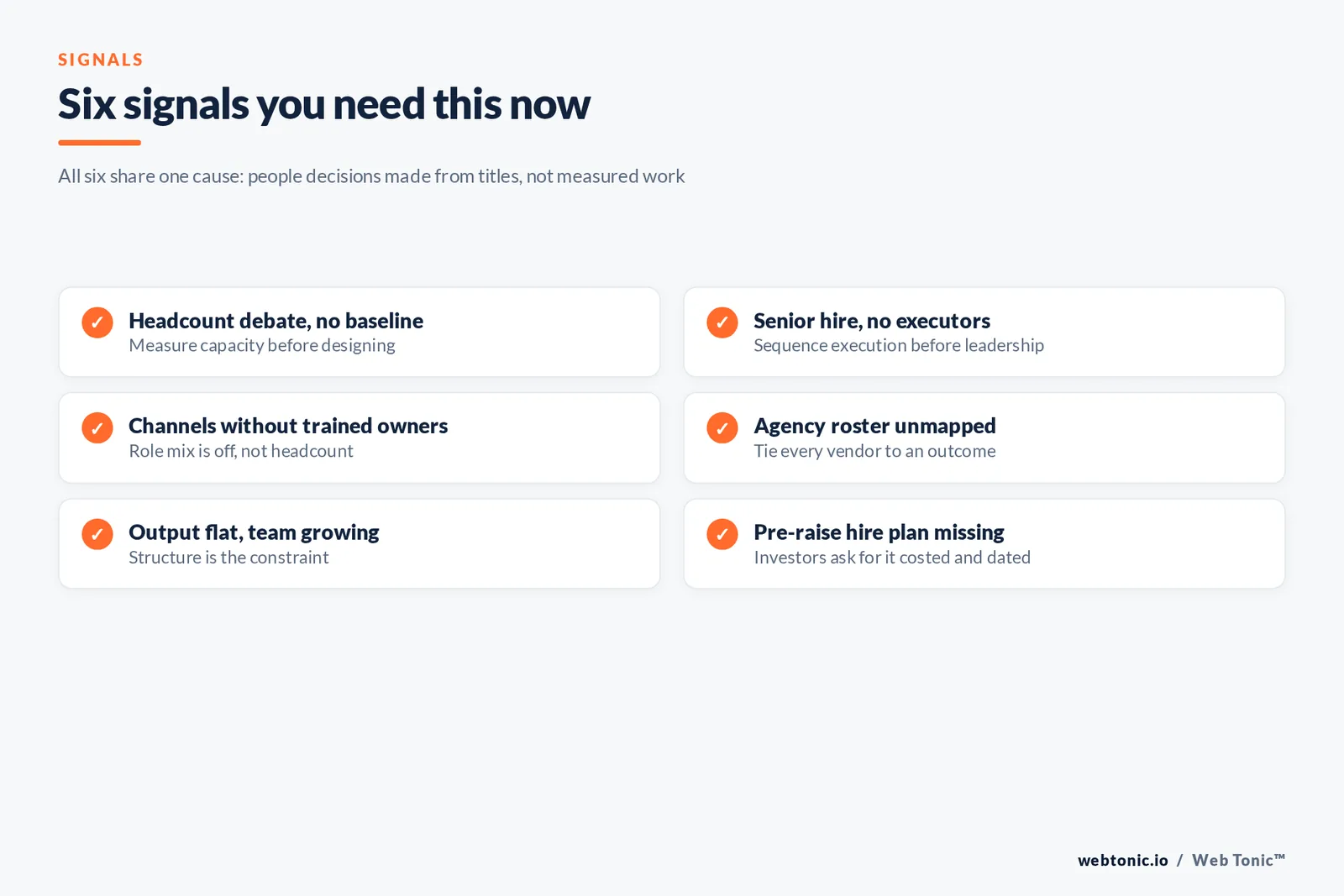
None of these signals are about ambition or budget. They are all about the same underlying condition: a decision about people is being made from a job title rather than from measured work. That is why the diagnosis is short and cheap relative to what it governs — a few weeks of analysis sitting in front of several hundred thousand dollars of annual commitment.
The clearest signal is a headcount argument with no capacity data underneath it. Others recur: a senior leader hired into a team with no execution capacity; three marketers each carrying a channel they were never trained for; an agency roster nobody can map to an outcome; a plan that assumes hiring speed the market does not support; and the quiet one — output flat while the team grows.
First-hire decisions deserve special care. Seed-stage hiring guidance makes the sequencing argument plainly: where a channel already works and the founder is the execution bottleneck, a contractor or agency can extend founder leverage for 4–6 months without committing equity or salary, and startup hiring discipline has tightened — overall startup hiring fell nearly 30% year over year in the recent correction, so each seat has to clear a higher bar. First-hire guidance and analysis of why first marketing leads fail both land on the same root cause: hiring a strategist when the gap is execution, or vice versa.
| Situation | Advisory is the right call | Advisory is not needed |
|---|---|---|
| Team size debate | No baseline of where current hours go | One clearly scoped, well-understood vacancy |
| Post-funding scale-up | Several seats to sequence in one year | Backfilling a proven role at the same level |
| Agency sprawl | Vendors cannot be mapped to outcomes | One vendor, one channel, clear reporting |
| Leadership gap | Unclear whether the seat is full or fractional | A leader in place with a working scorecard |
| Flat output, growing team | Structure or process is the constraint | A single channel underperforming on spend |
| Pre-raise | Investors will ask for a costed hire plan | Plan already written, costed and dated |
The build-versus-rent split is now a default, not a debate
Most functions are already hybrid, so the advisory question is proportions rather than principle. The same 2026 benchmark set reports the median mid-market marketing organisation running roughly 70% of spend in-house, 22% with agencies and 8% with fractional leaders and specialist freelancers, and notes that companies leaning hard into AI-augmented workflows operate with 15–22% fewer marketers than the medians while producing equivalent output. It also records job postings growing 6% while measured output grew closer to 24% — the productivity gap that makes a structure review timely rather than theoretical.
Budget context sharpens the same decision. B2B org-structure benchmarks put marketing budget at 7.7% of company revenue across respondents (8.1% for the B2B subset), martech at 19% of marketing budget, agencies at 23%, and the marketing-to-sales headcount ratio at roughly 1 marketer per 2.5 sellers in the $10–50M ARR band. Those ratios are what a costed plan should be argued against, and where an outside read is worth more than an internal one.
How to run the engagement well
Insist on measurement before design. A structure recommendation built without a capacity baseline is an opinion, and the baseline takes days, not weeks: where the current team's hours go, which of that work is recurring, and which channels have an owner who was actually trained for them. Analysis of early-stage hiring mistakes and first-hire post-mortems repeatedly trace failures to a mandate written from a job title rather than from the work in front of the company.
Then demand three things in the deliverable: loaded costs rather than salaries, dates rather than priorities, and a named interim answer for every seat that will not be filled this quarter. Team-cost modelling for 2026 and startup hiring guidance are useful sanity checks on both. We do this work as a written design you keep — see marketing team advisory, with fractional CMO cover when a seat needs holding during a search, and growth marketing for the execution the plan assumes.
The sequencing question nobody asks first
Almost every structure engagement ends up rearranging the same three decisions: leadership before execution or after, specialists before generalists or after, and operations before either. The default instinct is to hire leadership first, which works only when execution capacity already exists — a senior leader with nobody to run the plan produces documents. The reverse order fails differently: three capable executors with no owner of the channel mix produce activity without direction.
The benchmark that settles it is the role mix. If the target design says 15% of the function should be marketing operations and today that is zero, the next hire is probably operations rather than another campaign owner, because reporting and data hygiene already absorb a large share of ops time in mature teams. If demand generation should be 25% and sits at 60%, the gap is not headcount at all — it is that one person is carrying a channel portfolio that a benchmarked team would split across three seats.
What a costed plan looks like on paper
A usable hiring sequence has five columns: role, quarter, loaded cost, the number that seat owns, and who carries the work until it is filled. Loaded cost is where most internal plans understate reality — on the published inputs, a manager-level seat at a $108,000 base reaches roughly $138,000 to $148,000 a year before bonus, and year one lands between $157,000 and $221,000 once search fees and ramp are included.
The "who carries it" column is the one that changes behaviour. Marketing manager roles took around 52 days to fill on average in recent market data, and senior roles longer, so a plan that assumes a January hire is productive in February is already wrong. Naming interim cover — an agency, a fractional operator, or an explicit decision to leave the work undone for a quarter — converts a wish list into something a finance team can approve and a CEO can hold someone to.
Advisory, consulting or a fractional leader
Three delivery models sit behind the same brief, and the right one depends on how much of the decision is design versus execution. A structure advisor works in short bursts: a capacity read, an org model, a costed sequence, then periodic review as hires land. A consulting engagement goes further, running the selection process and building the scorecards and onboarding plans with your managers. A fractional CMO is a different purchase again — a leader holding the seat while the design is implemented, which is what companies choose when the quarter cannot wait for a search.
The choice has a measurable tell. If sales and marketing disagree about what a qualified lead is, or nobody can state the revenue number marketing owns, the gap is leadership rather than design, and a model on paper will not close it. If the numbers and the sales alignment are clear but the shape of the team is not, advisory is the cheaper and faster route. Market data on hiring timelines and pay bands — the kind of role-level benchmarks published from job-posting datasets — is the input that keeps either conversation grounded in what a seat actually costs and how long it takes to fill.

Frequently Asked Questions
How is this different from recruiting?
Recruiting fills a defined seat. This advisory decides which seats should exist and in what order, which is why it belongs before a search — especially given recruiting fees of 15–25% of first-year base on a role that may be the wrong one.
How long does it take?
Two to six weeks for most companies: about a week on the capacity baseline, one to two on design and costing, then a review cycle. It is a project, not a retainer.
Do we need it if we only want one hire?
Usually not. If the role is well understood, the work is recurring and a scorecard exists, hire. Structure work earns its fee when several seats interact or when the level of the hire is genuinely unclear.
Will it tell us to cut people?
Sometimes it recommends re-pointing roles rather than adding them, because output flat against a growing team is a structure problem. A good engagement is explicit about which conclusions are evidence-based and which are judgement.
What should the final document contain?
An org design, a hiring sequence with loaded costs and dates, a build-versus-rent split with the 70/22/8 benchmark as reference, and one number per seat. Read more in our resources or talk to our team.
Sources
Marketing team structure 2026 headcount benchmarks · B2B marketing org structure benchmarks · Cost of hiring a marketing manager 2026 · Cost of a leadership mis-hire, 2026 data · First marketing hire at seed: when and when not · Startup first marketing hire · Why hiring your first marketing lead often fails · Why companies under $5M ARR get the first hire wrong · The first marketing hire mistake · Cost of hiring a marketing team in 2026 · First marketing hire for a startup.