



Table of contents

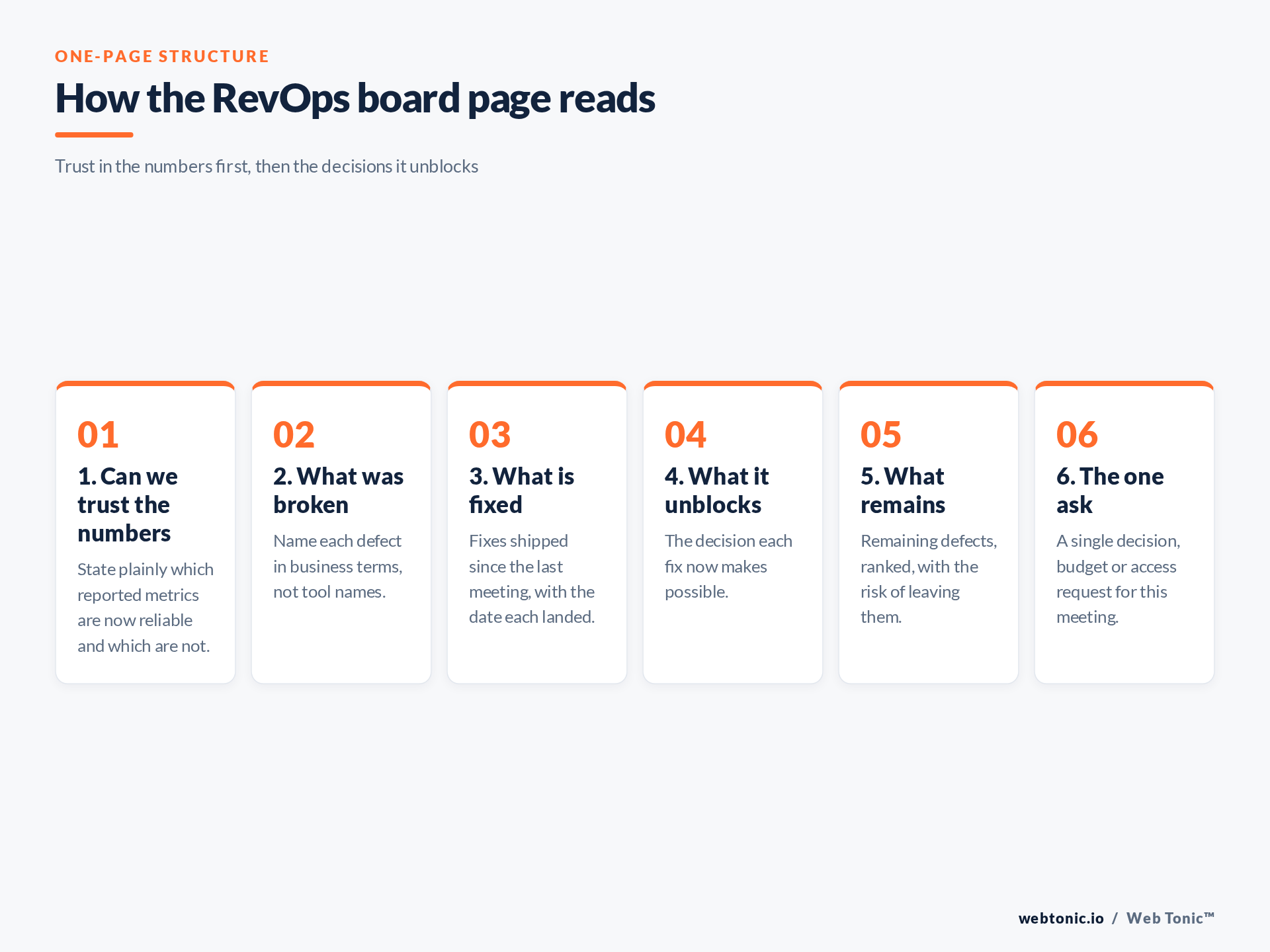
Quick answer: Report marketing operations consulting to a board on one page: state which numbers can now be trusted, what was broken, what is fixed, which decision each fix unblocks, what remains ranked by risk, and one ask.
Last verified: 2026-09-11
Lead with trust in the numbers, not the work
A board does not buy plumbing. It buys the ability to make decisions on numbers that hold up. So the first line of a RevOps consulting update is a verdict, not a status: which reported metrics are now reliable, which are still provisional, and which should not be used for a decision yet. That single sentence is the whole reason the engagement exists.
Directors carry a legal duty of care in how they rely on management information, so a stated confidence level per metric is more useful to them than a completion percentage. Frame it the way a board already thinks: reliable, provisional, unusable — with a date beside anything provisional.
Translate every fix into a consequence
"We rebuilt the deduplication rules" means nothing in a boardroom. "Lead counts stopped double-counting, so reported pipeline is twelve percent smaller and now correct" is a governance statement. Every line of marketing automation and CRM work has a consequence sentence like that, and the consequence is what belongs on the page.
Attribution deserves its own line because it is where boards get burned twice — once when the numbers were wrong, again when a fix makes them look worse. Explain in one sentence that ad platforms count on their own conversion windows and attribution settings while the CRM counts records, so a permanent gap is expected and only part of it was ever a defect. Say which part you closed.
Tie each fix to a decision it unblocks
The strongest column on the page is the one nobody writes: the decision this fix now makes possible. Source capture on every lead unblocks splitting budget by source. Clean stage definitions unblock a pipeline-coverage conversation. Working conversion tracking unblocks pausing a channel on evidence instead of on a hunch. Where analytics gaps were genuine collection losses, name what server-side tracking recovered and what it did not.
Keep the measurement detail one layer down. Boards do not need event configuration or consent mode mechanics, but they do need to hear that collection is lawful under obligations such as GDPR and that remaining gaps are explained rather than estimated.

Show the same lines every meeting
Operations reporting earns credibility through repetition, not through range. Pick a small fixed set of health lines — record hygiene, event collection, sync errors, reporting definitions, access and administration — and show the same lines with a trend arrow at every meeting. A balanced-scorecard style layout works well here because each line has a target, an owner and a direction.
Give each line a KPI definition that does not move between meetings. If a definition has to change, say so out loud and restate the prior period on the new definition; a silent redefinition destroys more trust than a bad number.
| Board line | What it shows | Failure signal |
|---|---|---|
| Metric confidence | Reliable, provisional or unusable per reported metric | Everything is green while numbers are still disputed |
| Record hygiene | Duplicate rate and missing-source rate | Rate drifts up quietly between meetings |
| Collection health | Event and conversion capture versus expected | Flat lines or overnight spikes after a release |
| Definitions | Agreed stage and qualification criteria in force | Two reports answer the same question differently |
| Access and admin | Named owner and MFA status per system | Shared logins, or a former agency still holding admin |
| Open risk | Ranked remaining defects and the decision each blocks | A flat backlog with no ranking |
Include access and control, briefly
Ownership of marketing systems is a governance question, so one line covers it: a named administrator per system, multi-factor authentication on every admin account per CISA guidance and NIST SP 800-63, and no vendor or consultant holding access without an expiry.
Close with one ask. Not five. Boards approve single, well-framed decisions — a budget release, an access mandate, an owner appointed to a data definition — and stall on a list. If two asks genuinely compete, say which one you would take.
What goes wrong
The failure mode: the update becomes a ticket report. Twenty-two items shipped, four in progress, no verdict on whether the numbers can be trusted. Boards read that as activity without direction, and the next conversation is about the operations budget rather than the operations findings.
Second failure mode: burying the restatement. If a fix changed a headline number, that belongs in the first paragraph with the reason, before anyone finds the discrepancy in another report. A restatement that surfaces on its own becomes a credibility problem instead of an accuracy improvement.
Third: reporting only the wins. A page with no ranked open risk reads as incomplete to anyone who has sat on a board, because operations debt never reaches zero. Process notes sit in the help library; delivery sits under data intelligence.
Related reading
- How to Report Marketing Strategy Consulting to a Board
- How to Report a Fractional CMO's Work to the Board
- Marketing Audit / Growth Audit — How to Report It to a Board
- Marketing Strategy Consulting services at Web Tonic
Frequently Asked Questions
How long should a RevOps board update be?
One page, with an appendix nobody is required to read. If the verdict on data trust cannot fit in the first two sentences, the update is not ready.
What if a fix makes reported performance look worse?
Say it first, with the reason and the restated prior period. Discovered later, the same fact reads as a concealed error rather than a correction.
Should the board see attribution methodology?
Only the consequence: which definition the company counts on, and why platform totals will never match it exactly. Methodology goes in the appendix.
How often should operations report to a board?
Every board meeting, using the same fixed health lines. Consistency is what turns operations reporting into something directors can trend rather than interpret.
Sources: Google Ads conversion windows, GA4 events, Consent Mode (Google); GDPR; CISA MFA; NIST SP 800-63-3; Balanced scorecard, KPI, Board of directors (Wikipedia). Verified 2026-09-11.


