



Table of contents

Martech has fallen to 19.4% of the marketing budget, yet 62% of organisations plan to invest more. The stack is not shrinking; it is being repriced, consolidated and pointed at AI workflows. Here is the 2026 adoption and tooling data a marketing operations engagement works from.
Key Takeaways
- Martech is 19.4% of marketing budget, a five-year low against 26.6% in 2021.
- 62% of organisations plan to invest more in technology.
- 56% are shifting to consumption-based pricing against 9% cutting spend.
- 41% are adding usage controls and 24% are overhauling systems.
- Only 9% describe their stack as fully AI-optimised.
- AI covers 24.2% of marketing activities, up from 13.1%.
- Generative AI use rose from 7.0% to 22.4%, a 220% increase.
- Marketers project AI across 55.9% of activities within three years.
- 41.5% report working on generative engine optimisation.
- Content generation leads AI use cases at 73.9%.
- Vendor selection self-rates 4.9 of 7 while demonstrating ROI rates 4.2.
- Training fell to 3.8% of marketing spend, from 5.8%.
- AI capability gaps block 35.7% of marketers, architecture 19.1%.
- 61% call this the biggest disruption to marketing in twenty years.
- 80% use AI for content and 75% for media production.
A smaller share of budget, not a smaller stack
Gartner's 2026 CMO Spend Survey, via Chief Marketer, puts martech at 19.4% of the marketing budget - a five-year low against 26.6% in 2021 - while 62% plan to invest more. Both can be true: consolidation and repricing lower the share even as capability is added.
For an operations team the headline number is less useful than its direction. A falling share with rising investment means the money is moving between line items, and somebody has to be accountable for where it lands.
| Stack economics | 2026 figure | What it changes operationally |
|---|---|---|
| Martech share of budget | 19.4% | Cost per tracked outcome becomes the test |
| Planning to invest more | 62% | New systems keep arriving |
| Consumption-based pricing | 56% | Monthly review replaces annual renewal |
| Cutting technology spend | 9% | Cuts are the exception, not the trend |
| Adding usage controls | 41% | Caps need an owner and an alert |
| Overhauling systems | 24% | Migration work is project-shaped |
| Fully AI-optimised stack | 9% | Target state has to be documented |
Consumption pricing is the real change
56% shifting to consumption-based pricing against 9% cutting spend is the most consequential line in the Gartner data, and 41% adding usage controls is the admission that follows it. A consumption contract means a bad automation, a duplicate sync or an unthrottled enrichment job now has a direct invoice attached.
That is a marketing operations job in the strict sense: not choosing the tool, but governing its use. It is also why tool cost has started to behave like media spend, and should be reviewed on the same cadence.
AI adoption has roughly doubled in a year
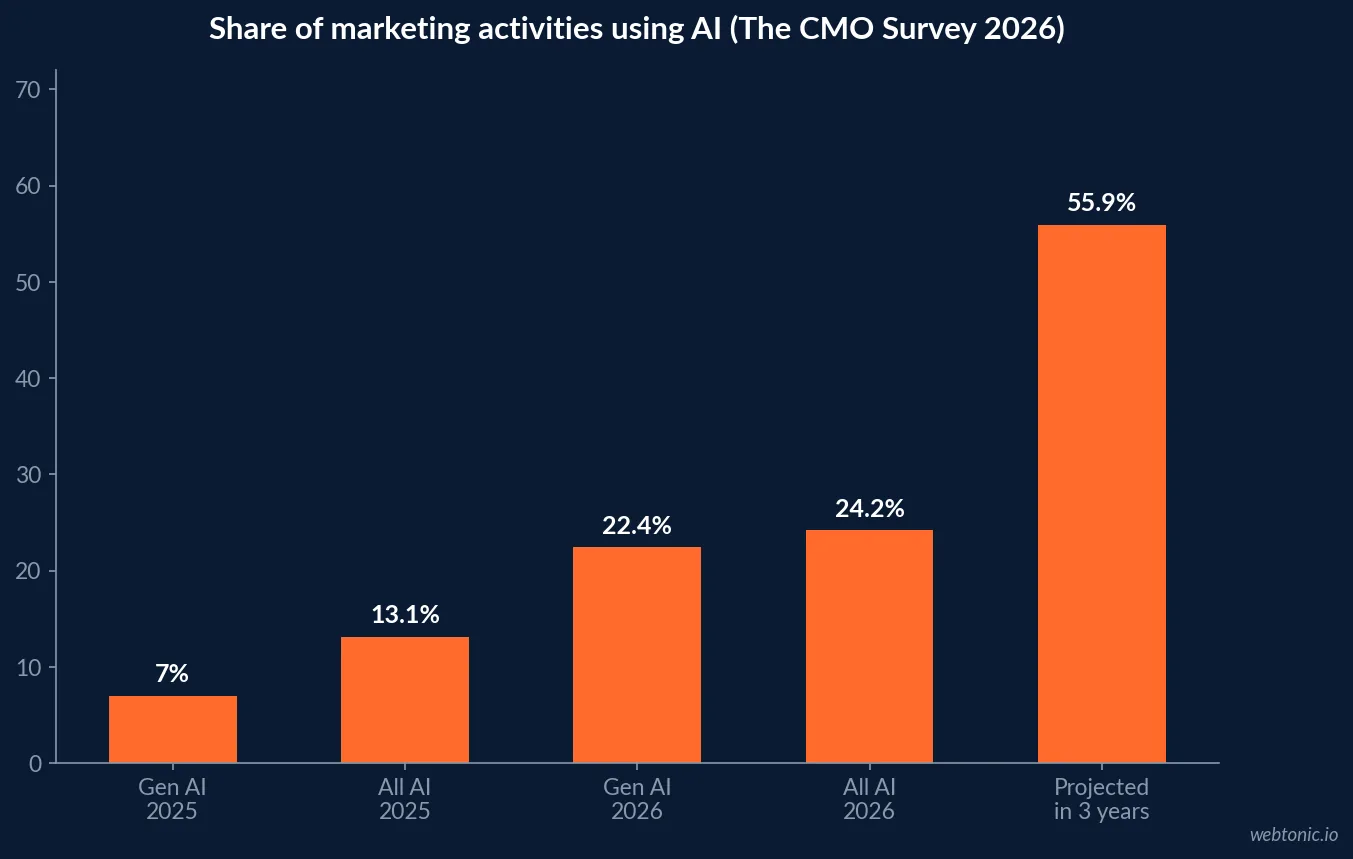
The CMO Survey 2026 reports AI covering 24.2% of marketing activities, up from 13.1%, with generative AI rising from 7.0% to 22.4% - a 220% increase - and a projection of 55.9% within three years. 41.5% report work on generative engine optimisation.
Adoption at that speed outruns process. The operations consequence is predictable: more outputs, more systems touching the same records, and no agreed definition of which output counts.
| AI use case | Share of marketers | Operations control it needs |
|---|---|---|
| Content generation | 73.9% | Approval and provenance logging |
| Personalisation | 65.4% | Consent and segment definitions |
| Automation | 48.9% | Trigger inventory and kill switches |
| Analysis | 46.3% | Agreed metric definitions |
| Targeting | 45.2% | Audience overlap and suppression rules |
Teams buy better than they operate
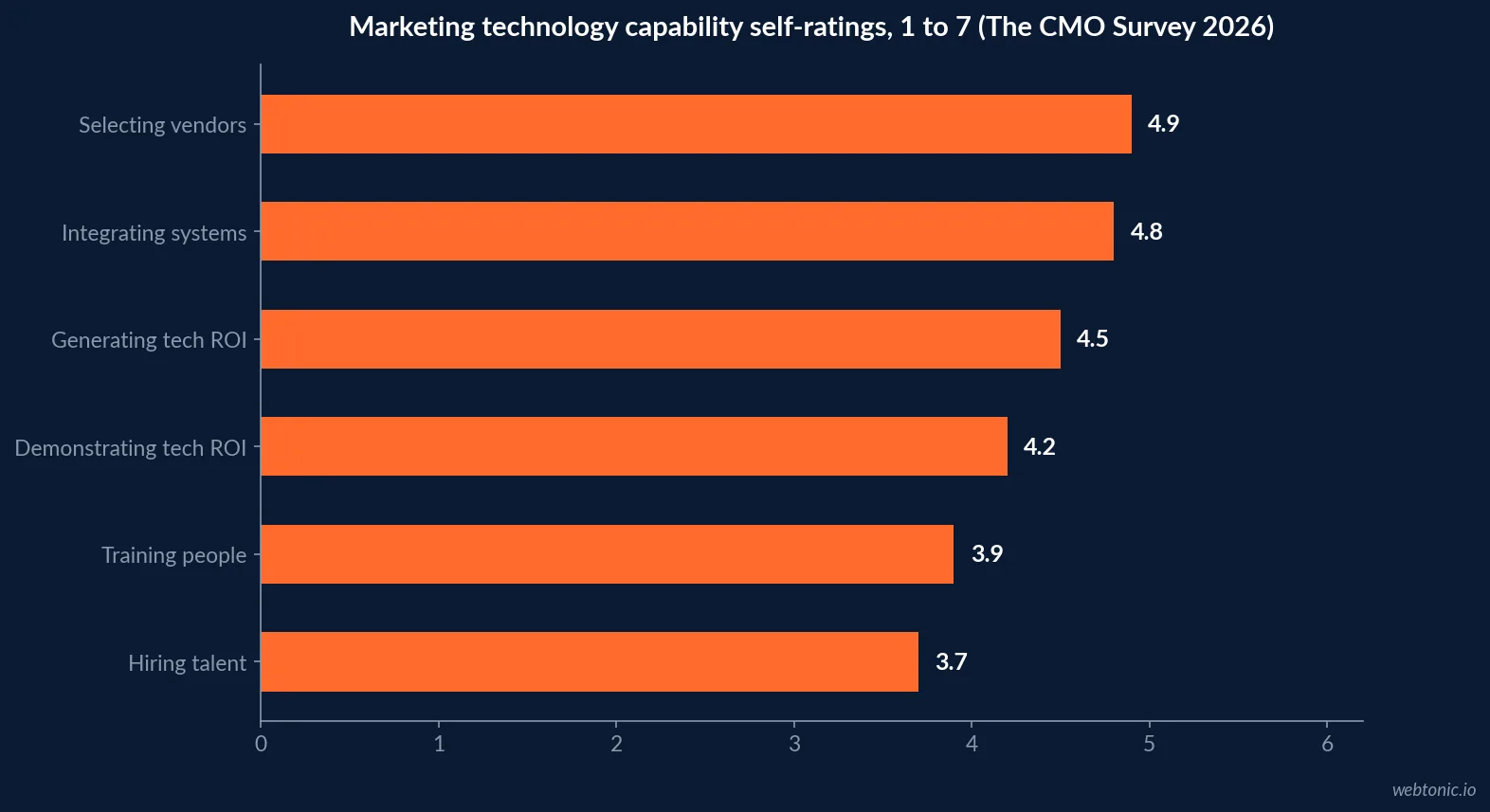
The same survey asks marketers to self-rate on a 1-to-7 scale: vendor selection 4.9, tactical use of data 4.8, systems integration 4.8, generating technology ROI 4.5, demonstrating that ROI 4.2, training 3.9 and hiring 3.7. No capability scores above 5, and the ratings are flat against 2024.
The ranking is the finding. Selection is the strongest skill and proof is among the weakest, which is exactly the gradient that produces a large stack nobody can defend at budget time.
Training was cut while complexity rose
The CMO Survey puts training at 3.8% of marketing spend, down from 5.8%, with barriers ranked AI capability gaps 35.7%, resourcing 22.3%, data and system architecture 19.1%, bandwidth 14.1% and talent 13.1%. Spending less on enablement while adoption doubles is how a capability gap becomes structural.
It also explains why tool consolidation projects so often fail to reduce cost: the licences go, the workflows stay, and the people who could rebuild them were never trained on the surviving system.
| Barrier | Share of marketers | Cheapest first response |
|---|---|---|
| AI capability gaps | 35.7% | Standardise two use cases, then train |
| Resourcing | 22.3% | Automate reconciliation before hiring |
| Data and system architecture | 19.1% | One source of truth per object |
| Bandwidth | 14.1% | Retire reports nobody opens |
| Talent | 13.1% | Document the process, not the person |
The scale of the shift, from the vendor side
HubSpot's State of Marketing finds 61% of marketers calling this the biggest disruption to marketing in twenty years, with 80% using AI for content and 75% for media production. Vendor research overstates enthusiasm as a rule, but the direction matches the academic survey data closely enough to plan against.
Where the two disagree - vendor adoption figures run higher than the CMO Survey's activity share - the gap is mostly definitional: trying a tool is not the same as running a process on it.
Governance is the gating factor
The Content Marketing Institute's 2026 B2B research reports 97% of organisations with a content strategy but only 52% of top performers describing their governance as mature, with measurement a top challenge for 33%. Governance, not tooling, is what turns adoption into a reportable outcome.
That is the same conclusion the barrier data reaches from another direction, and it is why our data intelligence practice starts every stack review with owners and definitions rather than with a vendor list.

Six checks before the next licence
Name one owner per system, given architecture blocks 19.1%. Restore the training line cut to 3.8%. Standardise two AI use cases rather than ten, starting with content at 73.9%. Review consumption monthly for the 56% on usage-based contracts. Decide what gets switched off, as the 41% adding controls have. And instrument the outcome, since proving technology ROI still rates 4.2 of 7.
None of those requires new software, which is the point. The measurable gains in a tooling review usually come from the five decisions above rather than from the purchase that prompted it.
Consolidation rarely returns the savings promised
With 24% overhauling systems and martech down to 19.4% of budget, tool consolidation is the fashionable answer. It works when the workflows move with the licences and fails when they do not - and with training at 3.8% of spend and hiring self-rated 3.7 of 7, the capacity to rebuild workflows on the surviving platform is often missing.
A safer sequence is to freeze new purchases for a quarter, inventory what each system is actually used for, retire the unused, and only then consolidate what remains. The first three steps cost nothing but attention.
| Consolidation step | Prerequisite | 2026 anchor |
|---|---|---|
| Freeze new purchases | An owner who can say no | 62% still plan to invest more |
| Inventory real usage | Consumption reporting | 56% on consumption pricing |
| Retire unused systems | A named owner per tool | Architecture blocks 19.1% |
| Rebuild surviving workflows | Trained internal team | Training fell to 3.8% of spend |
| Renegotiate contracts | Usage evidence | 41% are adding usage controls |
Where generative engine optimisation fits
The CMO Survey reports 41.5% of marketers working on generative engine optimisation, alongside AI at 24.2% of activities. Operationally this is a measurement problem before it is a content problem: answers surfaced inside an AI assistant do not arrive with the referral data that the existing dashboard assumes.
The practical step is to decide now which imperfect proxy the scorecard will carry - branded search, direct traffic, assisted conversions - and to record that choice, so the number means the same thing in six months as it does today.
Tie the stack to an efficiency number
Adoption statistics do not settle a renewal argument; efficiency ones do. Benchmarkit's CY-2025 benchmarks report a median CAC payback of 16 months, improved from 18, with the strong quartile at 10 months and the weak quartile at 24. Hinge's 2026 High Growth Study adds that high-growth firms spend 12.0% of revenue on marketing against 5.0% for no-growth firms.
Attach one of those to every material system. A tool that cannot be connected to payback, pipeline or a documented time saving is a candidate for the 41% usage-control list rather than for renewal.
What good looks like in twelve months
A defensible target state after a year: every system has a named owner, every consumption contract has a cap and a monthly report, two AI use cases are standardised with documented review steps, and the reporting layer produces one number per definition. Against 9% of stacks currently described as fully AI-optimised, that is ahead of the market without being heroic.
Measured against the same benchmarks used to set it, the target is arguable in a budget meeting - the standard we apply to paid channel strategy as well. If you want your stack reviewed on that basis, our growth team can run it, or get in touch.
Related reading
- Marketing Strategy Consulting Statistics: Adoption and Tooling
- Marketing Audit Statistics: Adoption and Tooling
- Marketing Team Structure Statistics: Adoption and Tooling
- Marketing Strategy Consulting services at Web Tonic
Frequently Asked Questions
How much of the marketing budget goes to technology in 2026?
Gartner's 2026 CMO Spend Survey, reported by Chief Marketer, puts martech at 19.4% of the marketing budget - a five-year low against 26.6% in 2021 - while 62% of organisations still plan to invest more. The share is falling because contracts are being repriced and consolidated, not because teams are buying fewer capabilities.
What is changing about how martech is bought?
The pricing model. Gartner reports 56% of organisations shifting to consumption-based pricing against 9% cutting spend, 41% adding usage controls and 24% overhauling their systems outright. Consumption pricing turns tool cost into a variable that behaves like media spend, which is why it needs a monthly owner rather than an annual renewal review.
How fast is AI being adopted inside marketing operations?
The CMO Survey 2026 reports AI covering 13.1% of marketing activities a year ago and 24.2% now, with generative AI specifically rising from 7.0% to 22.4% - a 220% increase - and a projection of 55.9% of activities within three years. Content generation leads the use cases at 73.9%, followed by personalisation 65.4%, automation 48.9%, analysis 46.3% and targeting 45.2%.
Why do stacks underperform even when the tools are good?
Because capability is uneven. The CMO Survey's self-ratings on a 1-to-7 scale put vendor selection at 4.9, tactical use of data 4.8, systems integration 4.8, generating technology ROI 4.5, demonstrating that ROI 4.2, training 3.9 and hiring 3.7. Nothing scores above 5 and the ratings are flat against 2024. Teams are better at buying than at operating what they bought.
What should a tooling review actually decide?
Which systems have a named owner, which contracts are consumption-based and need caps, and what gets switched off. With AI capability gaps blocking 35.7% of marketers, resourcing 22.3% and data architecture 19.1%, and only 9% of stacks described as fully AI-optimised, most reviews find that ownership and definitions matter more than the next licence.
Sources
Chief Marketer - Gartner 2026 CMO Spend Survey coverage
The CMO Survey - Highlights and Insights Report 2026
HubSpot - State of Marketing
Content Marketing Institute - B2B Content Marketing Trends 2026
Benchmarkit - CY-2025 B2B SaaS Performance Metrics Benchmarks
Hinge Research Institute - 2026 High Growth Study


