



Table of contents
Key Takeaways
- Shopify's B2B gross merchandise volume hit $9.4 billion in H1 2026, surging 140% year-over-year as manufacturers increasingly adopt the platform for wholesale and direct-to-consumer sales. (Ecommerce Times)
- The average B2B order value on Shopify is $1,840, compared to approximately $130 for DTC orders — reflecting the high-value nature of manufacturing transactions. (Ecommerce Times)
- B2B manufacturing ecommerce conversion rates average 1.9–2.2%, with mid-market manufacturers ($50–250M revenue) achieving 2.4% and enterprise firms reaching 2.6%. (Atwix)
- 62.3% of industrial buyers now purchase products online, representing a 702% increase since 2018 and signaling the mainstream adoption of ecommerce in manufacturing. (BigCommerce)
- Shopify Plus ARR grew approximately 34% year-over-year in Q1 2026, significantly outpacing overall revenue growth as enterprise and B2B merchants drive platform expansion. (Online Store News)
- Manufacturing ecommerce sites with ERP integration achieve 15.8% higher conversion rates, moving from 1.9% to 2.2% when product data flows seamlessly between systems. (Atwix)
| Metric | Manufacturing B2B | DTC / Retail | Source |
|---|---|---|---|
| Avg. Order Value | $1,840 | $130 | Ecommerce Times |
| Conversion Rate | 1.9–2.2% | 2.3% (all ecommerce) | Atwix / WisePIM |
| Shopify B2B GMV (H1 2026) | $9.4B | — | Ecommerce Times |
| YoY GMV Growth | 140% | ~20% | Ecommerce Times |
| Online Purchase Rate | 62.3% | 80%+ | BigCommerce |
Shopify B2B Growth in Manufacturing
Shopify's wholesale and B2B commerce capabilities have reached an inflection point for manufacturers. The company disclosed in its Q2 2026 investor letter that its B2B segment generated $9.4 billion in GMV in the first half of 2026, a 140% increase year-over-year from $3.9 billion in the same period of 2025. (Ecommerce Times)
This acceleration follows Shopify's overhauled B2B storefront framework, launched in Q4 2025, which gave merchants the ability to run fully separate buyer-facing portals with custom catalogs, net terms (30/60/90-day options for approved buyers), and volume pricing tools. (Ecommerce Times) The average B2B order value on Shopify reached $1,840, compared to approximately $130 for DTC orders — a 14× difference that reflects the high-ticket nature of industrial procurement. (Ecommerce Times)
Shopify Plus ARR grew roughly 34% year-over-year in Q1 2026, significantly outpacing overall platform revenue growth as enterprise merchants — including manufacturers — adopt Plus for its B2B capabilities and API flexibility. (Online Store News) Manufacturers evaluating ecommerce platforms can benefit from understanding how growth marketing services accelerate channel adoption and revenue growth.
Manufacturing Ecommerce Conversion Rate Benchmarks
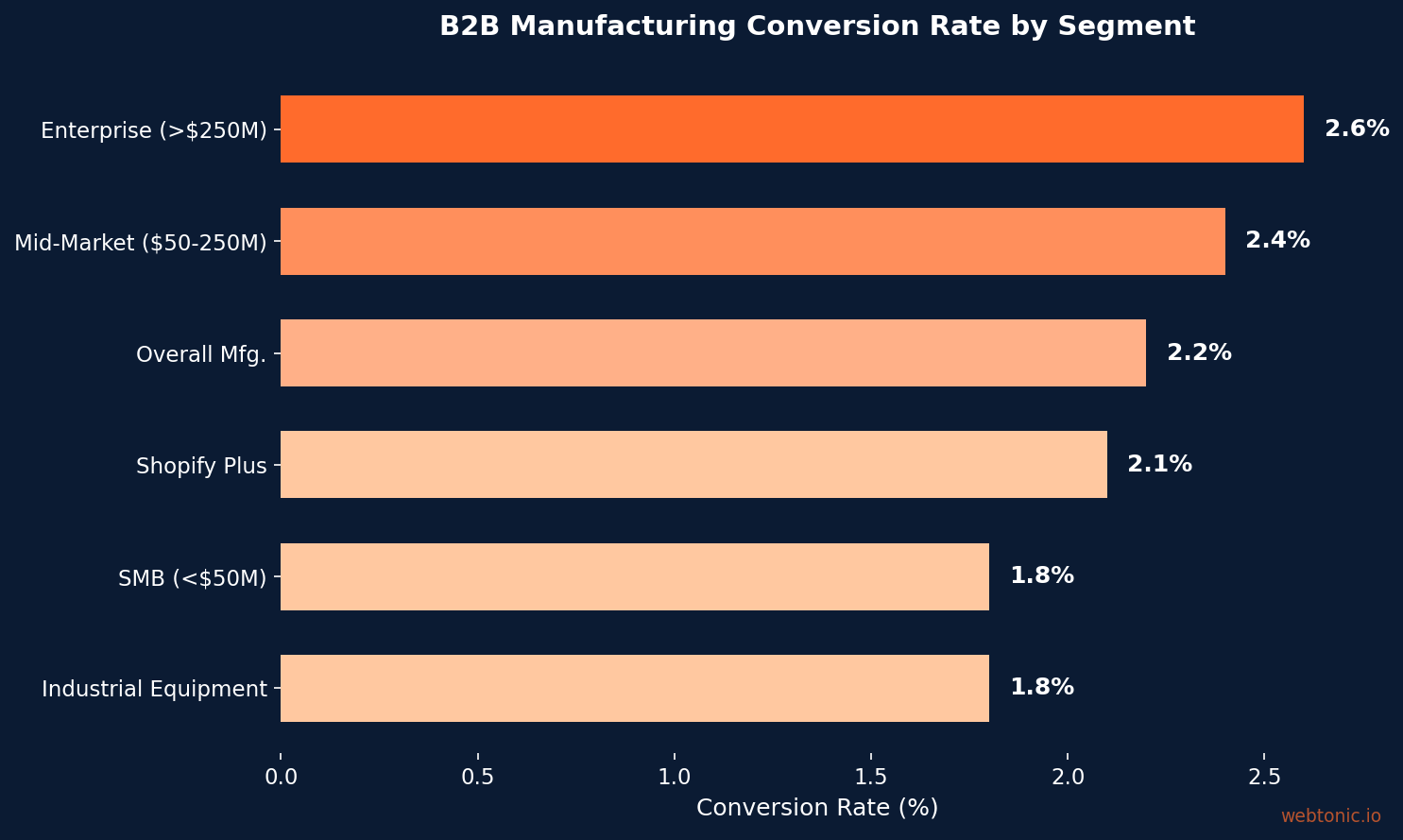
Manufacturing ecommerce presents unique conversion dynamics compared to retail. According to Atwix's analysis of 250+ B2B implementations across Magento, Shopify Plus, and Shopware, manufacturing B2B conversion rates average 2.2% overall, with significant variation by company size and platform choice:
| Segment | Conversion Rate | YoY Change | Key Conversion Drivers |
|---|---|---|---|
| SMB (<$50M revenue) | 1.8% | — | Simplified catalogs, fast checkout |
| Mid-Market ($50–250M) | 2.4% | — | ERP integration, account management |
| Enterprise (>$250M) | 2.6% | — | Custom portals, contract pricing |
| Overall Manufacturing | 2.2% | +15.8% | ERP integration, mobile optimization |
| Distribution | 2.4% | +14.3% | Bulk ordering, quick reorder |
| Wholesale | 2.6% | +13.0% | Volume discounts, repeat purchasing |
| Industrial Equipment | 1.8% | — | Complex configuration, RFQ workflows |
Source: (Atwix)
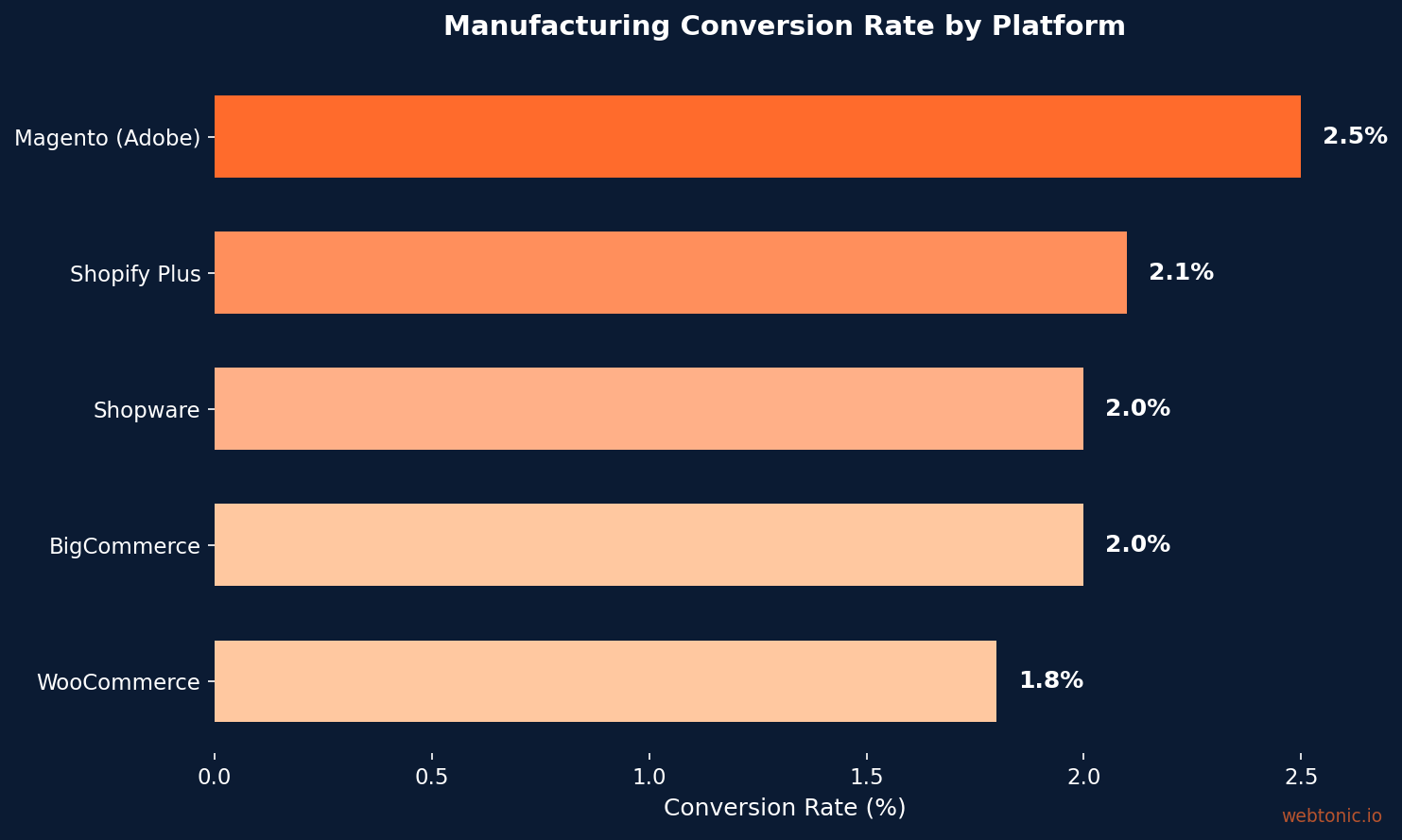
Platform choice also impacts conversion. Manufacturing sites on Magento (Adobe Commerce) convert at 2.5%, Shopify Plus at 2.1%, and Shopware at 2.0%. (Atwix) The Magento advantage stems from deeper ERP integration capabilities and more flexible product configuration, though Shopify Plus is closing the gap rapidly through its B2B storefront features and expanding app ecosystem.
For industrial equipment specifically, conversion rates sit lower at 1.2% versus the overall ecommerce average of 2.3%. (WisePIM) This gap reflects longer purchase cycles, higher order values, and the RFQ-driven nature of industrial procurement rather than a failure of platform optimization. Elogic Commerce reports that B2B manufacturing conversion targets of 3%+ are achievable with ERP integration, mobile optimization, and streamlined ordering workflows. (Elogic Commerce)
Shopify Market Position and Platform Statistics
Shopify's overall market dominance provides context for its manufacturing push. Shopify commands 14%+ of the U.S. ecommerce market share, with merchants processing over $170 billion in domestic ecommerce annually. (Axis Intelligence) The platform now powers businesses across 175+ countries with over 1.2 million active merchants, and total merchant sales have grown 13-fold over the past decade.
The Shopify Payments processing infrastructure now handles two of every three transactions on the platform, reducing payment friction for B2B manufacturers who previously relied on offline invoicing and manual purchase order reconciliation. (99 Coupons) This payments integration is particularly valuable for manufacturing, where net terms and credit-based purchasing are standard procurement practices.
The competitive landscape shows Shopify and WooCommerce dominating overall market share, though the practical reading varies by merchant shape. (EcomToolkit) For manufacturers specifically, Shopify Plus, Magento, and BigCommerce are the most common enterprise choices. Manufacturers exploring Google Ads management alongside their Shopify stores can drive qualified traffic directly to product pages and RFQ forms.
Industrial Ecommerce Adoption Trends
The manufacturing sector's shift to ecommerce is accelerating beyond early-adopter territory. 62.3% of industrial buyers now purchase electrical, HVAC, or industrial supply products online, representing 30% of total industry purchases — a staggering 702% increase since 2018. (BigCommerce)
This shift is structural rather than cyclical. 98% of industrial manufacturers generate sales-qualified leads through digital marketing channels, and 57% of industrial buyers make purchase decisions before ever contacting a supplier. (ManufacturingLeadGeneration) Manufacturers without ecommerce capabilities are increasingly invisible during the procurement research phase.
Gartner predicted that 80% of B2B sales interactions between suppliers and buyers would occur in digital channels by 2025, and the data confirms this trajectory. Meanwhile, 86% of B2B purchases stall during the buying process and 81% of buyers express dissatisfaction with their chosen providers — making seamless ecommerce experiences a competitive differentiator for manufacturers. (Atwix, citing Gartner and Forrester)
The direct-to-consumer opportunity is also growing. The U.S. DTC market reached $213 billion in 2023 and continues expanding as manufacturers bypass traditional distribution to sell directly to end users via platforms like Shopify. (Shopify) Many manufacturers are adopting a hybrid model — running B2B wholesale portals and DTC consumer storefronts simultaneously on Shopify Plus. Learn how performance creative helps ecommerce brands maximize conversion rates across both channels.
Shopify vs. Competing Platforms for Manufacturing
| Platform | Mfg. Conversion Rate | Best For | B2B Features |
|---|---|---|---|
| Shopify Plus | 2.1% | D2C + wholesale hybrid | Company accounts, net terms, custom catalogs |
| Magento (Adobe Commerce) | 2.5% | Complex B2B catalogs | Deep ERP integration, shared catalogs |
| Shopware | 2.0% | European manufacturers | Rule-based pricing, B2B suite |
| BigCommerce | ~2.0% | Mid-market manufacturers | B2B edition, headless commerce |
| WooCommerce | ~1.8% | Budget-conscious SMBs | Plugin-based B2B functionality |
Shopify's primary advantage for manufacturers is speed to market. The B2B storefront framework launched in Q4 2025 enables manufacturers to set up custom buyer portals with volume pricing and net terms within weeks, compared to months-long Magento implementations. However, Magento retains its edge for manufacturers with deeply integrated ERP requirements, complex product configurators, or multi-warehouse inventory management. (Atwix)
Manufacturing Ecommerce Revenue and AOV Data
The revenue potential for manufacturers on ecommerce platforms is substantial and growing. The overall Shopify average AOV in 2026 is approximately $85–$95, but manufacturing and industrial categories dramatically exceed this baseline. (Growth Suite) Top-performing Shopify stores (top 20%) achieve AOV of $192+, while the top 10% reach $311+. (Growth Suite, citing Littledata)
Manufacturing B2B orders at $1,840 average on Shopify dwarf even the highest consumer verticals — electronics ($120–$180), home and garden ($95–$130), and fashion ($85–$105). (Growth Suite) This AOV premium makes manufacturing one of the most valuable segments for Shopify, even with lower conversion rates. A manufacturer converting at 2.1% with $1,840 AOV generates $38.64 in revenue per visitor, compared to $2.21 for a typical Shopify store at 2.3% conversion and $96 AOV.
The U.S. B2B ecommerce market continues to expand at double-digit growth rates, with manufacturing representing one of the fastest-adopting sectors. Distribution companies convert at 2.4% and wholesale at 2.6%, indicating that supply-chain-adjacent ecommerce is outperforming direct manufacturing sales and presenting partnership opportunities. (Atwix) For manufacturers looking to maximize their ecommerce revenue, pairing platform optimization with data intelligence services provides the analytics foundation for informed growth decisions.
Best Practices for Manufacturers on Shopify
- Integrate your ERP system — manufacturing sites with ERP integration achieve 15.8% higher conversion rates by providing real-time inventory, pricing, and order status to buyers.
- Set up separate B2B and DTC storefronts — Shopify Plus supports custom catalogs, contract pricing, and net terms for wholesale alongside consumer-facing stores.
- Optimize for mobile procurement — industrial buyers increasingly research on mobile, and manufacturers with mobile-optimized sites see 34% higher engagement.
- Add detailed product specifications — 59% of industrial buyers prefer suppliers with comprehensive technical content, and pages with specs convert significantly better.
- Implement RFQ workflows — for high-value manufacturing orders ($1,840 avg B2B AOV), quote-request processes outperform standard checkout experiences.
- Drive targeted traffic with paid media — pairing Shopify with Google Ads maximizes the platform's conversion potential for qualified manufacturing buyers.
Related reading
- 50+ Veterinary Shopify Statistics: Pet E-Commerce Benchmarks (2026)
- Shopify for Allergy & Immunology: 45+ Statistics & Benchmarks (2026)
- Automotive Shopify Statistics: 70+ E-Commerce Benchmarks for 2026
- Custom Web Development services at Web Tonic
FAQ
How big is Shopify's B2B manufacturing market?
Shopify's B2B commerce segment generated $9.4 billion in GMV in H1 2026, up 140% year-over-year from $3.9 billion. The average B2B order value is $1,840, reflecting the high-ticket nature of manufacturing transactions. Shopify Plus, the enterprise tier driving most B2B adoption, grew ARR roughly 34% year-over-year in Q1 2026.
What conversion rate should manufacturers expect on Shopify?
Manufacturing B2B conversion rates on Shopify Plus average 2.1%, compared to 2.5% on Magento and 2.0% on Shopware. SMBs average 1.8%, mid-market firms reach 2.4%, and enterprise manufacturers hit 2.6%. ERP integration is the single biggest conversion driver, adding 15.8% to baseline rates.
Is Shopify good for B2B manufacturing?
Yes, especially since Q4 2025 when Shopify launched its overhauled B2B storefront framework. Manufacturers can now run fully separate buyer-facing portals with custom catalogs and net terms (30/60/90 days). The 140% B2B GMV growth validates rapid adoption. For complex ERP integrations, Magento still leads on conversion rate.
What percentage of industrial buyers purchase online?
62.3% of industrial buyers now purchase products online, representing a 702% increase since 2018. Additionally, 57% of buyers make purchase decisions before contacting a supplier, making ecommerce presence essential for manufacturer visibility during the procurement research phase.
How does manufacturing AOV compare to other Shopify industries?
Manufacturing B2B orders average $1,840 on Shopify, dramatically higher than the overall Shopify AOV of $85–$95. This 14× difference reflects the nature of B2B procurement — bulk orders, industrial equipment, and raw materials. Even manufacturing DTC orders typically exceed consumer AOV benchmarks due to higher product values.
Sources
ecommerce-times.com — Shopify B2B GMV Surges 140%
atwix.com — B2B eCommerce Conversion Rate Benchmarks
elogic.co — B2B Ecommerce Conversion Rate Benchmarks 2026
axis-intelligence.com — Shopify Statistics 2026
onlinestorenews.com — Shopify Global Merchant Sales 2026
bigcommerce.com — Industrial Ecommerce in 2026
wisepim.com — Industrial Equipment Ecommerce Benchmarks
manufacturingleadgeneration.com — 110+ Manufacturing Marketing Statistics
ecomtoolkit.net — Ecommerce Platform Market Share 2026
99coupons.ai — Shopify Statistics 2026
shopify.com — Direct to Consumer Manufacturing


