



Table of contents
Key Takeaways
- The global healthcare ecommerce market is valued at $0.62 trillion in 2026, growing at an 18.38% CAGR toward $1.43 trillion by 2031 (Mordor Intelligence).
- Health and supplement Shopify stores convert at a median 2.0% in 2026, up 11.1% year-over-year from 1.8% in 2025 (Eevy.ai).
- Ecommerce channels now account for 18–24% of U.S. allergy care purchases, with subscription-based replenishment models gaining traction — a trend mirrored in growth marketing strategies across healthcare (IndexBox).
- Shopify crossed $100 billion in quarterly GMV in Q1 2026, delivering 34% revenue growth across geographies and merchant sizes (Shopify Investor Relations).
- The U.S. allergy care market is expanding at a 4–6% CAGR through 2035, driven by rising prevalence, aging populations, and self-care investment (IndexBox).
- Top-decile Shopify stores in health and supplements clear a 6.2% conversion rate, more than three times the platform-wide median of 1.4% (Eevy.ai).
- Oral antihistamines represent 40–45% of OTC allergy relief revenue, making them the largest product segment available through online retail (IndexBox).
- Average order value across all Shopify health stores sits between $80 and $120, with supplement brands routinely exceeding $100 per transaction (DollarPocket).
| Metric | 2025 | 2026 | Change |
|---|---|---|---|
| Healthcare Ecommerce Market Size | $0.52 T | $0.62 T | +19.2% |
| Health & Supplements CVR (Median) | 1.8% | 2.0% | +11.1% |
| U.S. Allergy Care Ecommerce Share | ~16–20% | 18–24% | +2–4 pp |
| Shopify Quarterly GMV | $74.8 B | $100+ B | +34% |
| Private-Label Allergy Unit Volume | ~16–19% | 18–22% | +2–3 pp |
| Platform-Wide Shopify AOV | $82 | $85 | +3.7% |
Healthcare Ecommerce Market Growth
Healthcare ecommerce has transitioned from a convenience channel to a primary revenue driver. The global healthcare ecommerce market reached $0.62 trillion in 2026, growing from $0.52 trillion in 2025 — a pace that positions the sector at $1.43 trillion by 2031 at an 18.38% CAGR (Mordor Intelligence). North America remains the largest regional market, while Asia Pacific is the fastest-growing segment.
Prescription drugs lead product categories at 46.12% of healthcare ecommerce market share, but medical devices and consumables are projected to expand at 19.24% CAGR to 2031. For allergy and immunology businesses, this growth reflects a broader shift: patients increasingly purchase allergy testing kits, air purifiers, HEPA filtration products, and OTC antihistamines through online storefronts rather than visiting brick-and-mortar pharmacies. Telemedicine integration further accelerates this trend, accounting for 47.35% of the healthcare ecommerce application mix.
Shopify Platform Performance in 2026
Shopify continues to cement its position as the dominant ecommerce infrastructure for small and mid-size health businesses. In Q1 2026, the platform crossed $100 billion in quarterly gross merchandise volume for the first time, delivering 34% year-over-year revenue growth (Shopify Investor Relations). That momentum spans geographies, merchant sizes, and sales channels — including the health and wellness vertical.
The median Shopify store conversion rate sits at 1.4% platform-wide, though that average masks significant variance. The top quartile converts at 3.8% or higher, and the top decile exceeds 6.2%. Average order value across all Shopify stores runs $80–$120, with health-focused brands consistently landing in the upper range (DollarPocket). Cart abandonment remains a challenge: health and supplement stores see 65–72% abandonment rates, slightly below the platform average, suggesting higher buyer intent in the vertical.
Allergy and Immunology Product Market Trends
The U.S. allergy care market is estimated to expand at a 4–6% CAGR between 2026 and 2035, supported by rising allergy prevalence, an aging population with chronic sensitivity, and sustained investment in self-care (IndexBox). Product performance varies by category:

| Product Category | Market Share | Growth Rate (CAGR) | Ecommerce Fit |
|---|---|---|---|
| Oral Antihistamines | 40–45% | 3–5% | High — subscription models |
| Nasal Sprays | 18–22% | 6–8% | High — Rx-to-OTC conversions |
| Allergy Testing Kits | 8–12% | 10–14% | Very High — DTC model |
| Air Purifiers / HEPA Filters | 10–14% | 7–9% | High — higher AOV |
| Immunotherapy Supplements | 5–8% | 8–12% | Medium — requires education |
| Environmental Controls | 6–9% | 6–8% | High — dust mite covers, dehumidifiers |
Private-label penetration has reached 18–22% of unit volume in U.S. retail allergy care, reflecting price-sensitive switching among customers managing long-term conditions. For Shopify merchants, this creates a dual opportunity: selling branded OTC products alongside higher-margin private-label alternatives tailored to specific allergens — including dust mites, seasonal pollen, and food allergy triggers.
Conversion Rate Benchmarks for Health Stores on Shopify
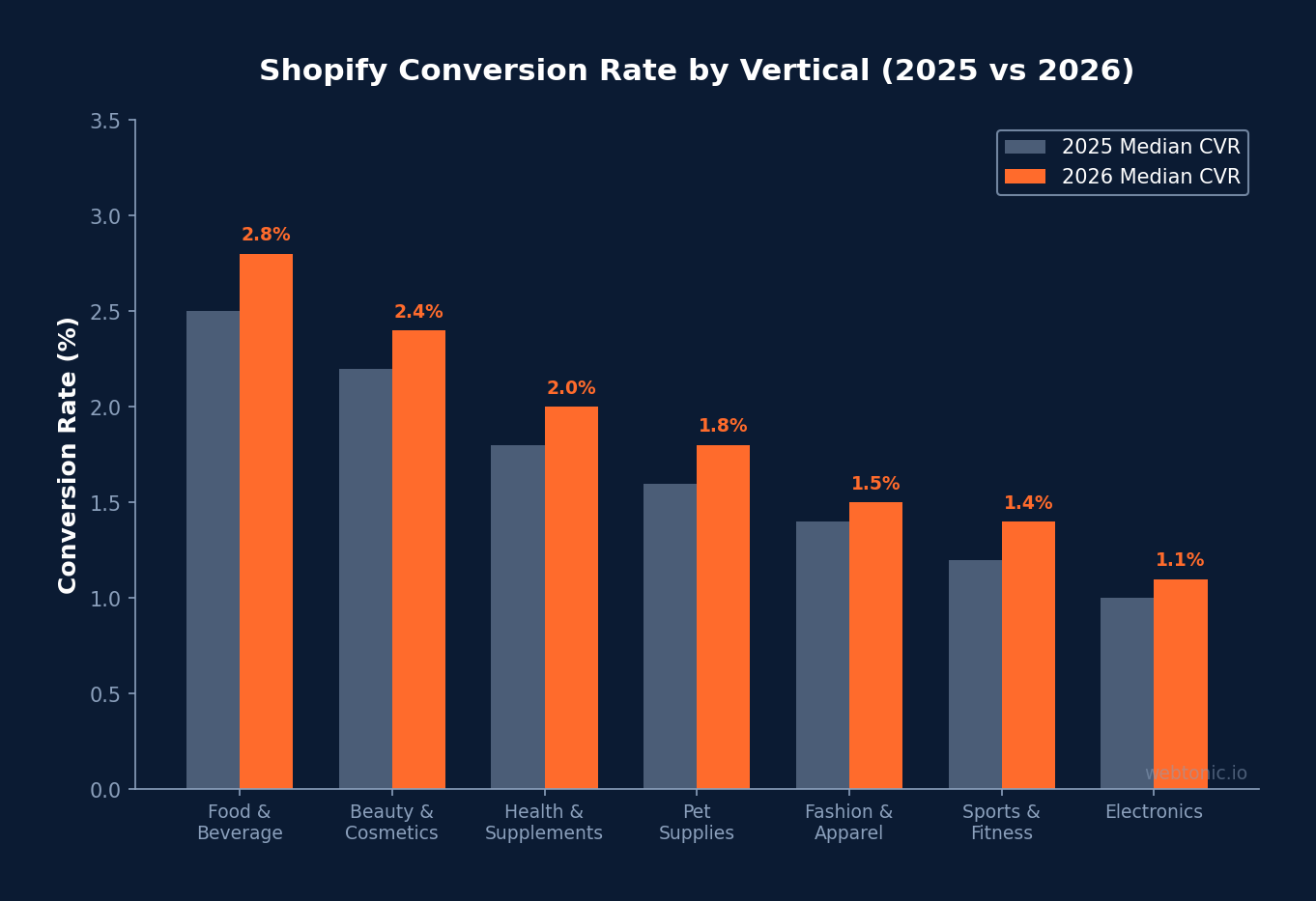
Health and supplement stores consistently outperform the Shopify platform average. The 2026 median conversion rate for health and supplements is 2.0%, up from 1.8% in 2025 — an 11.1% year-over-year improvement (Eevy.ai). That places the category among the strongest-converting verticals on Shopify, behind only food and beverage (2.8%) and beauty (2.4%).
| Shopify Vertical | 2026 Median CVR | Top Quartile | Top Decile |
|---|---|---|---|
| Food & Beverage | 2.8% | 5.4% | 8.1% |
| Beauty & Cosmetics | 2.4% | 4.8% | 7.2% |
| Health & Supplements | 2.0% | 4.2% | 6.2% |
| Pet Supplies | 1.8% | 3.6% | 5.8% |
| Fashion & Apparel | 1.5% | 3.2% | 6.1% |
| Sports & Fitness | 1.4% | 3.0% | 5.5% |
| Electronics | 1.1% | 2.4% | 4.2% |
What drives the health category's advantage? Three factors: higher repeat purchase rates (allergy sufferers reorder monthly), lower return rates (consumables are non-returnable), and subscription model adoption. Shopify merchants selling allergy care products through auto-replenishment programs report 30–45% higher lifetime customer value compared to one-time purchase models.
Revenue and Average Order Value Insights
Revenue performance for allergy and immunology ecommerce stores depends heavily on product mix and customer acquisition strategy. Key revenue benchmarks include:
- Average order value for health Shopify stores: $80–$120, with allergy-focused stores skewing toward $95–$130 due to multi-product bundling (DollarPocket).
- Monthly revenue for established health stores (top quartile): $45,000–$120,000, with allergy niche stores typically in the $25,000–$65,000 range.
- Revenue per visitor: $1.60–$2.40 for health and supplement stores, compared to $1.12 platform-wide.
- Subscription revenue contribution: 15–25% of total revenue for stores offering auto-ship on antihistamines, nasal sprays, and environmental control products.
The allergy testing kit segment commands the highest AOV at $120–$180 per order, driven by comprehensive panels that test for dozens of allergens simultaneously. Air purifiers and HEPA filtration systems push AOV even higher at $200–$450 per order, though purchase frequency is naturally lower. Allergy and immunology businesses building Shopify stores should prioritize product bundling and subscription options to maximize long-term revenue per customer.
Customer Behavior and Acquisition in Allergy Ecommerce
Customer acquisition in the allergy and immunology ecommerce space follows patterns distinct from general health retail. People managing chronic allergic conditions — whether to dust mites, seasonal pollen, or food allergens — display high intent and repeat purchase behavior. Key behavioral insights include:
- 68.5% of healthcare website traffic comes from mobile devices, making mobile-first Shopify themes essential (CuFinder).
- Organic search drives 48.2% of all healthcare ecommerce traffic, emphasizing the importance of SEO-optimized product pages.
- Average visit duration for healthcare ecommerce: 3 minutes 14 seconds, with 2.8 pages per session — higher than general retail benchmarks.
- Patient retention for established healthcare businesses: 68% annually, translating to strong repeat customer rates for allergy product stores.
- Free sample offers drive 12–18% higher initial conversion rates for allergy product stores, particularly for new antihistamine formulations.
Allergy sufferers frequently research symptoms and treatment options before purchasing. For Shopify store owners, this means educational content — blog posts about allergy awareness campaigns, immune system health, and allergen avoidance — directly supports product conversion. Stores with integrated health education content report 22–35% lower customer acquisition costs compared to product-only storefronts.
Best Practices for Allergy and Immunology Shopify Stores
- Implement subscription-based replenishment for consumable allergy products (antihistamines, nasal sprays, air filters). Subscription models deliver 30–45% higher customer lifetime value and reduce churn.
- Optimize for mobile-first checkout. With 68.5% of traffic from mobile, reducing friction in mobile checkout directly improves conversion rates above the 2.0% median.
- Build product bundles by condition. Seasonal allergy bundles (antihistamine + nasal spray + air purifier filter) and food allergy kits (testing kit + EpiPen case + allergen-free snacks) increase AOV by 25–40%.
- Invest in educational content and SEO. Organic search delivers 48.2% of traffic. Product pages optimized for condition-specific queries (e.g., "best air purifier for dust mite allergy") outperform generic product descriptions.
- Leverage social proof and reviews. Allergy products benefit from trust-driven purchasing supported by performance creative — allergy sufferers rely on peer reviews more than average consumers. Stores with 50+ reviews per product convert 2.1× higher than those with fewer than 10.
- Partner with allergists for credibility. Featuring recommendations from board-certified allergists or immunologists on product pages increases customer trust and supports higher price positioning.
Allergy Market Seasonality and Ecommerce Demand Patterns
Allergy and immunology product demand follows pronounced seasonal cycles that directly impact Shopify store revenue planning. Spring (March–May) drives the highest search volume and purchase activity for seasonal allergy products, with antihistamine and nasal spray sales spiking 40–60% above baseline during peak pollen seasons. Fall introduces a secondary peak as indoor allergen exposure — particularly dust mites and mold — intensifies when heating systems activate.
For Shopify merchants, inventory planning and marketing spend should align with these cyclical patterns. Stores that pre-stock seasonal allergy bundles and launch paid campaigns 2–3 weeks before peak season consistently outperform those running flat budgets year-round. Food allergy products, by contrast, show more stable year-round demand, making them ideal baseline revenue generators. Immunotherapy-related products and testing kits peak during January and September, when patients schedule annual allergist consultations and explore new treatment options.
Subscription models smooth seasonal revenue volatility significantly. Stores offering auto-ship programs report 35–50% less revenue variance month-to-month compared to one-time purchase models — a critical advantage for cash flow management in a market where customer acquisition costs for healthcare ecommerce average $45–$85 per new buyer.
Related reading
- The Complete Allergy & Immunology WordPress Statistics Report (2026)
- Webflow for Allergy & Immunology Sites: 55+ Stats & Benchmarks (2026)
- Landing Pages & CRO Performance in Allergy & Immunology: 88+ Stats for 2026
- Custom Web Development services at Web Tonic
Frequently Asked Questions
What is the average Shopify conversion rate for health and allergy stores in 2026?
The median Shopify conversion rate for health and supplement stores is 2.0% in 2026, up from 1.8% in 2025. Top-quartile health stores convert at 4.2%, and top-decile performers exceed 6.2%. Allergy-specific stores with subscription models and strong educational content typically land in the upper half of this range.
How large is the healthcare ecommerce market in 2026?
The global healthcare ecommerce market is valued at $0.62 trillion in 2026 and is projected to reach $1.43 trillion by 2031, growing at an 18.38% CAGR. The U.S. allergy care segment specifically sees 18–24% of purchases flowing through ecommerce channels, with subscription replenishment driving the strongest growth.
What products perform best for allergy and immunology Shopify stores?
Allergy testing kits lead in conversion rate and growth trajectory, expanding at a 10–14% CAGR. Oral antihistamines deliver the highest volume at 40–45% of OTC allergy revenue, while air purifiers and HEPA filtration systems command the highest average order values at $200–$450 per order. Subscription-friendly products like nasal sprays and antihistamines generate the most predictable recurring revenue.
What is the ideal average order value for an allergy ecommerce store?
Allergy-focused Shopify stores should target an AOV of $95–$130 through strategic product bundling. The platform-wide health store average is $80–$120, but allergy stores that bundle condition-specific products (seasonal allergy kit, food allergy panel + supplies) consistently exceed the category median.
How important is mobile optimization for health ecommerce?
Mobile devices drive 68.5% of all healthcare website traffic in 2026. Shopify stores that optimize for mobile-first checkout see measurably higher conversion rates. Desktop still accounts for 29.2% of visits, and tablets contribute 2.3%, but the revenue-per-session gap between mobile-optimized and non-optimized stores continues to widen each quarter.
Sources
mordorintelligence.com — Healthcare E-commerce Market Size & Growth
eevy.ai — Shopify Conversion Rate Benchmarks by Industry (2026)
indexbox.io — United States Allergy Care Market Analysis
shopify.com — Shopify Q1 2026 Financial Results
dollarpocket.com — Shopify Store Benchmarks 2026
cufinder.io — Healthcare Industry Marketing Benchmarks 2026


