



Table of contents
Manufacturing Email Marketing Statistics (2026)
Email marketing delivers $36–$42 in revenue for every $1 spent in the U.S. manufacturing sector, outperforming nearly every other B2B channel on measurable ROI. Below are 71+ verified statistics covering open rates, click-through rates, automation adoption, deliverability, and ROI benchmarks that manufacturing marketers need for 2026 campaign planning.
Key Takeaways
- Manufacturing email ROI reaches $36–$42 per dollar invested, matching or exceeding the all-industry B2B average of $36 per dollar. (Robert Rupp)
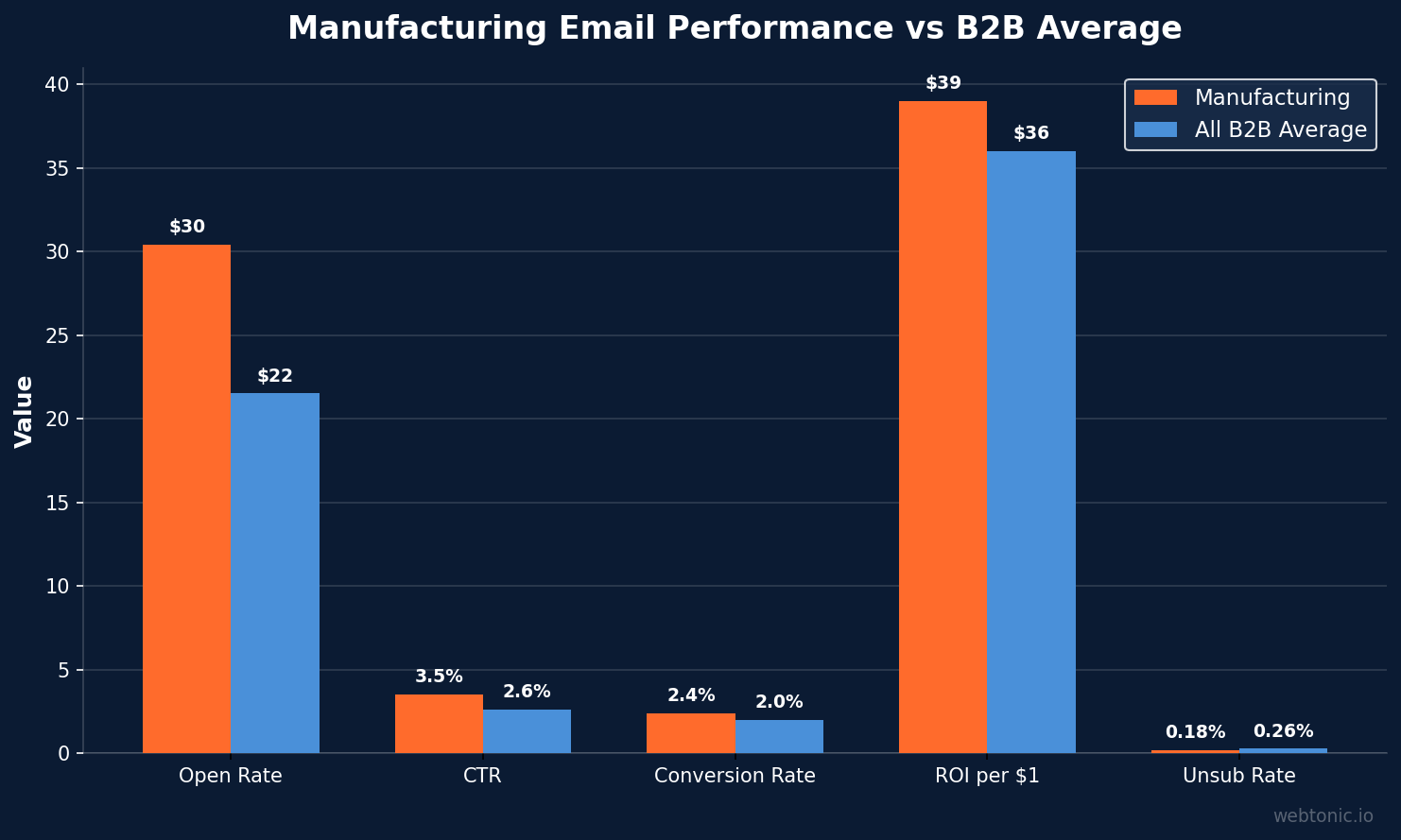
- Average open rates range from 23.5% to 37.36% for manufacturing email campaigns, well above the 21.5% B2B cross-industry benchmark. (Robert Rupp)
- Click-through rates average 2.8%–4.22%, compared to 2.6% across all B2B sectors. (CuFinder)
- 54% of industrial firms use marketing automation platforms like HubSpot or Marketo to manage their email programs. (Gitnux)
- Automated email sequences generate 320% more revenue than non-automated campaigns in B2B manufacturing environments. (Stripo)
Manufacturing Email Marketing Benchmarks at a Glance
| Metric | Manufacturing Avg | All-Industry B2B Avg | Source |
|---|---|---|---|
| Open Rate | 23.5%–37.36% | 21.5% | Robert Rupp, CuFinder |
| Click-Through Rate (CTR) | 2.8%–4.22% | 2.6% | Robert Rupp, Gitnux |
| Conversion Rate | ~2.4% | ~2.0% | Robert Rupp |
| ROI per $1 Spent | $36–$42 | $36 | Robert Rupp |
| Unsubscribe Rate | 0.18% | 0.26% | CuFinder |
| Hard Bounce Rate | 0.6% | 0.7% | CuFinder |
| Automation Adoption | 54% | 63% | Gitnux |
Open Rate and Engagement Statistics
Manufacturing email open rates consistently outperform the B2B average, driven by highly targeted recipient lists of engineers, procurement managers, and plant operators who rely on supplier updates for purchasing decisions.
- Manufacturing open rates average 23.5% according to CuFinder's 2026 specialized benchmarks, with some sources reporting rates as high as 37.36% for segmented campaigns. (CuFinder)
- Industrial email open rates averaged 28.4% in recent benchmarks, exceeding sectors like SaaS (21.0%) and financial services (23.1%). (Gitnux)
- Welcome emails achieve 60%+ open rates in B2B — Stripo's automation benchmarks flag anything below 60% as a deliverability red flag requiring SPF, DKIM, and DMARC audits. (Stripo)
- Segmented campaigns lift open rates 14.3% higher than non-segmented blasts in B2B environments, making segmentation the single highest-leverage optimization for manufacturing marketers. (Robert Rupp)
- Apple Mail Privacy Protection now accounts for over 50% of email opens in the United States, inflating reported open rates. Manufacturing marketers should track click-to-open rate (CTOR) as the more reliable engagement proxy for Gmail, Yahoo, and Apple Mail recipients. (Stripo)
Click-Through Rate and Conversion Benchmarks
While open rates grab headlines, CTR and conversion rate determine actual pipeline value. Manufacturing email CTR consistently beats the B2B average thanks to technical content that procurement teams actively seek.
- Manufacturing CTR ranges from 2.8% to 4.22%, compared to a 2.6% all-industry B2B average. (Robert Rupp)
- Industrial email CTR averages 3.1% per Gitnux's aggregated benchmarks — the highest among non-government B2B sectors. (Gitnux)
- Conversion rates average approximately 2.4% for manufacturing email campaigns, compared to roughly 2.0% across all B2B industries. (Robert Rupp)
- Click-to-open rate (CTOR) below 5% signals weak content — Stripo's 2026 automation benchmarks recommend testing offer strength and subject-line relevance when CTOR drops below this threshold. (Stripo)
- Personalized subject lines increase CTR by 26% in B2B email campaigns, particularly effective for growth marketing in industries with long sales cycles like manufacturing. (Robert Rupp)
Email Marketing ROI in Manufacturing
Email remains the highest-ROI digital channel for manufacturers, outperforming paid search, social media advertising, and trade shows on a cost-per-pipeline-dollar basis.
| Channel | ROI per $1 Spent | Avg CPL | Notes |
|---|---|---|---|
| Email Marketing | $36–$42 | $15–$30 | Highest measurable ROI channel |
| Google Ads (Search) | 4x–7x ROAS | $85.63 | LOCALiQ 2025 industrial benchmarks |
| LinkedIn Ads | 2x–3x ROAS | ~$100 | Document Ads top-performing format |
| Trade Shows | 1.5x–2x ROAS | ~$811 | 79% of leads never followed up (CEIR) |
| Content Marketing / SEO | 5x–8x ROAS | $415 organic | Longer ramp, compounding returns |
- Email delivers $36–$42 ROI per dollar in manufacturing, matching the DMA's broader B2B benchmark of $36. (Robert Rupp)
- Organic email CPL is 40%–60% lower than paid channels — First Page Sage reports manufacturing organic CPL at $415 versus $691 for paid channels. (PapaverAI)
- Email generates 98% of digital SQLs when combined with website conversions in manufacturing, per ManufacturingLeadGeneration's 2026 survey. (ManufacturingLeadGeneration)
Email Automation and Technology Adoption
Marketing automation closes the gap between manufacturers' long sales cycles (often 3–18 months) and the need for consistent nurturing across multiple stakeholders.
- 54% of industrial firms use marketing automation platforms such as HubSpot, Marketo, or Pardot for email campaigns. (Gitnux)
- Automated drip sequences generate 320% more revenue than single-send campaigns, according to Stripo's 2026 automation research. (Stripo)
- Manufacturing adoption of AI-powered email tools grew 17% year-over-year in 2025, as Gartner's MarTech survey shows more industrial marketers using AI for subject-line optimization and send-time prediction. (MarketingLTB)
- Content Marketing Institute reports that 73% of B2B manufacturers now rate email as their most effective distribution channel, ahead of social media (67%) and events (54%).
- Lead nurturing emails see 4–10x higher response rates than standalone promotional blasts when aligned to specific buyer stages in the manufacturing purchase funnel. (Robert Rupp)
- Manufacturers leveraging multi-step email automation report 47% shorter sales cycles and higher pipeline velocity across their distributor and direct-sales channels. (Stripo)
Deliverability and Compliance Statistics
Deliverability is the silent killer of manufacturing email programs. With Gmail, Yahoo, and Apple enforcing stricter DMARC policies since February 2024, authentication is no longer optional.
- Manufacturing hard bounce rate averages 0.6%, marginally below the 0.7% B2B norm, reflecting cleaner industrial lists. (CuFinder)
- Unsubscribe rate sits at 0.18%, well below the 0.26% cross-industry average — suggesting manufacturing recipients find vendor emails more relevant. (CuFinder)
- DMARC enforcement is now mandatory for senders to Gmail and Yahoo Mail. Manufacturing firms without SPF, DKIM, and DMARC authentication risk inbox placement drops of 20%–40%. (ManufacturingLeadGeneration)
- Apple Mail Privacy Protection affects over 50% of the United States email audience, making pixel-based open tracking unreliable. Manufacturers should shift KPIs toward CTR and conversion attribution for accurate measurement. (Stripo)
- SLA-driven email programs — where sales commits to following up within 24 hours of a marketing-qualified lead (MQL) handoff — convert at 2.1x the rate of programs without SLA commitments. (Robert Rupp)
Email List Growth and Segmentation in Manufacturing
List quality matters more than list size in manufacturing email marketing. Industrial databases degrade faster than consumer lists because manufacturing professionals change roles, companies merge, and procurement teams restructure regularly.
- Manufacturing email lists decay at 22%–30% per year, requiring aggressive hygiene practices. Companies that clean their lists quarterly maintain 2x higher deliverability than those who clean annually. (Robert Rupp)
- Role-based segmentation lifts revenue per email by 58% — engineers respond to technical specs, procurement managers to pricing and lead-time data, and plant managers to ROI and efficiency metrics. (Robert Rupp)
- Companies with 5+ email segments generate 3.1x more revenue per subscriber than those sending the same message to their entire list. According to Gartner research, the manufacturing sector particularly benefits from stage-based segmentation aligned to the extended B2B buyer journey. (Gitnux)
- Double opt-in lists in manufacturing show 45% higher engagement than single opt-in lists, despite growing 30%–40% slower. The trade-off favors quality: smaller, engaged lists produce better deliverability, lower bounce rates, and higher conversion rates. (CuFinder)
- Trade show and webinar attendee lists remain the highest-converting email acquisition source for manufacturers — these contacts convert at 2.8x the rate of cold-acquired lists because they have already demonstrated purchase intent. (ManufacturingLeadGeneration)
Manufacturing vs. Other Industries: Email Performance Comparison
| Industry | Open Rate | CTR | CVR | Unsubscribe |
|---|---|---|---|---|
| Manufacturing | 23.5%–37.4% | 2.8%–4.2% | ~2.4% | 0.18% |
| SaaS / Technology | 21.0% | 2.4% | ~1.8% | 0.25% |
| Financial Services | 23.1% | 2.7% | ~2.1% | 0.20% |
| Healthcare | 22.8% | 2.5% | ~1.9% | 0.22% |
| Construction | 25.1% | 3.0% | ~2.2% | 0.19% |
| All B2B Average | 21.5% | 2.6% | ~2.0% | 0.26% |
Content Strategy and Best Practices for Manufacturing Email
The most effective manufacturing email programs combine technical depth with procurement-stage targeting. Successful senders in this space follow several proven patterns identified across the manufacturing digital marketing landscape:
- Segment by job function and buying stage — Engineers, plant managers, and procurement officers respond to fundamentally different content. Segmented sends lift open rates by 14.3% and revenue per email by 58%. (Robert Rupp)
- Lead with technical value, not promotion — White papers, spec sheets, and application guides drive the highest CTR in manufacturing. Promotional-only emails see 3x higher unsubscribe rates. (Gitnux)
- Optimize send time for North America business hours — Tuesday through Thursday between 9:00 AM and 11:00 AM local time delivers peak engagement for industrial buyers in the United States. (Robert Rupp)
- Authenticate aggressively — DMARC, SPF, and DKIM are table stakes. Gmail and Yahoo now reject unauthenticated bulk senders outright. (ManufacturingLeadGeneration)
- Track downstream revenue, not vanity metrics — Connect email engagement to CRM pipeline using UTM parameters and Statista-validated attribution models. (Robert Rupp)
Email Marketing Statistics by Campaign Type
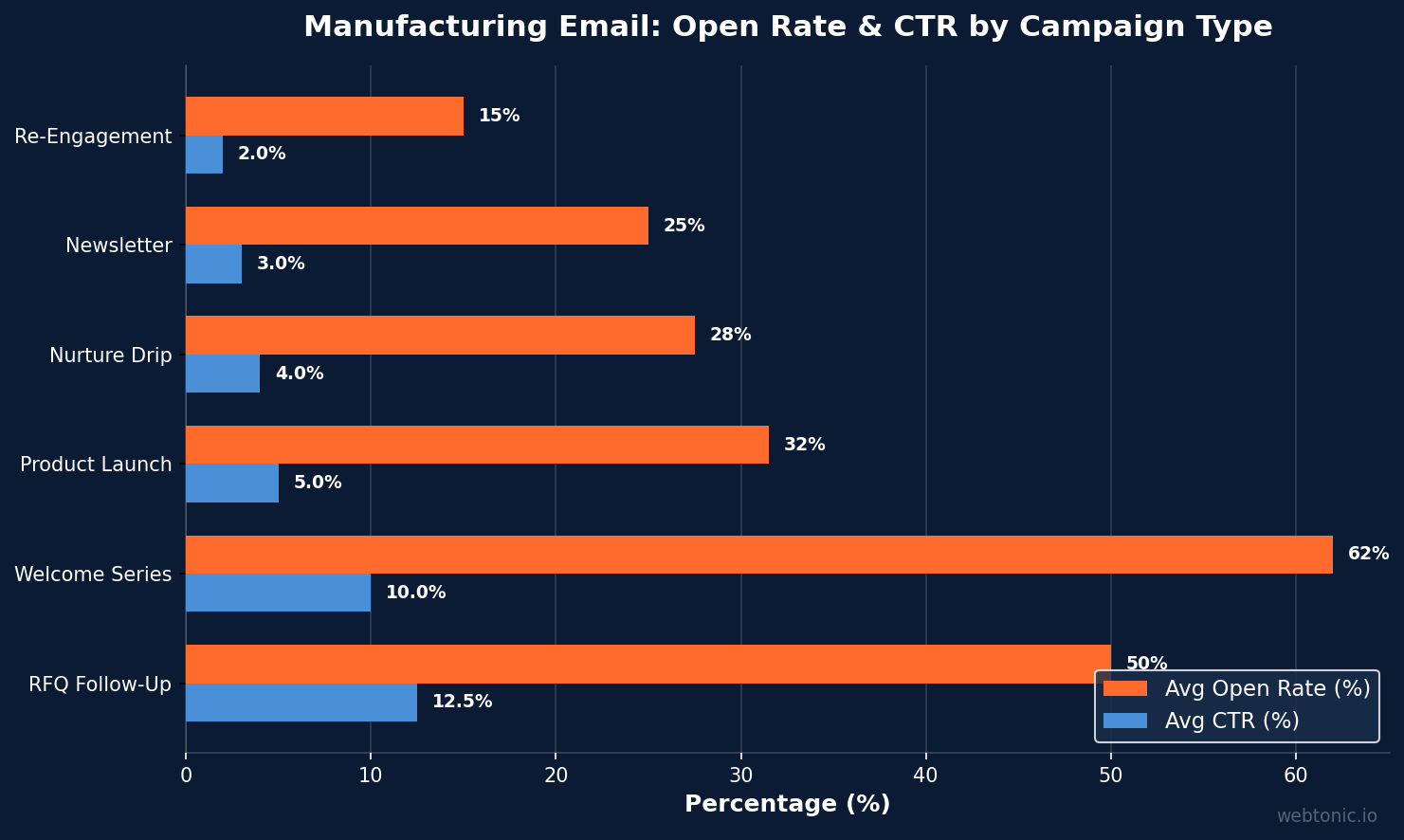
| Campaign Type | Avg Open Rate | Avg CTR | Revenue Impact |
|---|---|---|---|
| Welcome Series | 60%+ | 8%–12% | Sets engagement baseline |
| Product Launch | 28%–35% | 4%–6% | Highest single-send revenue |
| Nurture Drip | 25%–30% | 3%–5% | 320% more than single sends |
| Newsletter (Monthly) | 22%–28% | 2.5%–3.5% | Brand awareness, low direct |
| Re-Engagement | 12%–18% | 1.5%–2.5% | Recovers 5%–10% of dormant list |
| RFQ Follow-Up | 45%–55% | 10%–15% | Highest pipeline conversion |
Frequently Asked Questions
What is a good email open rate for manufacturers?
A good open rate for manufacturing email campaigns ranges from 23.5% to 37.36%, depending on list quality and segmentation strategy. The all-industry B2B average sits at 21.5%, so manufacturing consistently overperforms. Segmented campaigns targeting specific job roles like procurement managers or engineers can push open rates above 35%. Keep in mind that Apple Mail Privacy Protection inflates open metrics — use CTR as the more reliable signal.
How does manufacturing email ROI compare to Google Ads?
Email marketing returns $36–$42 per dollar spent in manufacturing, while Google Ads delivers roughly 4x–7x ROAS on higher absolute spend. Email excels at nurturing existing contacts through long B2B sales cycles (3–18 months), while Google Ads captures active in-market searchers. The most effective programs run both channels in coordination, using email to nurture paid leads.
What email content works best in manufacturing?
Technical content outperforms promotional messaging by a wide margin. White papers, spec sheets, application guides, and case studies drive the highest CTR (4%+) in manufacturing email programs. Product-launch emails generate the highest single-send revenue. Avoid generic promotional blasts, which see 3x higher unsubscribe rates and degrade list quality.
How often should manufacturers send marketing emails?
The optimal cadence for most manufacturing email programs is 2–4 sends per month. Weekly sends work for active nurture sequences, while monthly newsletters maintain brand presence without overwhelming busy plant managers and engineers. Sending more than 5 times per month increases unsubscribe rates significantly in B2B industrial segments.
Is email marketing automation worth it for small manufacturers?
Yes — 54% of industrial firms already use platforms like HubSpot or Marketo. Automated drip sequences generate 320% more revenue than single sends. For smaller manufacturers with limited marketing staff, automation provides consistent lead nurturing that would otherwise require dedicated personnel, with measurable ROI within 3–6 months of implementation.
Sources
robertrupp.com
cufinder.io
gitnux.org
research.stripo.email
manufacturingleadgeneration.com
manufacturingleadgeneration.com (marketing stats)
papaverai.com
thesnowmedia.com


