Table of contents

No published study prices a single "manufacturing marketing automation CPL," so this page benchmarks the pieces that actually build a cost-per-lead number: email click-through rate by industry, what the automation platforms themselves charge, and how technical buyers behave once they are inside a nurture sequence. Every figure below names its source and its year.
Key Takeaways
- Manufacturing's average email click rate is 2.83% on a 29.08% open rate (Mailchimp).
- That compares with a 2.66% click rate and 34.20% open rate across all industries in the same report.
- 62% of the industrial buying journey happens online before a vendor is contacted (GlobalSpec/TREW/Elektor 2026).
- 59% of technical buyers prefer email for first vendor contact, versus 22% for a phone call.
- 94% of technical buyers subscribe to newsletters and 85% will trade information for useful content.
- 70% pick the better-known brand when two technical solutions look alike.
- 91% attend at least one work-related webinar a year; 49% attend more than three.
- Leveraging automation is the #2 marketing trend for 2026, cited by 47.38% of 1,500+ marketers (HubSpot).
- HubSpot Marketing Hub Professional runs USD 890 a month (USD 800 billed annually) plus a USD 3,000 onboarding fee.
- HubSpot Enterprise runs USD 3,600 a month plus a USD 7,000 onboarding fee.
- Mailchimp's paid tiers start at USD 13, USD 20 and USD 350 a month at the smallest contact tier.
- No benchmark study publishes a manufacturing-specific paid CPL; the honest cross-industry backdrop is USD 66.69 (WordStream).
- The odds of qualifying a lead drop 21-fold when contact slips from 5 to 30 minutes (HBR 2011).
- The odds of ever reaching a lead drop 100-fold over that same 25-minute delay.
- Manufacturing's unsubscribe rate is 0.27%, close to the 0.22% cross-industry rate (Mailchimp).
- Manufacturing's hard bounce rate is 0.55%, over double the 0.25% cross-industry average.
Why manufacturers automate the funnel instead of staffing it
Manufacturing buying cycles run long, involve several stakeholders, and increasingly start without a salesperson in the room - the same pattern this marketing automation statistics hub tracks across every industry. The 2026 State of Marketing to Engineers report, produced by GlobalSpec, TREW Marketing and Elektor, found technical buyers now complete 62% of the buying process online before they contact a vendor, and that share keeps climbing every year the survey runs. Automation is what fills that stretch: it is the only practical way to stay in front of a buyer who has not asked to talk to a rep yet.
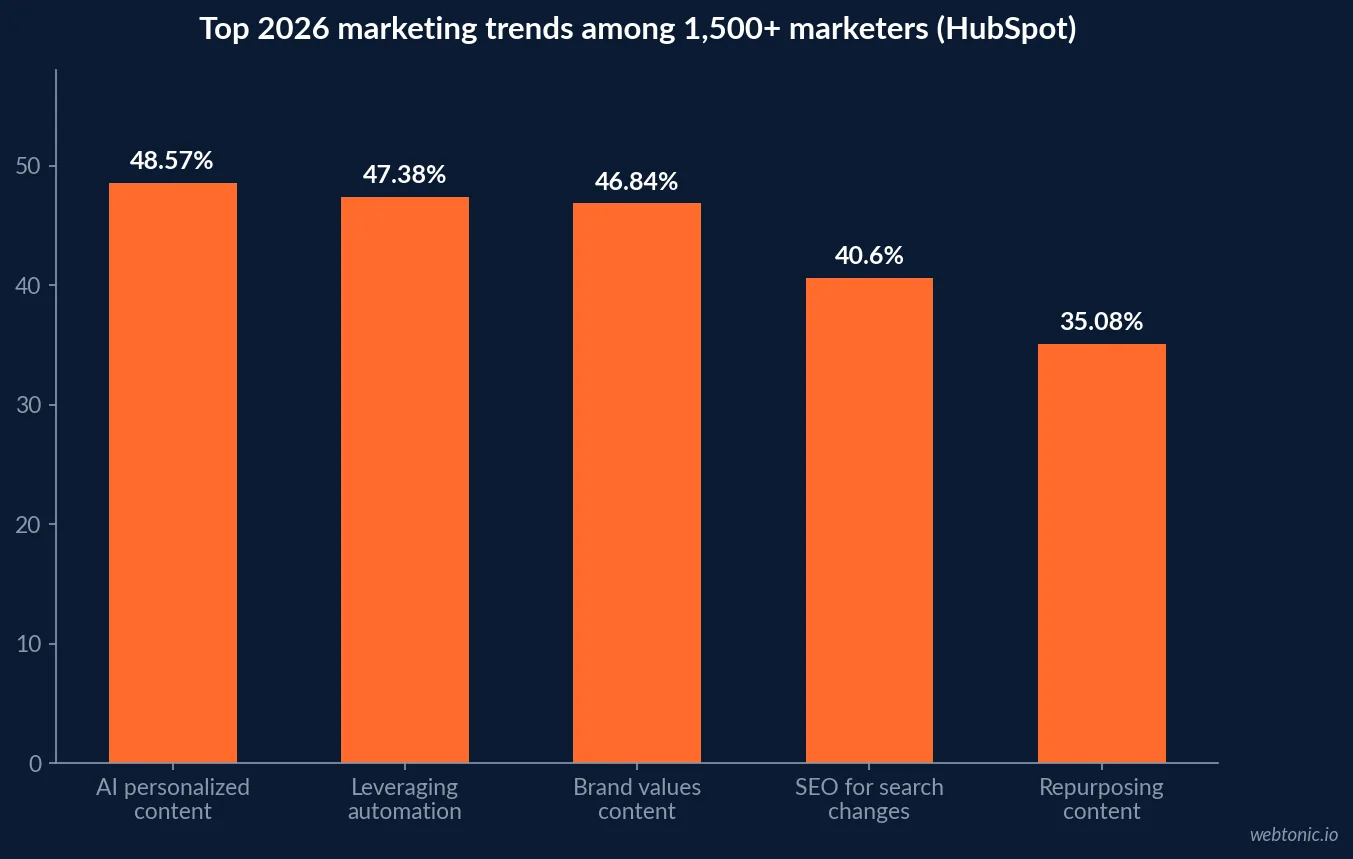
At the same time, HubSpot's 2026 State of Marketing, based on 1,500+ global marketers, lists "leveraging automation" as the #2 marketing trend of the year at 47.38%, trailing only AI-personalized content at 48.57%. That is a cross-industry number, not a manufacturing-only one - but it is the direction every industrial marketing stack is being pulled.
| Trend (2026) | Share of marketers citing it | Source |
|---|---|---|
| Using AI to create personalized content | 48.57% | HubSpot State of Marketing 2026 |
| Leveraging automation | 47.38% | HubSpot State of Marketing 2026 |
| Creating content that reflects brand values | 46.84% | HubSpot State of Marketing 2026 |
| Updating SEO for search changes | 40.60% | HubSpot State of Marketing 2026 |
| Repurposing content across channels | 35.08% | HubSpot State of Marketing 2026 |
Manufacturing email click-through rate, benchmarked
Email is still the backbone of most manufacturing automation programs, so its click-through rate is the closest thing the industry has to a public automation-performance benchmark. Mailchimp's own Email Marketing Benchmarks and Metrics report puts manufacturing at a 29.08% open rate and a 2.83% click rate, against 34.20% and 2.66% across all industries in the same dataset. Manufacturing opens less often but clicks at essentially the same rate as everyone else - a smaller, more self-selecting list rather than a disengaged one. See our companion breakdown of manufacturing email marketing statistics for the wider open-and-click picture.
| Metric (Mailchimp report) | Manufacturing | All industries | Read |
|---|---|---|---|
| Average open rate | 29.08% | 34.20% | Below-average opens |
| Average click rate | 2.83% | 2.66% | On par or slightly ahead |
| Unsubscribe rate | 0.27% | 0.22% | Close to average |
| Hard bounce rate | 0.55% | 0.25% | More than double - list hygiene gap |
| Soft bounce rate | 1.67% | 0.79% | Also elevated |
What the automation platforms themselves charge
No published study prices "manufacturing marketing automation" as a category, so the honest way to answer a cost question is to read the platforms' own rate cards. On its own pricing breakdown, HubSpot's Marketing Hub starts at USD 15 a month for Starter (USD 9 per seat billed annually, 1,000 contacts included), rises to USD 890 a month for Professional (USD 800 billed annually, plus a USD 3,000 one-time onboarding fee, 3 core seats and 2,000 contacts included), and reaches USD 3,600 a month for Enterprise (plus a USD 7,000 onboarding fee, 5 seats and 10,000 contacts included). Mailchimp's own pricing page starts its paid tiers at USD 13 (Essentials), USD 20 (Standard) and USD 350 (Premium) a month at its smallest contact band.
| Platform / tier | Published starting price | What is included | Source |
|---|---|---|---|
| HubSpot Marketing Hub Starter | USD 15/mo (USD 9/seat annual) | 1,000 contacts, basic automation | HubSpot |
| HubSpot Marketing Hub Professional | USD 890/mo (USD 800 annual) + USD 3,000 setup | 3 seats, 2,000 contacts | HubSpot |
| HubSpot Marketing Hub Enterprise | USD 3,600/mo + USD 7,000 setup | 5 seats, 10,000 contacts | HubSpot |
| Mailchimp Essentials | USD 13/mo (smallest contact tier) | Basic automation, single audience | Mailchimp |
| Mailchimp Standard | USD 20/mo (smallest contact tier) | Customer journeys, retargeting | Mailchimp |
| Mailchimp Premium | USD 350/mo (smallest contact tier) | Advanced segmentation, multivariate testing | Mailchimp |
The lead-routing math automation is built to beat
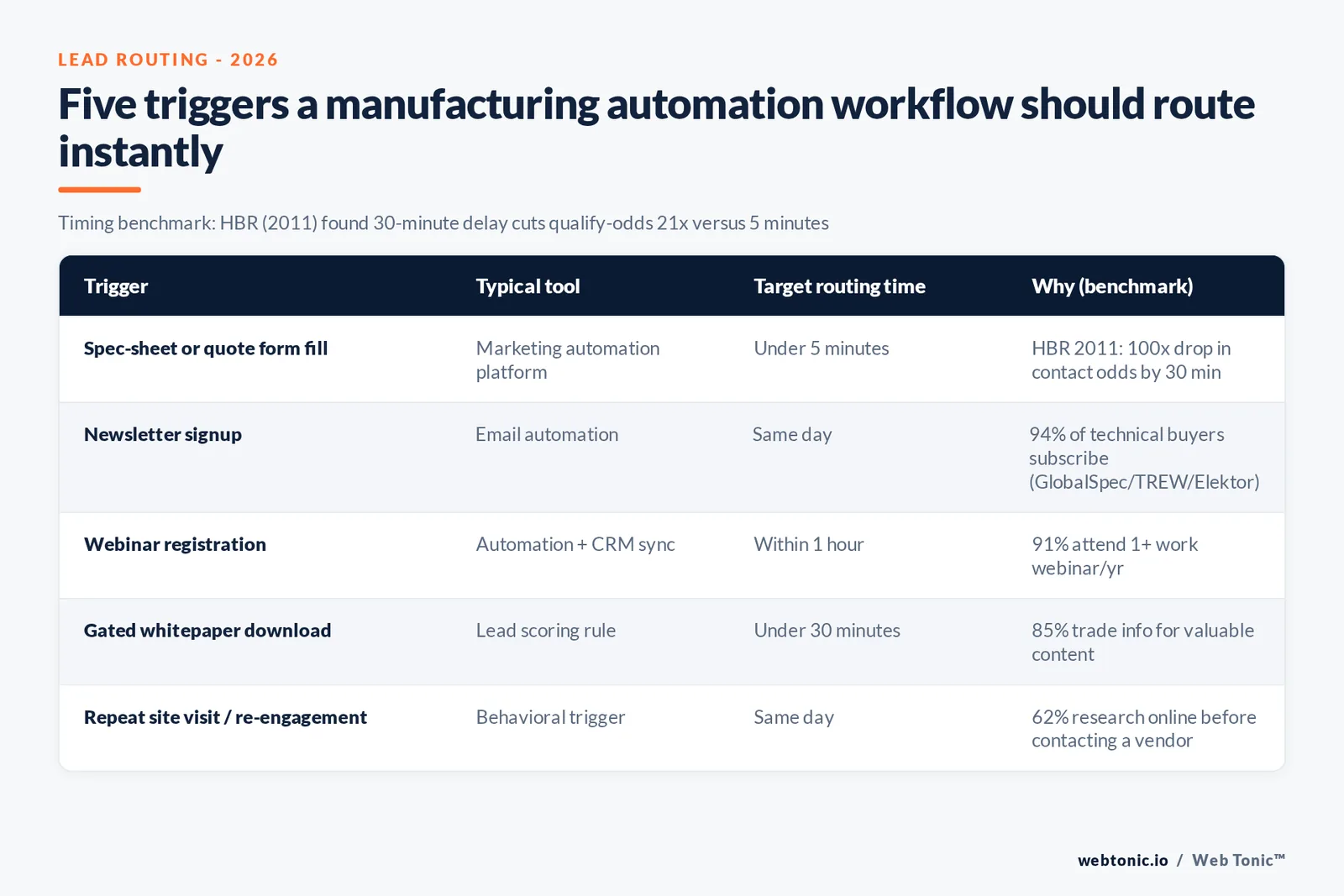
Automated lead routing exists to solve one problem: humans are slow, and slow is expensive. The Harvard Business Review study "The Short Life of Online Sales Leads" (2011, Oldroyd, McElheran and Elkington) found that the odds of ever contacting a lead drop 100-fold and the odds of qualifying it drop 21-fold when first contact slips from 5 minutes after the inquiry to 30 minutes after it. A manufacturing automation workflow that instantly routes a form fill to the right rep, rather than batching it into a nightly export, is directly answering that 2011 finding - which is why it remains the reference point for lead-routing design fourteen years later.
| Time to first contact | Relative odds of reaching the lead | Relative odds of qualifying it | Source |
|---|---|---|---|
| 5 minutes | Baseline | Baseline | HBR 2011 / Oldroyd, McElheran, Elkington |
| 30 minutes | 100x lower | 21x lower | HBR 2011 / Oldroyd, McElheran, Elkington |
How technical buyers behave once they are in the nurture sequence
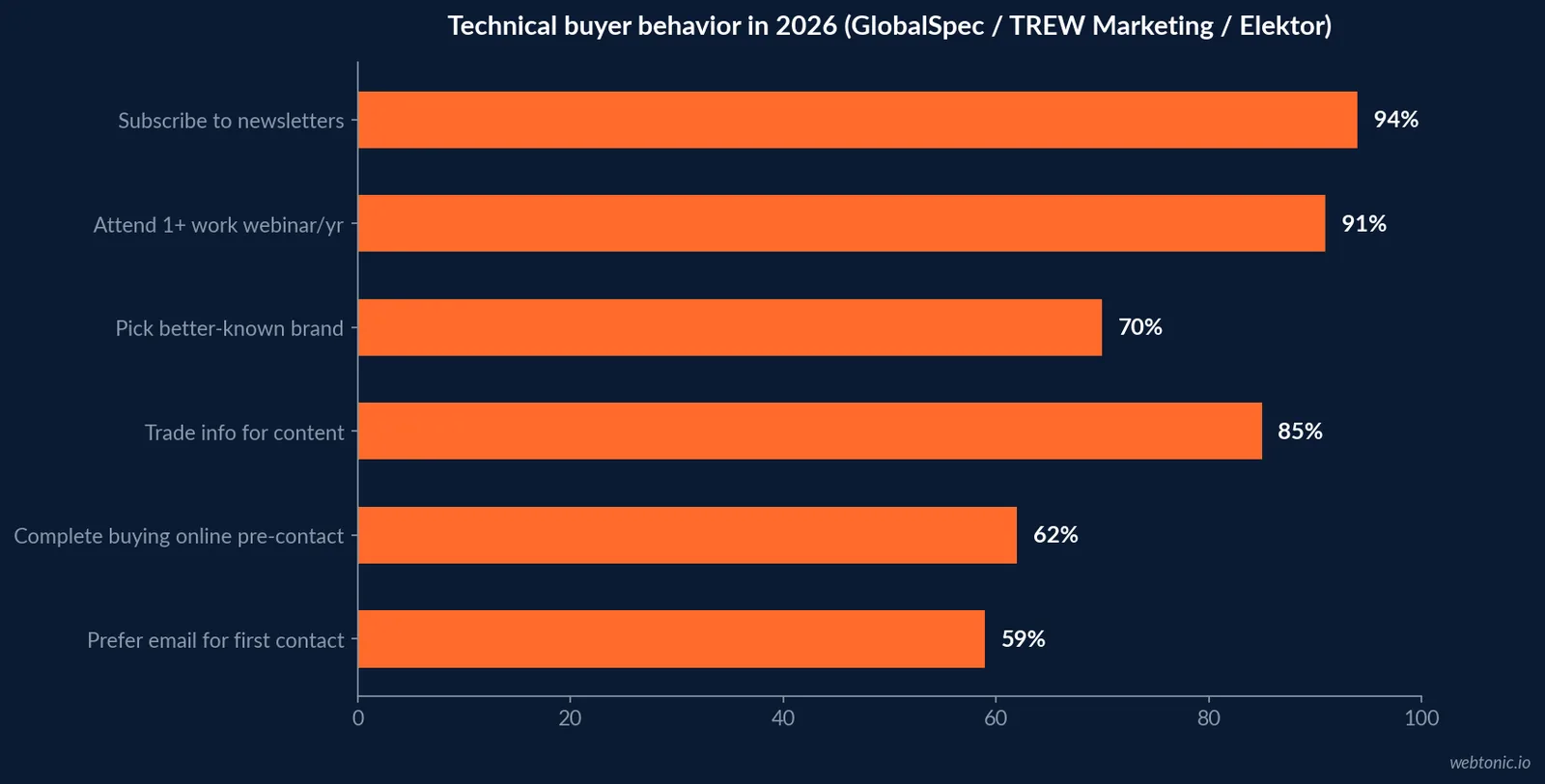
Getting an industrial lead into an automated sequence is only useful if the format matches how engineers actually consume content. The 2026 State of Marketing to Engineers report says 59% of technical buyers prefer email for that first vendor contact, against 22% for a phone call and a smaller share for LinkedIn messages or text. Once buyers are subscribed, 94% stay on a newsletter and 85% will hand over contact details for content they consider genuinely useful - the two numbers a manufacturing nurture program is really being scored against.
| Buyer behavior (2026) | Share of technical buyers | What it means for automation design |
|---|---|---|
| Complete buying process online before contacting a vendor | 62% | Nurture has to do real selling work, not just reminders |
| Prefer email for first vendor contact | 59% | Email remains the primary automation channel |
| Subscribe to newsletters | 94% | A steady content cadence is tolerated, even expected |
| Trade contact info for valuable content | 85% | Gated technical assets still convert |
| Pick the better-known brand when solutions look alike | 70% | Brand-building content belongs in the sequence, not just offers |
| Attend at least one work webinar a year | 91% | Webinar-driven nurture tracks have a real audience |
Building an honest CPL picture without an invented number
No vendor or association study we could verify publishes a manufacturing-specific cost-per-lead figure for marketing automation the way WordStream's 2026 Google Ads benchmark report prices a search ad click across 23 industries. That report's cross-industry average - built from over 13,000 campaigns - is a USD 66.69 cost per lead, the first year-over-year decrease WordStream has recorded in five years. Manufacturing is not broken out separately in that dataset, so treat any single "manufacturing automation CPL" you see elsewhere as an estimate built on assumptions the source did not publish, not as a benchmark.
The defensible way to price a manufacturing lead is still to build it, the way a rate card for any bespoke service is built: take the platform cost from the table above, add the hours a marketer spends running the sequences, and divide by the leads the email and nurture numbers above say you should expect from your list size. That produces a number specific to your program instead of a quoted average nobody can trace. Our own growth marketing team builds that math per account rather than quoting a stock CPL.
| Cost input | Published figure | Source | Role in the CPL build |
|---|---|---|---|
| Cross-industry paid search CPL (backdrop only) | USD 66.69 | WordStream 2026 (13,000+ campaigns) | Sanity-check ceiling, not a manufacturing number |
| Automation platform cost, mid-tier | USD 890/mo + USD 3,000 setup | HubSpot | Fixed monthly input |
| Automation platform cost, entry-tier | USD 13-20/mo | Mailchimp | Fixed monthly input |
| Expected click rate on nurture email | 2.83% | Mailchimp manufacturing benchmark | Feeds the funnel math |
| Content-for-contact exchange rate | 85% | GlobalSpec/TREW/Elektor 2026 | Feeds the funnel math |
A short checklist before you automate the funnel
- Match channel to the 59% figure - build the first-contact sequence around email before layering in other channels.
- Route new leads in minutes, not overnight - the 100-fold and 21-fold HBR figures above are the cost of not doing this.
- Budget for onboarding, not just the license - HubSpot's own USD 3,000-7,000 setup fees are separate from the monthly price and are easy to underquote.
- Clean the list before you judge the click rate - manufacturing's 0.55% hard bounce rate is more than double the cross-industry 0.25%, which drags deliverability down before a single email is opened.
- Give buyers something to trade for - 85% will exchange information for content they rate as valuable; a generic brochure gated behind a form is not that content.
Manufacturing automation at a glance
| Metric | Manufacturing | Cross-industry benchmark | Source |
|---|---|---|---|
| Email open rate | 29.08% | 34.20% | Mailchimp |
| Email click rate | 2.83% | 2.66% | Mailchimp |
| Buying process completed online pre-contact | 62% (industrial/technical) | n/a - industry-specific | GlobalSpec/TREW/Elektor |
| Marketers citing automation as a top 2026 trend | 47.38% (cross-industry) | n/a | HubSpot |
| Published automation CPL | None found | USD 66.69 (paid search backdrop) | WordStream |
Frequently Asked Questions
What is a good email click-through rate for manufacturing marketing automation?
Mailchimp's own benchmark data puts the manufacturing sector at a 2.83% average click rate on a 29.08% open rate, against a 2.66% click rate and 34.20% open rate across all industries in the same report. Manufacturing opens slightly less than the cross-industry average but clicks at roughly the same rate, which points to a smaller but more qualified list rather than a weaker one.
Is there a published cost-per-lead figure for manufacturing marketing automation?
No. No vendor or association study we could verify prices a manufacturing-specific marketing-automation lead the way WordStream prices a search ad click. WordStream's 2026 Google Ads benchmark report puts the cross-industry average cost per lead at USD 66.69 across 13,000+ campaigns, which is the closest honest backdrop; treat any single manufacturing CPL number you see elsewhere as an estimate, not a benchmark.
How fast should a manufacturer respond to an automated lead?
As fast as the workflow allows. The original Harvard Business Review study on this, 'The Short Life of Online Sales Leads' (2011, Oldroyd, McElheran and Elkington), found the odds of ever contacting a lead drop 100-fold and the odds of qualifying it drop 21-fold when the call moves from 5 minutes to 30 minutes after the inquiry. A workflow that queues the lead for next-day follow-up is competing with that math.
What does manufacturing marketing automation software cost?
On their own pricing pages, HubSpot's Marketing Hub runs USD 15 a month for Starter (or USD 9/seat billed annually), USD 890 a month for Professional (USD 800 billed annually, plus a USD 3,000 onboarding fee, 3 seats included), and USD 3,600 a month for Enterprise (plus a USD 7,000 onboarding fee, 5 seats included). Mailchimp's paid tiers start at USD 13 (Essentials), USD 20 (Standard) and USD 350 (Premium) a month at the smallest contact tier. Neither publishes a manufacturing-specific rate card.
Do technical buyers actually respond to automated nurture content?
The 2026 State of Marketing to Engineers report (GlobalSpec, TREW Marketing and Elektor) says yes: 94% of technical buyers subscribe to newsletters, 85% will trade contact information for content they judge valuable, and 91% attend at least one work-related webinar a year. Automation earns that attention by matching format to what the report shows engineers already do, not by adding more sends.
Sources
Mailchimp - Email Marketing Benchmarks and Metrics report
GlobalSpec, TREW Marketing & Elektor - 2026 State of Marketing to Engineers
HubSpot - 2026 State of Marketing (1,500+ marketers)
HubSpot - Marketing Hub pricing guide
Mailchimp - pricing
Harvard Business Review (2011) - The Short Life of Online Sales Leads
WordStream - 2026 Google Ads Benchmarks