Table of contents

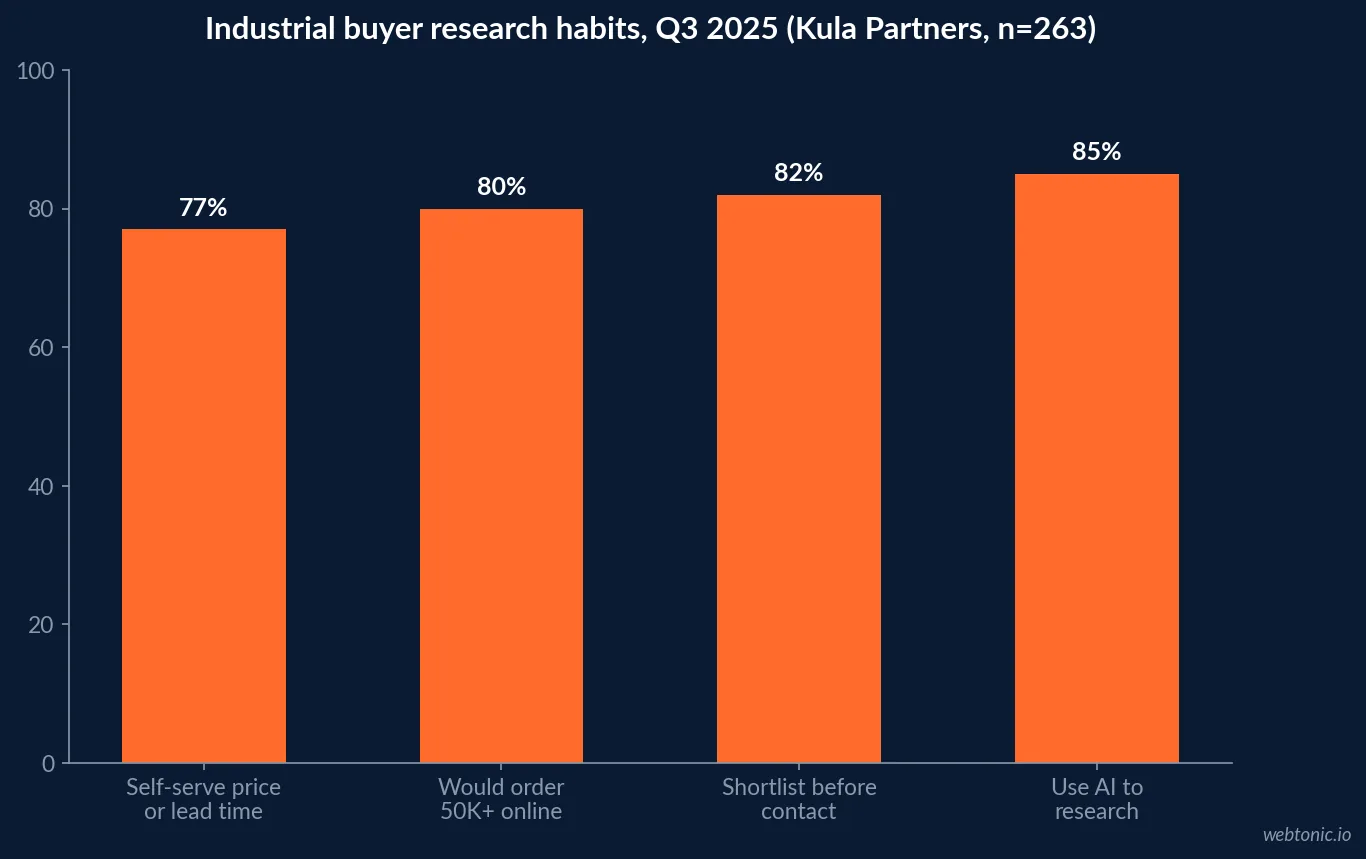
Google Shopping can pay for an industrial manufacturer, but only for catalog lines that are standard, priced and orderable online; quote-only equipment and services are excluded by policy. Buyer behaviour supports the channel: Kula Partners found that just over 77% of industrial buyers obtain pricing or lead times through self-serve tools.
Key Takeaways
- 77% of industrial buyers get price or lead time online via self-serve tools (Kula Partners, n=263, Q3 2025).
- 80% would place an e-commerce order of 50K or more in the same survey.
- 82% shortlist suppliers before speaking to them.
- 239,265 US manufacturing firms in 2022; about three quarters have fewer than 20 employees (NAM, Census data).
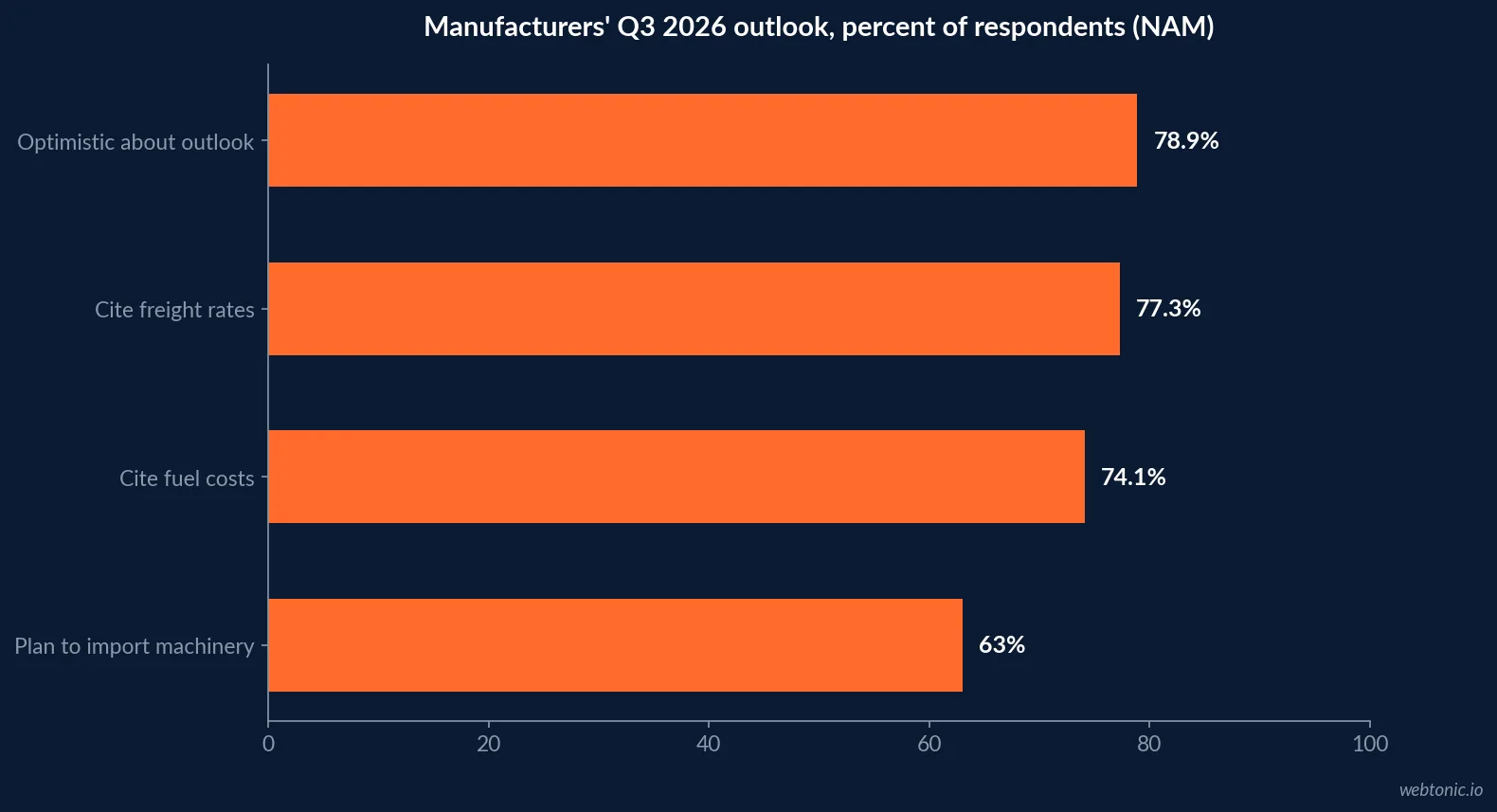
- 78.9% of manufacturers were optimistic in the NAM Q3 2026 outlook, up from 74.2%.
- An MPN is required for every product without a manufacturer-assigned GTIN.
- Up to 100 product details and 10 additional images per item in the feed spec.
- Google Shopping spend grew 16% in Q4 2025 with CPC down 1% (Tinuiti, retail vendor data).
- No named dataset publishes a manufacturing Shopping CTR, conversion rate or ROAS.
Industrial Shopping Feeds at a Glance
This summary separates buyer-behaviour data, sector size and Google's own feed rules. None of it is a manufacturing performance rate, because no one publishes one.
| Metric | Figure | Scope and source |
|---|---|---|
| Buyers using self-serve price/lead-time tools | Just over 77% | Kula Partners Q3 2025, n=263 |
| Buyers willing to place a 50K+ online order | 80% | Kula Partners Q3 2025 |
| US manufacturing firms | 239,265 (2022) | NAM from Census SUSB |
| Manufacturers optimistic, Q3 2026 | 78.9% | NAM Outlook Survey |
| Max product title length | 150 characters | Product data specification |
| Manufacturing Shopping ROAS | Not published | No named dataset found |
Which Industrial Lines Are Eligible for Shopping
Shopping ads and free listings are built for physical products with a price. Google's Unsupported Shopping content policy states that "labor, time, effort, expertise, or actions, which do not result in ownership of a tangible product are not allowed", and that this includes "any services sold bundled with physical goods", with maintenance and repair services among the examples. For a manufacturer, contract machining, installation, calibration and field service therefore sit outside Shopping.
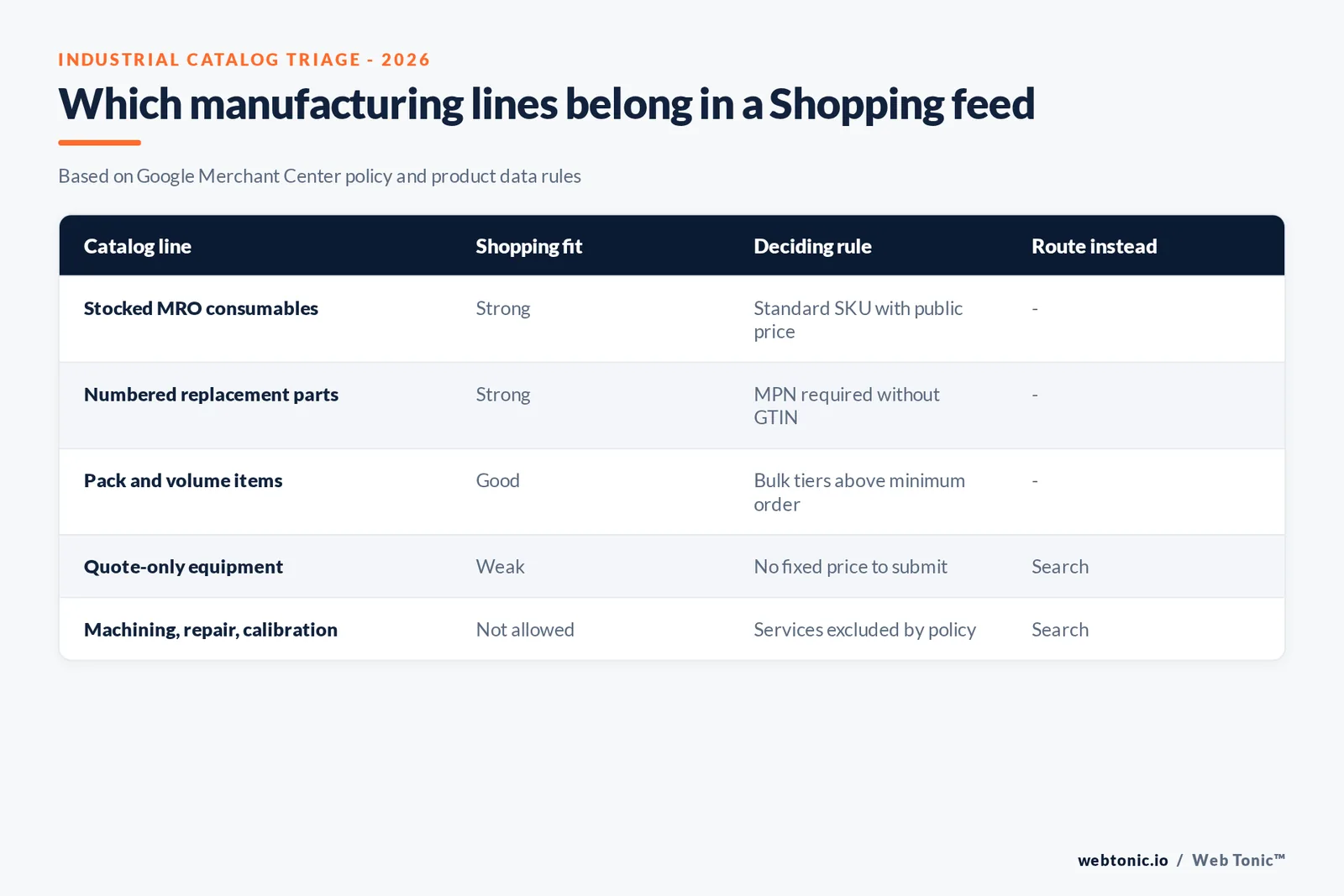
What remains eligible is the stocked catalog: MRO consumables, fasteners, replacement parts, tooling, sensors, safety gear and packaged components. Custom-engineered systems with no public price are a poor fit even if they are physical, because the feed needs a price the landing page also shows.
| Catalog line | Shopping fit | Why | Better Google route |
|---|---|---|---|
| Stocked MRO consumables | Strong | Standard SKUs, public price | Shopping / PMax with feed |
| Replacement parts with part numbers | Strong | MPN matches buyer queries | Shopping, Search on part number |
| Configured equipment, quote only | Weak | No fixed price to submit | Search, lead-form PMax |
| Contract manufacturing, machining | Not allowed | Service under policy | Search |
| Repair and calibration | Not allowed | Listed service example | Search, Local Services where offered |
Part Numbers and Identifiers: The First Filter
Industrial buyers search by part number more than by category, so identifiers do double duty. Google's unique product identifier guidance names GTIN, MPN and brand as the common identifiers and warns that products with an assigned GTIN, but submitted without one, may have limited visibility. The MPN attribute is required for all products without a manufacturer-assigned GTIN, and a manufacturer that is also the only seller of an unnumbered part may enter an identifier of its own choosing.
That is good news for manufacturers with thousands of SKUs and no barcodes: the internal part number can serve as the MPN. The GTIN attribute page adds that, where a GTIN is assigned, including it can increase product performance. Distributors reselling the same part should use the manufacturer's numbers, not their own, so listings for one part consolidate.
Feed Attributes That Carry Technical Detail
Spec sheets are the product for engineers, and Google's product data specification leaves room for them. A title can run to 150 characters, a description to 5,000, and the product detail attribute accepts up to 100 product details in section, name and value form, with values up to 1,000 characters. Each item can carry up to 10 additional images beyond the main one.
| Attribute | Limit in Google's spec | Industrial use |
|---|---|---|
| Title [title] | 150 characters | Brand + part number + key dimension + material |
| Description [description] | 5,000 characters | Tolerances, standards, compatibility |
| Product detail [product_detail] | Up to 100 details | Thread pitch, voltage, pressure rating |
| Additional image link | Up to 10 extra images | Drawings, installed view, packaging |
| MPN [mpn] | Required without GTIN | Internal or catalog part number |
| Brand [brand] | Max 70 characters | Manufacturer name, not distributor |
Quantity Pricing and Minimum Orders
Industrial buying is volume buying, and Merchant Center now models it. Google's help page on bulk price and order quantity describes a minimum order quantity, a maximum order quantity and bulk price tiers, and sets the rule: the minimum quantity of a bulk tier must be greater than the minimum order quantity and less than or equal to the maximum. Google's example uses a minimum order of 100 and a maximum of 199. Fixes can take 24-72 hours to clear from the "Needs attention" view.
A minimum order value is handled differently: the price attribute page says to set it in shipping settings rather than in the price. Getting these right keeps a pack-of-100 fastener listed at the pack price rather than a misleading unit price that the landing page does not honour.
How Industrial Buyers Research Before They Call
The strongest argument for feeds is that buyers stay anonymous for longer. In Kula Partners' Industrial Buyer Pulse Q3 2025, a survey of 263 North American decision-makers fielded with InnovateMR, 82% shortlisted suppliers for a major purchase before speaking with them and 85% reported using AI to research suppliers. Supplier websites still came first as a research source, with almost twice as many respondents preferring them over trade events.
The same survey found 88% expected capex budgets to grow over the next six months and 94% were confident primary suppliers would meet delivery times. Kula Partners is a B2B marketing agency and this is its own dataset; read it as a directional signal about research habits rather than proof that Shopping ads drive industrial orders.
The Manufacturing Market Behind the Catalog
Most manufacturers are small, which shapes how much feed work they can staff. The NAM reports 239,265 manufacturing firms in 2022, all but 4,177 with fewer than 500 employees, about three quarters with fewer than 20 and 93.1% with fewer than 100. The sector employed 12,638,000 people in August 2026 and produced $3.000 trillion of value-added output at an annual rate in Q1 2026, 9.4% of the US economy.
Sentiment is improving but cost pressure is real. NAM's Q3 2026 Outlook Survey put optimism at 78.9%, up from 74.2% in Q2, while 77.3% cited freight rates and 74.1% fuel costs as challenges, and input costs were expected to rise 5.0% over the next year. Freight matters for Shopping because shipping cost is part of the price a listing must show.
| Indicator | Value | Period | Source |
|---|---|---|---|
| Manufacturing firms | 239,265 | 2022 | NAM / Census SUSB |
| Firms with fewer than 100 employees | 93.1% | 2022 | NAM / Census SUSB |
| Manufacturing employment | 12,638,000 | August 2026 | NAM / BLS |
| Value-added output, annual rate | $3.000 trillion | Q1 2026 | NAM / BEA |
| Manufacturers citing freight rates | 77.3% | Q3 2026 | NAM Outlook Survey |
| Expected input cost increase | 5.0% | Next 12 months | NAM Outlook Survey |
Manufacturer Center for Brands Sold Through Distributors
Many manufacturers never sell direct, yet their products still appear in Shopping through distributors' feeds. Google's Manufacturer Center lets the brand submit authoritative titles, descriptions and images that Google can use to improve how those products show. Google's product page quotes brands reporting 27%, 35% and 37% increases in clicks. Those are selected success stories published by Google itself, not a controlled benchmark, but the mechanism is relevant to any manufacturer whose part numbers are listed inconsistently by resellers.
Feed Problems That Quietly Cost Industrial Listings
Large parts catalogs fail in predictable ways, and Google documents the consequence of each. The pattern is that errors rarely delete a listing outright; they throttle it, which is harder to spot in a 20,000-SKU account. Google's policy page also notes that for the unsupported-content policy, a warning is issued at least 7 days before any account suspension, which gives a manufacturer time to pull service lines out of a feed.
| Problem | What Google does | Source |
|---|---|---|
| Assigned GTIN left out | Product may have limited visibility | Unique product identifiers |
| No GTIN and no MPN | MPN is required without a GTIN | MPN attribute |
| Bulk tier below minimum order | Item flagged; fixes take 24-72 hours to clear | Bulk price help |
| Service line in the feed | Unsupported content; warning at least 7 days before suspension | Shopping policy |
| Minimum order value in price | Belongs in shipping settings | Price attribute |
A quarterly export of the "Needs attention" tab, sorted by product type, is usually enough to see whether one catalog family is dragging the rest. Treat identifier coverage as a KPI in its own right: the share of active SKUs that carry either a valid GTIN or a manufacturer part number tells you how much of the catalog Google can actually match to part-number searches.
What Cross-Industry Shopping Data Says
Public Shopping benchmarks come from retail. Tinuiti's Q4 2025 report shows Google Shopping ad spend up 16% year over year with CPC down 1%, and Performance Max at 62% of Shopping spend for brands running both campaign types. The Census Bureau puts US retail e-commerce at 17.1% of retail sales in Q2 2026. On the checkout side, Baymard Institute estimates that a large e-commerce site can gain as much as a 35% conversion increase from checkout design changes alone, a reminder that feed traffic is wasted if the parts site cannot take an order. Even consumer data hints at tool demand: Adobe saw the share of units sold for the most expensive goods rise 29% in tools during the 2025 holidays.
For related channel data see manufacturing CTV statistics and our Google Ads cost guide, plus advertising statistics.
Worth-It Checklist for an Industrial Feed
- Split the catalog: priced, stocked SKUs in; quote-only and service lines out.
- Map every SKU to a GTIN or an MPN; never leave both blank.
- Write titles as brand, part number, key spec and pack size within 150 characters.
- Load technical attributes into product details rather than burying them in the description.
- Set minimum order quantity and bulk tiers so feed prices match the site.
- Fix the checkout before scaling spend.
Our growth marketing team runs catalog audits of this kind; talk to Web Tonic about yours.
Frequently Asked Questions
Are Google Shopping feeds worth it for industrial manufacturers?
Only for the part of the catalog that is a priced, shippable product a buyer can order online. No named study publishes a Shopping return on ad spend for manufacturers, so the case rests on buyer behaviour: in Kula Partners' Q3 2025 survey of 263 North American industrial decision-makers, just over 77% got pricing or lead-time information from self-serve digital tools and 80% said they would place an e-commerce order of 50K or more. Quote-only, configured-to-order and service lines do not belong in a Shopping feed.
Do industrial parts need a GTIN for Google Shopping?
Not always. Google requires an MPN for all products without a manufacturer-assigned GTIN, and says a GTIN is recommended wherever one exists because products with an assigned GTIN submitted without it may have limited visibility. If you are the manufacturer and only seller of a part with no MPN, Google lets you supply a unique identifier of your choice in the MPN field.
Can Merchant Center handle minimum order quantities and volume pricing?
Yes. Merchant Center supports a minimum order quantity, a maximum order quantity and bulk price tiers. Google's rule is that the minimum quantity of a bulk price tier must be greater than the minimum order quantity and no more than the maximum order quantity, or the item is flagged. Minimum order values belong in shipping settings.
Can a manufacturer advertise installation, machining or repair services in Shopping?
No. Google's Unsupported Shopping content policy excludes labor, time, effort, expertise or actions that do not result in ownership of a tangible product, including services sold bundled with physical goods, and lists maintenance and repair services as examples. Promote those through Search or Performance Max without a feed.
What is Google Manufacturer Center and does it help brands that sell through distributors?
Manufacturer Center lets a brand submit authoritative product data and images that Google can use across listings, including those run by its resellers. Google's own product page features brand quotes reporting 27%, 35% and 37% increases in clicks; these are selected case claims published by Google, not an independent benchmark.
Sources
Kula Partners, Industrial Buyer Pulse Q3 2025 (agency survey, n=263)
National Association of Manufacturers, Facts About Manufacturing
NAM, 2026 Third Quarter Manufacturers' Outlook Survey
Google Merchant Center, Unsupported Shopping content
Google, About unique product identifiers
Google, MPN attribute
Google, Product data specification
Google, Bulk price and order quantity range
Google Manufacturer Center
Tinuiti Digital Ads Benchmark Report Q4 2025 (vendor)
US Census Bureau, Quarterly Retail E-Commerce Sales
Baymard Institute, Checkout UX 2025
Adobe, 2025 Holiday Shopping Season release