Table of contents
Plant-level buyers reply to cold email at a fraction of the rate outreach tools advertise, and the exact number depends on which vendor's denominator you trust. This page lines up Instantly, Woodpecker and Belkins' own 2026 benchmark data against the Google/Yahoo 2024 sender-authentication rules and CAN-SPAM so a manufacturing or industrial supplier can set a realistic target before the first sequence ships.
Key Takeaways
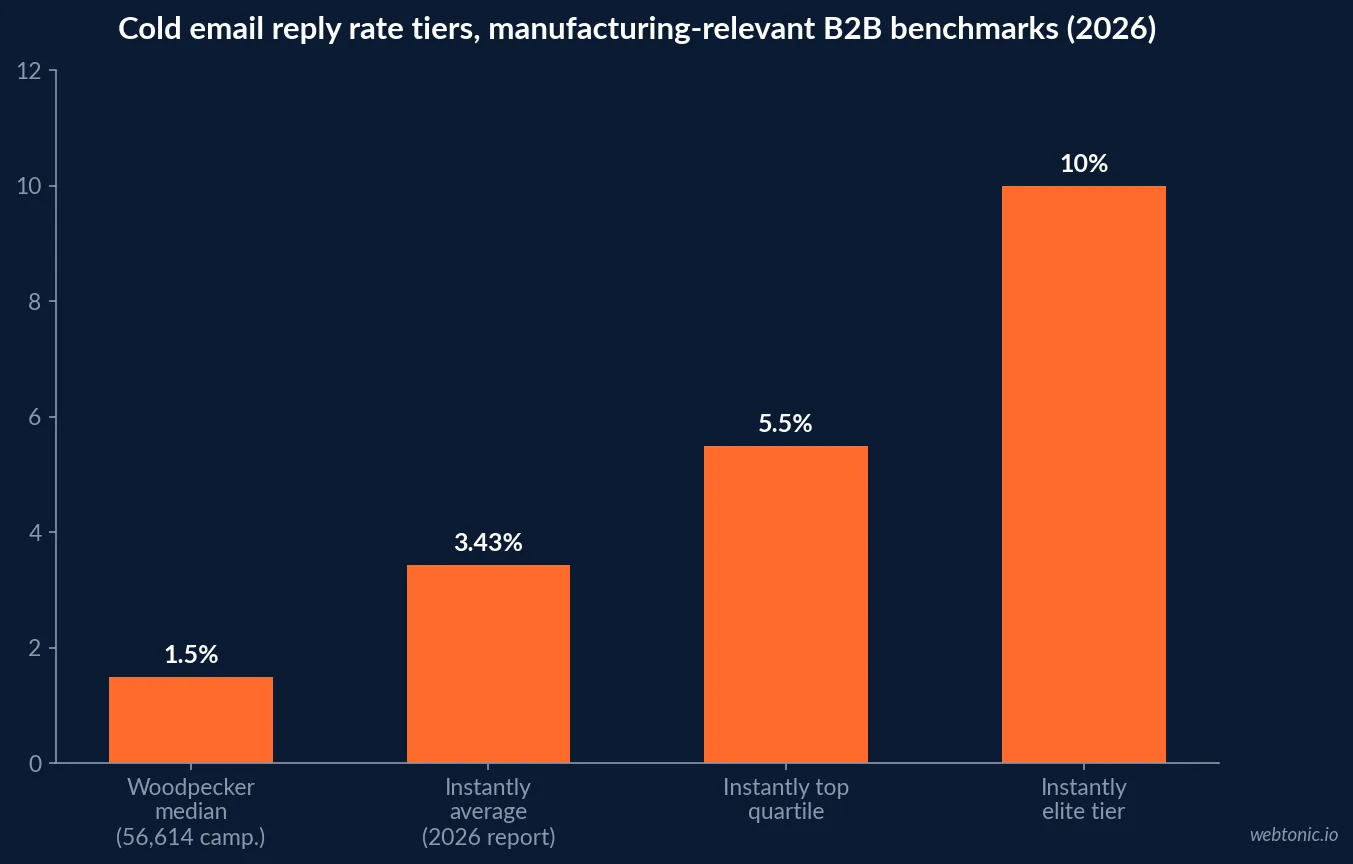
- Instantly's 2026 cross-industry average reply rate is 3.43%, with a top quartile above 5.5%.
- Woodpecker's median reply rate is 1.5% across 56,614 campaigns.
- Belkins reports a 0.45% reply rate against total sends across 7.5 million emails in 2025.
- Belkins' reply rate peaked at 0.54% in February and fell to 0.35% in December.
- Woodpecker's median open rate is 26% across 37,000 campaigns.
- Campaigns under a 2% bounce rate see a 60% higher reply rate than campaigns bouncing over 20%, per Woodpecker.
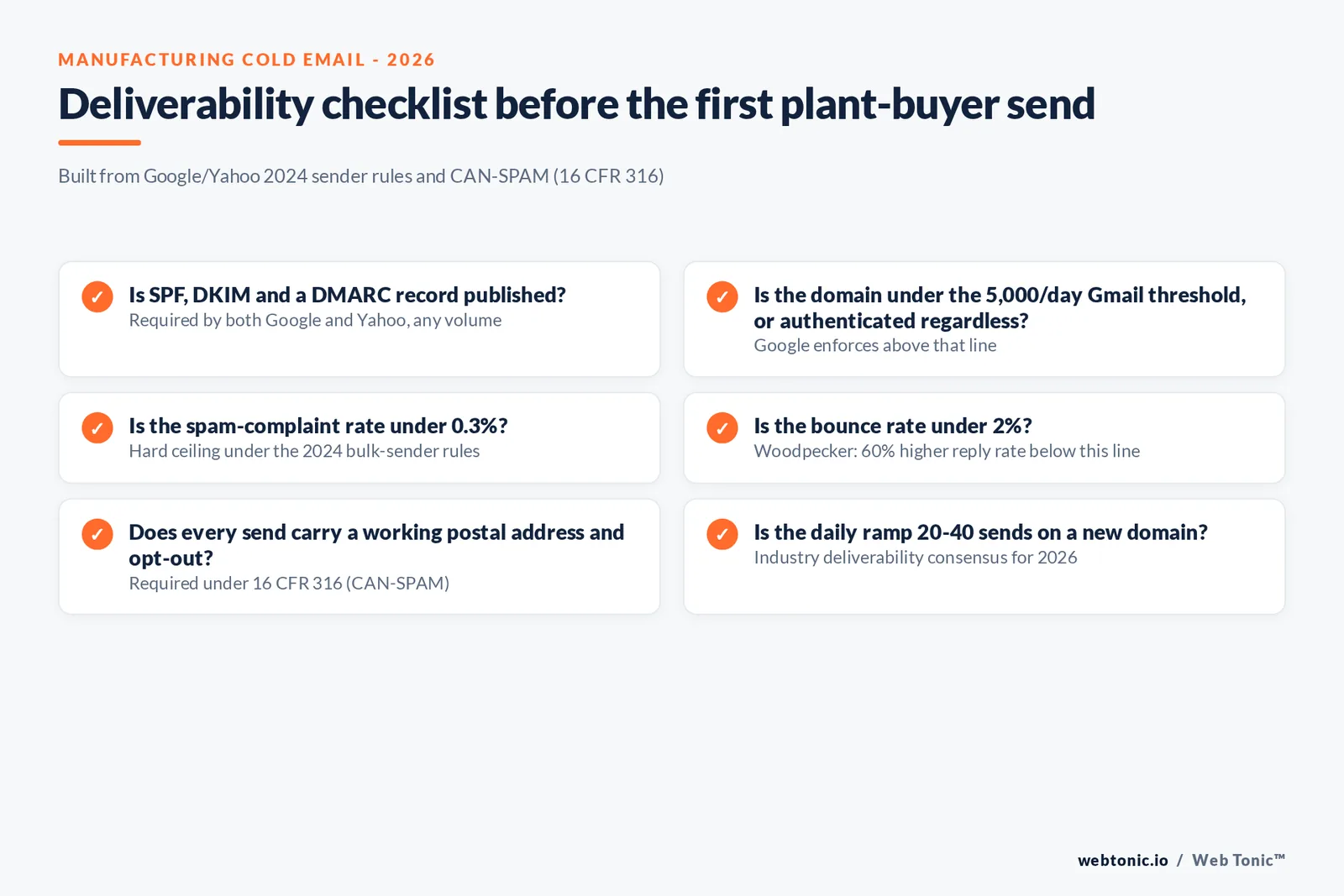
- Google requires authentication at 5,000+ messages a day to Gmail addresses.
- Yahoo enforces the same SPF/DKIM/DMARC trio regardless of volume tier.
- Spam-complaint rates must stay under 0.3% under the 2024 bulk-sender rules.
- CAN-SPAM opt-outs must be honored within 10 business days, per 16 CFR 316.
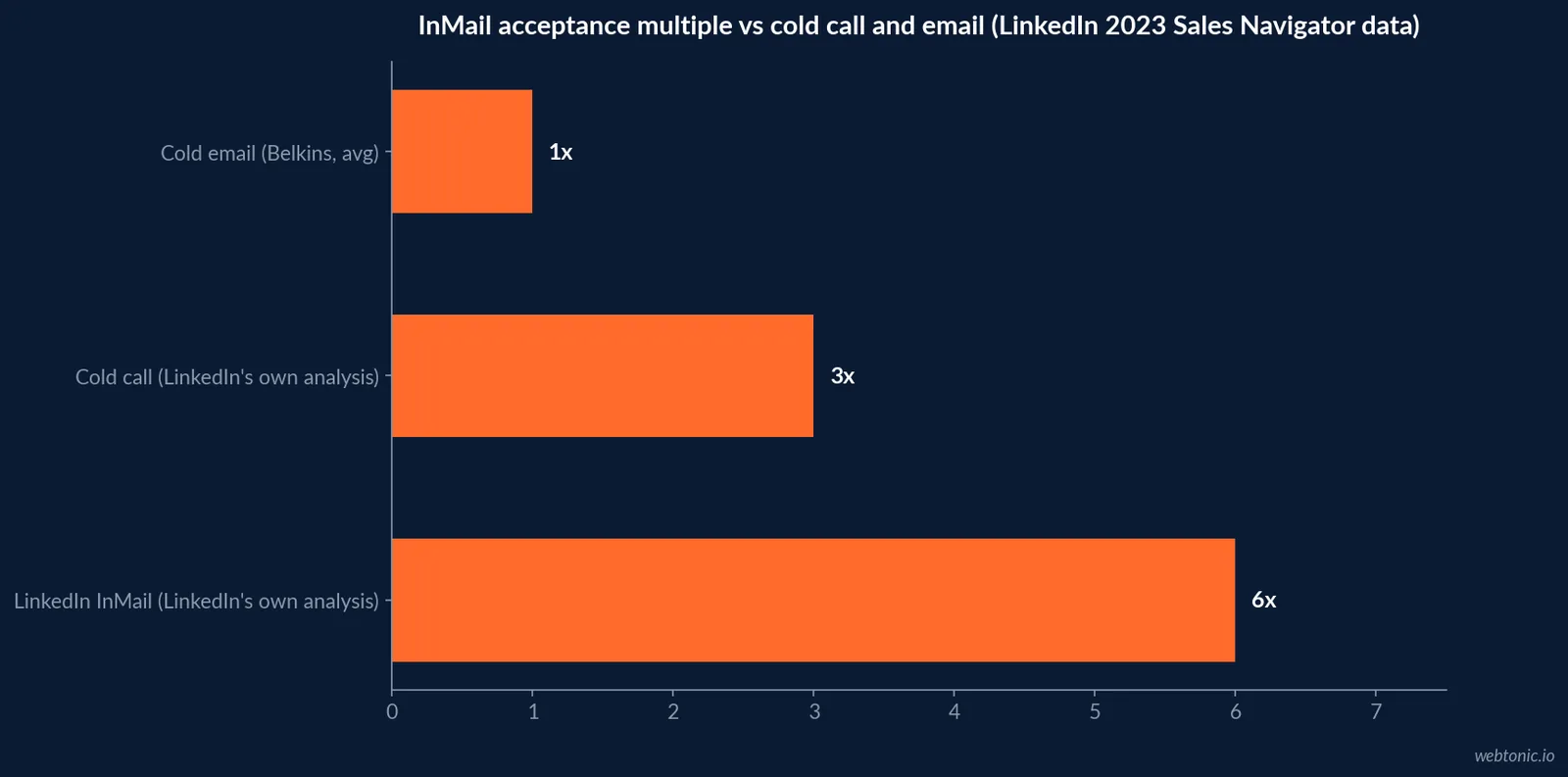
- LinkedIn InMail is accepted 3x more often than a cold call, per LinkedIn's own 2023 analysis.
- InMail is accepted 6x more often than email in that same LinkedIn dataset.
- The US had 284,452 manufacturing establishments with paid employees in the 2023 Census Bureau County Business Patterns file.
- 78.9% of manufacturers reported a positive outlook in NAM's Q3 2026 survey.
- 74.1% of manufacturers cited fuel costs as an operating challenge in that same survey.
- A cold email ramp typically runs 20 to 40 sends a day on a new domain.
- 58% of all Instantly replies come from the first-touch email, not a follow-up.
- The remaining 42% of replies come from follow-ups, making a sequence, not a single send, the unit that should be measured.
| Vendor dataset | Metric | Figure | What it measures |
|---|---|---|---|
| Instantly (2026 Benchmark Report) | Average reply rate | 3.43% | Replies over emails delivered, billions of sends |
| Instantly (2026 Benchmark Report) | Top-quartile reply rate | 5.5%+ | Better-targeted campaigns, same denominator |
| Instantly (2026 Benchmark Report) | Elite-tier reply rate | 10%+ | Top-performing senders only |
| Woodpecker (cold email benchmarks) | Median reply rate | 1.5% | 56,614 campaigns, replies over sends |
| Woodpecker (cold email benchmarks) | Median open rate | 26% | 37,000 campaigns, agencies excluded |
| Belkins (2025 B2B outreach study) | Average reply rate | 0.45% | 7.5M emails, replies over total sends |
Why the three benchmark numbers do not agree
These are not conflicting facts about the same thing - they are three different measurement choices. Instantly's 2026 report states its average reply rate is 3.43% with elite senders clearing 10%, measured across billions of sends on its own platform. Woodpecker's live benchmark tool reports a 1.5% median reply rate across 56,614 campaigns. Belkins switched its 2025-2026 methodology to replies-over-total-sends specifically because open-rate tracking became unreliable, landing at 0.45% across 7.5 million emails - a stricter, more honest denominator by the vendor's own account. Take the median (Woodpecker's 1.5%) as the working planning number for a mixed-quality industrial list, and treat 3.43% as the ceiling once targeting and personalization are dialed in.
What manufacturing buyers actually look like as a list
The addressable universe is finite and countable. The US had 284,452 manufacturing establishments with paid employees in the Census Bureau's most recent County Business Patterns national file, which means most plant-buyer TAMs are built from a few thousand named accounts rather than a scraped list of millions. Sentiment matters too: the National Association of Manufacturers' Q3 2026 outlook survey found 78.9% of manufacturers positive about their own company, up from 74.2% in Q2, while 74.1% flagged fuel costs and 98.6% depend on trucks to move goods - a supply-chain-cost lens worth working into subject lines aimed at plant managers and procurement.
The Google and Yahoo 2024 bulk-sender rules, in practice
As of 2024, Google's sender guidelines require authenticated mail, a spam-complaint rate under 0.3% and easy unsubscribe for any domain sending 5,000 or more messages a day to Gmail addresses. Yahoo's Sender Hub enforces the same SPF, DKIM and DMARC trio and a one-click unsubscribe header, and evaluates senders at the authenticated-domain level rather than per mailbox - so three reps sending from subdomains of the same root domain are judged together, not separately.
| Requirement | Google (Gmail) | Yahoo |
|---|---|---|
| Authentication | SPF + DKIM required; DMARC required at p=none or stronger | Same SPF/DKIM/DMARC trio required |
| Bulk-sender threshold | 5,000+ messages/day to Gmail addresses | Evaluated at authenticated-domain level, any volume |
| Unsubscribe | One-click unsubscribe header for bulk senders | One-click unsubscribe header required |
| Spam-complaint ceiling | Under 0.3%, per Google's own guidance | Not separately published; enforced via reputation review |
Where CAN-SPAM sets the legal floor
CAN-SPAM does not require opt-in consent - it is a disclosure-and-opt-out law. Under 16 CFR Part 316 and the FTC's compliance guide, every commercial email needs an accurate From/Subject line, a valid physical postal address, and a working opt-out that is honored within 10 business days. There is no manufacturing carve-out and no minimum company size - the rule applies to a two-person parts distributor exactly as it applies to an OEM.
List sourcing and volume per inbox
Belkins' monthly data shows reply rates are not flat across the year: the first half of 2025 averaged 0.50%, the second half dropped to 0.40%, and December bottomed at 0.35% - a roughly 20% decline the vendor attributes to inbox saturation and tighter filtering, not a single cause. On volume, Woodpecker's data shows campaigns with a bounce rate under 2% post a 1.6% median reply rate, about 60% higher than campaigns bouncing over 20% (which sit at 1.0%) - meaning list hygiene moves the number more than almost any copy change. The safe operating range most deliverability guidance converges on is 20 to 40 sends a day on a newly warmed domain, ramping toward 50 a day per mailbox once engagement is stable.
| List/volume factor | Benchmark | Source |
|---|---|---|
| Bounce rate under 2% | 1.6% median reply rate | Woodpecker, 56,614 campaigns |
| Bounce rate over 20% | 1.0% median reply rate | Woodpecker, same sample |
| New-domain daily volume | 20-40 emails/day, ramping 2-4 weeks | Industry deliverability consensus |
| Warmed-mailbox daily ceiling | ~50 emails/day | Industry deliverability consensus |
| H1 2025 average reply rate | 0.50% | Belkins, 7.5M emails |
| H2 2025 average reply rate | 0.40% | Belkins, same sample |
Cold email versus LinkedIn versus the phone
LinkedIn's own analysis of every Sales Navigator InMail sent in 2022 found InMails are 3 times more likely to be accepted than a cold call, and 6 times more likely than email. That is a real edge, but InMail has hard send caps and per-seat licensing cost that email does not, so it does not replace email for a plant-buyer list in the thousands - it works best as the second or third touch on the accounts that opened the email but never replied, which is exactly the segment first-touch email alone under-serves (58% of Instantly's replies land on the first touch; the other 42% only show up after a follow-up).
Sequence and copy practices that hold up in manufacturing
- Address the plant, not the corporate office - route to the site or facility contact where the buying decision for consumables, MRO and automation actually gets made.
- Lead with downtime or cost, not features - procurement and plant management respond to a specific operating cost or risk, not a product spec sheet.
- Keep the sequence to 3-5 touches over 2-3 weeks and budget for the fact that 42% of replies arrive after the first email, per Instantly's data.
- Segment by establishment size - a 284,452-establishment universe spans single-plant shops to multi-site OEMs, and one script rarely fits both.
- Ramp new domains slowly and keep spam complaints under 0.3% and bounces under 2% - both are enforcement triggers, not just best practice.
Frequently Asked Questions
What reply rate should a manufacturing cold email campaign expect?
There is no manufacturing-only benchmark with a disclosed sample, so the honest anchor is the cross-industry vendor data. Instantly's 2026 report puts the average across its platform at 3.43%, with a top quartile above 5.5% and an elite tier above 10%. Woodpecker's median across 56,614 campaigns is 1.5%. Belkins reports 0.45% against total sends across 7.5 million emails. The three numbers are not comparable on their face because they use different denominators - see the methodology note below - but all three point to low single digits as the realistic range for a plant-buyer list, not the 8-10% figures some outreach tools advertise on their homepage.
Does the Google and Yahoo 2024 bulk sender rule apply to a small industrial supplier?
It applies the moment a domain sends 5,000 or more messages a day to Gmail addresses, per Google's own sender guidelines - which is easy to hit once several reps run parallel sequences from shared domains. Below that threshold Google still expects SPF, DKIM and a published DMARC record; Yahoo enforces the same authentication trio and a one-click unsubscribe header regardless of volume. A supplier with three SDRs each sending 300 emails a day from the same root domain should assume the bulk-sender rules apply to the whole domain, not to each mailbox.
Is cold email even legal for B2B manufacturing outreach?
Yes, under CAN-SPAM, provided the message carries a working postal address, an honest subject line, clear identification as an ad where required and a functioning opt-out honored within 10 business days - the requirements are laid out in 16 CFR Part 316 and the FTC's compliance guide. CAN-SPAM does not require opt-in consent the way GDPR or CASL do, which is why it remains the legal baseline for US-focused industrial outbound; suppliers selling into Canada or the EU need to layer those regimes on top.
Should an industrial supplier use email, LinkedIn or the phone first?
LinkedIn's own 2023 analysis of Sales Navigator InMail found messages are 3 times more likely to be accepted than a cold call and 6 times more likely than email - but InMail carries a monthly send cap and a per-message cost, while email scales to a full plant-buyer list for a fraction of the price. Most working sequences for manufacturing accounts pair the two: email for the reach, a LinkedIn touch or a call in the same week for the accounts that open but do not reply.
How many cold emails can one mailbox safely send per day?
Deliverability guidance converges on 20 to 40 new-domain emails a day ramping over two to four weeks, rising to roughly 50 a day per warmed mailbox once authentication and engagement are stable - the ceiling is a spam-complaint rate under 0.3% and a bounce rate under 2%, both hard limits under the Google/Yahoo rules and both metrics Woodpecker and Instantly track directly in their benchmark data.
Sources
Instantly, Cold Email Benchmark Report 2026
Woodpecker, Cold Email Benchmarks
Belkins, Cold Email Response Rates 2025-2026
Google, Email sender guidelines
Yahoo, Sender Hub FAQs
eCFR, 16 CFR Part 316 (CAN-SPAM Rule)
FTC, CAN-SPAM Act Compliance Guide
LinkedIn Sales Blog, InMail acceptance-rate analysis
US Census Bureau, 2022 Economic Census, NAICS Sector 31-33 Manufacturing
National Association of Manufacturers, Q3 2026 Outlook Survey
See the full cold email outbound benchmark hub for cross-industry figures, or Manufacturing Email Marketing Statistics for the warm-list side of the channel. For hands-on sequence build-out, see Growth Marketing services or get in touch.