Table of contents
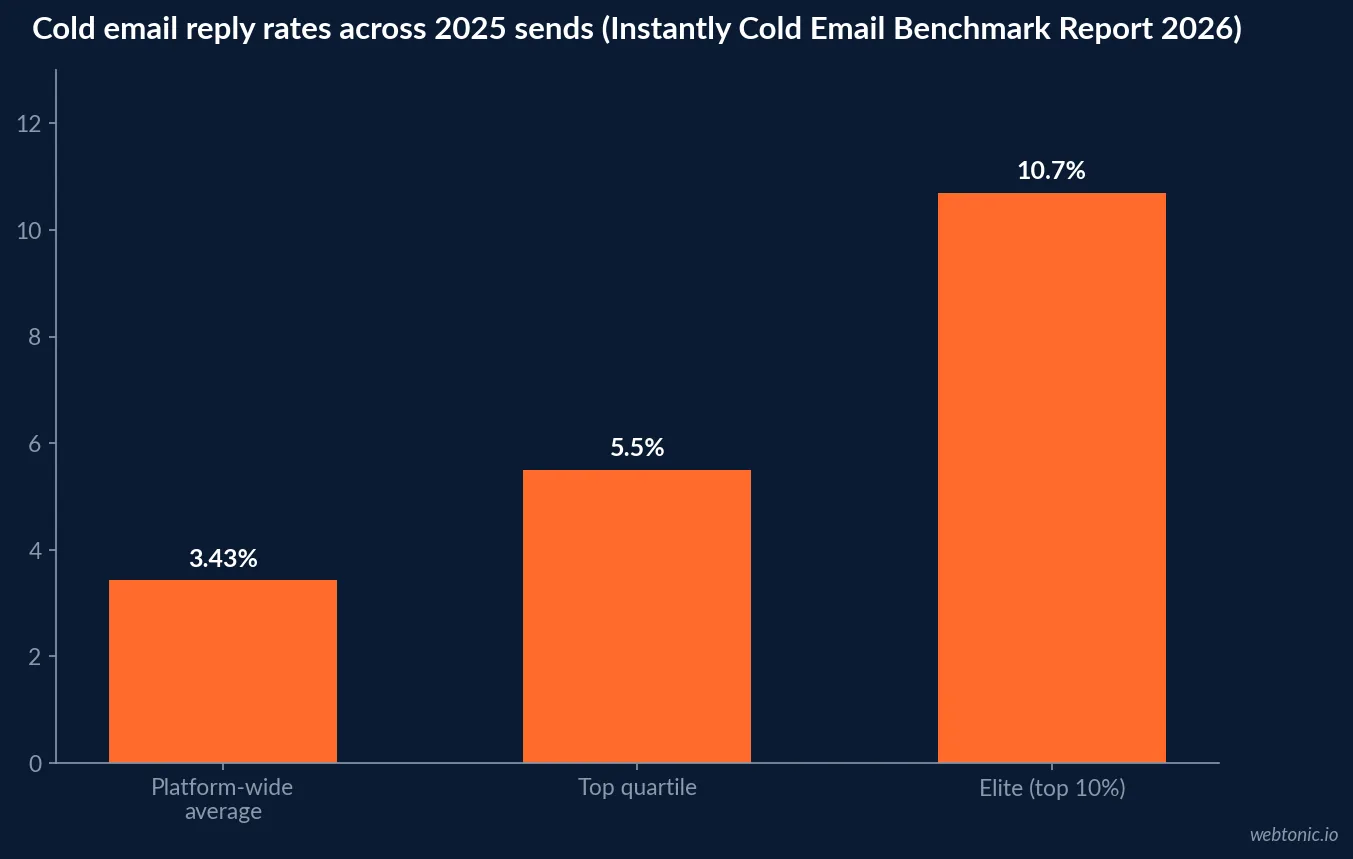
Cold email in 2026 replies at 3.43% on average across Instantly's own dataset, and cold calling before the email nearly doubles that number to 3.44% per Gong's data - so the real budgeting question is not "does cold email work" but which sequence, list and volume gets a message delivered at all. Every figure below is a vendor's own labelled dataset or a regulator's published rule.
Key Takeaways
- 3.43% is the average cold email reply rate across Instantly's 2026 benchmark.
- Top-quartile senders reach 5.5% and elite senders exceed 10.7%.
- Woodpecker's median reply rate sits at 1.5% across 56,614 tracked campaigns.
- Woodpecker's median open rate is 26% across 37,000 campaigns.
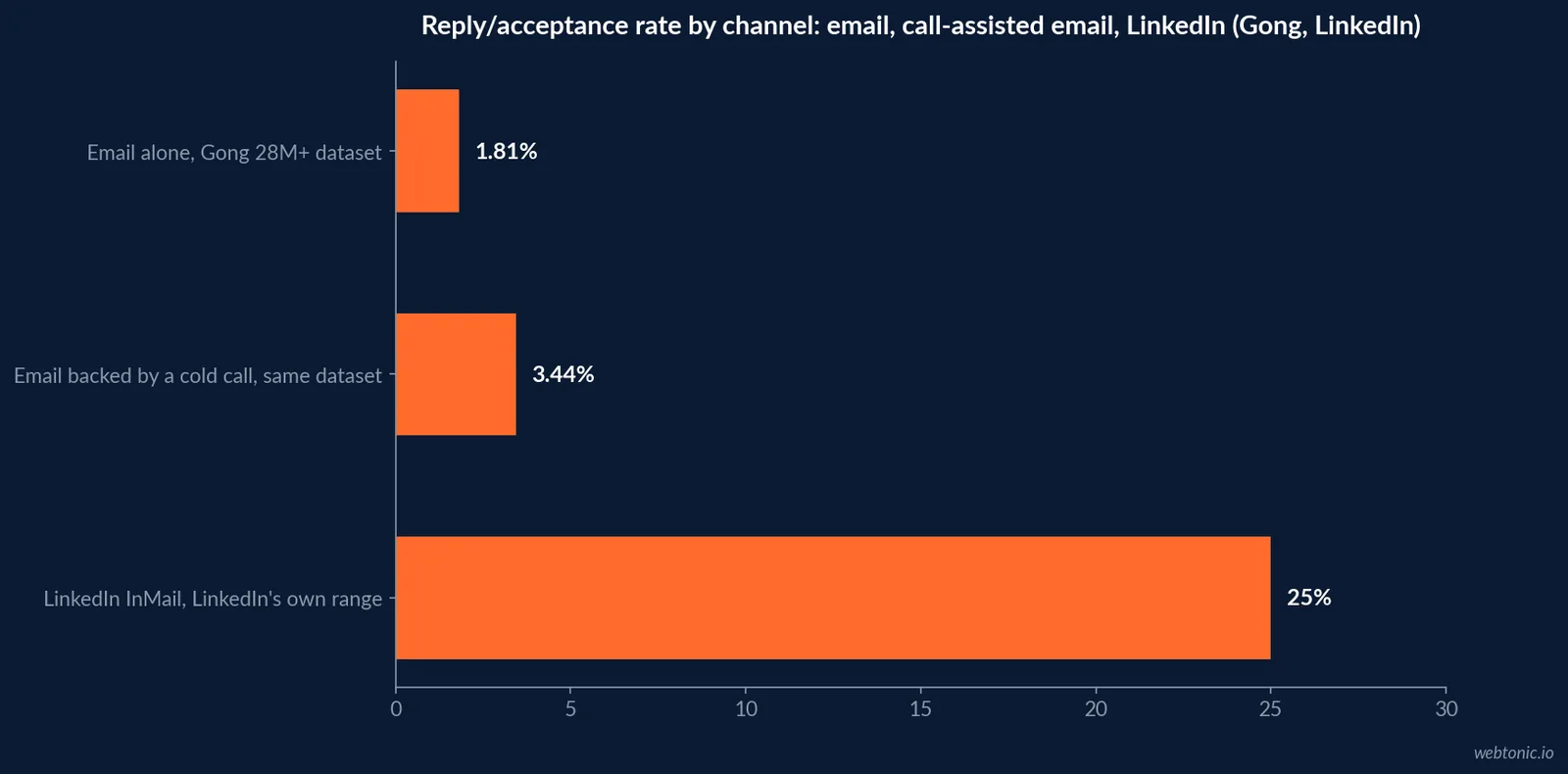
- Email alone replies at 1.81% in Gong's 28 million-plus email dataset.
- A cold call first nearly doubles that, to 3.44%, per the same Gong dataset.
- The top 25% of reps land 4.3x more meetings than average reps.
- The top 10% of reps land 8.1x more meetings than average reps.
- LinkedIn InMail acceptance typically runs 10-25%, per LinkedIn's own data.
- A complete profile lifts InMail acceptance by 87%.
- Belkins' 2025 study covers 16.5 million cold emails and 20 million-plus LinkedIn touches.
- Google requires under 0.3% spam complaints for bulk senders, ideally under 0.1%.
- 5,000+ messages/day to Gmail triggers mandatory SPF, DKIM and DMARC since Feb 2024.
- Yahoo requires the same DMARC floor, p=none at minimum, for bulk senders.
- CAN-SPAM (16 CFR 316) sets the federal floor for every commercial email sent in the US.
- One-click List-Unsubscribe is mandatory under the 2024 bulk-sender rules.
- Bounce rates above roughly 2-3% flag a list problem, per vendor deliverability data.
Why two vendor benchmarks disagree, and why that is fine
Instantly's Cold Email Benchmark Report 2026 puts the platform-wide average reply rate at 3.43%, with the top quartile at 5.5% and elite senders (top decile) above 10.7%. Woodpecker's own benchmark tool, drawn from 56,614 tracked campaigns, reports a lower median reply rate of 1.5% alongside a 26% median open rate across 37,000 campaigns.
Both are real, both are vendor-labelled, and both are correct for their own sender base - Instantly's figure skews toward its platform's sales-focused user base, Woodpecker's toward a broader campaign mix including recruitment and agency outreach. The lesson is to benchmark against the vendor whose sender profile looks like yours, not the higher number in a sales deck.
| Reply-rate tier | Instantly 2026 benchmark | Woodpecker benchmark | Sample size |
|---|---|---|---|
| Average / median sender | 3.43% | 1.5% | Instantly platform-wide; 56,614 Woodpecker campaigns |
| Top quartile | 5.5% | Not separately published | Instantly platform-wide |
| Elite / top decile | 10.7%+ | Not separately published | Instantly platform-wide |
| Open rate, median | Not the headline metric | 26% | 37,000 Woodpecker campaigns |
| What moves the number | List quality, personalization, volume/inbox | Subject line, timing, provider | Both vendors |
Does the phone actually help the email, or is that folklore?
Gong's own analysis of 28 million-plus cold emails found a cold email sent with no call replied at 1.81%, while the same rep's email backed by a cold call replied at 3.44% - just under double. That same call dataset, covering 300 million-plus calls, found the top 25% of reps land 4.3 times more meetings than average reps and the top 10% land 8.1 times more.
Read together, the two Gong datasets say the channel matters less than the rep and the sequence - a call-plus-email motion outperforms either channel alone, and the spread between top and average reps dwarfs the spread between any two channels.
Where LinkedIn actually beats email, and where it does not
LinkedIn's own analysis of InMail sending reports acceptance typically in the 10-25% range, and finds a complete profile lifts InMail acceptance by 87%. That acceptance metric is not the same measurement as a cold email reply rate - InMail acceptance tracks whether the recipient engages with the message request at all, closer to an open rate than a full conversation.
Belkins' 2025 cross-channel study, analyzing 16.5 million cold emails alongside 20 million-plus LinkedIn outreach attempts and 5 million-plus cold calls, treats the three channels as a combined motion rather than competitors - the honest framing for most B2B sequences today.
| Channel | What the metric measures | Published figure | Source |
|---|---|---|---|
| Cold email, no call | Full reply | 1.81% | Gong, 28M+ email dataset |
| Cold email + cold call | Full reply | 3.44% | Gong, same dataset |
| LinkedIn InMail | Message acceptance | 10-25% | LinkedIn's own analysis |
| LinkedIn InMail, complete profile | Acceptance lift | +87% | LinkedIn's own analysis |
| Combined sequence (email+call+LinkedIn) | Not a single metric | 16.5M/20M+/5M+ touches analyzed | Belkins 2025 |
What Google and Yahoo actually require since 2024
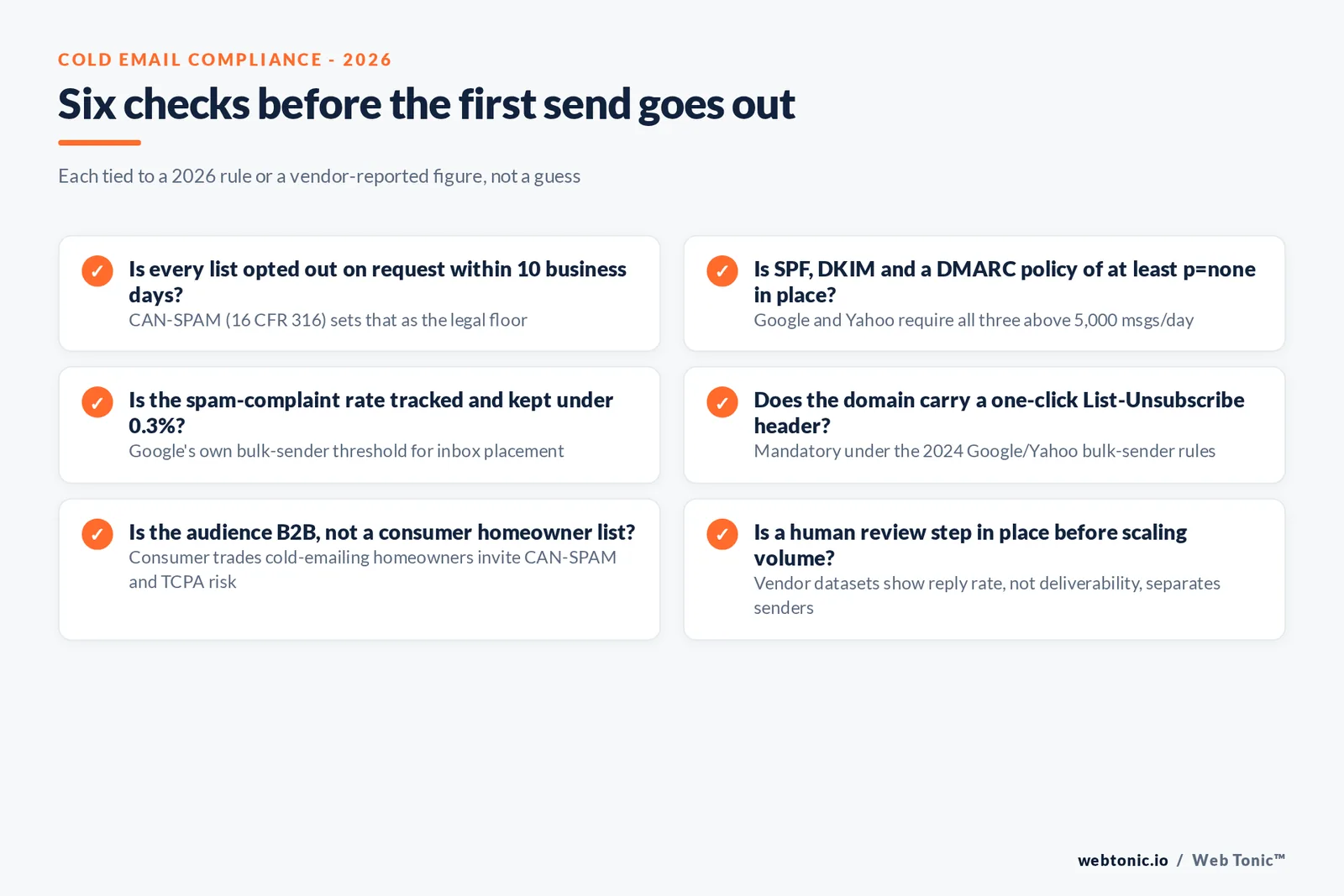
Under the Gmail bulk-sender guidelines effective February 2024, any sender pushing 5,000 or more messages a day to Gmail addresses must authenticate with SPF, DKIM and a DMARC policy, support one-click unsubscribe, and keep the spam-complaint rate under 0.3% - Google's own threshold guidance recommends staying under 0.1% to avoid inbox-placement problems before ever reaching that ceiling. Yahoo's Sender Hub requires the same authentication floor - SPF, DKIM, and DMARC at minimum p=none with alignment to the From: domain.
Below the 5,000-message threshold the legal bar is lower, but the deliverability bar is not - an unauthenticated domain sending even a few hundred cold emails a day routinely lands in spam at both providers regardless of the sender's volume tier.
| Requirement (2024 rules) | Google threshold | Yahoo threshold | Consequence of missing it |
|---|---|---|---|
| SPF + DKIM + DMARC | Mandatory at 5,000+/day | Mandatory for bulk senders | Authentication failure, spam folder |
| Spam-complaint rate | Keep under 0.3%, target 0.1% | Not separately numbered, same intent | Domain reputation damage |
| One-click unsubscribe | Mandatory at 5,000+/day | Mandatory for bulk senders | Non-compliant headers rejected |
| CAN-SPAM opt-out honor window | 10 business days (federal law) | 10 business days (federal law) | FTC enforcement exposure |
| From: domain alignment | Required for DMARC pass | Required for DMARC pass | Authentication failure |
The federal floor underneath both providers' rules: CAN-SPAM
The FTC's CAN-SPAM compliance guide and its underlying 16 CFR Part 316 apply to every commercial email sent to a US recipient, cold or warm, at any volume - honoring opt-outs within 10 business days, including a working physical postal address, and never using a deceptive subject line or header. Google and Yahoo's 2024 rules sit on top of CAN-SPAM; they do not replace it, and a sequence that clears the platform rules but breaks CAN-SPAM is still a federal violation.
Which industries should not cold-email consumers at all
Roofing, HVAC, plumbing, pest control and personal-injury law all sell to homeowners or injured individuals, and cold-emailing that consumer audience directly invites CAN-SPAM exposure plus, for personal-injury specifically, solicitation restrictions under ABA Model Rule 7.3. The channel still applies to those trades pointed at a commercial list - property managers, general contractors, facilities teams, insurance adjusters and referral partners - which is exactly the B2B audience CAN-SPAM assumes rather than the consumer audience it was written to protect.
Dental and med-spa practices sit in a related gray zone: HIPAA does not prohibit B2B outreach email to referring physicians or employer benefits contacts, but protected health information must never appear in the outreach itself, and any SMS follow-up to a patient list needs separate TCPA consent.
Building the sequence, not just the list
A working cold outbound motion budgets for domain warm-up and authentication before the first send, caps volume per inbox well under the 5,000-message provider ceiling on any single domain, and follows Gong's own finding that pairing the email with a call roughly doubles reply rate. None of that requires a bigger list - it requires a smaller, cleaner one sent from a properly authenticated domain.
Woodpecker's own benchmark data breaks reply rate down by sequence length as well as by open rate, and both vendors report the same directional pattern: a short, personalized sequence with one to three follow-ups over one to two weeks consistently outperforms a single blast, regardless of which reply-rate benchmark you are measuring against.
| Sending discipline | Recommended practice | Why it matters | Source |
|---|---|---|---|
| Volume per sending domain | Well under 5,000/day per domain | Google/Yahoo bulk-sender ceiling triggers extra scrutiny above it | Google, Yahoo sender guidelines |
| Spam-complaint rate | Under 0.1%, never above 0.3% | Crosses into inbox-placement penalties past 0.3% | Google sender guidelines |
| Follow-up cadence | 1-3 follow-ups over 7-14 days | Matches the sequence length vendors report performing best | Woodpecker, Instantly benchmark data |
| Opt-out honoring window | Within 10 business days | Federal minimum under CAN-SPAM | FTC / 16 CFR 316 |
| Channel pairing | Email plus a call where feasible | Nearly doubles reply rate per Gong's dataset | Gong 28M+ email dataset |
Where this fits next to a paid channel
Cold outbound and paid search answer different buying stages - outbound reaches a prospect before they are searching, paid search catches them once they are. Teams running both should expect outbound reply rates to look unimpressive next to a paid-search conversion rate; they are not measuring the same moment in the funnel. See our Google Ads agency practice for how the two typically get sequenced inside one B2B pipeline, and our performance creative practice for how subject-line and opening-line testing borrows directly from paid-ad copy testing discipline.
If outbound needs to sit alongside a paid channel rather than replace one, see how our growth marketing practice sequences outbound against paid demand, or talk to us about auditing an existing sequence against the 2024 sender rules above.
Frequently Asked Questions
What is a realistic cold email reply rate in 2026?
Instantly's Cold Email Benchmark Report 2026, built from its platform-wide sending data through December 2025, puts the average reply rate at 3.43%, the top quartile at 5.5%, and elite senders (top 10%) above 10.7%. Woodpecker's own benchmark tool, drawn from 56,614 campaigns, puts the median reply rate lower, at 1.5%, with a 26% median open rate across 37,000 campaigns - the gap between the two vendor datasets is a reminder to read the reply-rate number next to its own sample before setting a target.
Does a cold call before the email actually change the reply rate?
Yes, according to Gong's own analysis of 28 million-plus cold emails: a cold email sent alone replied at 1.81%, while the same rep's email backed by a cold call replied at 3.44% - very close to double. Gong's separate 300 million-plus call dataset found the top 25% of reps land 4.3 times more meetings than the average rep, and the top 10% land 8.1 times more - the gap is mostly rep skill, not channel choice.
Is LinkedIn outreach really better than cold email?
By acceptance rate, usually yes: LinkedIn's own data on InMail puts typical acceptance in the 10-25% range, and a complete profile lifts InMail acceptance by 87% according to LinkedIn's internal analysis. But InMail and cold email answer different questions - InMail measures whether a message gets opened at all, while cold email reply-rate benchmarks measure a completed reply. The honest comparison is channel mix, not a single winner: Belkins' cross-channel 2025 study analyzed 16.5 million emails alongside 20 million-plus LinkedIn outreach attempts specifically because neither channel alone covers a full sequence.
What do Google and Yahoo actually require before a sequence can be sent?
Since February 2024, any sender pushing 5,000-plus messages a day to Gmail or Yahoo addresses must authenticate with SPF, DKIM and a DMARC policy of at least p=none, support one-click unsubscribe, and keep the reported spam-complaint rate under 0.3% (Google recommends staying under 0.1%). Below that volume the technical bar is lower but not zero - Google's own sender guidelines apply the authentication requirement to every sender regardless of volume.
Can a home-services or consumer-facing business cold email its way to customers?
Not to homeowners, no - a roofing, HVAC, plumbing or personal-injury-law business cold-emailing consumer prospects invites both a CAN-SPAM compliance problem and, for any text-based follow-up, TCPA exposure, on top of the trust cost of unsolicited consumer outreach. The tactic still works for those trades pointed at commercial recipients - property managers, GCs, facilities teams, insurance adjusters, referral partners - which is a B2B list, not a consumer one, and is exactly the audience CAN-SPAM was written to regulate rather than ban.
Sources
Instantly - Cold Email Benchmark Report 2026
Woodpecker - Free cold email benchmarks tool
Gong - Does cold email even work any more? (28M+ email dataset)
Gong - The hidden power of cold calling (300M+ call dataset)
LinkedIn - Data on sending InMails and acceptance rates
Belkins - The key B2B cold outreach benchmarks 2025
Google - Email sender guidelines (Gmail bulk-sender rules)
Yahoo - Sender Hub best practices
FTC - CAN-SPAM Act compliance guide for business
eCFR - 16 CFR Part 316, CAN-SPAM Rule