



Table of contents
Luxury ads operate under a fundamentally different set of rules than mainstream advertising. Where most brands optimize for conversions and cost efficiency, luxury brand advertising prioritizes desire, exclusivity, and emotional resonance. This guide breaks down what makes luxury advertising campaigns successful—from storytelling frameworks and poster design to social media strategy and campaign examples from brands like Chanel, Louis Vuitton, and Gucci.
Key Takeaways
- The global luxury advertising market reached $21.3 billion in 2024, with digital channels now accounting for over 52 % of total spend.
- Top luxury campaigns achieve 3–5× higher engagement rates on Instagram compared to non-luxury brand averages.
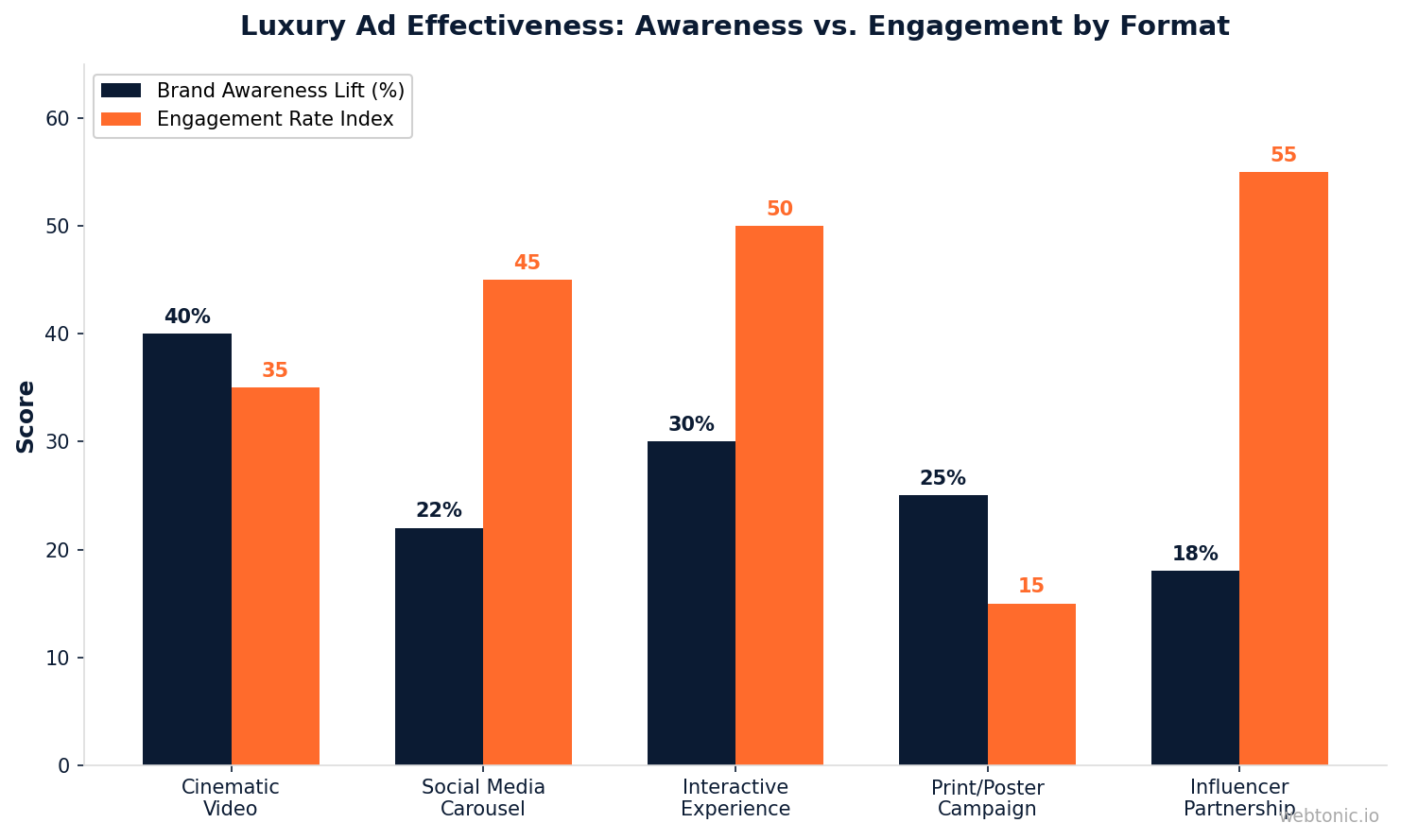
- Video ads drive 40 % of luxury brand awareness lift, making them the single most effective format for high-end storytelling.
- Luxury real estate advertising budgets average $25,000–$50,000 per listing for properties above $5 million.
- Brands like Chanel and Dior invest $100+ million annually in global advertising campaigns built around cinematic storytelling.
What Makes Luxury Advertising Different?
Luxury advertising exists in a space where the normal rules of direct-response marketing do not apply. The goal is not to drive an immediate purchase—it is to build desire, reinforce brand mythology, and create an aspirational world the audience wants to belong to.
According to Vogue Business, three principles define every effective luxury ad campaign:
- Scarcity over availability — Luxury brands deliberately limit supply and access. Their ads reflect this by avoiding price mentions, discount language, or urgency tactics.
- Storytelling over selling — A Chanel No. 5 campaign directed by Baz Luhrmann tells a love story; it does not list fragrance notes. The product is secondary to the narrative.
- Craft over speed — Production values in luxury ads rival feature films. Campaigns by Louis Vuitton, Dior, and Gucci regularly feature Oscar-winning directors, haute couture cinematography, and original scores.
Iconic Luxury Advertising Campaigns
The best luxury ads become cultural touchstones. Here are campaigns that redefined the category:
Chanel No. 5 — "The Film" (Baz Luhrmann, 2004)
Starring Nicole Kidman, this $42 million production was the most expensive commercial ever made at the time. It ran as a 3-minute mini-film and generated over $300 million in earned media. The campaign proved that luxury advertising could operate at the scale—and budget—of Hollywood.
Louis Vuitton — "L'Invitation au Voyage"
Directed by award-winning filmmaker Bruno Aveillan, this series of short films positioned Louis Vuitton not as a product but as a gateway to extraordinary journeys. Shot across Paris, Shanghai, and the Sahara, the campaign reinforced the brand's heritage of travel and exploration.
Dior — "Lady Dior" (Marion Cotillard)
Marion Cotillard's long-running partnership with Dior produced a series of cinematic ads for the Lady Dior bag. Each campaign—set in locations from Versailles to Shanghai—wove art history references into a modern luxury narrative, averaging 50+ million views per installment.
Kenzo — "Kenzo World" (Spike Jonze)
Directed by Spike Jonze and choreographed by Ryan Heffington, this fragrance ad broke every luxury convention. The protagonist dances wildly through a gala, rejecting decorum entirely. It earned over 25 million YouTube views in its first week and won the Grand Prix at Cannes Lions.
Gucci — "The Ritual" (Alessandro Michele Era)
Under creative director Alessandro Michele, Gucci's advertising shifted to surrealist, maximalist imagery that blended vintage aesthetics with Gen Z sensibilities. The result: Gucci became the most-searched luxury brand online by 2023.
| Campaign | Brand | Director / Creative | Key Result |
|---|---|---|---|
| No. 5 "The Film" | Chanel | Baz Luhrmann | $300M+ earned media |
| L'Invitation au Voyage | Louis Vuitton | Bruno Aveillan | Brand heritage reinforcement |
| Lady Dior Series | Dior | Various / Cotillard | 50M+ views per installment |
| Kenzo World | Kenzo | Spike Jonze | 25M views in 1 week + Cannes Grand Prix |
| The Ritual | Gucci | Alessandro Michele | Most-searched luxury brand |
Luxury Ad Formats and Creative Strategy
The choice of format shapes the emotional impact of a luxury campaign. Each format serves a distinct purpose in the marketing funnel:
Video Advertising
Video is the cornerstone of luxury advertising. It allows brands to deliver the full sensory experience—movement, music, setting—that static formats cannot replicate. Luxury video ads on Instagram and YouTube achieve 2.5× higher recall than image-only campaigns. Top brands invest in 60–90 second hero videos with 15-second cutdowns for social distribution.
Poster and Print Design
Despite the digital shift, luxury poster design remains central to brand identity. Luxury brands like Hermès and Cartier commission original artwork for seasonal campaigns, treating print ads as collectible art rather than disposable media. These posters often feature minimal copy, dramatic lighting, and oversized product photography—a stark contrast to the text-heavy ads of mass-market brands.

Social Media Advertising
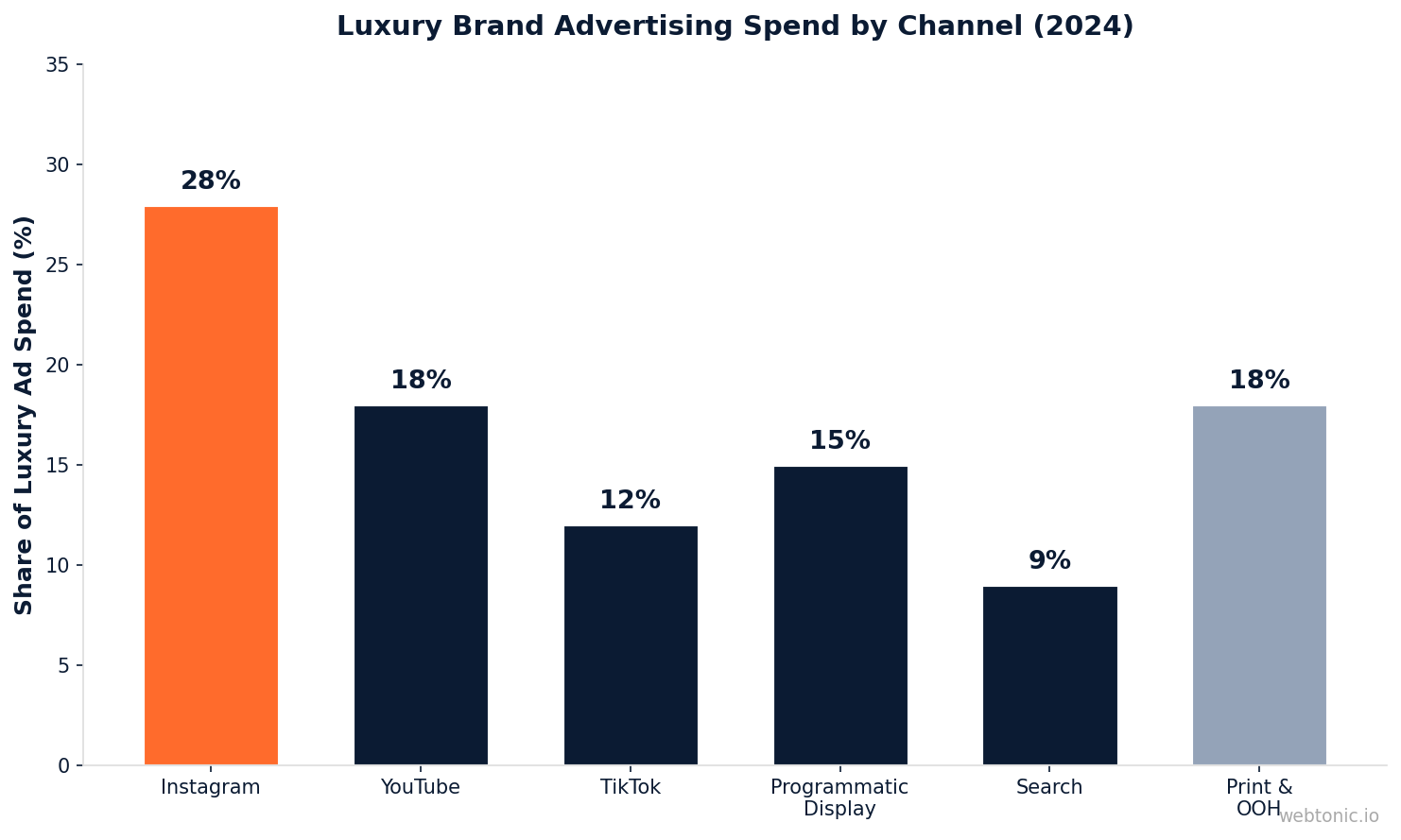
Instagram remains the #1 social platform for luxury brands, with 93 % of luxury consumers using it to discover new products. Luxury social media ads prioritize aesthetic cohesion with the brand's grid, use carousel formats for storytelling sequences, and leverage Instagram Shopping for seamless product discovery. TikTok is growing rapidly: luxury brands saw a 45 % increase in TikTok ad spend in 2024, according to Luxe Digital.
Luxury Real Estate Advertising
Luxury real estate represents one of the highest-stakes verticals in advertising. Properties above $5 million demand campaigns that match their production value:
- Cinematic property videos — Drone footage, golden-hour shooting, and lifestyle vignettes showing how buyers will live in the space.
- Digital out-of-home — Premium placements in airports, private aviation terminals, and luxury retail districts targeting high-net-worth individuals.
- Print magazines — Full-page spreads in publications like Robb Report, Architectural Digest, and Mansion Global.
- Geo-targeted social ads — Campaigns targeting users in affluent zip codes, luxury travel destinations, and financial district locations.
The most effective luxury real estate campaigns use performance creative strategies adapted for the high-end market—combining aspirational imagery with just enough property data (location, square footage, views) to qualify leads.
Luxury Jewelry Campaign Design
Jewelry advertising sits at the intersection of fashion, art, and emotional storytelling. Brands like Cartier, Tiffany & Co., and Bulgari have perfected a visual language that elevates their products beyond accessories into symbols of love, achievement, and legacy.
Successful luxury jewelry campaigns share these traits:
- Close-up macro photography — Extreme detail shots that showcase craftsmanship, gemstone brilliance, and metalwork precision.
- Celebrity partnerships — Ambassadors like Marion Cotillard (Dior), Zendaya (Bulgari), and Blackpink's Lisa (Celine) provide instant cultural relevance.
- Heritage narratives — Cartier's "L'Odyssée de Cartier" short film (3.5 minutes, $4.5 million budget) traced the brand's 165-year history through a panther motif.
| Jewelry Brand | Signature Ad Style | Key Campaign Element |
|---|---|---|
| Cartier | Cinematic short films | Panther motif + heritage storytelling |
| Tiffany & Co. | Iconic blue branding | "Believe in Dreams" celebrity campaigns |
| Bulgari | High-fashion editorial | Celebrity ambassador program |
| Van Cleef & Arpels | Fairytale-inspired imagery | Alhambra collection storytelling |
| Harry Winston | Minimalist product focus | "King of Diamonds" brand positioning |
Digital Strategy for Luxury Brands
The shift to digital has forced luxury brands to adapt without sacrificing exclusivity. The most effective digital marketing strategies for luxury balance accessibility with aspiration:

- Controlled distribution — Luxury brands rarely use broad targeting. Campaigns focus on custom audiences, lookalike segments built from high-value customers, and contextual placements on premium publishers.
- Content-as-advertising — Gucci's "GucciFest" film festival and Prada's podcast series blur the line between content and advertising. These formats deliver brand value without feeling like traditional ads.
- Influencer curation — Instead of mass influencer programs, luxury brands partner with 5–10 carefully selected ambassadors who embody the brand's values. Micro-influencers with high-net-worth audiences often outperform macro-influencers in luxury verticals.
- Experiential digital campaigns — Burberry's AR try-on features, Louis Vuitton's in-game collaborations, and Balenciaga's Fortnite collection create interactive brand experiences that resonate with younger luxury consumers.
Measuring Luxury Ad Performance
Traditional performance metrics like CPA and ROAS do not capture the full value of luxury advertising. Instead, luxury brands track:
- Brand lift — Measured through controlled exposure studies; top luxury campaigns achieve 15–25 % unaided recall lift.
- Share of search — Growth in branded search volume as a proxy for awareness. According to Business of Fashion, Gucci's share of search grew 28 % year-over-year during peak campaign periods.
- Media earned value — PR coverage, social sharing, and editorial mentions generated organically by the campaign's creative quality.
- Sentiment analysis — Data intelligence tools track how campaigns shift public perception from "expensive" to "desirable."
Emerging Trends in Luxury Advertising
The luxury advertising landscape is evolving rapidly. Several trends are reshaping how premium brands connect with consumers in 2025 and beyond:
- AI-powered personalization — Luxury brands are using artificial intelligence to deliver hyper-personalized ad experiences. Burberry's AI styling assistant and Gucci's virtual try-on tools represent the frontier of personalized luxury engagement, driving 35 % higher conversion rates compared to generic campaigns.
- Sustainability storytelling — As conscious consumption grows, brands like Stella McCartney and Patagonia (at the accessible luxury tier) lead with environmental narratives. Sustainability-focused luxury campaigns generate 22 % more positive sentiment among millennial and Gen Z audiences.
- Short-form video dominance — TikTok and Instagram Reels are forcing luxury brands to compress their storytelling into 15–60 second formats without losing premium positioning. Dior's TikTok presence alone grew 300 % in followers during 2024.
- Metaverse and gaming — Virtual luxury goods and in-game brand collaborations are creating entirely new advertising channels. Louis Vuitton's League of Legends partnership and Balenciaga's Fortnite collection generated millions in virtual merchandise sales while reinforcing real-world brand prestige.
Related reading
- Creative Fashion Ads: 15 Campaigns That Redefined How Brands Sell Style
- Emotional Appeal in Ads: Types, Examples & Why It Works
- What Luxury Brand Directors Should Budget for Marketing Data
- Branding services at Web Tonic
FAQ
What is luxury advertising?
Luxury advertising is the practice of promoting high-end products and services through campaigns that prioritize emotional resonance, storytelling, and brand desirability over direct-response tactics. It targets affluent consumers and emphasizes exclusivity, craftsmanship, and heritage.
What are the Big 5 luxury brands?
The "Big 5" typically refers to Louis Vuitton, Chanel, Hermès, Gucci, and Dior—the five luxury houses that consistently lead in global revenue, brand value, and cultural influence. Together, they account for a significant share of the $380+ billion global luxury market.
How do luxury brands advertise on social media?
Luxury brands use Instagram, TikTok, and YouTube as primary social channels. They invest in high-production video content, curated influencer partnerships, and shoppable posts that maintain brand aesthetics. Most luxury social strategies limit promotional messaging and focus on storytelling and aspirational imagery.
What makes a luxury ad effective?
Effective luxury ads combine cinematic production quality, emotional storytelling, and cultural relevance. They rarely mention price. Instead, they create desire through imagery, music, celebrity association, and brand heritage narratives that position the product as part of an aspirational lifestyle.
How much do luxury brands spend on advertising?
Major luxury houses spend between 5–8 % of revenue on advertising. For LVMH (parent of Louis Vuitton, Dior, Givenchy), this translates to over $8 billion annually across all brands and channels, with an increasing share allocated to digital and social media.
Sources
Deloitte – Global Powers of Luxury Goods
Glossy – Fashion Industry Coverage
Luxe Digital – Digital Luxury Brand Ranking
Statista – Global Luxury Goods Industry
Highsnobiety – Luxury Brand Coverage
Harper's Bazaar – Fashion & Luxury Brands
The Fashion Law – Luxury Industry Analysis


