



Table of contents
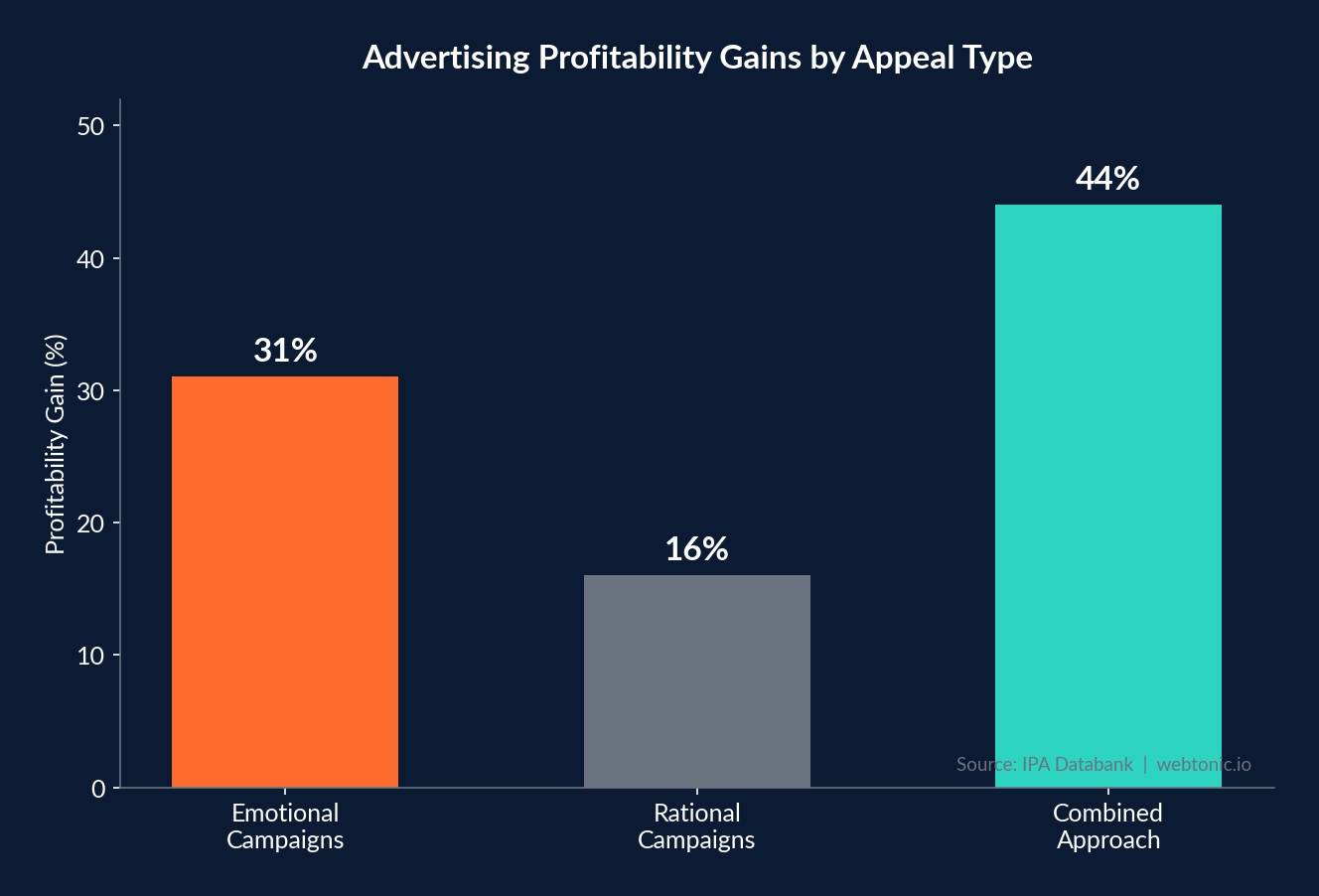
Emotional appeal in advertising uses feelings — happiness, fear, nostalgia, or empathy — to influence consumer behavior and drive action. IPA data spanning 1,400 campaigns confirms that purely emotional ads deliver 31% profitability gains versus just 16% for rational campaigns.
Key Takeaways
- Emotional advertising campaigns deliver 31% profitability gains compared to 16% for purely rational campaigns (IPA databank, 1,400+ case studies).
- Ads with above-average emotional response drive a 23% lift in sales volume versus average ads (Nielsen neuroscience research).
- Emotional memories are more durable than factual ones, compounding the effectiveness of emotional ads over time.
- Positive content is significantly more likely to be shared than negative content, with high-arousal positive emotions driving the strongest sharing behavior (Wharton research, Jonah Berger).
- Emotional advertising results in greater recall, trust, and purchase intention than rational appeals across a 5,400-respondent study (IJFMR, 2025).
- Fear-based advertising follows a U-shaped effectiveness curve: moderate fear motivates action, but extreme fear causes avoidance.
- Combined emotional-rational campaigns outperform pure emotional by 26% and pure rational by 44% in long-term brand effects (IPA).
- Coca-Cola's "Share a Coke" campaign generated billions of social impressions by leveraging happiness and personalization as emotional triggers.
- Google's "Reunion" ad reached 2 million views within days by using empathy and nostalgia without any product demonstration.
- Nike's emotional campaigns consistently outperform product-focused ads by building brand loyalty through aspiration and empowerment.
What Is Emotional Appeal in Advertising?
Emotional appeal in advertising is a persuasion strategy that targets the audience's feelings rather than their logic. Instead of listing product features and specifications, emotional ads create an emotional connection between the consumer and the brand through storytelling, imagery, music, and situational triggers. In Aristotle's framework, this is pathos — the appeal to emotion.
The approach works because consumer behavior is driven more by feeling than by reason. Neuroscience research shows that emotions process 5× faster than conscious thought, and purchasing decisions are made emotionally before being justified rationally. That is why emotional advertising campaigns consistently outperform rational ones in both short-term sales lift and long-term brand building.
Types of Emotional Appeals in Advertising
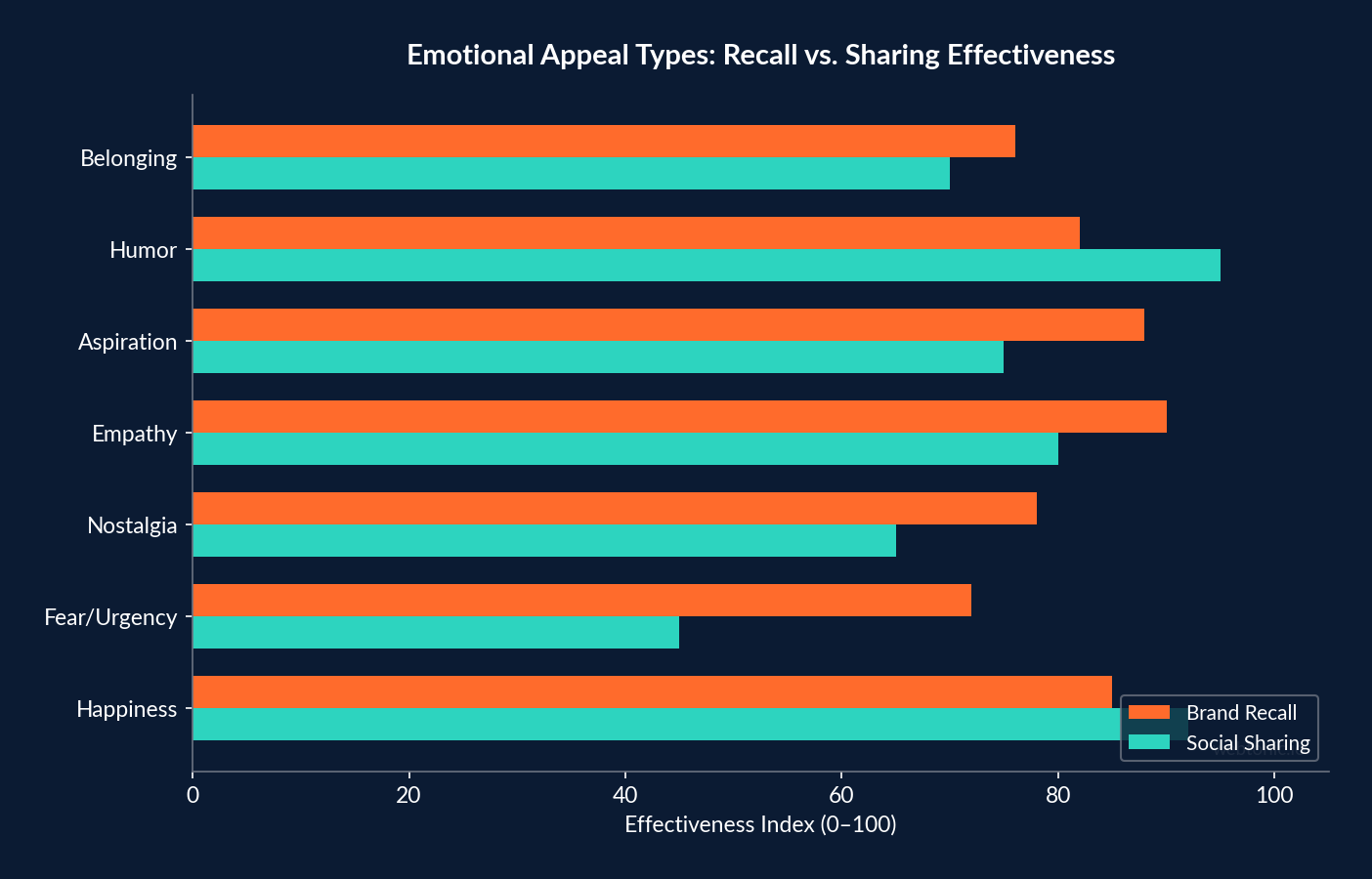
Effective emotional ads tap into specific feelings that resonate with the target audience. Each type of emotional appeal creates a different response — and not every emotion works for every brand or product. Understanding which emotional triggers align with your creative strategy is critical for campaign success.
| Emotional Appeal | How It Works | Best For | Example Brand |
|---|---|---|---|
| Happiness | Associates the brand with joy, celebration, and positivity | FMCG, lifestyle, social occasions | Coca-Cola ("Open Happiness") |
| Fear & Urgency | Makes threats visceral to motivate protective action | Insurance, public health, cybersecurity | WWF (environmental campaigns) |
| Nostalgia | Links the product to cherished memories and simpler times | Heritage brands, family products, holidays | Kodak, Volkswagen ("The Force") |
| Sadness & Empathy | Creates compassion that drives donations or brand trust | Nonprofits, healthcare, social causes | Google ("Reunion") |
| Aspiration | Inspires the audience to become a better version of themselves | Sportswear, education, luxury, tech | Nike ("Just Do It") |
| Humor | Entertains to increase recall and shareability | Consumer tech, food & beverage, casual brands | Old Spice ("The Man Your Man Could Smell Like") |
| Belonging | Taps into the desire to be part of a community or movement | Social platforms, membership brands, causes | Apple ("Think Different") |
Emotional vs. Rational Advertising: The Data
The debate between emotional and rational advertising has been settled by data, not opinion. The IPA (Institute of Practitioners in Advertising) databank — containing 1,400+ case studies over 30 years — provides the most robust evidence available:
- Purely emotional campaigns: 31% profitability gains
- Purely rational campaigns: 16% profitability gains
- Combined emotional + rational: highest overall effectiveness
The superiority of emotional advertising extends beyond profitability. Nielsen's neuroscience-based copy testing of 100 FMCG ads found that emotional ads generate a 23% lift in sales volume. The effect compounds because emotional memories are encoded differently in the brain — they are more durable, more easily retrieved, and more likely to influence future behavior.
However, the strongest long-term results come from campaigns that blend emotional storytelling with rational proof points. A 2025 study of 5,400 respondents confirmed that emotional advertising produces greater recall and trust, but consumers still want factual support — especially for high-involvement purchases. The practical takeaway: lead with emotion, then substantiate with evidence.
| Metric | Emotional Campaigns | Rational Campaigns | Combined Approach |
|---|---|---|---|
| Profitability Gain | 31% | 16% | Highest overall |
| Sales Volume Lift | 23% (above-average emotional response) | Lower lift | Strong |
| Brand Recall | Higher — emotional memories more durable | Moderate | Highest |
| Shareability | High — positive emotions drive sharing | Low | High |
| Purchase Intent | Strong for low-involvement | Stronger for high-involvement | Strongest across both |
| Long-Term Brand Effect | Strongest — builds brand equity over time | Weakest | Strong |

How Emotional Advertising Influences Consumer Behavior
Emotional appeal ads influence consumer behavior through three psychological mechanisms that create lasting brand associations and drive purchase decisions:
1. Emotional encoding strengthens memory. The amygdala tags emotionally charged experiences as significant, causing the brain to store them with greater fidelity and retrieve them more easily. This is why consumers remember a Nike empowerment commercial years after viewing it but forget a spec-sheet comparison ad within hours.
2. Emotions bypass rational gatekeeping. Emotional triggers activate fast, automatic cognitive processing (System 1 in Daniel Kahneman's framework) before the analytical mind (System 2) can intervene. This makes emotional ads especially effective for impulse-driven and brand-switching decisions.
3. Social sharing amplifies reach. Research by Wharton's Jonah Berger found that positive, high-arousal emotions — excitement, awe, amusement — drive the highest sharing rates on social media. Brands like Coca-Cola and Google engineer their creative ads to trigger these specific emotions because shared content earns free distribution.
Best Practices for Creating Emotional Ad Campaigns
Building effective emotional advertising campaigns requires more than picking an emotion and writing a script. These six practices, drawn from the most successful campaigns across industries, help brands connect authentically:
- Know your audience's emotional triggers. Emotional triggers that resonate with the target audience vary by demographic, culture, and context. What inspires a 22-year-old athlete (aspiration) differs from what moves a 55-year-old parent (nostalgia, family). Conduct qualitative research — interviews, focus groups, social listening — to identify which emotions create the strongest brand loyalty.
- Use real human faces. Ads featuring authentic human expressions generate higher emotional responses than abstract imagery or product shots. Eye contact, genuine smiles, and tears create mirror-neuron activation that causes viewers to feel what the subject feels.
- Lead with story, not product. Google's "Reunion" ad never demonstrated a feature. It told a story of two childhood friends separated by the India-Pakistan border who use Google Search to reconnect. The product was the enabler, not the hero. This structure makes the emotional connection to the brand implicit and more powerful.
- Pair emotion with a clear CTA. Emotion without direction dissipates. Every emotional appeal in advertising should channel the feeling toward a specific action — a purchase, a share, a sign-up. The CTA should feel like the natural resolution of the emotional arc, not an interruption.
- Test emotional intensity. Fear-based advertising follows a U-shaped effectiveness curve: moderate fear motivates, but extreme fear causes avoidance. Test different intensities with focus groups or A/B tests to find the threshold where emotion drives action without overwhelming the audience.
- Measure beyond clicks. Emotional campaign effectiveness should be measured through brand lift studies, aided and unaided recall, sentiment analysis, and long-term sales impact — not just click-through rates. Google's most emotionally resonant campaigns often have low direct CTR but massive brand equity impact.

Iconic Emotional Advertising Campaigns
Studying the most successful emotional marketing campaigns reveals patterns that any brand can adapt — regardless of budget or industry.
Nike — "Just Do It" and "Dream Crazy": Nike's advertising emotional appeal centers on aspiration and empowerment. The "Dream Crazy" campaign featuring Colin Kaepernick generated $6 billion in brand value despite initial controversy. The emotional connection with consumers who identified with the message of perseverance drove both social sharing and sales — proving that emotional appeals in advertising can create brand loyalty even when polarizing.
Coca-Cola — "Share a Coke": By printing real names on bottles, Coca-Cola transformed a mass-produced product into a personal gift. The campaign generated billions of social media impressions as consumers photographed and shared their personalized bottles. The emotions — happiness, nostalgia, belonging — turned a $0.99 beverage into an emotional experience.
Google — "Reunion": A three-minute film with no product demonstration, no voiceover, and no call-to-action beyond feeling. It showed two childhood friends separated by the India-Pakistan partition using Google Search to find each other. The ad crossed 2 million views in days and is studied in advertising schools worldwide as the definitive example of emotional product demonstration.
Frequently Asked Questions
What are emotional appeals in advertising?
Emotional appeals in advertising are persuasion techniques that target the audience's feelings — happiness, fear, nostalgia, empathy, aspiration, or humor — rather than presenting logical arguments or product features. They work by creating an emotional connection between the consumer and the brand, which drives recall, trust, and purchase intent more effectively than rational appeals alone. The IPA databank shows emotional campaigns deliver 31% profitability gains versus 16% for rational campaigns.
Why is emotional advertising more effective than rational?
Emotional advertising is more effective because emotions are processed faster than logic, create stronger and more durable memories, and drive sharing behavior that amplifies reach. Neuroscience research confirms that emotional memories are encoded more deeply by the amygdala, making emotional ads more easily recalled during purchase decisions. However, the most effective campaigns combine emotional storytelling with rational proof points — particularly for high-involvement products where consumers need factual justification.
How do you measure the effectiveness of emotional ads?
Measure emotional ad effectiveness through brand lift studies (aided and unaided recall), sentiment analysis, social sharing metrics, and long-term sales impact. Short-term metrics like click-through rate undervalue emotional campaigns because their primary benefit is brand equity and recall, which convert over weeks and months rather than immediately. Nielsen recommends neuroscience-based copy testing to quantify emotional response intensity before launch.
What is the difference between pathos and emotional appeal?
Pathos and emotional appeal are the same concept in different frameworks. Pathos is Aristotle's term for the persuasive mode that appeals to emotions, alongside ethos (credibility) and logos (logic). "Emotional appeal" is the modern marketing term for the same strategy. Both describe the practice of using feelings — not facts — to persuade. Advertising campaigns that use pathos create emotional connections through storytelling, imagery, and music to influence consumer behavior.
Can emotional advertising backfire?
Yes. Emotional advertising can backfire when the emotional trigger feels manipulative, when it is misaligned with the brand identity, or when the intensity is too high. Fear-based ads follow a U-shaped curve — moderate fear motivates action, but extreme fear causes viewers to shut down and disengage. Brands that attempt emotional campaigns without authenticity risk being perceived as exploitative, which damages trust. Always test emotional intensity with target audiences before broad launch.
Sources
advergize.com/emotional-advertising-examples
doi.org/10.36948/ijfmr.2025.v07i05.57059
studiobinder.com/blog/pathos-definition-examples
springer.com — emotional vs rational advertising research
markhub24.com — Google Year in Search


