Table of contents
Only 42% of websites pass all three Core Web Vitals and median mobile LCP is 3.8 seconds — on a page whose visitor is standing outside a locked door at 9 PM. For locksmiths, technical SEO is conversion work. Here is the 2026 data.
Key Takeaways
- 42% of websites pass all three Core Web Vitals; by metric, CLS 74%, INP 65%, LCP 58%.
- A June 2026 CrUX reading puts mobile pass rates at 51.3% and desktop at 67.8%.
- Median LCP is 3.8s on mobile versus 2.1s on desktop — an 81% gap.
- The median top-10 Google result loads in 1.65 seconds; the top 3 average 1.4s.
- 53% of mobile visitors abandon pages that take longer than 3 seconds.
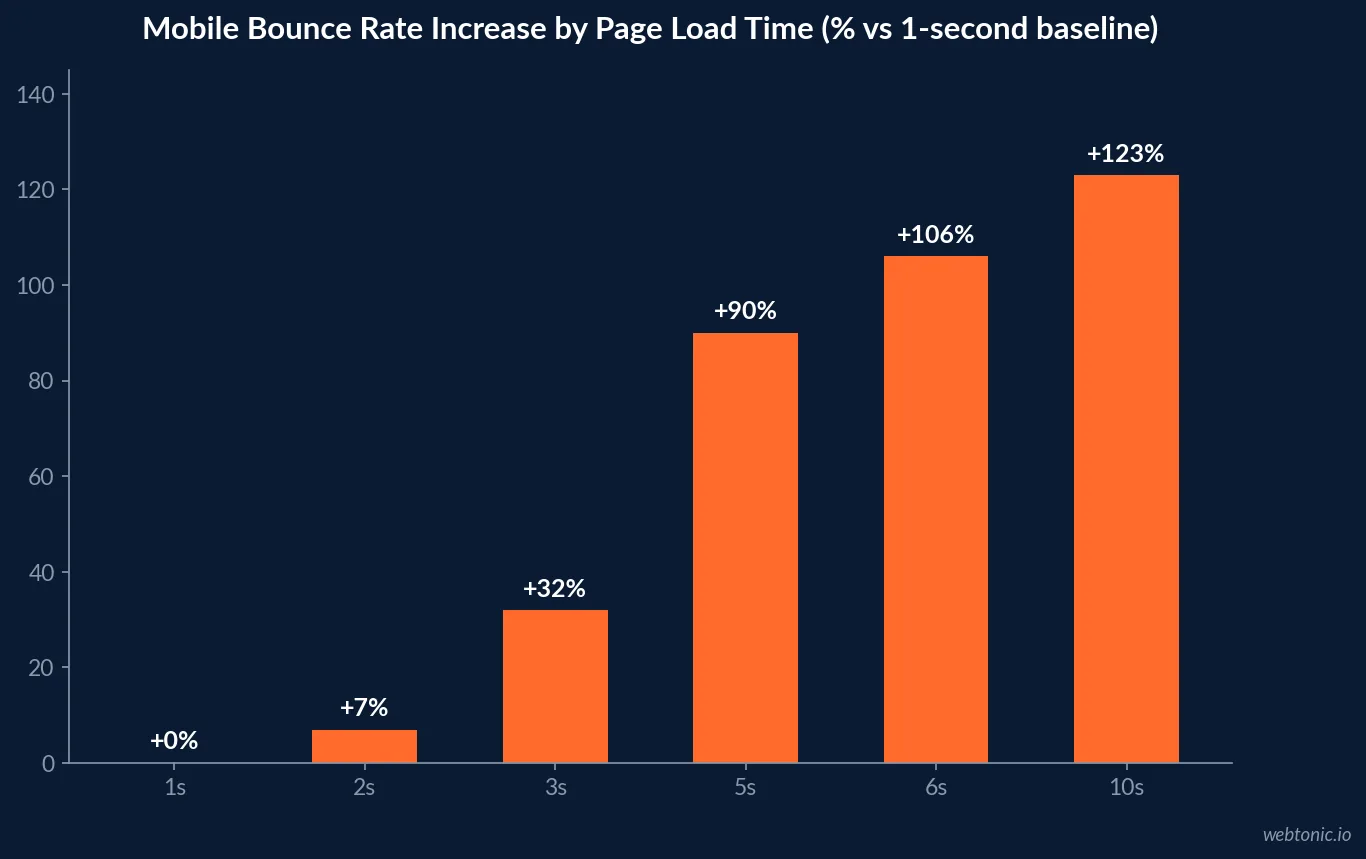
- Bounce rate rises 32% at 3 seconds, 90% at 5 seconds and 123% at 10 seconds versus a 1-second baseline.
- Each extra second of load time costs roughly 7% of conversion rate.
- 60–64% of emergency locksmith searches are mobile, rising above 80% for "locked out" queries.
- Average mobile bounce rate is 51% against 41% on desktop.
- 71% of sites deploy schema but only 22% validate cleanly — a 49-point gap.
- Clean schema validation correlates +0.34 with AI-search citation rate.
- Controlled testing found LocalBusiness schema did not move SERP or Maps rank.
- Only 45.9% of crawler requests return a 200; 403s are 20.6% of all requests.
- A CDN cuts average TTFB by 52% and improves LCP by 33%.
- The Map Pack takes 40–55% of clicks on high-intent locksmith queries — speed protects the click you win.
Core Web Vitals: The 2026 Baseline
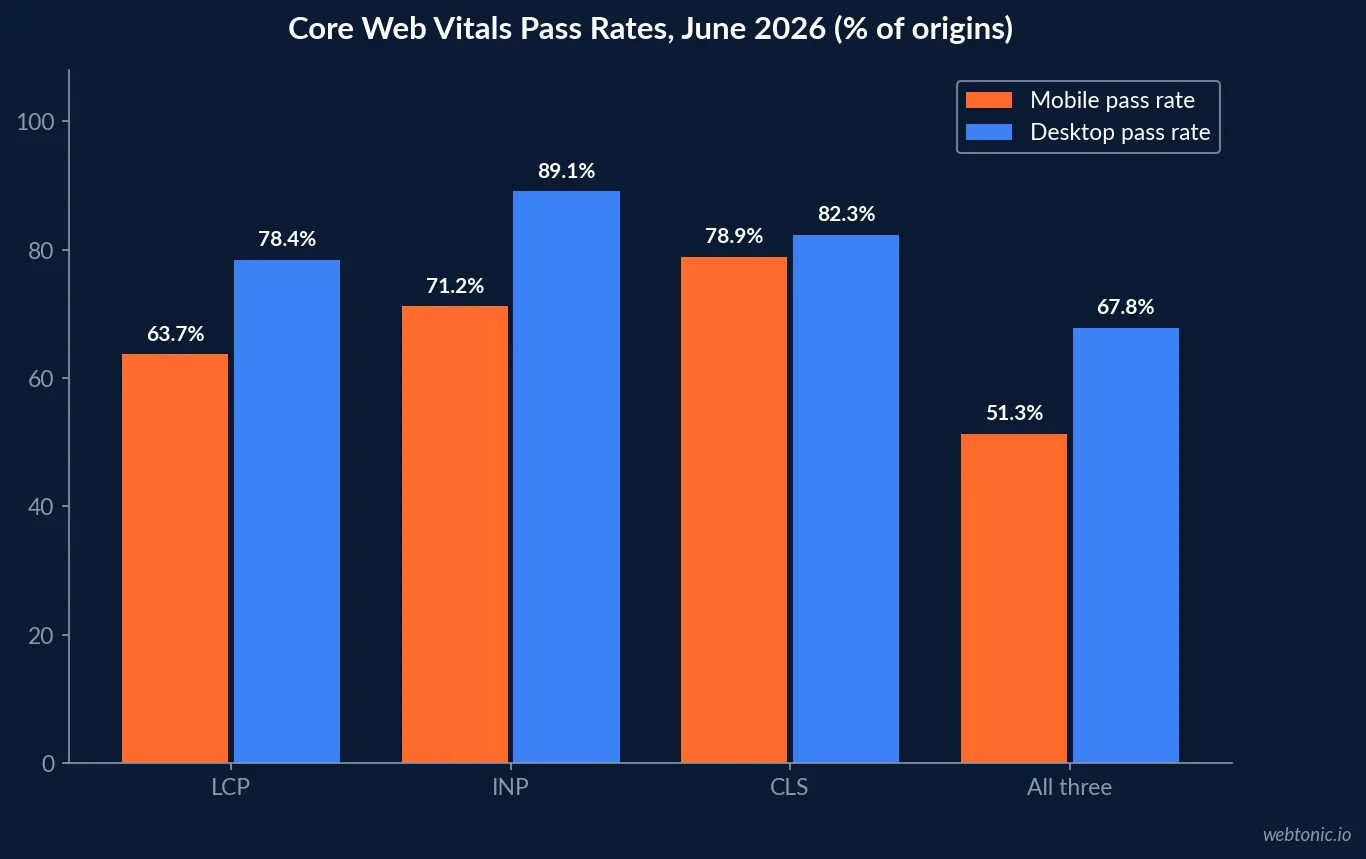
Two credible 2026 readings, two different numbers, one conclusion. Searchlab’s compilation of HTTP Archive and Chrome UX Report data puts 42% of websites passing all three Core Web Vitals. JustAnalytics’ June 2026 CrUX analysis reports 51.3% of origins passing on mobile and 67.8% on desktop, up from 43.2% mobile a year earlier. The datasets differ in scope; both agree LCP is the bottleneck.
| Metric | Threshold (good) | Pass rate — all devices | Pass rate — mobile (Jun 2026) |
|---|---|---|---|
| LCP | ≤ 2.5s | 58% | 63.7% |
| INP | ≤ 200ms | 65% | 71.2% |
| CLS | ≤ 0.1 | 74% | 78.9% |
| All three | — | 42% | 51.3% |
| All three — desktop | — | — | 67.8% |
Two supporting figures worth quoting in a budget conversation: pages with good CWV scores rank in the top 10 73% of the time versus 53% for poor-scoring pages, and sites that pass all three see 24% lower bounce rates. Improving LCP from 4 seconds to 2 produced a 15% conversion lift in the published Vodafone case study.
Speed Is the Locksmith Conversion Metric
Locksmith traffic is the least patient traffic in local search. BizIQ’s 2026 locksmith analysis reports 60–64% of emergency locksmith searches happen on mobile, climbing above 80% for critical "locked out" situations. Now overlay the abandonment curve: LogicMonitor and Digital Applied both report 53% of mobile visitors abandoning above 3 seconds, with bounce probability up 123% by 10 seconds.
| Mobile load time | Bounce increase vs 1s | Approx. conversion rate | What it means at 100 emergency sessions |
|---|---|---|---|
| 1 second | Baseline | ~3.2% | Best case; matches top-3 rankings |
| 2 seconds | +7% | ~2.9% | Acceptable ceiling for an emergency page |
| 3 seconds | +32% | ~2.4% | 53% of mobile visitors already gone |
| 5 seconds | +90% | ~1.1% | Roughly two-thirds of the calls lost |
| 6 seconds | +106% | <1% | Paid clicks funding a bounce |
| 10 seconds | +123% | <1% | Effectively offline |
The competitive bar is public: the median top-10 Google result loads in 1.65 seconds, top-3 results in 1.4 seconds. Median mobile TTFB is 1.4 seconds against 0.8s desktop, and a CDN cuts TTFB by 52% on average while improving LCP 33% — usually the single cheapest fix for a small trade site on shared hosting.
Mobile-First Indexing and the Click-to-Call Path
Google has indexed the mobile version of every site since July 2024, and 63.4% of web traffic is mobile. Two failure modes still cost locksmiths calls. Sites missing a viewport meta tag are treated as not mobile-friendly and lose an average of 34% of mobile rankings. Touch targets spaced closer than 48px are the #1 mobile usability error in Search Console, reported on 23% of scanned sites — which is precisely the bug that turns a tel: button into a mis-tap.
Average mobile bounce sits at 51% versus 41% on desktop, a gap largely attributable to load time. And 82% of mobile searchers use "near me" at least weekly, so the mobile template is the emergency template. Build every city page around one thumb-reachable call button, a visible service area, and a headline that names the city.
Structured Data: Deployed vs Valid
The 2026 schema story is a quality story. A 5,000-site audit published in April 2026 found 71% of sites deploy at least one schema type while only 22% pass Google’s Rich Results Test cleanly across every type they emit — a 49-point gap. Clean validation correlated +0.34 with AI-search citation rate, and Article plus BreadcrumbList together produced a +47% citation lift versus no schema.
Temper that with the control group. A 10-week test running February to April 2026 found LocalBusiness schema did not affect SERP rank or Google Maps rank — but did affect how AI systems described the business. That is the right expectation to set with a shop owner: schema is not a ranking lever, it is a machine-readability lever.
| Schema type | Adoption (5,000-site audit) | Locksmith priority | Why |
|---|---|---|---|
| Organization | 61% | High | Entity baseline for AI answers |
| LocalBusiness | Baseline tier | High | Hours, service area, NAP — no rank effect |
| WebPage | 54% | Medium | Page-level context |
| BreadcrumbList | 38% | High | +47% citation lift when paired with Article |
| Service | Long tail | High | Rekey, lockout, transponder as entities |
| FAQPage | Long tail | High | Matches voice and AI query patterns |
| Article | 29% | Medium | Blog and guide content only |
Common errors are boringly preventable: missing required properties (38% of error pages), invalid ISO-8601 dates (24%), wrong @type for the content (12%), missing image dimensions (9%) and duplicate @id values (7%). One validator in the deploy pipeline eliminates all five.
Crawling and Indexing: Waste, Not Budget
SEOmator’s July 2026 crawl waste report, built on Cloudflare Radar data, found only 45.9% of crawler requests return a 200. 403 Forbidden is the largest non-200 bucket at 20.6%, followed by 301s at 8.0% and 404s at 7.8%. Verified AI bots get a 200 back 73.0% of the time while non-AI bots — SEO tools, scrapers, monitors — get one only 33.3% of the time.
Crawl budget itself is not a locksmith problem: the pages-per-day ceiling only bites above roughly 10,000 URLs. What is a problem is a security plugin or WAF handing out 403s, a chain of city-page redirects left over from a rebuild, or JavaScript that hides the phone number from the rendering stage. Google’s own crawler documentation notes rendering executes JavaScript and CSS with a 2MB limit per requested resource — so anything critical belongs in the server-rendered HTML.
Why Technical SEO Now Doubles as AI Visibility
Authority Specialist’s locksmith study (40 standardised questions across three models, July 2026) found an 82.2% AI Recommendation Index for locksmith queries — how often ChatGPT, Claude and Gemini tell buyers to hire a professional, against a 14-industry average of 44.2%. Yet the same study found models almost never name a specific provider. The naming slot is open, and the entry ticket is machine-readable facts: valid schema, consistent NAP, crawlable service pages.
The same research puts the Map Pack at 40–55% of clicks on high-intent queries such as "locksmith near me", with emergency keywords converting 3–5× better than informational ones. Technical SEO does not win those clicks — it stops you from wasting them.
The Locksmith Technical SEO Checklist
- Get emergency and city pages under 2 seconds mobile LCP — the top-10 median is 1.65s.
- Put a
tel:button above the fold on every mobile template with 48px+ touch spacing. - Serve WebP or AVIF — 30–50% smaller than JPEG/PNG, and images are 48% of page weight.
- Add a CDN: −52% TTFB, +33% LCP on average.
- Ship LocalBusiness + Service + FAQPage schema and validate every type — only 22% of sites do.
- Audit for 403s and redirect chains monthly; 403s are 20.6% of all crawler requests web-wide.
- Confirm the phone number and service area exist in server-rendered HTML, not JS-injected.
- Verify a viewport meta tag on every template — missing it costs about 34% of mobile rankings.
- Track INP, not just LCP: 35% of sites that passed FID now fail INP.
- Re-test after every plugin or theme update; page weight rose 18% since 2023 to 2.3MB average.
For the demand side of the same site, see our locksmith local SEO statistics and locksmith SEO benchmarks. Conversion mechanics on the page itself are covered in locksmith landing page statistics, and the channel mix in locksmith digital marketing statistics. Measurement plumbing lives with our data intelligence team.
Frequently Asked Questions
What is the most important technical SEO metric for a locksmith site?
Mobile Largest Contentful Paint on the emergency landing page. Between 60 and 64 percent of emergency locksmith searches happen on a phone, and that figure climbs above 80 percent for 'locked out' queries. Median mobile LCP across the web is 3.8 seconds versus 2.1 seconds on desktop, and 53 percent of mobile visitors abandon a page that takes longer than 3 seconds. The pages that rank also load fast: the median load time of a Google top-10 result is 1.65 seconds. Get the emergency page and every city page under 2 seconds before touching anything else.
How many websites pass Core Web Vitals in 2026?
It depends on the dataset and the device. HTTP Archive and Chrome UX Report figures compiled in March 2026 put 42 percent of websites passing all three Core Web Vitals, with individual pass rates of 74 percent for CLS, 65 percent for INP and 58 percent for LCP. A June 2026 CrUX analysis reports 51.3 percent of origins passing all three on mobile and 67.8 percent on desktop, up from 43.2 percent on mobile a year earlier. Both readings agree on the important part: LCP is the hardest metric to pass and the one that drags overall scores down.
Does schema markup help a locksmith rank?
Not directly for Map Pack position, but it matters for how machines describe you. A 10-week controlled study published in June 2026 found LocalBusiness schema did not move classic SERP or Google Maps rank. A separate 5,000-site audit in April 2026 found 71 percent of sites deploy at least one schema type while only 22 percent pass Google's Rich Results Test cleanly, and measured a +0.34 Pearson correlation between clean validation and AI-search citation rate. Valid schema is an AI-visibility and rich-result play, not a ranking shortcut.
Does crawl budget matter for a small locksmith site?
Almost never. Crawl budget becomes a real constraint above roughly 10,000 URLs; a locksmith site with 30 to 300 pages is normally crawled fully. What does hurt small sites is crawl waste in the form of 403s, redirect chains and soft 404s. Across the web only 45.9 percent of crawler requests return a 200, 403 Forbidden accounts for 20.6 percent and 404s for 7.8 percent. The locksmith-specific risk is a bot-blocking WAF or an aggressive security plugin quietly refusing Googlebot on city pages.
What technical fixes convert the most locksmith traffic?
Four, in order. A tel: click-to-call button above the fold on every mobile template, because the emergency journey ends in a phone call rather than a form. Sub-2-second LCP on the emergency and city pages, since each extra second costs roughly 7 percent of conversion rate. Valid LocalBusiness, Service and FAQPage schema with real hours and service-area data. And a crawl-clean site: no blocked resources, no redirect chains, canonical tags that agree with the internal link graph.
Sources
Searchlab — Technical SEO Statistics 2026
JustAnalytics — Core Web Vitals Statistics 2026
Digital Applied — Page Speed Statistics 2026
Digital Applied — Schema Markup Adoption: 5,000-Site Audit
Evergrow Marketing — How Schema Affects Google and AI
SEOmator — Crawl Waste Report 2026
Google Search Central — Inside Googlebot
BizIQ — SEO for Locksmiths 2026
Authority Specialist — Locksmith SEO Benchmarks 2026
LogicMonitor — Web Performance Statistics 2026