Table of contents
Locksmith attribution is a phone problem, not an analytics problem. 60–80% of home-services leads arrive as calls, 34% of locksmith calls go unanswered, and 39% land after 6 PM — which turns a $34 lead into a $52 answered lead. Here is the 2026 data.
Key Takeaways
- 60–80% of home-services leads come by phone, not by web form.
- Median locksmith miss rate: 34% in 2026, down from 38% in 2024.
- 39% of locksmith calls arrive between 6 PM and midnight; 8 PM is the busiest hour.
- A 9-to-5 dispatch schedule covers only 39% of call volume; 8 AM–8 PM covers 65%.
- Locksmith Local Services Ads cost per lead: $34 average, up 21% YoY (from $22 in 2024).
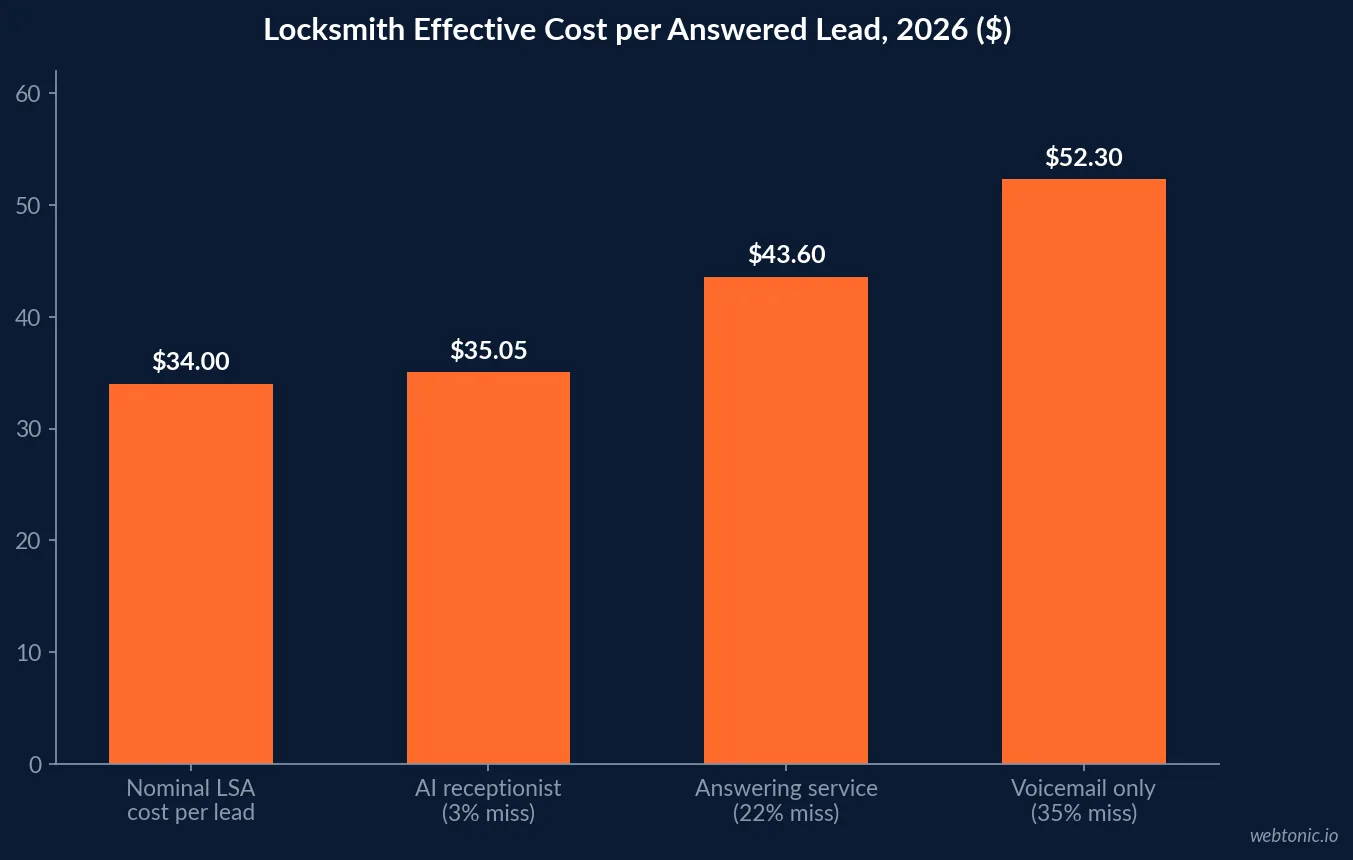
- Effective cost per answered lead at a 35% miss rate: $52.30 versus $35.05 at 3%.
- 84% of contractors cannot state their cost per lead by source.
- Only 56% of calls to businesses reach a person; 86% of callers refuse voicemail.
- 38% of answered home-services calls are genuine leads; 45% of those convert on the call.
- Locksmiths post the highest LSA booking rate of 24 trades at 55%.
- Call attribution recovers 15–25% of disputed LSA charges.
- Multi-touch attribution adoption reached 47% in 2026, up from 31% in 2023.
- Aggregator platforms take 25–35% of the ticket — $54–$75 on a $215 lockout.
- Call tracking runs $30–$215/month; conversation intelligence adds $60–$110.
1. The Attribution Gap Starts With the Phone
Every measurement problem in this trade traces back to one fact: the conversion is a voice call, and voice calls do not fire GA4 events on their own. Contractor attribution research puts 60–80% of home-services leads on the phone rather than a web form, which means a form-only setup measures the minority of demand and then optimises bids against it.
PipelineOn’s 2026 call-tracking analysis quantifies the consequence bluntly: 84% of contractors cannot tell you their cost per lead by marketing source. They know the monthly spend and the job count; they cannot say whether the $72 Performance Max call closed at 22% and the $149 non-branded search call closed at 41%, or the reverse. For locksmiths the stakes are sharper than for most trades because ticket values differ by a factor of three between a lockout and a transponder key.
| Attribution reality | 2026 figure | Why it matters for a locksmith |
|---|---|---|
| Share of leads by phone | 60–80% | Form-only tracking measures the minority of revenue |
| Contractors who know CPL by source | 16% | Budget decisions are made on blended averages |
| Calls answered by a person | 56% | Rises to 65% for calls over 15 seconds |
| Callers who refuse voicemail | 86% | A missed call is a lost lead, not a delayed one |
| Answered calls that are real leads | 38% | Raw call volume overstates lead volume |
| Home-services phone leads closing on the call | 45% | The call itself is the conversion event |
2. The 8 PM Problem
Locksmith demand does not respect office hours. Platform data across 240+ shops shows 39% of all inbound calls landing between 6 PM and midnight, with 8 PM as the single busiest hour of the day — not anything inside the traditional workday. After-hours share has climbed from 34% in 2024 to 39% in 2026.
That distribution has a direct measurement consequence. A traditional 9-to-5 dispatcher schedule covers roughly 39% of call volume; an extended 8 AM–8 PM model covers about 65%. Everything above that requires either rotating human coverage or an automated receptionist. Whatever is not covered still shows up in the ad platform as a click you paid for, so your reported cost per lead stays flat while your real cost per booked job rises.
| Coverage model | Share of calls reachable | Median miss rate | Effective cost per answered lead |
|---|---|---|---|
| Voicemail only | ≈39% | 35% | $52.30 |
| Extended hours (8 AM–8 PM) | ≈65% | 22% | $43.60 |
| Answering service / rotation | Near 100% | 22% | $43.60 |
| AI receptionist | 100% | 3% | $35.05 |
The industry is already moving. Median miss rate fell from 38% (2024) to 36% (2025) to 34% (2026), driven mostly by AI-receptionist adoption among shops running three or more trucks — about 15% of that cohort in mid-2026, roughly 3.7× the 2024 rate.
3. What a Missed Call Costs Before Any Job Value
Treat the lead fee as sunk and the arithmetic gets uncomfortable. Locksmith Local Services Ads cost per lead has moved from roughly $22 in mid-2024 to $34 in mid-2026 — up 21% year over year and about 55% across two years. At a 35% miss rate, each answered lead really costs $52.30. Halve the miss rate and you have cut acquisition cost more cheaply than any bid adjustment could.
Broader home-services research is harsher still: CallJolt’s 2026 compilation reports 62% of home-service calls going unanswered and 86% of voicemail-reached callers hanging up without leaving a message, with 76% of the week (128 of 168 hours) falling outside standard business hours. Speed matters as much as coverage: conversion holds near baseline inside five minutes, drops to roughly 15% of baseline at 10–30 minutes, and falls below 5% after half an hour.
| Response time | Relative conversion rate | Attribution consequence |
|---|---|---|
| Under 1 minute | 100% (baseline) | Source credit is clean and immediate |
| 1–5 minutes | ≈95% | Still attributable to the originating click |
| 5–10 minutes | ≈40% | Caller is dialling competitors in parallel |
| 10–30 minutes | ≈15% | Credit often lands on the competitor's channel |
| 30+ minutes | Under 5% | Spend recorded, revenue never appears |
| Voicemail callback | Under 3% | Lead fee paid, conversation never happens |
4. Dynamic Number Insertion Is the Whole Foundation
Dynamic number insertion (DNI) is the mechanism that makes locksmith cost per lead calculable at all. A snippet reads the visitor’s source — UTM parameters, referring URL, Google click ID, organic query — and swaps the displayed number for a tracking number tied to that source. Every ring hits the same business line; the dashboard sees distinct source tags.
Without DNI you have one number and an opinion. With it you get a row that reads "9:22 call, source: Google Ads, campaign: Lockout-Emergency-Phoenix, keyword: car key replacement" — and, once joined to the job ticket, a real cost per booked job. Pair it with the fundamentals in our locksmith Google Ads benchmarks and the local-pack behaviour covered in our locksmith local SEO data.
| Platform | 2026 entry price | Top tier | Best fit |
|---|---|---|---|
| WhatConverts | $30/mo | $159/mo | Pure attribution, no contact centre |
| CallRail | $55/mo | $215/mo | Default for 1–10 truck shops |
| CallTrackingMetrics | $39/mo | $149–$499/mo | 4+ CSRs, IVR and routing |
| Conversation intelligence add-on | +$60–$110/mo | — | Booked-rate visibility (+30–50%) |
Two 2026 details are easy to miss. First, AI conversion scoring — separating a real lead from a price shopper, a wrong number or a billing question — now runs at roughly 85–92% accuracy across the major platforms. Second, per-minute and per-number overages can add 20–30% to a base subscription at 800+ calls a month, so model usage before signing.
5. Recovering Local Services Ads Charges
Attribution pays for itself fastest inside Google Local Services Ads, because the platform charges per lead and lets you dispute the bad ones. Contractors who attribute calls to source recover on average 15–25% of LSA charges through disputes — spam, wrong-area and non-service enquiries that are only provable with a recording or transcript.
The channel is worth defending. Across 9,790+ contractor accounts spanning 24 trades, locksmiths sit at a $32 median LSA cost per lead ($18–$58 range) and post the highest lead booking rate of any trade at 55% — ahead of garage door (50%) and water damage (48%). Cheap leads that book at better than one in two are exactly the leads worth measuring precisely.
| Trade | Median LSA CPL | Lead booking rate |
|---|---|---|
| Locksmith | $32 | 55% |
| Garage door | $40 | 50% |
| Water damage restoration | $85 | 48% |
| Plumbing | $38 | 42% |
| HVAC | $42 | 38% |
| General contractor | $68 | 22% |
6. Where the Revenue Data Actually Lives
Lead-level attribution is only half the job. The other half is ticket value, and locksmith tickets are not interchangeable. Rate-sheet audits put the average automotive lockout at $215 (up 8.1% YoY), a transponder key at $248 and a four-door residential rekey at $178. A campaign that produces plenty of cheap lockout calls can lose on gross profit to one producing half as many key-programming jobs.
Two leaks compound the problem. Deposits change show-up behaviour: no-show rates run 14% with no deposit collected versus 2% when one is. And aggregator platforms charge 25–35% of the ticket as a referral fee — $54 to $75 on a $215 lockout — while keeping the callback, the review and the customer relationship. The shops growing fastest in 2026 cap aggregator volume at under 30% of total leads, a decision only visible when revenue is attributed by source.

7. Why Multi-Touch Models Usually Fail Here
Industry-wide, multi-touch attribution adoption reached 47% in 2026, up from 31% in 2023, with marketing-mix modelling at 26%. That is a story about high-volume advertisers, not local trades.
As local-PPC analysis points out, most local businesses generate 20–50 conversions a month — nowhere near enough for a data-driven model to distribute credit reliably. Sophisticated calculations on insufficient data produce confident nonsense. A locksmith’s correct order of operations is: get every call attributed to a source, join it to the booked job in the CRM, push revenue back into the ad platform, and only then argue about models.
Channel-level context helps too: Invoca’s analysis of 70 million calls found ChatGPT-sourced calls carrying the highest lead rate of any channel at 49%, against a 38% cross-channel average — a signal worth capturing before it is large enough to matter, alongside the organic picture in our locksmith SEO statistics.
8. The 2026 Tracking Plumbing You Cannot Skip
Two platform changes reshaped local measurement this year. Consent Mode v2 enforcement made the ad_storage signal the single authority over data flowing into Google Ads, so a misconfigured banner silently undercounts conversions. And as of June 15, 2026, offline conversion imports and enhanced conversions for leads migrated to the Data Manager API and are blocked in the older Google Ads API — breaking any custom upload built before that date.
The practical checklist for a locksmith shop:
- DNI on every page, plus static tracking numbers on vehicles, print and Google Business Profile.
- Call recording and transcription — the evidence base for LSA disputes and booked-rate coaching.
- Offline conversion import of booked revenue, not lead counts, via the Data Manager API.
- Enhanced conversions for leads with hashed phone or email to survive cookie loss.
- One source-of-truth field in the CRM for lead source, written once at intake.
- Aggregator leads tagged separately so net margin per source is visible.
Call tracking is now mainstream rather than exotic: Mediahawk’s 2026 survey records adoption rising from 28% to 35% of marketing teams, driven by the push toward full attribution coverage. Our data intelligence service and growth marketing team build exactly this stack for trades.
9. Locksmith Attribution Versus Other Trades
Set the trade against its peers and the profile is distinctive: cheap leads, excellent booking rates, brutal timing, small tickets. That combination rewards operational attribution (answer rate, booked rate, net margin per source) far more than modelling sophistication.
| Attribution dimension | Locksmith | Home services average | Implication |
|---|---|---|---|
| Median LSA cost per lead | $32–$34 | $40–$53 | Lead volume is affordable; waste is the enemy |
| Lead booking rate | 55% | 22–50% | Answered calls convert unusually well |
| After-hours share of calls | 39% | 35–45% | Coverage is an attribution decision |
| Median miss rate | 34% | 55–65% | Better than average, still a third of demand |
| Average ticket | $178–$248 | $165–$8,200 | Low tolerance for wasted lead fees |
| Monthly conversions per shop | 20–50 | 20–500+ | Too thin for data-driven attribution |
For a broader view of the trade’s channel mix, see our locksmith digital marketing statistics. If you want this measured properly rather than estimated, talk to us.
Frequently Asked Questions
Why is attribution harder for locksmiths than for most local businesses?
Because the conversion is a phone call placed under stress, usually outside office hours. Home-services data puts 60 to 80 percent of leads on the phone rather than a web form, and locksmith platform data shows 39 percent of inbound calls arriving between 6 PM and midnight, with 8 PM the single busiest hour. A form-only measurement setup built around GA4 events therefore misses the majority of revenue, and it misses the most valuable slice of it — the emergency lockout that pays $215 on average.
What does call tracking cost a locksmith in 2026?
Between roughly $30 and $215 a month for one to three trucks. WhatConverts sits at $30 to $159 a month for pure attribution, CallRail runs $55 a month on Lead Tracking up to $215 with conversation intelligence, and CallTrackingMetrics starts near $39 and reaches $149 to $499 where contact-centre features are needed. Conversation intelligence adds roughly $60 to $110 a month on top of a base plan. Against a $34 Local Services Ads lead, one recovered job a month covers the software.
How much of a locksmith's paid spend is wasted on unanswered calls?
More than most owners assume, because the lead fee is sunk whether the phone is answered or not. Locksmith platform data reports a 34 percent median miss rate in 2026 and a $34 average Local Services Ads cost per lead, which makes the effective cost per answered lead about $52. Cutting the miss rate toward 3 to 5 percent brings that to roughly $35 — a 31 percent reduction in marginal acquisition cost without adding a dollar of ad budget.
Which attribution model should a small locksmith shop use?
A single-source, call-level model joined in the CRM — not a data-driven multi-touch model. Local advertisers generating 20 to 50 conversions a month do not have the volume to make data-driven attribution statistically stable, and multi-touch adoption sits at 47 percent industry-wide precisely because most of that adoption happens in high-volume accounts. Track source-to-booked-job with dynamic number insertion, push booked revenue back into Google Ads as an offline conversion, and revisit modelling once monthly conversions pass a few hundred.
What should be tracked beyond the lead itself?
Booked rate, ticket value and aggregator share. Locksmith rate-sheet audits put the average automotive lockout at $215, a transponder key at $248 and a four-door rekey at $178, so a channel that produces cheap lockout calls can still lose to one producing fewer key-programming jobs. Aggregator platforms take 25 to 35 percent of the ticket, which is $54 to $75 off a $215 job, and the fastest-growing shops in 2026 hold aggregator volume under 30 percent of total leads. None of that is visible in a platform dashboard.
Sources
TheKeyBot — State of the Locksmith Industry 2026
PipelineOn — Contractor Call Tracking Insights 2026
Invoca — 70 Million Phone Conversations, 2026 Report
CallJolt — Home Service Missed Call Statistics 2026
SkillMammoth — Marketing Attribution for Contractors 2026
Digital Applied — Marketing Attribution Statistics 2026
Clicks Geek — Marketing Attribution Challenges
Blue Grid Media — LSA CPL by Industry, 2026 Dataset
Google Ads Help — Enhanced Conversions & Data Manager API
Mediahawk — State of Call Tracking 2026