Table of contents
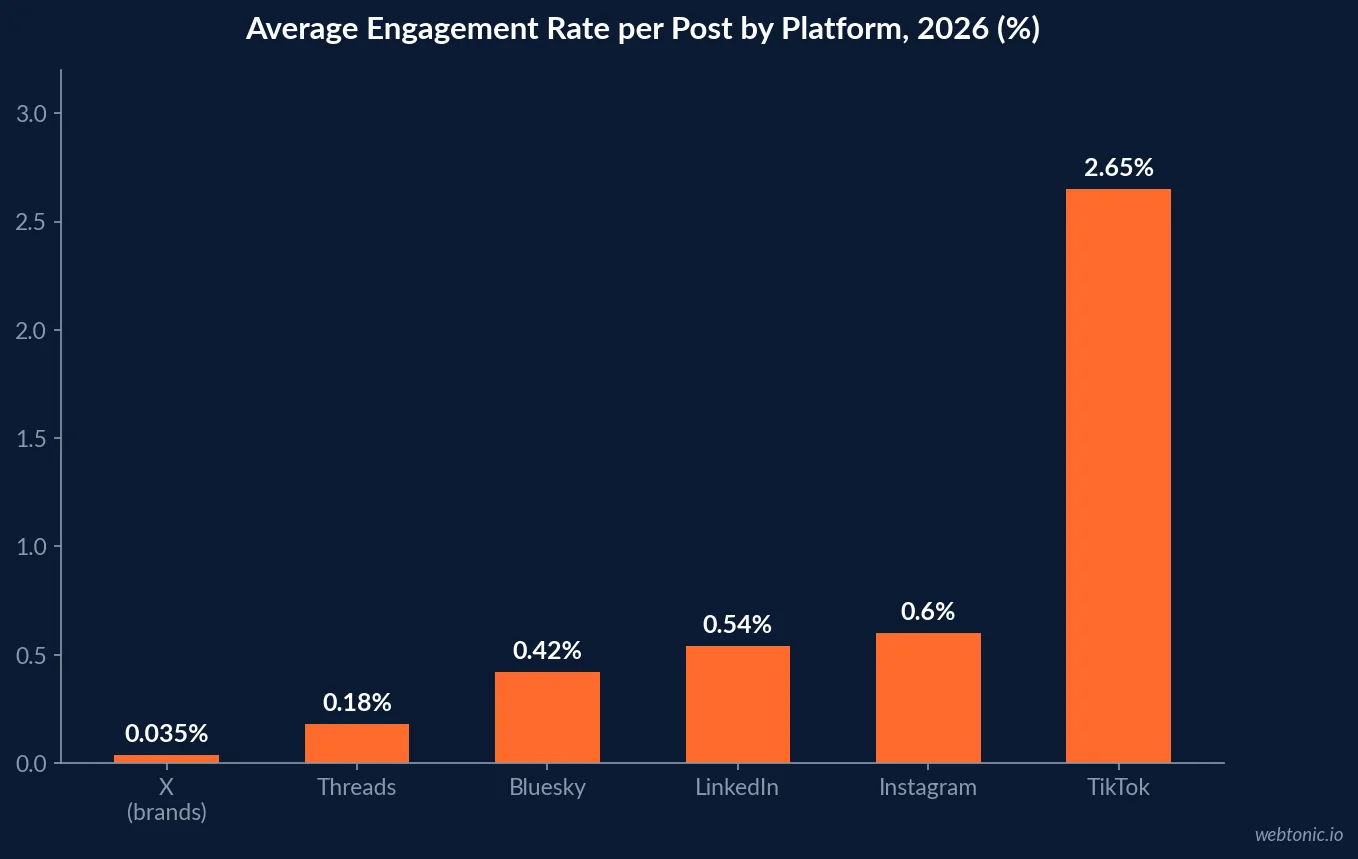
X sells the cheapest impressions in paid social — a $5.65 CPM, down 38% since 2022 — and posts the lowest engagement rate of any major platform at 0.035%. For a locksmith that narrows the platform to two jobs: keyword-triggered capture and public service response. Here are the 2026 numbers.
Key Takeaways
- X has 611 million monthly active users in 2026, up 4.3% YoY, with 95.4M in the US.
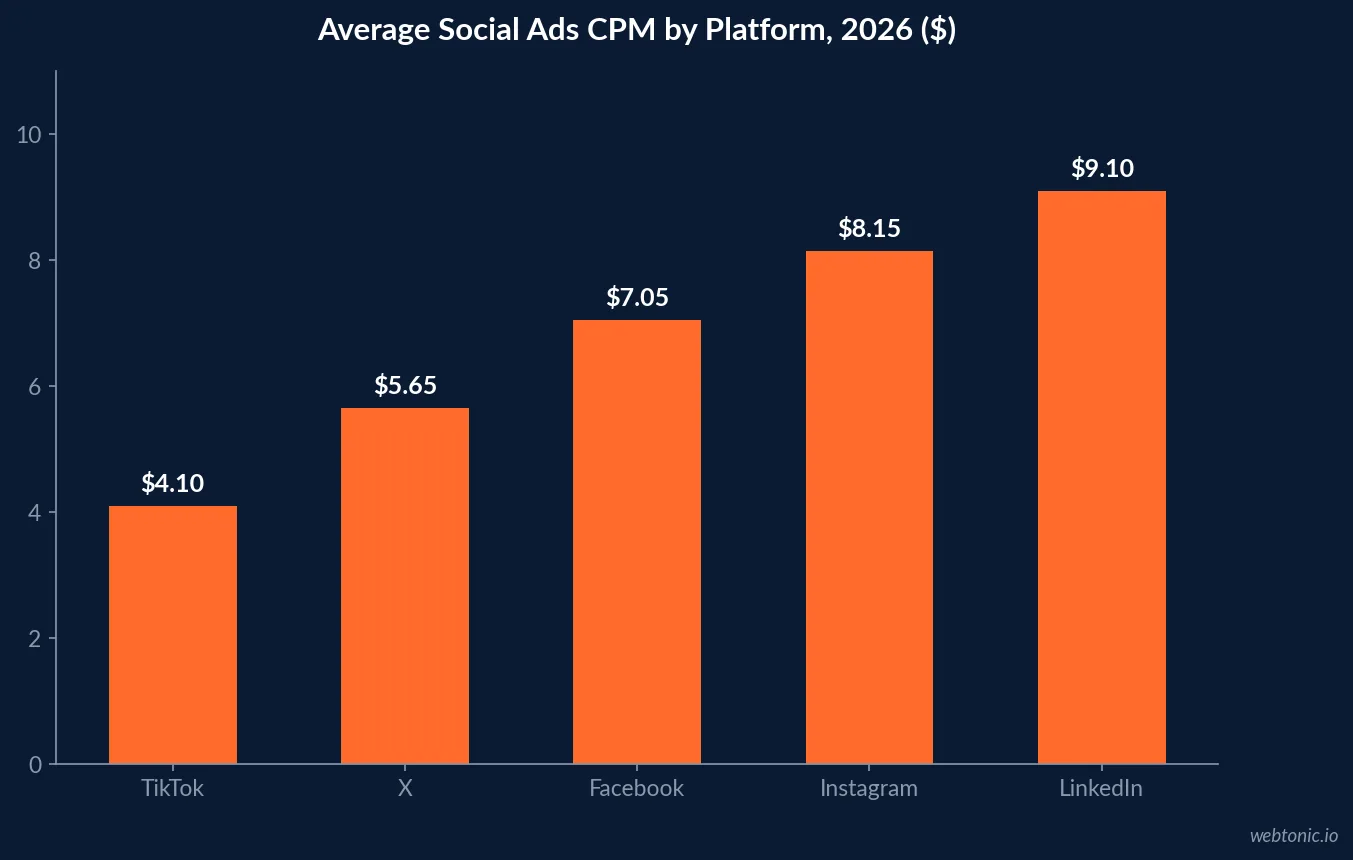
- Average CPM is $5.65 vs Instagram $8.15, LinkedIn $9.10, TikTok $4.10 — and down 38% since 2022.
- Average CPC is $0.74 across a $0.27–$1.95 band; service-business consultants report $0.80–$2.50.
- Average CTR is 0.86%; promoted video reaches 1.24%.
- Lead-gen conversion rate is 0.77% and average CPL is $41 — vs $34 for a median locksmith LSA lead.
- Marketers report 34% lower lead quality on X than LinkedIn.
- Keyword targeting delivers ~31% higher CTR than interest targeting — the one locksmith-relevant edge.
- Brand engagement rate is 0.035%, down 28% since 2023; video posts perform 3.1× text.
- 47% of users are lurkers and 20% of users produce 98% of posts.
- 82% of X traffic is mobile; average session time is 34 minutes/day.
- 68% of users live in urban areas — the highest share of any major platform.
- 78% of businesses on X use it for customer service; average response time 2.8 hours.
- 61% of consumers expect a reply within 1 hour; 31% of business interactions happen in DMs.
- 52% of advertisers cut or stopped X spend; 18% increased it on cheap CPMs.
- Ad revenue is roughly $2.5B in 2026, about half the 2021 peak; Promoted Trends cost $100K–$250K/day.
The 2026 Cost Picture: Cheapest Inventory, Weakest Signal
SearchLab’s 2026 compilation of eMarketer, Hootsuite and Wordstream benchmarks puts average X CPM at $5.65 and average CPC at $0.74 inside a $0.27–$1.95 range. Consultant benchmarks for service businesses read materially higher — $8–$15 CPM and $0.80–$2.50 CPC — because they exclude the broad awareness inventory that drags the platform average down. Both numbers are true; the gap is the difference between buying reach and buying clicks with intent.
| Metric | X (2026) | Comparison | What it means for a locksmith |
|---|---|---|---|
| CPM | $5.65 | IG $8.15 / LinkedIn $9.10 / TikTok $4.10 | Cheap metro reach, low attention |
| CPC | $0.74 (band $0.27–$1.95) | Service-business reads $0.80–$2.50 | Traffic is affordable, intent is thin |
| CTR | 0.86% | Facebook 0.90%, Pinterest 1.16% | Promoted video best at 1.24% |
| Lead-gen CVR | 0.77% | Facebook 1.11%, Google Search 3.75% | Expect 4–5× more clicks per lead than search |
| Cost per lead | $41 | LinkedIn $82, Facebook $24, TikTok $20 | Above the $34 median locksmith LSA lead |
| Lead quality | −34% vs LinkedIn | — | Qualify before counting a lead |
| Promoted Trends | $100K–$250K/day | — | Not a local-business product |
Why the Cheap CPM Exists
The discount is not a bargain the platform engineered — it is what an advertiser exodus looks like in an auction. 52% of advertisers who ran on the platform pre-acquisition reduced or stopped spend, and CPM has fallen 38% since 2022. Ad revenue sits at roughly $2.5 billion in 2026, about half the 2021 peak, per eMarketer’s revenue series. 18% of marketers went the other way and increased budgets, treating the platform as a bargain buy with real reach.
Advertiser sentiment reporting shows the base partially rebuilding through 2025 and 2026, weighted toward small and mid-sized advertisers doing exactly what a locksmith would do: small tests at low CPM. For a local trade the brand-safety exposure is different from a national CPG account, but it is not zero — your ad can render beside content you would never choose.
Audience: Urban, Mobile, and Mostly Silent
The audience profile is the strongest argument for a locksmith test. 68% of X users live in urban areas, the highest share of any major platform, and locksmith demand concentrates in dense housing and vehicle-heavy metros. 82% of traffic is mobile and the average user spends 34 minutes a day on the app, so an ad that resolves to a tap-to-call is technically well placed.
The weakness is participation. 47% of users describe themselves as lurkers, only 8% post daily, and 20% of users generate 98% of all posts. That skew matters because keyword targeting depends on people writing things down. The pool of users who will publicly post "locked out of my house" in your metro on a given night is small — real, but small.
| Audience metric | 2026 figure | Locksmith relevance |
|---|---|---|
| Monthly active users | 611M global / 95.4M US | Reach is not the constraint |
| Urban share | 68% (highest of any platform) | Matches lockout demand density |
| Mobile share of traffic | 82% | Tap-to-call is viable |
| Time on platform | 34 min/day (−8% vs 2022) | Short attention windows |
| Lurkers | 47% read but rarely post | Shrinks keyword-targeting pool |
| Posting concentration | 20% of users = 98% of posts | Signal comes from a thin slice |
| Largest age band | 25–34 (29.6%), then 18–24 (23.1%) | Renter-heavy, rekey-heavy |
| Gender split | 60.9% male / 39.1% female | Skews automotive service lines |
The One Real Edge: Keyword Targeting on Live Lockout Language
X is the only major social platform where you can bid against the words in recent posts and searches rather than inferred interests, and that targeting mode delivers roughly 31% higher CTR than interest targeting. Paired with a metro-level geo, that is a functional — if low-volume — version of search intent inside a social feed: "locked out", "lost my keys", "broken key in the lock", "car key won’t turn".
Run it as a permanent, tiny always-on line item rather than a campaign. Bid to a single tap-to-call destination, cap daily spend, and accept that some nights it spends nothing. This is the inverse of how the trade should use short-form video platforms, where cheap clicks buy future demand rather than tonight’s job.
Creative: Video or Nothing
Format choice moves more than bid strategy on X. Video posts perform 3.1× better than text-only posts, native uploads earn 2.5× more reach than YouTube links, and promoted video carries the platform’s best CTR at 1.24%. Vertical 9:16 video outperforms horizontal by 28%. Consultant data reads the same directionally, with video 3–4× static in 2026 campaigns.
Organic mechanics reinforce it: posts with 1–2 hashtags get 21% more engagement while more than three cuts it 17%, and threads generate 4.3× the impressions of single posts. A 25-second phone video of a rim-cylinder pick or a transponder key being cut is cheap to make and is the only creative worth paying to distribute. The same asset library feeds your brand consistency work across every other channel.
Service Response: The Non-Optional Half of X
The reputation math is stronger than the ad math. 78% of businesses using X deploy it for customer service, average business response time is 2.8 hours — 2.1× faster than email at 6.1 hours — and 61% of consumers expect a reply within one hour. 31% of business customer interactions now happen in DMs rather than public replies.
For a locksmith, a public complaint about a callout price or an ETA that sits unanswered for three days is a permanent, indexable artifact. And 63% of X users are on the platform primarily for news and current events, which makes it the place local outrage travels fastest. Monitoring costs nothing; ignoring it costs the same as a bad review. Feed those exchanges back into your reporting stack so response time is measured, not assumed.
Where X Sits Against the Rest of a Locksmith Budget
The reference point is the same one every channel gets measured against: a $34 median cost per Local Services Ads lead that books at roughly 55%, with ticket anchors of $248 for a transponder key and $178 for a four-door rekey, per TheKeyBot’s 2026 industry research. PipelineOn’s 2026 home-service benchmarks put average paid-search CPL in the trades near $90, so X’s $41 CPL looks attractive until the 34% quality discount and the 0.77% conversion rate are applied.
Order of operations: fund Google Business Profile and local SEO first, then LSA and search, then a discovery test, then X. Nothing in the 2026 data supports moving emergency budget into this platform.
Budget, Seasonality and a Test Design That Answers Something
Consultants recommend $2,000–$5,000 a month for 60 days before deciding to scale, with a 1.5:1 ROAS threshold. For a single-van shop, $500–$1,000 a month for 60–90 days is the honest version of that test. Expect 15–20% higher costs in November, December and early September, and the cheapest inventory from January to August.
| Test element | Recommendation | Why |
|---|---|---|
| Monthly budget | $500–$1,000 (single-van) | Consultant $2K–$5K assumes 7-figure revenue |
| Duration | 60–90 days | 0.77% CVR needs volume to read |
| Primary campaign | Keyword targeting, metro geo | +31% CTR vs interest targeting |
| Creative | Vertical native video | 3.1× text; +28% vs horizontal |
| Objective | Website clicks to tap-to-call | Engagement bids do not book jobs |
| Seasonality buffer | +15–20% Nov–Dec, early Sept | Auction competition spikes |
| Kill criteria | CPL > $60 or 0 booked jobs in 60 days | Compare to $34 LSA lead |
What the Data Says to Do
Treat X as two separate line items with different jobs. The first is a permanent, free, monitored service account with a response-time target under one hour. The second is a capped keyword-targeting experiment against live lockout language in one metro, judged on booked jobs rather than clicks. Everything else on the platform — Promoted Trends, follower campaigns, broad interest audiences — is priced for brands that need awareness, not for a trade where the buyer already knows what they need and needs it in twenty minutes. If you want that test designed and measured against your LSA baseline, our growth marketing team runs it.
Frequently Asked Questions
Do X (Twitter) Ads work for locksmiths?
Not as a primary acquisition channel. X delivers the cheapest impressions in paid social at a $5.65 average CPM and a $0.74 average CPC, but it also posts the lowest engagement rate of any major platform at 0.035% per brand post and a 0.77% lead-generation conversion rate. Average cost per lead is $41 against $34 for a median locksmith Local Services Ads lead, and marketers report 34% lower lead quality than LinkedIn. The two plays that do work are keyword targeting against live lockout language and a fast public response channel.
What do X Ads cost in 2026?
Average CPC is $0.74 with a working band of $0.27 to $1.95, and average CPM is $5.65 versus $8.15 on Instagram, $9.10 on LinkedIn and $4.10 on TikTok. CPM has fallen 38% since 2022 because major advertisers left. Consultant benchmarks for service businesses read higher at $8 to $15 CPM and $0.80 to $2.50 CPC because they exclude cheap awareness inventory. Average cost per lead is $41 and Promoted Trends still cost $100,000 to $250,000 per day in the US.
Is X's keyword targeting useful for emergency locksmith work?
It is the single feature worth testing. Keyword targeting bids against the words in recent posts and searches rather than declared interests, and it delivers roughly 31% higher CTR than interest targeting on X. Because it can be paired with a metro-level geo, a locksmith can bid on live lockout language such as "locked out", "lost my keys" or "broken key" inside one service area. Volume is small, which is why it belongs on a $500 to $1,000 monthly test budget rather than a core plan.
How fast do consumers expect a reply on X?
61% of consumers expect a response on X within one hour, and the average business response time on the platform is 2.8 hours — still 2.1x faster than email at 6.1 hours. 78% of businesses that use X use it for customer service, and 31% of business customer interactions there happen in DMs rather than public replies. For a trade where 39% of calls arrive between 6 PM and midnight, an unmonitored account is a visible liability, not a neutral one.
How much should a locksmith spend testing X Ads?
$500 to $1,000 a month for 60 to 90 days, and only after search, Local Services Ads and Google Business Profile are fully funded. Consultants recommend $2,000 to $5,000 monthly for 60-day tests, which is aimed at seven-figure service businesses rather than single-van shops. Budget 15% to 20% more in November, December and early September, when CPMs and CPCs spike on holiday and back-to-school competition.
Sources
SearchLab — X (Twitter) Statistics 2026
Christoph Olivier Consulting — X (Twitter) Ads in 2026
MarketingLTB — Twitter/X Ads Statistics
SocialPilot — Twitter/X Statistics 2026
AdLibrary — X Ads vs Meta Ads 2026
SQ Magazine — Twitter/X Statistics
TheKeyBot — State of the Locksmith Industry 2026
PipelineOn — Home Service Marketing Benchmarks 2026
eMarketer — X Ad Revenue Forecast to 2027
True Interactive — Where X Stands With Advertisers in 2026