Table of contents
Locksmith branding is not a design exercise — it is fraud defence with a marketing budget. Google pulled 10,000+ fake locksmith listings, complaints about rogue operators rose 147%, and 51% of buyers refuse anyone under 4 stars. Here are 36+ verified 2026 data points on what actually builds a credible locksmith brand.
Key Takeaways
- Google removed 10,000+ fraudulent locksmith listings and sued the operators behind them.
- Rogue-locksmith and misleading-advert complaints rose 147% year over year (MLA).
- Vehicle wraps cost $0.48–$0.77 CPM vs $3.56 billboards and $19.70 newspaper.
- One wrapped van generates 30,000–70,000 impressions/day; recall runs near 97%.
- 64% of people notice a wrap monthly; wrap lifespan is 5–7 years with no media fees.
- 51% reject providers under 4 stars; 26% demand 4.5+; 74% paid more for better reviews.
- 49% of homeowners start on Google, only 21% with friends and family.
- Brand consistency is tied to a 23% (up to 33%) revenue increase across industries.
- US locksmith revenue is $2.6–$2.9B across ~26,000–29,000 establishments; top 10 chains hold under 8%.
- Median shop: 1–3 employees, $185K–$620K revenue, 34% missed-call rate.
- 40% of locksmith customers arrive via Google Local Services Ads at a $34 average CPL.
1. The Market Your Brand Competes In
Locksmithing is one of the most fragmented trades in home services, which is exactly why brand is available as an advantage. TheKeyBot's 2026 industry report and Housecall Pro's data put the shape of it clearly.
| Market metric | 2026 figure | Brand implication |
|---|---|---|
| US services revenue | $2.6–$2.9B | Small pie, low brand saturation |
| Establishments | ~26,000–29,000 | Almost all unbranded |
| Share held by top 10 chains | Under 8% | No dominant national identity |
| Median shop size | 1–3 employees | Owner is the brand |
| Median shop revenue | $185K–$620K | Budget favours owned assets |
| Mobile/automotive share of demand | ~58% | Van is the primary surface |
| Residential/commercial storefront share | ~28% | Repeat-customer branding |
| Average lockout ticket | $215 (+8.1% YoY) | Price defence needs trust |
| Median missed-call rate | 34% (was 38% in 2024) | Brand demand wasted at the phone |
Two facts should shape every branding decision here. The median operator has one to three employees, so brand spend has to be durable and unpaid — wraps, uniforms, review assets — rather than rented impressions. And a 34% missed-call rate means roughly one in three brand-generated calls currently reaches nobody, which caps the return on any awareness work until intake is fixed. Our locksmith digital marketing statistics quantify the channel mix around that.
2. The Trust Problem Branding Has to Solve
No other trade carries this specific headwind. The category has been actively impersonated at scale, and consumers know it.
- Google announced removal of more than 10,000 fraudulent listings impersonating real locksmiths, plus litigation against the operators.
- The Master Locksmiths Association logged a 147% rise in complaints about rogue locksmiths and misleading emergency adverts.
- Lead-generation networks operate hundreds of fake profiles across 30+ states, dispatching untrained subcontractors who quote 4–10x above market on arrival.
- The FTC has pursued national locksmith lead-gen networks, and state consumer-protection agencies continue issuing warnings into 2026.
- Practitioner guidance is consistent: real photos of technicians and a consistently branded van are the signals fraudulent operations cannot replicate.
That reframes the brief. A locksmith brand is not competing on being the most attractive option — it is competing on being verifiably real: physical address rather than a PO box, named technicians, a licence or association badge, identical logo on van, uniform, invoice and Google profile. Service-business branding research notes nearly 70% of homeowners begin their search online, where those cues are the only evidence available.
3. Vehicle Wraps: The Cheapest Impressions in Local Media
For a trade whose asset base is trucks, fleet graphics are the highest-leverage brand investment available. The CPM comparison is not close.
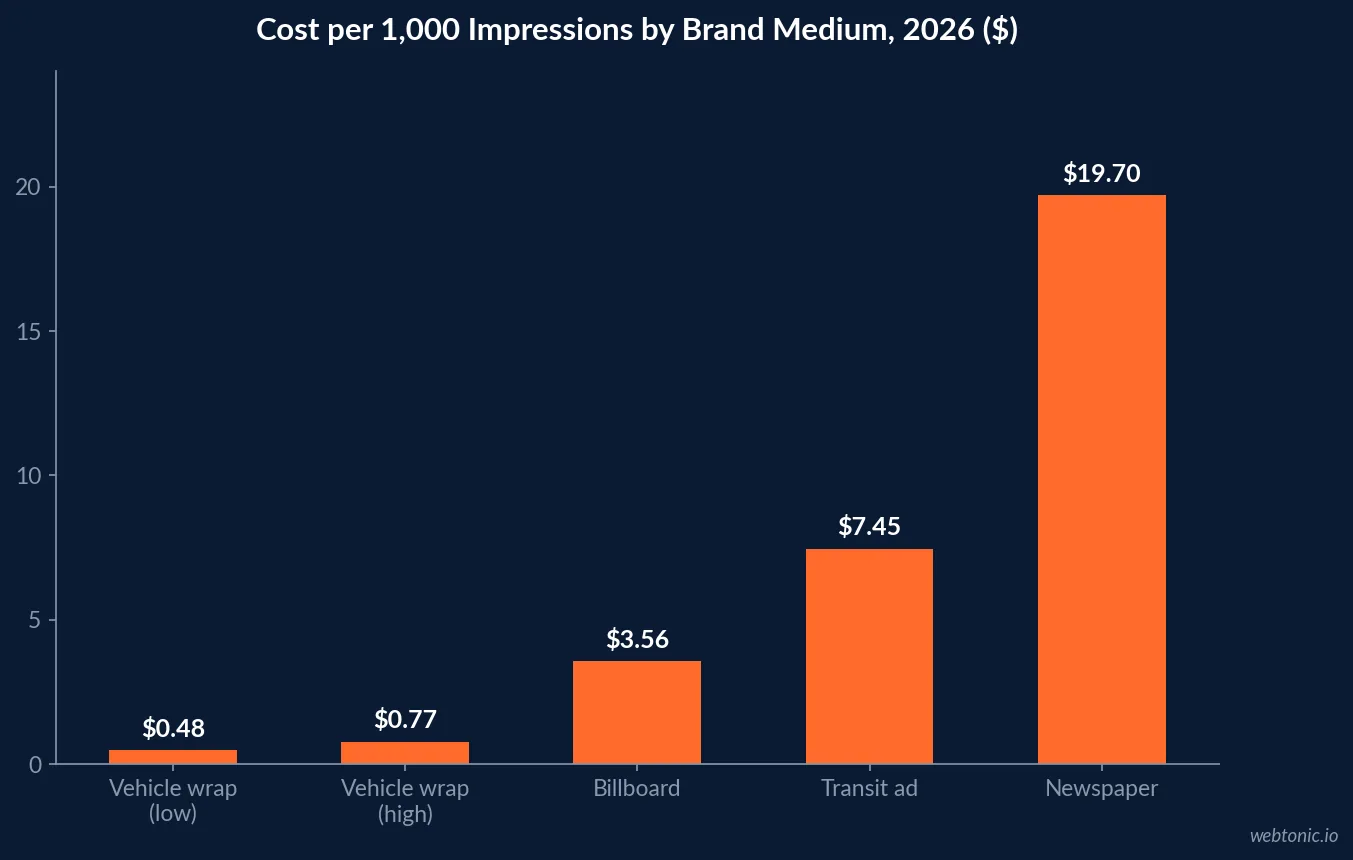
| Medium | CPM | Notes |
|---|---|---|
| Vehicle wrap | $0.48–$0.77 | One-time cost, 5–7 year lifespan |
| Billboard | $3.56 | Recurring monthly rent |
| Transit advertising | $7.45 | Recurring, route-limited |
| Newspaper | $19.70 | Declining local reach |
| Vehicle wrap vs TV | ~60% lower | TV benchmarked above $20 CPM |
Volume is equally favourable. Compiled 2026 wrap data puts urban delivery vans at about 40,000 impressions per day (roughly 15 million a year), with a range of 30,000 to 70,000 depending on route and metro, and a fleet of 50 trucks reaching around 5 million impressions a month. Fleet lifecycle analysis adds the durability numbers: 64% of people notice a wrap monthly (OAAA/Nielsen), recall sits near 97%, and average wrap lifespan is five to seven years with no ongoing media fee.
The locksmith-specific twist: the wrapped van is also your anti-fraud proof. A branded vehicle photographed for a Google Local Services profile is doing double duty as media and as identity — which matters when 40% of locksmith customers find services through Local Services Ads at an average $34 cost per lead, up 21% year over year.
4. Reviews and Ratings as Brand Equity
In an emergency purchase, the star rating is the brand. Buyers apply explicit thresholds before they read a word of your copy.
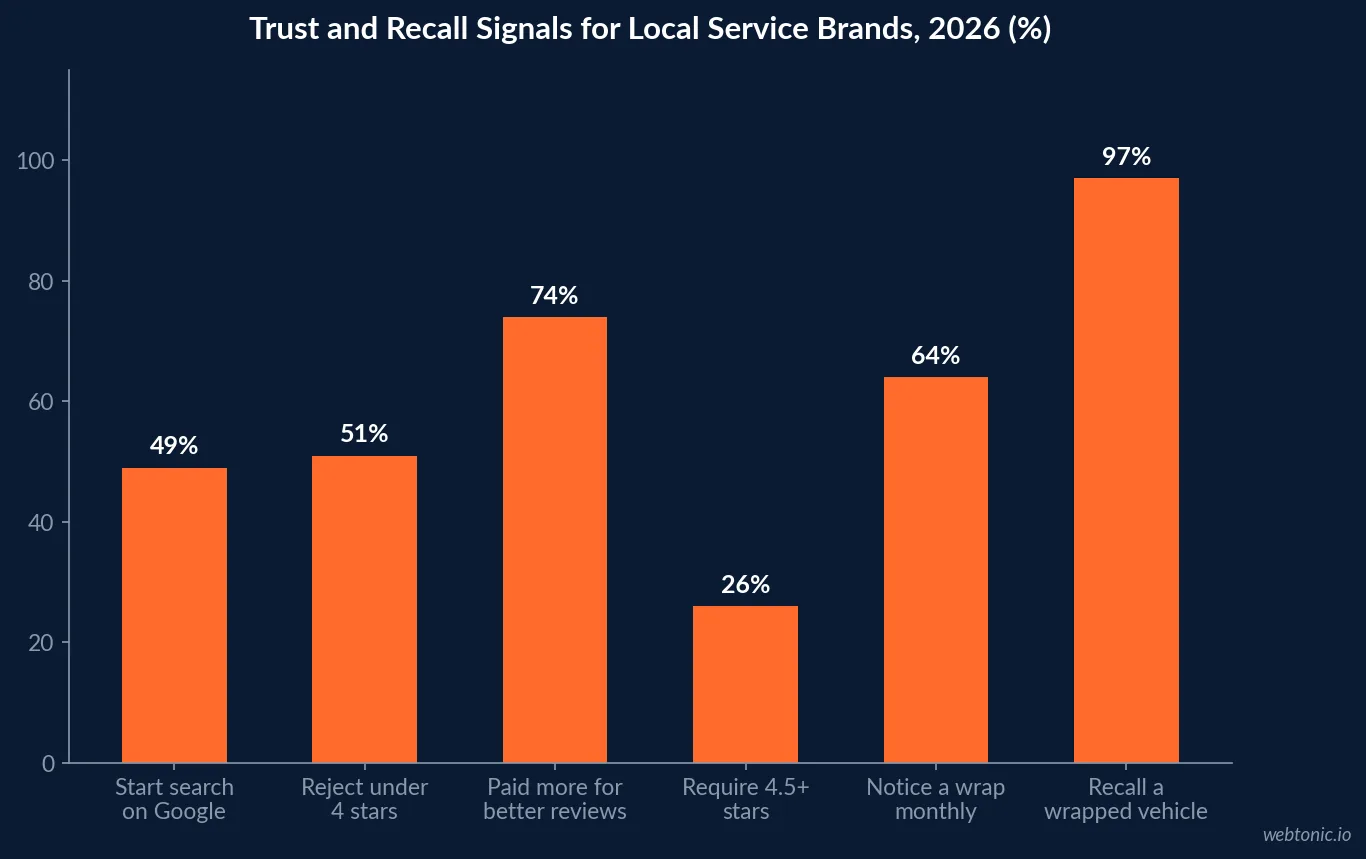
| Buyer behaviour | Share of consumers | Consequence |
|---|---|---|
| Start the search on Google | 49% | Profile is the first impression |
| Start by asking friends/family | 21% | Word of mouth is secondary |
| Will not consider under 4 stars | 51% | Hard filter before contact |
| Require 4.5 stars or higher | 26% | Premium positioning needs 4.5+ |
| Paid more for better reviews | 74% | Rating supports price |
| Rely on online reviews (homeowners) | 91% | Near-universal |
| Worry about unreliable contractors | ~70% | Reassurance is the message |
The home-services selection research and homeowner-behaviour reporting agree on the mechanism: reputation is the first filter, urgency compresses evaluation to seconds, and 33% of emergency buyers rank response time above everything else. That is why review velocity beats review volume for a locksmith — and why the profile, not the homepage, is the brand asset to optimise first. Our locksmith local SEO statistics cover the profile mechanics in detail.
5. What Consistency Is Worth
The revenue figures attached to brand consistency are cross-industry and often mis-cited, so here they are with provenance.
- Demand Metric / Lucidpress: consistent presentation associated with a ~23% revenue increase.
- Later Lucidpress research: up to a 33% increase, per 2026 compilations.
- Survey reporting: 68% of companies credit consistency with 10–20% of revenue growth.
- Consistent colour use is credited with lifting recognition by up to 80%.
- Brands with a stable visual identity are cited as 3.5x more likely to be top-of-mind.
Treat those as directional, not as a locksmith benchmark. What is locksmith-specific is the downside of inconsistency: when a customer's van, invoice and online profile do not visually match, the buyer's default explanation in this category is not sloppiness — it is a scam. Consistency here buys the absence of suspicion, which is worth more than the percentage points.
6. Emergency Brand vs Commercial Brand
The two revenue streams reward different identities, and most shops brand only for the first.
| Dimension | Emergency / residential | Commercial / access control |
|---|---|---|
| Share of activity | ~58% mobile/automotive | ~35% of industry revenue |
| Buying trigger | Lockout, 2am, panic | Contract, RFP, renewal |
| Decision window | Minutes | Weeks to months |
| Dominant proof | Reviews, van, response time | Certifications, references, SLAs |
| Economics | $215 avg lockout ticket | $200/door/yr recurring |
| Margin profile | Volatile, price-shopped | 70–85% gross margin RMR |
| Service adoption | — | 65% now offer electronic access control |
Industry data shows the commercial side is where durable value accrues: 65% of locksmiths now provide electronic access control, master-key systems appear in about 18% of business calls, access-control audits make up roughly 14% of corporate contracts, and commercial services are ~35% of industry revenue. A commercial-led operator with 500 monitored doors at $200 per door per year books $100K of recurring revenue at 70–85% gross margin with 5–10% annual churn. That buyer never sees your lockout ad — which is the argument for a distinct commercial brand layer and, often, for a B2B channel such as LinkedIn rather than the emergency-search auctions we cover in our locksmith Google Ads statistics.
7. Brand Asset Priorities on a Small Budget
Ordered by cost per unit of credibility, using the figures above.
- Full wrap on every truck — $0.48–$0.77 CPM, 5–7 years, ~97% recall.
- Real technician and van photography — the asset fake operators cannot copy.
- Google profile completeness — 49% of searches start there; 40% of customers arrive via LSA.
- Review engine to clear 4.5 stars — unlocks the 26% of buyers with the strictest filter.
- Uniforms and branded invoices — continuity from ad to doorstep to receipt.
- Association and licence badges — direct counter-signal to the 147% complaint rise.
- Named-address NAP everywhere — a PO box reads as a dispatch network.
- Separate commercial one-pager — the $200/door buyer needs different proof.
- Call answering before more awareness — a 34% missed-call rate wastes brand spend.
Every item on that list is an owned asset with a multi-year life, which suits a trade where the median shop turns over $185K to $620K. Our performance creative team builds these identity systems so the van, the profile and the paid creative all argue the same case.
8. Measuring Brand in a Trade Without Brand Metrics
Most locksmith shops have no brand-tracking budget, so use proxies that already exist in the stack.
| Proxy metric | What it tells you | Target direction |
|---|---|---|
| Branded search volume | Recall from wraps and reviews | Up quarter over quarter |
| Direct and organic call share | Brand vs rented demand | Up vs paid share |
| Review velocity | Live reputation momentum | Steady monthly additions |
| Average rating | Access to strict buyers | 4.5+ |
| LSA cost per lead | Auction pressure on brand | Below $34 average |
| Missed-call rate | Demand leakage | Below the 34% median |
| Aggregator lead share | Brand independence | Under 30% of volume |
| Repeat and referral share | Post-service brand equity | Rising with commercial mix |
The aggregator threshold is worth underlining: shops running on aggregator lead flow are described in 2026 industry reporting as breaking even on the marginal job while callbacks, repeat business and reviews route to the aggregator brand rather than the shop. The fastest-growing operators keep aggregator share under 30% of total volume — a brand-building decision disguised as a media decision. Our data intelligence team wires these proxies into a single view.
9. The Bottom Line
Locksmith branding in 2026 has an unusually clean business case. The category is fragmented (26,000–29,000 establishments, top 10 chains under 8%), actively impersonated (10,000+ fake listings removed, complaints up 147%), and gated by explicit trust filters (51% reject sub-4-star, 26% demand 4.5+). The cheapest credible medium available — a wrapped van at $0.48–$0.77 CPM with 30,000–70,000 daily impressions and 97% recall — also happens to be the strongest proof that you are a real business. Build the identity, feed the reviews, answer the phone (the median shop misses 34% of calls), and give the commercial buyer a separate story. If you want that built and measured, talk to our team.
Frequently Asked Questions
Does branding actually matter for a locksmith?
More than in most trades, because the category has a credibility problem it did not create. Google removed more than 10,000 fraudulent listings tied to people impersonating real locksmiths and sued the operators behind them, and the UK's Master Locksmiths Association recorded a 147% rise in complaints about rogue locksmiths and misleading emergency adverts. In a market where a stressed buyer cannot tell a real shop from a dispatch network, the visible markers of a real business — a consistent wrapped van, a physical address, a named technician, a logo that appears identically on the invoice and the profile — are the differentiator, not decoration.
What is the cheapest branding channel for a locksmith?
The van. Vehicle wraps deliver impressions at roughly $0.48 to $0.77 CPM against $3.56 for billboards, $7.45 for transit ads and $19.70 for newspaper. A single wrapped vehicle generates about 30,000 to 70,000 impressions a day in urban traffic, wraps last five to seven years with no monthly fees, and recall rates published across multiple 2026 compilations sit near 97%. For a shop with one to three trucks — the median locksmith business — it is the only brand medium whose cost per impression competes with organic search.
How many reviews and what rating does a locksmith need?
Enough to clear the buyer's filter, which is now explicit. Survey data on home-service selection shows 51% of consumers will not consider a provider rated under 4 stars and 26% require 4.5 or higher, while 74% say they have paid more for a provider with better reviews. Ratings function as the brand for an emergency purchase: 49% of homeowners start their search on Google and only 21% start by asking friends or family, so your profile is doing the introduction.
What is brand consistency worth in revenue terms?
The widely cited figures are a range, not a single number, and they should be quoted carefully. Demand Metric and Lucidpress research put consistent brand presentation at about a 23% revenue increase; later Lucidpress work raised it to as much as 33%, and separate survey reporting found 68% of companies attributing 10–20% of revenue growth to consistency. Those are cross-industry figures rather than locksmith-specific, but the mechanism travels: in a category defined by impersonation, identical presentation across van, uniform, invoice, website and Google profile is what makes a shop look real.
Should a locksmith brand around emergency work or commercial contracts?
Both, with different assets. Emergency lockouts are roughly 58% of the mobile/automotive subsegment's demand and carry an average lockout ticket near $215, but that work is price-shopped and aggregator-infested. Commercial services make up about 35% of industry revenue, and a commercial access-control operator with 500 monitored doors at $200 per door per year generates $100,000 of recurring revenue at 70–85% gross margin. The brand that wins emergency search — fast, local, verified — is not the brand that wins a property-management RFP, so build a commercial identity layer rather than reusing the lockout creative.
Sources
TheKeyBot — State of the Locksmith Industry 2026
Keyzoo — How to Spot a Fake Locksmith (2026)
Master Locksmiths Association — Rogue Locksmith Complaints Rise 147%
ProVinyl Solutions — Fleet Wrap ROI & Lifecycle 2026
ZipDo — Vehicle Wrap Advertising Statistics 2026
Local Impact — How Consumers Choose Home Service Providers 2026
DashoContent — Brand Consistency Statistics 2026
WifiTalents — Locksmith Industry Statistics 2026
improveit360 — Shifts in How Homeowners Choose Contractors 2026
ServiceLine Pro — Branding for Home Services Local Growth 2026
Housecall Pro — Locksmith Industry & Salary Data 2026