Table of contents
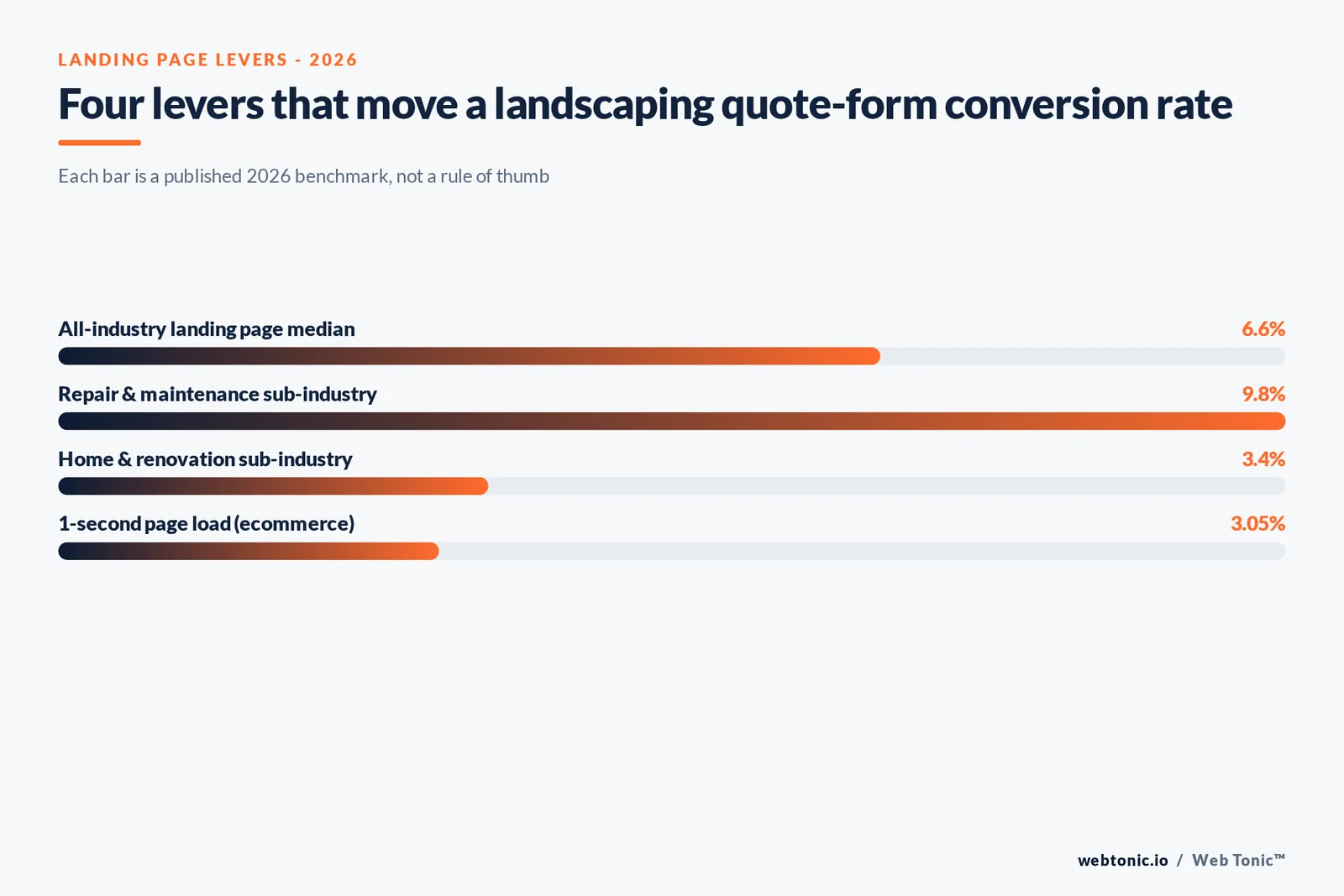
No published benchmark prices landscaping landing pages directly, so this page builds the CRO case from the two sub-industries closest to it. Unbounce's 2024 data puts repair and maintenance pages at roughly 9.8% median conversion and home and renovation pages at roughly 3.4% - almost a three-fold gap that comes down to how urgent the visitor's need feels on arrival.
Key Takeaways
- The all-industry landing page median is 6.6%, per Unbounce's 2024 report.
- Commercial and professional services pages convert at 6.1%, just below that median.
- Repair and maintenance pages convert at roughly 9.8%.
- Home and renovation pages convert at roughly 3.4%, nearly 3x lower.
- Email-driven traffic converts at 13.9%, Unbounce's best-performing channel.
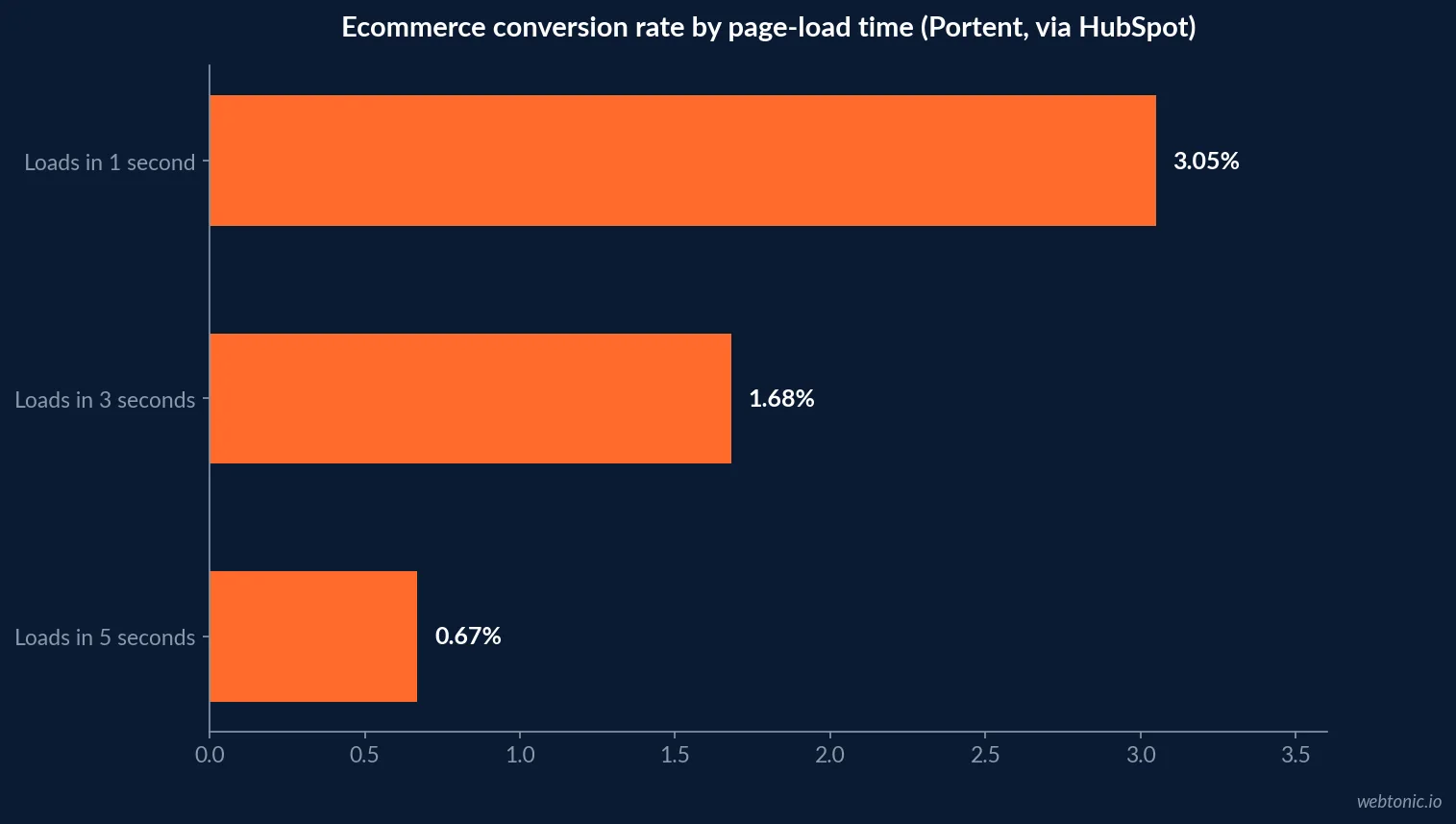
- A 1-second page load converts ecommerce visitors at 3.05%, per Portent's research.
- That rate drops to 1.68% at 3 seconds of load time.
- And drops further to 0.67% at 5 seconds of load time.
- That is roughly a 4.5x gap between the fastest and slowest pages studied.
- Cutting a form from 11 fields to 4 lifted conversions by 120% in HubSpot's cited Imagescape case.
- Landscaping's own paid-search CVR runs 6.42% once a visitor clicks through.
- Landscaping's paid CPL is USD 117.92, the cost every wasted landing-page visit adds up against.
- 51% of landscape contractors cite staffing as their top constraint, per NALP.
- 64% of landscape companies expected profitability growth in NALP's 2023 survey.
- 49% of landscape-maintenance-focused firms beat maintenance revenue expectations in 2023.
- Only 6% of local searchers click the very first result without comparing options, per BrightLocal.
The baseline: what "average" even means for a landing page
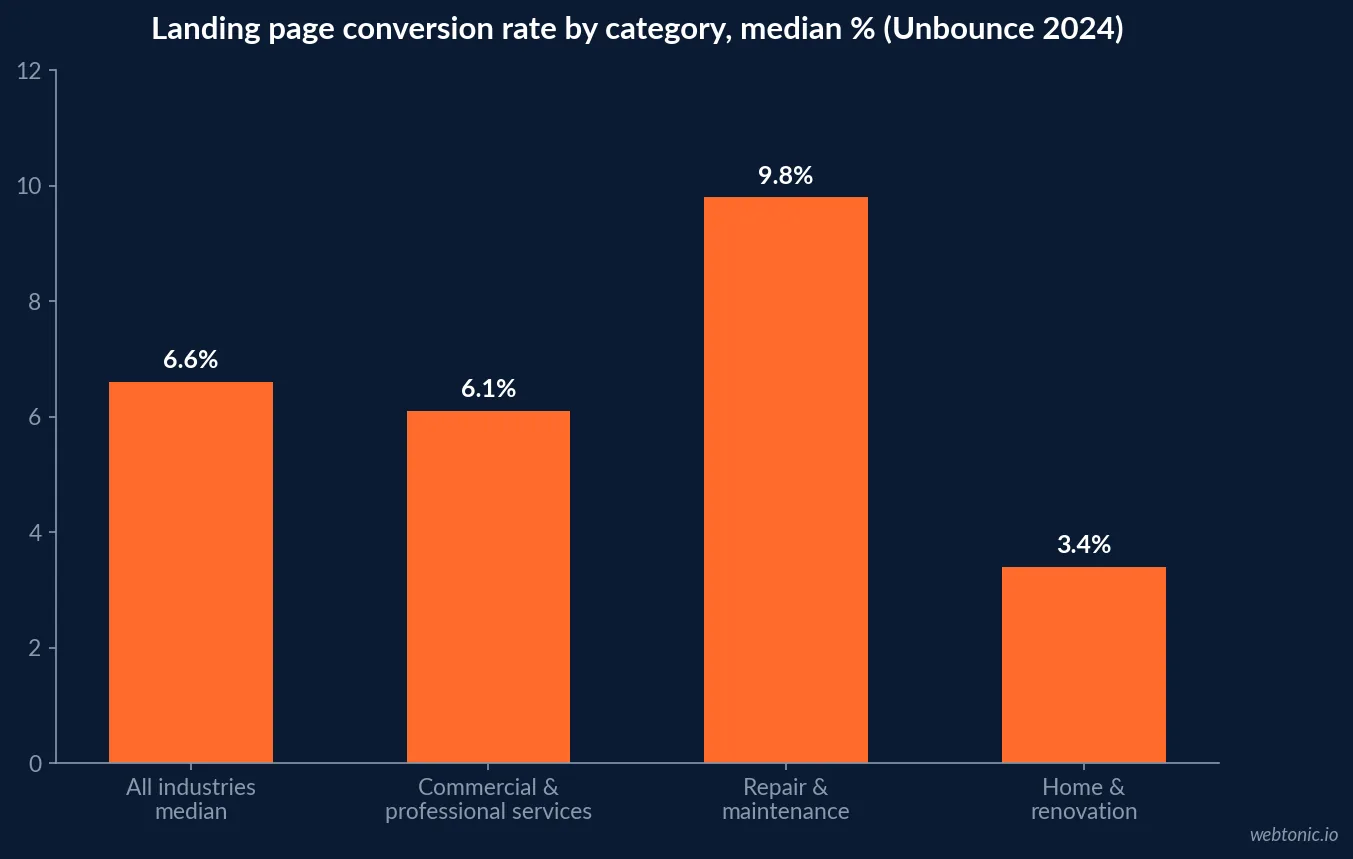
Unbounce's 2024 Conversion Benchmark Report, built from over 57 million conversions and 41,000 landing pages, puts the median conversion rate across all industries at 6.6%. The closest tracked category to landscaping, commercial and professional services, sits slightly below that at 6.1% - but the more useful split is one layer deeper, inside that category's own sub-industries.
Unbounce found repair and maintenance services pages converting almost 3x better than home and renovation services pages. A landscaping company runs both kinds of pages at once - a recurring-mow maintenance offer and a backyard-redesign project - and the data says they should not be built, or judged, the same way.
| Landing page category | Median conversion rate | Landscaping page type it maps to |
|---|---|---|
| All industries | 6.6% | General benchmark, not a landscaping-specific figure |
| Commercial & professional services | 6.1% | General service-business quote pages |
| Repair & maintenance services | 9.8% | Recurring mow, cleanup and maintenance contracts |
| Home & renovation services | 3.4% | Design-build and hardscape/renovation projects |
| Email as a traffic source (all industries) | 13.9% | Existing-customer upsell and seasonal renewal pages |
Why urgency, not design polish, explains most of that gap
Unbounce's own read on the repair-versus-renovation gap is a painkiller-versus-vitamin effect: a visitor who lands on a repair or maintenance page usually already knows they need the service and wants it resolved, while a renovation visitor is often still comparing budgets and ideas. A landscaping maintenance page can borrow that same urgency (a lawn that needs mowing now, a sprinkler leak that needs fixing) far more easily than a landscape-design page can manufacture it.
That reframes the CRO priority: before rewriting headlines or swapping button colors, decide whether the page in front of the visitor is actually selling urgency or selling a considered investment, and match the copy, offer and form length to that decision.
| CRO lever | Where it matters more | Why |
|---|---|---|
| Urgency-based headline ("same-week service") | Maintenance / repair pages | Matches an already-decided need |
| Portfolio / before-after gallery | Design-build / renovation pages | Builds the trust a considered purchase needs |
| Short quote form (name, phone, service) | Both, but especially maintenance | Speed matters more when intent is already high |
| Financing or payment-plan messaging | Renovation pages | Addresses the budget-comparison stage directly |
| Seasonal countdown / capacity messaging | Maintenance pages | Reinforces the urgency the category already has |
The part visitors never see: page speed
Portent's page-speed research, cited by HubSpot's analysis of that study, found ecommerce pages loading in 1 second converting at 3.05%, dropping to 1.68% at 3 seconds and 0.67% at 5 seconds. That is roughly a 4.5x gap between the fastest and slowest pages in the study. Landscaping quote pages are frequent offenders here because they lean on large, uncompressed before/after photo galleries that are exactly the kind of asset this effect penalizes.
The fix is rarely a redesign - it is usually image compression, lazy-loading galleries below the fold, and trimming third-party scripts (chat widgets, review-embed plugins) that quietly add seconds to load time without adding conversions.
The form itself is a conversion lever, not just a data-collection tool
HubSpot's own form design research cites Imagescape increasing conversion rates by 120% simply by reducing an 11-field form to four fields. A landscaping quote form that asks for property square footage, a budget range, and a full project description before a lead can hit submit is trading completeness for volume it never has to trade - that detail can be collected in the follow-up call instead.
The practical version for a landscaping page: name, phone number, service needed, and property zip code is usually enough to start a qualified conversation. Anything beyond that should have to earn its place on the form.
| Form field | Keep on first screen? | Why |
|---|---|---|
| Name | Yes | Minimum viable identity for follow-up |
| Phone number | Yes | Landscaping leads convert faster over a call than email |
| Service needed (dropdown) | Yes | Routes the lead without adding typing friction |
| Property size / budget range | No - move to follow-up | Adds friction without disqualifying a real lead |
| Detailed project description | No - move to follow-up | Best collected once the lead is already engaged |
The cost context that makes this worth fixing
Landscaping's average paid-search conversion rate on Google is 6.42%, against an average cost per lead of USD 117.92. Every visitor who abandons a slow-loading or over-long form after clicking through from a paid ad is a full CPL wasted, not just a missed page view. That is the real cost of treating page speed and form length as cosmetic rather than as direct inputs to acquisition cost.
The National Association of Landscape Professionals' 2023 survey found 51% of contractors naming staffing their top challenge - all the more reason not to let a leaky landing page burn through leads that a stretched crew cannot afford to re-earn through paid spend.
How landscaping's own paid funnel compares to the landing page averages
WordStream's 2026 cross-industry PPC benchmarks put the average conversion rate across 23 industries at 8.18%. Landscaping's own paid conversion rate, per LocaliQ's 2025 data, runs 6.42% - below that cross-industry average, and below Unbounce's 9.8% repair-and-maintenance benchmark too. That gap is a landing page problem as much as a targeting problem: the clicks are arriving, and a meaningful share are leaving before the form submits.
A landscaping-specific benchmarking tool, Benchmarketing's landing page benchmarks, puts the median landing page conversion rate at 2.35% across its own sample, with the top quartile reaching 11.45% or higher - a wide enough spread to show that page quality, not just traffic quality, is doing most of the work between those two ends.
| Benchmark | Reported conversion rate | Source |
|---|---|---|
| Cross-industry PPC average | 8.18% | WordStream, 2026 |
| Landscaping's own paid conversion rate | 6.42% | LocaliQ, 2025 |
| All-industry landing page median | 6.6% | Unbounce, 2024 |
| Landing page median (Benchmarketing sample) | 2.35% | Benchmarketing |
| Landing page top quartile (Benchmarketing sample) | 11.45%+ | Benchmarketing |
Building the test plan from these numbers
Start by classifying every landscaping landing page as either a maintenance/repair page or a design/renovation page, since the benchmark gap between those two is the single largest lever in this data. Then run page-speed and form-length fixes as their own test, since both are cheap to change and compound with whichever framing the page already uses.
Measure success as cost per booked estimate, not just form-fill rate - a shorter form usually raises submissions, and the CRO win only counts if a comparable share of those submissions still turn into booked jobs.
Where this fits with the rest of the funnel
A fast, well-framed landing page still needs qualified traffic behind it; pairing this CRO work with the SEO and local-search improvements that drive that traffic is what actually moves blended cost per lead. Our performance creative team can help build and test the page variants, our roundup of conversion rate statistics puts landscaping's numbers in a broader benchmark context, and our cost-per-lead comparison by industry shows what a leaky landing page is actually costing per wasted click.
What ranking-factor and behavioral research adds to the picture
Landing page conversion is downstream of search behavior, and BrightLocal's consumer search behavior research found only 6% of local searchers "just click the top result" - most compare review volume, rating and recency before committing to a click at all. A landscaping landing page that loses that comparison before the visitor even arrives is fighting a conversion-rate problem that starts upstream of the page itself, in the Business Profile and reviews that earned the click.
That is one more reason CRO work on a landscaping quote page should be paired with the local SEO and review-management effort covered elsewhere on this site, rather than treated as a page-design exercise in isolation.
| Upstream signal | Effect on the eventual landing page conversion rate |
|---|---|
| Review volume and recency | Sets the trust level a visitor arrives with, before any page copy |
| Star rating | Filters out lower-rated competitors before the click even happens |
| Local pack position | Determines whether the visitor arrives via a premium placement or scrolls further |
| Search intent match | A mismatched ad-to-page promise inflates bounce regardless of page speed |
Frequently Asked Questions
What is a good landing page conversion rate for a landscaping business?
No published study prices landscaping pages specifically, so the honest starting point is the nearest sub-industries in Unbounce's 2024 Conversion Benchmark Report: repair and maintenance pages convert at roughly 9.8%, while home and renovation pages convert at roughly 3.4%, almost three times lower. A landscaping quote page sits closer to the renovation end when it is selling a design project, and closer to the repair end when it is selling recurring maintenance - the framing of the page, not just the design, should follow which one it is.
Why do repair and maintenance pages convert so much better than renovation pages?
Unbounce's own analysis calls it a painkiller-versus-vitamin effect: a visitor landing on a repair or maintenance page usually has a more urgent, already-decided need, while a renovation visitor is often still comparing options and budgets. A landscaping maintenance page can borrow the same urgency framing a repair page uses; a design-build page has to work harder to create that urgency.
Does page load speed actually change conversion rate this much?
Yes, and the effect compounds. Portent's page-speed research, as reported by HubSpot, found ecommerce pages loading in 1 second converting at roughly 3.05%, dropping to 1.68% at 3 seconds and 0.67% at 5 seconds - roughly a 4.5x difference between the fastest and slowest pages in the study. A landscaping quote page loaded with large before/after photo galleries is exactly the kind of page this effect punishes if images are not compressed.
Does shortening the quote-request form actually help?
Directionally, yes. HubSpot's own case data cites Imagescape increasing form conversion by 120% by cutting a form from 11 fields to four. A landscaping quote form does not need property square footage, budget range, and a project description all on the first screen - a name, phone number, and service type is usually enough to start the conversation, with detail collected afterward.
Where should a landscaping company start if it can only fix one thing?
Start with the framing question - is this page selling urgent maintenance or a considered design project - because that decision changes the copy, the form length, and the offer. Only after that is set does it make sense to chase page-speed and form-field optimizations, since those amplify whichever framing is already on the page.
Sources
BrightLocal - Consumer Search Behavior Decisions (2026)
Unbounce - 2024 Conversion Benchmark Report
Unbounce - Commercial & Professional Services Conversion Rate Benchmarks
HubSpot - Page Load Time and Conversion Rate Statistics (citing Portent research)
HubSpot - Form Design Best Practices
LocaliQ - 2025 Search Ad Benchmarks for Home Services
National Association of Landscape Professionals - 2023 Year-End Business Pulse Survey
WordStream - Digital Benchmarks by Industry: PPC
Benchmarketing - Landing Page Benchmarks