Table of contents
No email platform publishes a landscaping-specific benchmark, so this page builds one from Mailchimp's 2026 cross-industry data and maps it to the landscaping service calendar. The floor to beat is a 35.63% open rate and a 2.62% click rate - the average across every Mailchimp customer, not a landscaping figure, and every assumption below says so.
Key Takeaways
- Mailchimp's cross-industry average open rate is 35.63% in its 2026 benchmarks.
- The cross-industry average click rate is 2.62%.
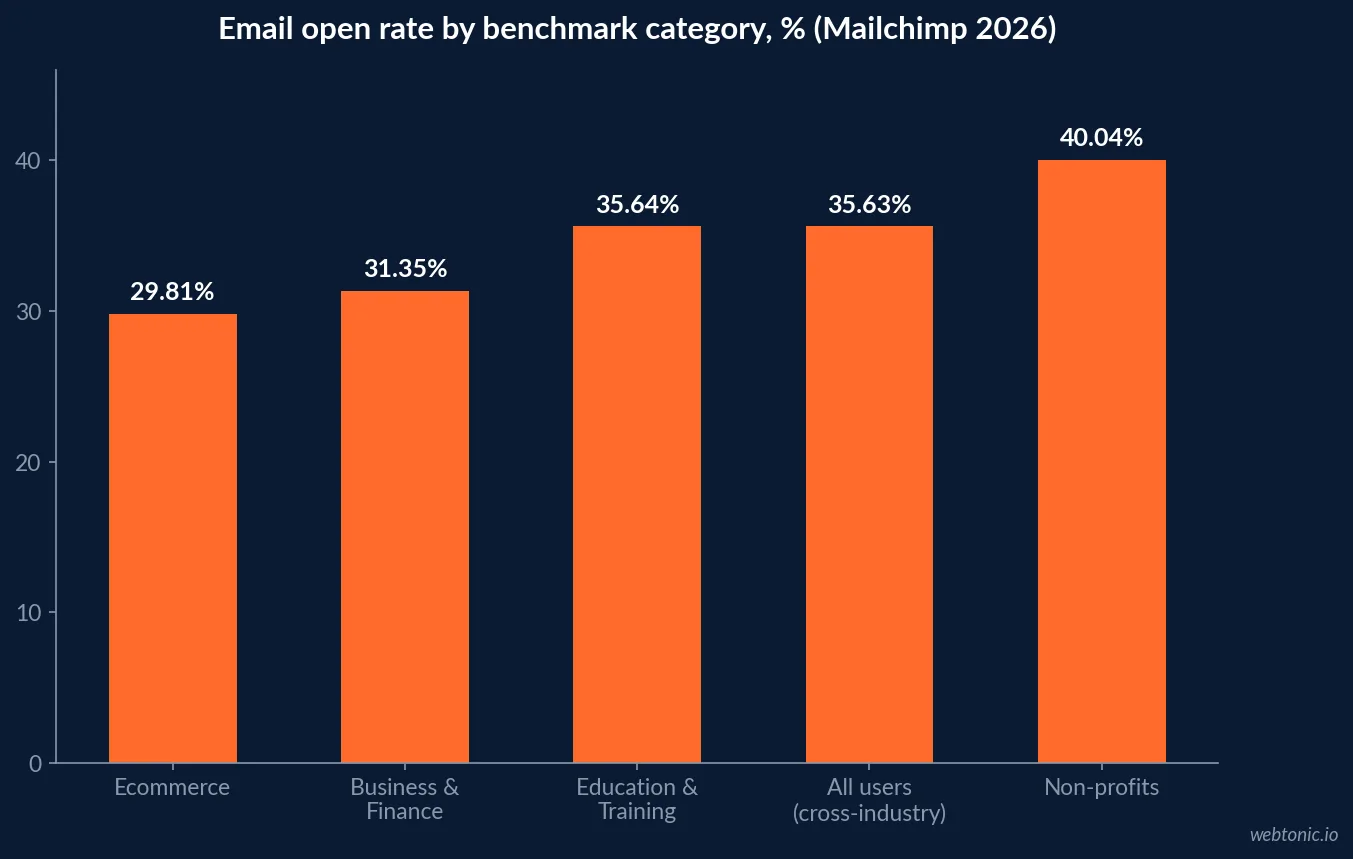
- Non-profits post the highest open rate tracked, at 40.04%.
- Education and training follows closely at 35.64% open.
- Ecommerce posts the lowest open rate of the tracked categories, at 29.81%.
- Business and finance opens at 31.35%, below the cross-industry average.
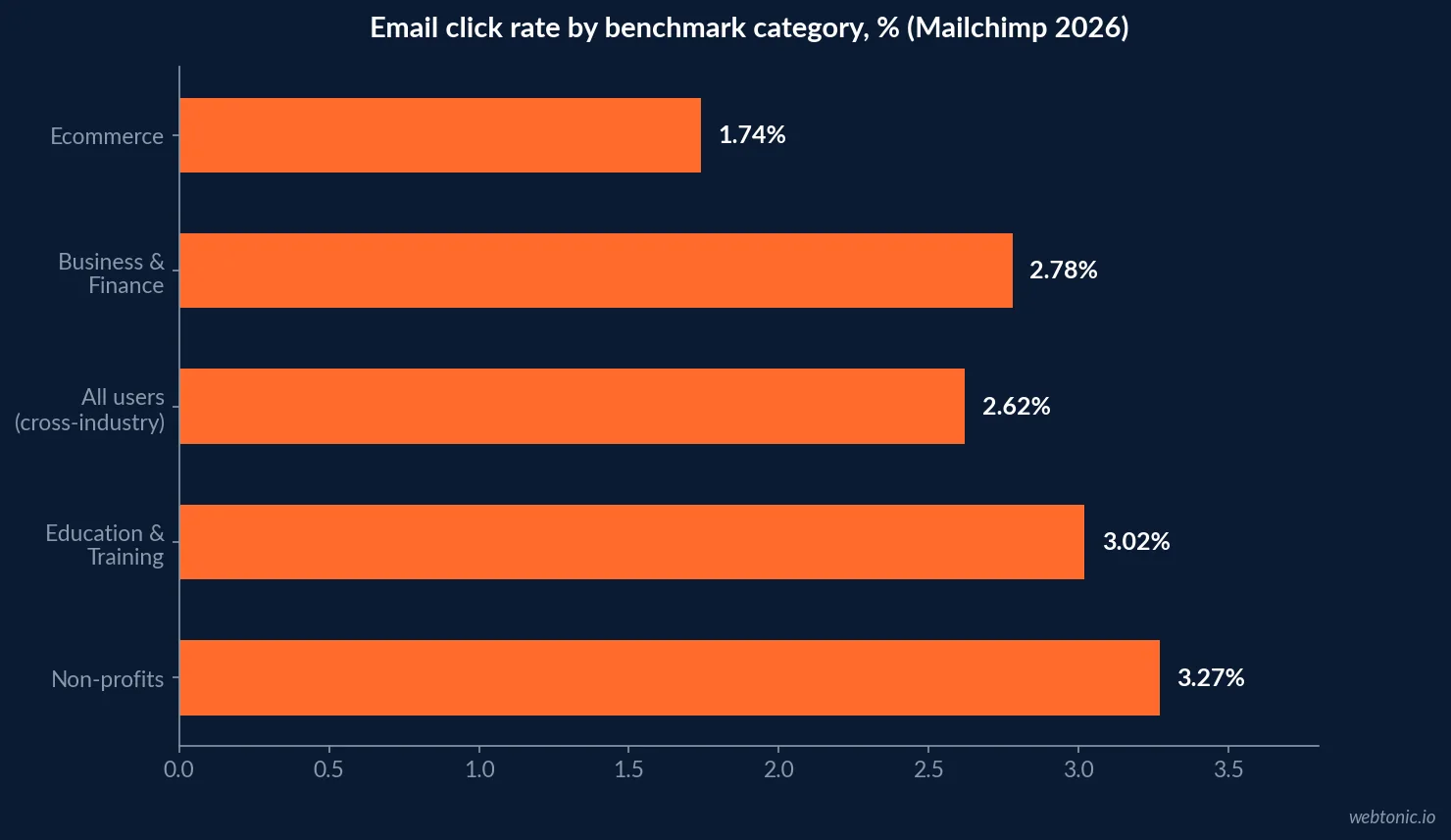
- Non-profits also lead on click rate, at 3.27%.
- Ecommerce trails on click rate too, at 1.74%.
- Email-driven landing page traffic converts at 13.9% across all industries, per Unbounce.
- That is more than double the 6.6% all-industry landing page median.
- Landscaping's own paid-search conversion rate is 6.42%, for comparison.
- Landscaping's average paid cost per lead is USD 117.92, a cost an email list does not carry per send.
- 51% of landscape contractors cite staffing as their top challenge, per NALP's 2023 survey.
- 64% of landscape companies expected profitability growth the following year.
- Unsubscribe rates across Mailchimp's tracked categories run 0.15% to 0.19%.
Why there is no landscaping-specific email benchmark
Email platforms publish benchmarks by broad industry category, and "landscaping" is not one of the categories Mailchimp's published benchmark table breaks out. The table it does publish covers Business + Finance, Non-Profits, Education + Training, Ecommerce, and an All Users row that averages across its full customer base at 35.63% open rate, 2.62% click rate, and 0.22% unsubscribe rate. That All Users row is the most honest floor a landscaping list can be judged against until a vendor publishes something more specific.
Every number that follows is either that cross-industry figure or the nearest comparable category, labeled as such - not a landscaping number dressed up as one.
| Mailchimp 2026 category | Open rate | Click rate | Unsubscribe rate |
|---|---|---|---|
| Non-Profits | 40.04% | 3.27% | 0.18% |
| Education + Training | 35.64% | 3.02% | 0.18% |
| All Users (cross-industry) | 35.63% | 2.62% | 0.22% |
| Business + Finance | 31.35% | 2.78% | 0.15% |
| Ecommerce | 29.81% | 1.74% | 0.19% |
Which category actually behaves most like landscaping
Landscaping email sends are rarely transactional the way ecommerce receipts are - they are more often seasonal reminders, contract renewals, and service-area news, which behaviorally sits closer to the education and non-profit categories that lead the click-rate table. Neither category is a perfect proxy, but both outperform ecommerce and business-and-finance on both metrics tracked, which is a useful signal that relevance and timing, not just list size, drive the difference.
The categories that struggle - ecommerce and business/finance - both tend to send high-frequency, lower-relevance promotional email. A landscaping list sending fewer, better-timed emails should expect to land nearer the top of this table than the bottom.
Mapping the benchmark to a landscaping send calendar
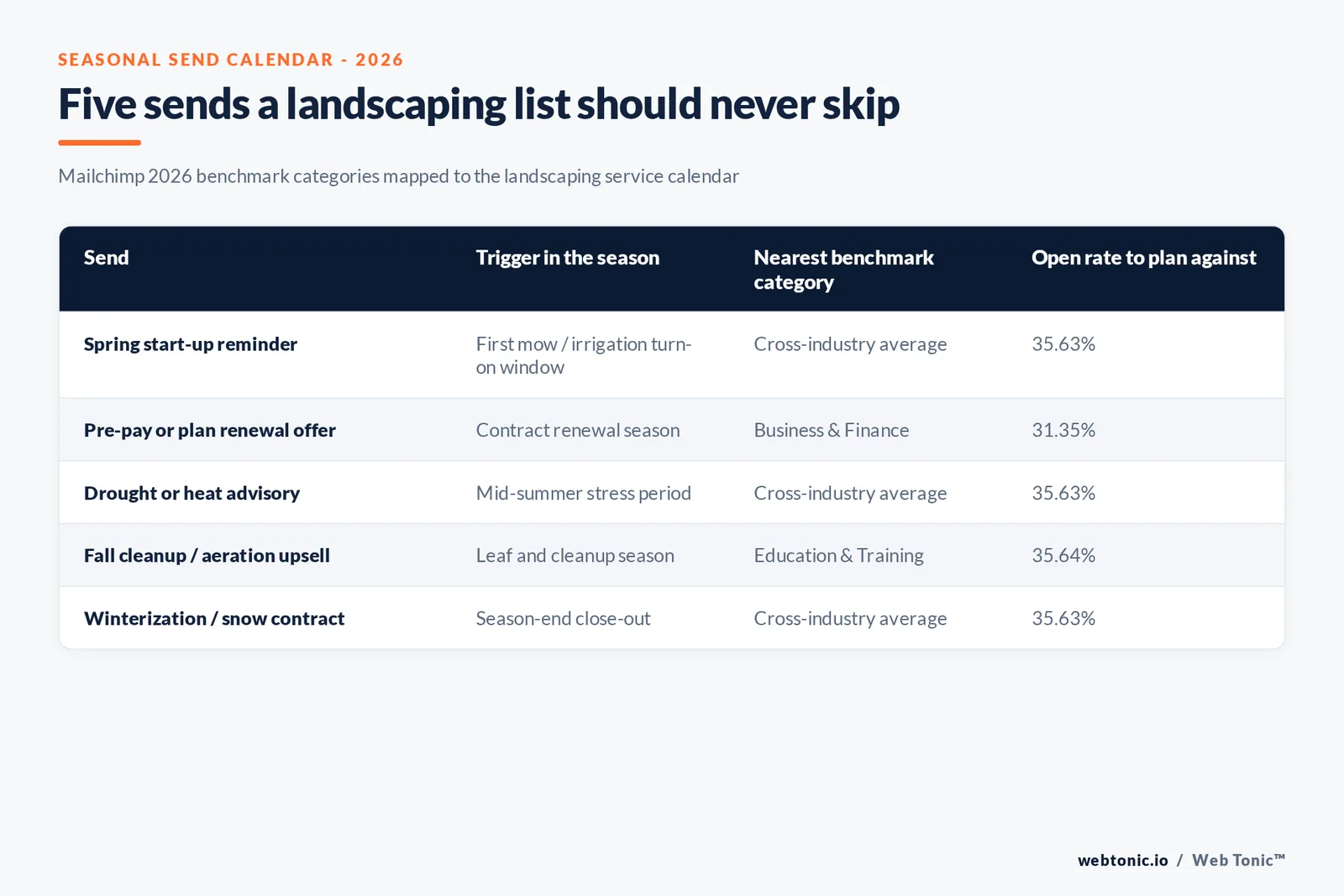
The category's demand is seasonal, so the calendar should be built around trigger windows rather than a flat monthly cadence. A spring startup reminder, a mid-summer drought or heat advisory, a fall cleanup and aeration upsell, and a winterization or snow-contract close-out each create a moment where the email is more relevant than a generic monthly update could be - and relevance is what the benchmark table above rewards.
Contract renewal offers deserve their own slot, timed to the season before the contract lapses rather than after, since a renewal email sent proactively behaves more like the higher-performing education/non-profit pattern than a reactive win-back campaign does.
| Seasonal send | Trigger window | Nearest benchmark category to plan against |
|---|---|---|
| Spring start-up reminder | First mow / irrigation turn-on | All Users cross-industry average |
| Contract pre-pay or renewal offer | Ahead of contract lapse | Business + Finance |
| Drought or heat-stress advisory | Mid-summer stress period | All Users cross-industry average |
| Fall cleanup / aeration upsell | Leaf-drop season | Education + Training |
| Winterization / snow contract close-out | Season-end | All Users cross-industry average |
Why email is the highest-leverage channel to build first
Unbounce's 2024 Conversion Benchmark Report found email-driven landing page traffic converting at 13.9% across all industries - more than double the 6.6% all-industry landing page median, and well above landscaping's own 6.42% paid-search conversion rate. Those are general, not landscaping-specific, figures, but they support building the email list before scaling paid spend: an email send to an existing customer carries no per-click cost, unlike the USD 117.92 average cost per lead landscaping pays on Google Search.
That comparison is also why the seasonal calendar above is worth building before a bigger media budget - the audience already exists, and reactivating it costs a send, not a click.
| Channel | Reported conversion rate | Per-contact marginal cost |
|---|---|---|
| Email (existing list) | 13.9% (all-industry benchmark) | Cost of the send, not per contact |
| Landing page, all-industry median | 6.6% | Depends on traffic source |
| Landscaping paid search | 6.42% | USD 8.76 per click, USD 117.92 per lead |
How email's discovery role compares to search
HubSpot's 2026 marketing statistics, citing DataReportal, report that 32.9% of internet users aged 16 and older discover new brands, products and services via search engines - email is not usually a discovery channel in that same sense; it is a retention and reactivation channel for people who already know the business. That distinction matters for a landscaping company's budget split: search and local SEO earn the first contact, while the email calendar built above is what keeps that contact paying season after season.
WordStream's 2026 cross-industry PPC benchmarks put the average paid search conversion rate at 8.18%, still below the 13.9% Unbounce reports for email-driven landing page traffic. Two different jobs, two different benchmarks, and a landscaping marketing plan needs both lines funded rather than treating email as an afterthought once the paid budget is set.
| Channel | Primary job | Reported rate | Source |
|---|---|---|---|
| Search engines (organic discovery) | New-customer discovery | 32.9% of discovery is search-driven | HubSpot / DataReportal |
| Paid search | New-customer acquisition | 8.18% cross-industry conversion | WordStream, 2026 |
| Email (existing list) | Retention and reactivation | 13.9% landing page conversion | Unbounce, 2024 |
The capacity constraint that makes this worth prioritizing
The National Association of Landscape Professionals' 2023 Year-End Business Pulse Survey of 328 member companies found 51% naming staffing their top business challenge, while 64% still expected profitability growth the following year. A seasonal email calendar that pre-sells renewals and upsells to an existing customer base does not add new-customer acquisition pressure onto a crew that is already the constraint - it protects revenue from people the business has already earned trust with.
That framing - protect and grow the existing list before spending more to acquire a new one - is the practical reason email deserves a real content calendar rather than an occasional blast.
What Google's own guidance adds to the seasonal case
Google's own Business Profile help documentation states that businesses with complete and accurate information are more likely to show up in local search results at all. An email list built from website and profile form submissions only keeps growing if that profile stays visible - which ties the email calendar's long-term performance back to the same seasonal profile-and-content upkeep covered in this site's local SEO research, not to a separate email-only fix.
Where this fits with the rest of the marketing plan
A seasonal email program works best paired with the SEO and local-search visibility that keeps growing the list it sends to; without new sign-ups from the website and the Business Profile, the same list ages and the open-rate benchmarks above start to slip. Our growth marketing team can help build and segment that calendar, our roundup of email marketing statistics covers the cross-industry benchmarks in more depth, and our cost-per-lead comparison by industry shows why an existing list is worth protecting before paying for new clicks.
What list health looks like against these benchmarks
Mailchimp's cross-industry unsubscribe rate averages 0.22%, with its tracked categories ranging from 0.15% (Business + Finance) to 0.19% (Ecommerce). A landscaping list that spikes noticeably above 0.22% on a given send is a signal the content missed the seasonal trigger it was supposed to match, not just a sign the list needs cleaning. Tracking unsubscribes alongside open and click rate, send by send, is how a seasonal calendar gets tuned year over year rather than guessed at once and left alone.
Backlinko's Local SEO Statistics also note that 98% of consumers search online for local businesses before making a decision - a reminder that an email list, however well it performs, is a retention channel sitting on top of an acquisition funnel that still has to be fed by search and local visibility. A landscaping company that stops investing in the top of that funnel will eventually see its email benchmarks slip too, simply because the list stops growing.
| List health signal | Mailchimp 2026 benchmark range | What a spike signals |
|---|---|---|
| Unsubscribe rate, cross-industry average | 0.22% | List fatigue or a mistimed send |
| Unsubscribe rate, lowest tracked category | 0.15% (Business + Finance) | Well-matched send cadence |
| Unsubscribe rate, highest tracked category | 0.19% (Ecommerce) | Higher-frequency promotional sending |
Frequently Asked Questions
What is a good email open rate for a landscaping company?
No email platform publishes a landscaping-specific benchmark, so the honest floor to beat is Mailchimp's 2026 cross-industry average of 35.63%, measured across all its users. Categories with similar buying cadence to landscaping - non-profits at 40.04% and education and training at 35.64% - sit at or above that average, which suggests a well-segmented landscaping list, sending relevant seasonal content, should be able to clear the cross-industry number rather than settle for it.
Why does landscaping email marketing need a seasonal calendar instead of a flat schedule?
The demand itself is seasonal - spring startup, summer drought stress, fall cleanup, and winterization or snow contracts each create a narrow window where a specific offer is relevant. A flat monthly newsletter misses all of those triggers; a calendar built around them lets each send compete for attention only when the recipient's actual need is highest, which is when email performs closest to its ceiling rather than its average.
What email click rate should a landscaping list expect?
Mailchimp's 2026 benchmark categories range from 1.74% (Ecommerce) to 3.27% (Non-Profits) for click rate, with the cross-industry average at 2.62%. A landscaping list sending timely, locally relevant offers (a spring cleanup discount tied to an actual calendar date, not a generic promo) should track closer to the non-profit and education end of that range, since both categories succeed on urgency and community relevance rather than price alone.
Does email actually convert better than paid search for a landscaping company?
Unbounce's 2024 landing-page research found email-driven traffic converting at 13.9% across all industries, well above the 6.6% all-industry landing-page median and far above landscaping's own 6.42% paid-search conversion rate. That is a general benchmark, not landscaping-specific, but it supports treating an existing customer list as the highest-leverage channel available before paying for a colder click.
How does staffing capacity affect an email marketing calendar for landscapers?
The National Association of Landscape Professionals' 2023 Business Pulse Survey found 51% of contractors naming staffing their top challenge. A well-timed email calendar that pre-sells renewal contracts and seasonal upsells to an existing list reduces the pressure to win new-customer volume through more labor-intensive channels like cold outbound or heavy paid acquisition, at a moment when crew capacity is already the constraint.
Sources
Google Business Profile Help - Tips to Improve Your Local Ranking
Backlinko - Local SEO Statistics
Mailchimp - Email Marketing Benchmarks and Metrics Businesses Should Track (2026)
Unbounce - 2024 Conversion Benchmark Report
LocaliQ - 2025 Search Ad Benchmarks for Home Services
National Association of Landscape Professionals - 2023 Year-End Business Pulse Survey
HubSpot - 2026 Marketing Statistics (citing DataReportal)
WordStream - Digital Benchmarks by Industry: PPC