Table of contents

No study prices "junk removal Google Ads" or "dumpster rental Google Ads" as its own category, so this page sizes the closest published proxy, LocaliQ's Storage subcategory, against a real job value from Angi's own cost survey and a real labor cost from BLS. The result is a directional budget model, not an exact industry number, and every figure below states which of those three sources it comes from.
Key Takeaways
- The closest paid-search proxy for dumpster/container demand, Storage, costs USD 120.30 per lead (LocaliQ, 2025, 3,200+ campaigns).
- The same proxy's click-through rate is 8.32% and cost per click is USD 7.46 (LocaliQ, 2025).
- Its conversion rate is 4.65%, below the broader Home and Home Improvement average of 8.05% (LocaliQ, 2025).
- Average junk removal job cost is USD 241, with a normal range of USD 133 to USD 372 (Angi/HomeAdvisor, 30,000+ customer survey, 2026).
- A full truckload can run USD 450-700+ (HomeGuide via Angi/HomeAdvisor cost data, 2026).
- The all-industry Google Ads CTR average is 6.64% and CPL average is USD 66.69 (LocaliQ, 2026, 13,474 campaigns, 23 industries).
- Refuse and Recyclable Material Collectors earn a median USD 43,540 a year (USD 20.94/hour), across an estimated 132,240 workers (BLS OEWS, May 2025).
- U.S. municipal solid waste generation reached 292.4 million tons in the most recent year EPA reported (EPA Advancing Sustainable Materials Management).
- 19,980 waste collection services businesses operate in the U.S. in 2026, growing 2.1% a year (IBISWorld industry summary).
- 1-800-GOT-JUNK? disclosed an average franchisee gross revenue of USD 2,311,990 across 288 US franchised and FlywheelDBA locations in its 2025 Franchise Disclosure Document Item 19 filing, a reference point for what a well-run multi-territory operator can generate.
- 52% of home services callers speak with a person, and 45% of leads convert on the call, a cross-industry proxy relevant to phone-driven Google Ads leads (Invoca, 2026 Home Services Lead Conversion Benchmarks Report).
- 55% of home services businesses don't ask a lead to buy or book the job on the call, the same cross-industry study found (Invoca, 2026).
The proxy, and why Storage is the closest fit
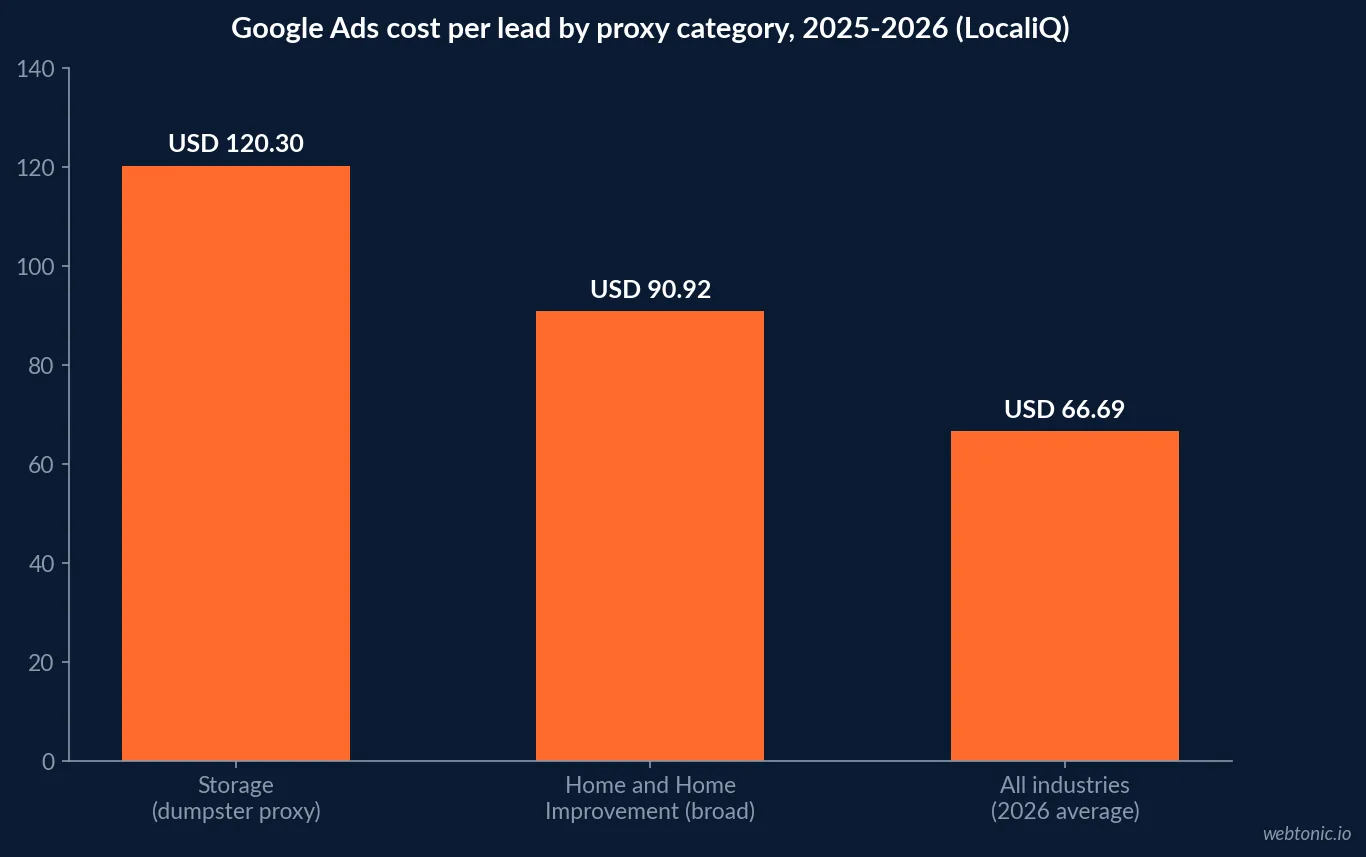
LocaliQ's 2025 home services search advertising benchmarks, built from more than 3,200 campaigns running April 2024 through March 2025, track 16 home service subcategories and do not include junk removal or dumpster rental by name. The closest fit is Storage, which LocaliQ groups container and storage-adjacent demand under, and which this page uses as the primary proxy for dumpster rental search specifically. The broader Home and Home Improvement category average is a second, looser proxy, useful mainly as a sanity check since it blends in contractors, HVAC, and other higher and lower-cost trades.
| LocaliQ 2025 proxy | CTR | CPC | CVR | CPL |
|---|---|---|---|---|
| Storage (primary dumpster/container proxy) | 8.32% | USD 7.46 | 4.65% | USD 120.30 |
| Home and Home Improvement (broad secondary proxy) | 6.47% | USD 8.33 | 8.05% | USD 90.92 |
| All-industry average, 2026 (context) | 6.64% | USD 5.42 | 8.18% | USD 66.69 |
Pricing the lead against the job it's supposed to book
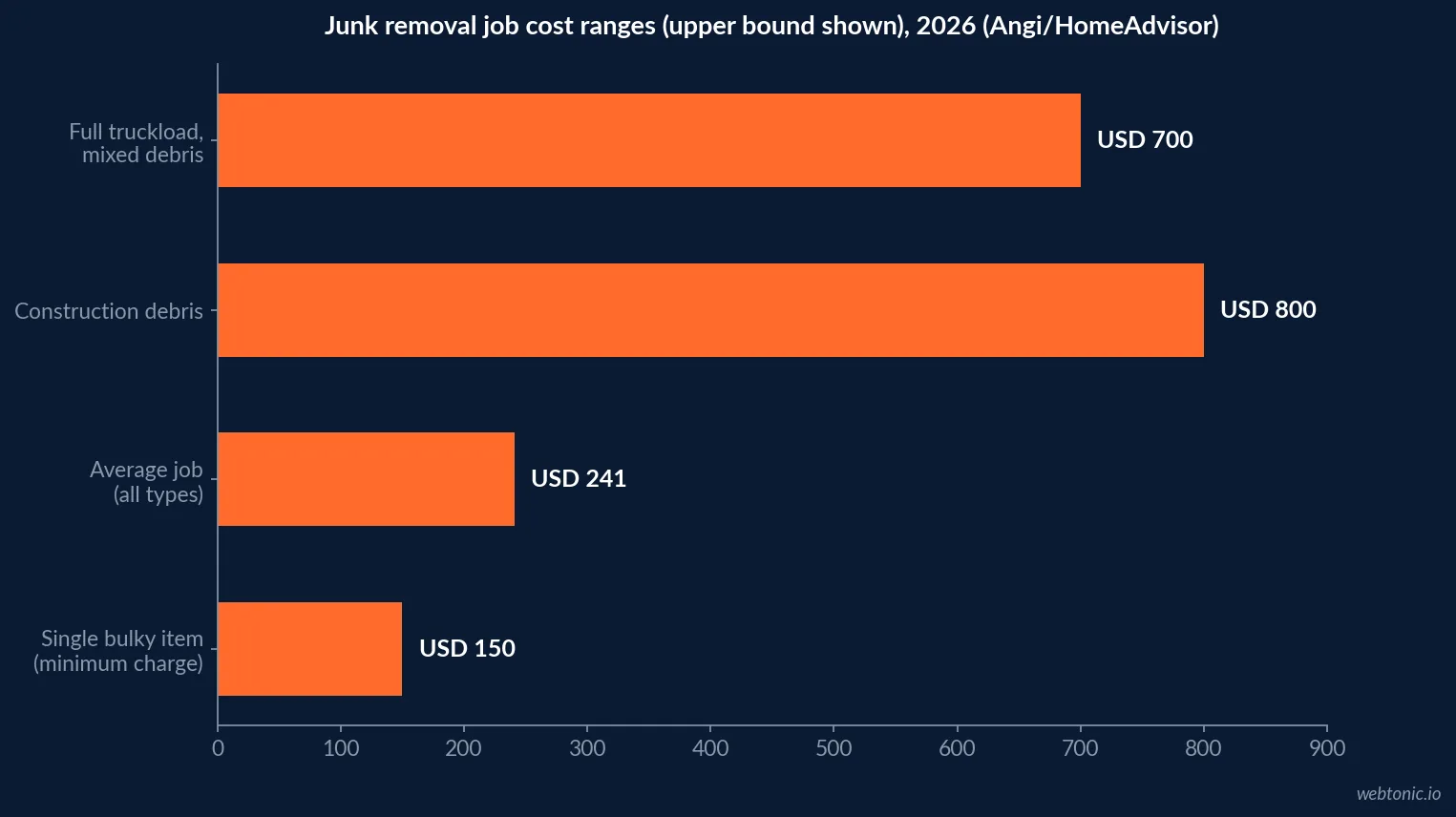
Angi's own cost data, drawn from a survey of more than 30,000 real Angi customers, puts average junk removal cost at USD 241, with most jobs landing between USD 133 and USD 372. A full truckload of mixed debris can reach USD 700 or more. Against a USD 120.30 cost per lead on the Storage proxy, a single average-ticket job absorbs roughly half its revenue in acquisition cost before the close rate is even applied, which only works at scale if a meaningful share of leads convert to booked jobs; that close-rate figure is not published for this specific pairing, so this is a directional read on unit economics, not a guaranteed margin.
| Angi/HomeAdvisor junk removal cost data (30,000+ customer survey, 2026) | Figure |
|---|---|
| Average job cost | USD 241 |
| Normal range | USD 133 - USD 372 |
| Minimum charge, single bulky item | USD 60 - USD 150 |
| Full truckload of mixed debris | USD 450 - USD 700+ |
| Construction debris removal | USD 100 - USD 800 |
What happens once the call connects
Google Ads for this industry is overwhelmingly a phone-call channel, not a form-fill channel, which makes call handling as much a part of the budget's return as the bid strategy. Invoca's 2026 Home Services Lead Conversion Benchmarks Report, built on anonymized call data across nine home services sub-industries, found 52% of calls to home services businesses are answered by a person, rising to 73% for calls lasting over 30 seconds. Of calls a person answers, 38% are real leads, and 45% of those convert on the call itself, Invoca's highest lead rate of any channel it tracked in 2026 going to ChatGPT-referred calls specifically, ahead of paid search.
The same report found 55% of home services businesses don't ask a lead to buy or book the job at all on the call, a gap that costs nothing in ad spend to fix and, on this data, may matter more to close rate than the bid strategy behind the Google Ads lead in the first place. None of these figures are junk removal-specific; all are Invoca's broader home services findings.
| Invoca 2026 Home Services Lead Conversion Benchmarks (cross-industry) | Figure |
|---|---|
| Calls answered by a person | 52% (73% for calls over 30 seconds) |
| Answered calls that are real leads | 38% |
| Leads that convert on the call | 45% |
| ChatGPT-referred call lead rate (highest of any channel) | 45% |
| Businesses that never ask the lead to buy or book | 55% |
The labor and materials floor under every roll-off job
The U.S. Bureau of Labor Statistics' May 2025 Occupational Employment and Wage Statistics puts the median wage for Refuse and Recyclable Material Collectors (SOC 53-7081) at USD 20.94 an hour, or USD 43,540 a year, across an estimated 132,240 workers nationally, with the top 10% earning USD 30.96 an hour or more. That direct-labor cost sits underneath every roll-off delivery and hauling job this industry's Google Ads spend is trying to book, and it rises independent of what happens to CPC or CPL.
Demand for that labor is structurally large: the EPA's Advancing Sustainable Materials Management data puts total U.S. municipal solid waste generation at 292.4 million tons in the most recent year reported, tracked separately from construction and demolition debris, which the EPA also measures as its own, larger category. IBISWorld's industry summary counts 19,980 waste collection services businesses competing for that volume in 2026, growing 2.1% a year.
| Structural fact | Figure | Source |
|---|---|---|
| Median wage, Refuse and Recyclable Material Collectors | USD 43,540/yr (USD 20.94/hr) | BLS OEWS, May 2025 |
| Estimated workers in that occupation | 132,240 | BLS OEWS |
| U.S. municipal solid waste generated (latest year) | 292.4 million tons | EPA ASM |
| Waste collection services businesses, 2026 | 19,980 | IBISWorld |
| Industry growth rate | 2.1%/year | IBISWorld |
How this compares to the all-industry Google Ads picture
Set against LocaliQ's 2026 all-industry benchmark of a 6.64% click-through rate and a USD 66.69 cost per lead across 13,474 campaigns and 23 industries, the Storage proxy this industry maps to runs both a higher CTR (8.32%) and a notably higher cost per lead (USD 120.30). That combination, more clicks and a higher price per conversion, points to a category with real search demand and real competition for it, which is consistent with a fragmented, growing 19,980-business market rather than a niche with thin search volume.
| Metric | Storage proxy (2025) | All-industry average (2026) |
|---|---|---|
| Click-through rate | 8.32% | 6.64% |
| Cost per click | USD 7.46 | USD 5.42 |
| Conversion rate | 4.65% | 8.18% |
| Cost per lead | USD 120.30 | USD 66.69 |
What a single operator can generate, as a scale reference
1-800-GOT-JUNK?'s 2025 Franchise Disclosure Document Item 19 filing, the legally required financial performance representation franchisors must file under FTC Rule 16 CFR 436, discloses an average franchisee gross revenue of USD 2,311,990 across 288 US franchised and FlywheelDBA locations operating more than one day in 2024, per FRANdata's published FDD summary. That figure is one franchise system's own disclosure, not an industry average, and it is included here only as a scale reference for what a well-run multi-territory operator can generate against the lead costs and job values above.
What a defensible first Google Ads budget looks like
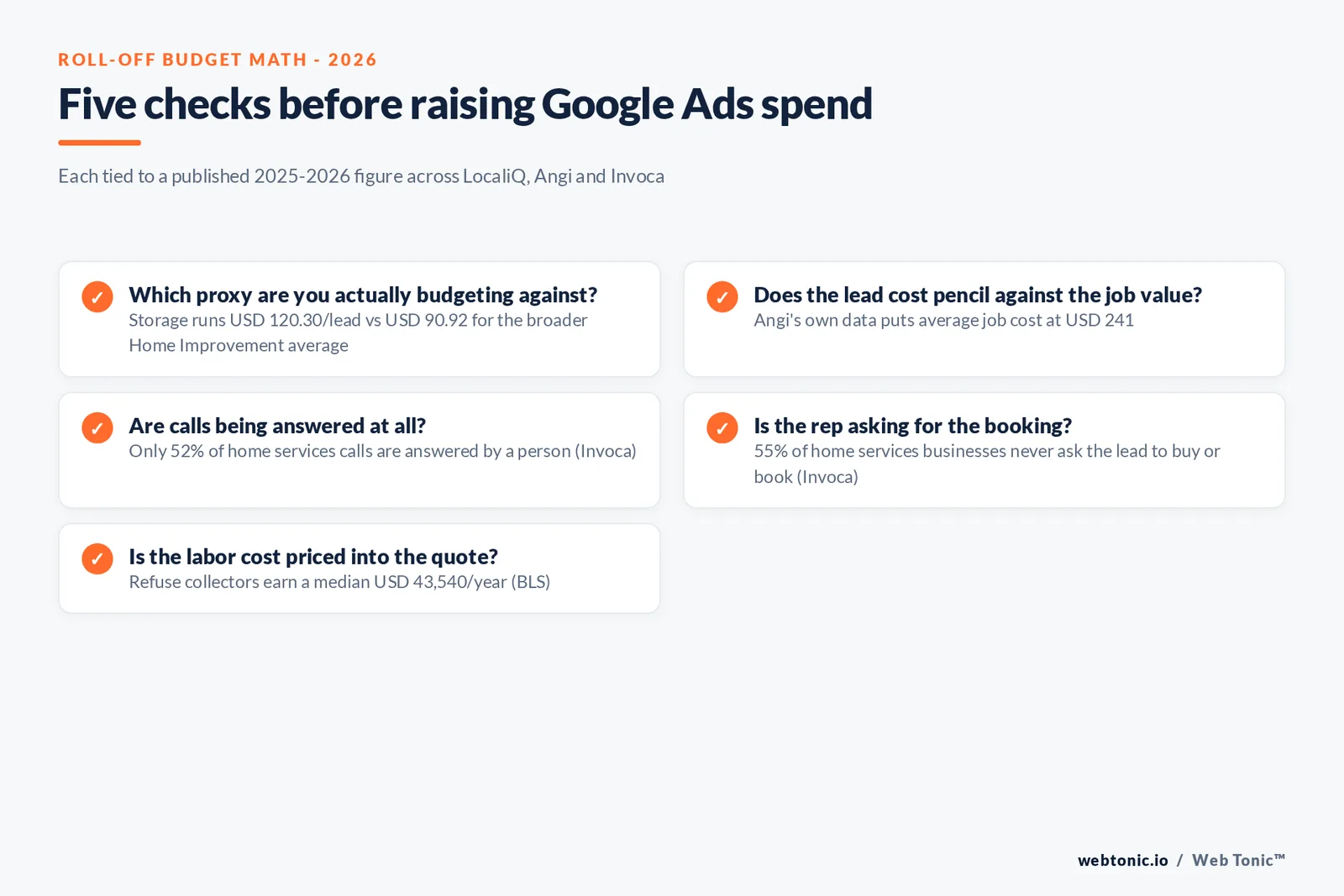
Given the USD 120.30 Storage proxy, the USD 241 average job value, and the 55% of businesses that never ask the lead to book, the highest-leverage first move for this industry is not raising bids, it is fixing the call-handling gap Invoca's data flags, since that costs nothing in ad spend and directly affects the conversion side of the same unit economics. Only once answer rates and booking asks are fixed does raising the Google Ads budget itself become a defensible next step, because a higher-volume campaign feeding an unfixed call process just buys more of the same 55% miss rate at a higher total cost.
| Budget sequencing, in priority order | Cost | Why it comes first |
|---|---|---|
| 1. Fix call answer rate and booking ask | USD 0 in ad spend | 52% answer rate and 55% no-ask rate are the cheapest fixes available |
| 2. Confirm cost per lead against the USD 241 job value | Analysis only | Sets the real ceiling for a sustainable CPL |
| 3. Scale Google Ads spend on the Storage/Home Improvement proxy | Variable, USD 90-120/lead | Only pencils out once steps 1-2 are done |
Where to go from here
Our Google Ads practice builds campaigns against proxy-and-job-value math like the above rather than a guessed budget. Our growth marketing practice handles the call-handling and booking-ask fixes this data flags as the higher-leverage first move. For the organic side of the same industry, our companion piece on building a Google Ads strategy covers the account-structure decisions this data should inform.
Frequently Asked Questions
Does Google Ads publish a junk removal or dumpster rental benchmark?
No. LocaliQ's 2025 home services search advertising benchmarks report, built from 3,200-plus campaigns, tracks 16 home service subcategories and neither junk removal nor dumpster rental is one of them. The closest proxy is Storage, which covers container and storage-adjacent search demand, and this page states that scope every time the figure is used.
What does a dumpster rental lead cost on the closest published proxy?
Using the Storage proxy, LocaliQ's 2025 data puts cost per lead at $120.30, cost per click at $7.46, click-through rate at 8.32%, and conversion rate at 4.65%. The broader Home and Home Improvement category average, a second, less-precise proxy, runs cheaper at $90.92 per lead, which suggests the Storage-specific proxy may be closer to the truth for container rental specifically, since it is a narrower, more comparable category.
Is that cost per lead worth it against what a job is worth?
On the numbers available, yes, with a caveat. Angi's own survey of over 30,000 customers puts average junk removal cost at $241, with a normal range of $133 to $372 (HomeAdvisor/Angi, 2026). A $120.30 cost per lead against a $241 average ticket implies roughly 50% of one job's revenue spent to acquire it before any conversion-rate math, which only pencils out at scale if the close rate on those leads is reasonably high; neither Angi nor LocaliQ publish a close rate for this specific pairing, so this is a directional read, not a guaranteed return.
How big is the labor cost behind a roll-off or hauling job?
The U.S. Bureau of Labor Statistics' May 2025 Occupational Employment and Wage Statistics puts the median wage for Refuse and Recyclable Material Collectors (SOC 53-7081) at $20.94 an hour, $43,540 a year, across an estimated 132,240 workers nationally. That is the direct-labor floor underneath every roll-off pickup and hauling job this industry's Google Ads budget is trying to book, and it is rising in line with the broader home services wage trend.
Does material volume support continued demand for this industry?
The demand side is large and durable. The EPA's national materials data puts total U.S. municipal solid waste generation at 292.4 million tons in the most recent year reported, with construction and demolition debris tracked as a separate, larger category. That volume is the structural reason waste collection services is a 19,980-business, 2.1%-a-year-growth industry (IBISWorld, 2026), independent of any single company's ad performance.
Sources
LocaliQ - Search Ad Benchmarks for Home Services, 2025
WordStream/LocaliQ - Search Advertising Benchmarks by Industry, 2026
Angi - How Much Does Junk Removal Cost, 2026 Data
Invoca - Home Services Lead Conversion Benchmarks Report 2026
U.S. Bureau of Labor Statistics - OEWS, Refuse and Recyclable Material Collectors, May 2025
U.S. EPA - National Overview: Facts and Figures on Materials, Wastes and Recycling
IBISWorld - Waste Collection Services industry summary, 2026
FRANdata - 1-800-GOT-JUNK? Franchise Disclosure Document data, 2025 FDD