



Table of contents
Google Ads is how the fastest-growing beauty and skincare brands acquire customers at scale — and the auction has never been more competitive. This report compiles the most important Google Ads statistics for the beauty and personal care industry in 2026, covering everything from average cost per click to incremental ROI by campaign type. The data comes from aggregated benchmark studies, incrementality analyses, and market-share trackers covering thousands of advertisers, so you can plan budgets, set targets, and optimize your marketing campaigns with real numbers rather than guesswork. Whether you sell skincare products online, run a skin care clinic, or manage Google Ads campaigns for beauty brands, this guide gives you the benchmarks that matter.
Key Takeaways
- The average CPC for beauty and personal care Google Ads campaigns is $5.70 — slightly above the all-industry average of $5.26, with a typical range of $4.28 to $7.70 (PPCChief).
- Average cost per lead for beauty marketing campaigns sits at $60.34 — well below the cross-industry average of $70.11 — making the beauty industry one of the more efficient categories for lead generation on the Google Ads platform (PPCChief).
- Conversion rates average 7.8%, above the all-industry benchmark of 7.5%, with top-performing Shopping feeds reaching 10–12%.
- Incremental ROI for Search Brand campaigns in the beauty and skin care space is 3.71×, while Performance Max delivers 2.37× and Search Non-Brand sits at 1.70× (Cassandra).
- Total advertising spend in the global beauty personal care market is projected to hit $11.4 billion in 2026, up from $7.7B in 2022, with the digital share climbing to 43.7% (Statista).
- More than 6,000 advertisers compete daily in US beauty and personal care Google Ads auctions, led by Sephora (~11% share of spend) and CVS (~10%) (Adthena).
Beauty Google Ads Benchmarks at a Glance (2026)
Before exploring the details, here is how the core Google Ads metrics for beauty and skincare brands stack up against the overall averages. This data helps marketing teams set realistic campaign targets and compare their own account performance against industry norms:
| Metric | Personal care benchmark | All-industry average | Source |
|---|---|---|---|
| Average CPC (search) | $5.70 | $5.26 | PPCChief |
| Cost per lead | $60.34 | $70.11 | PPCChief |
| Click-through rate | 5.7% | 6.7% | PPCChief |
| Conversion rate | 7.8% | 7.5% | PPCChief |
| Incremental ROI (search brand) | 3.71× | 4.14× | Cassandra |
| Incremental ROI (PMax) | 2.37× | 4.64× | Cassandra |
Beauty and skincare brands convert slightly above average but deliver below-average incremental returns on non-brand search. For marketing managers in this industry, that means cost discipline and product-feed quality are make-or-break factors for Google Ads profitability.
How Much Do Google Ads Cost for Beauty and Skincare Brands?
Click costs for beauty, skin care, and personal care products on Google vary by product type, consumer intent, and geography. The 2026 benchmark data shows a mid-point CPC of $5.70, with premium skincare sub-categories commanding significantly higher bids (PPCChief):
| Keyword category | Typical CPC range | Why |
|---|---|---|
| Branded terms (own brand) | $0.50–$2.00 | Low competition, high intent, defensive bidding |
| Generic skincare (moisturizer, serum) | $2.00–$5.00 | Broad intent, high volume, moderate case value |
| Concern-specific (acne treatment, anti-aging) | $4.00–$8.00 | Higher purchase intent and lifetime value |
| Professional / clinical (dermal filler, laser) | $8.00–$20.00+ | High case value ($500–$5,000+), FDA-regulated |
| Subscription / replenishment (vitamin C serum refill) | $1.50–$4.00 | Repeat purchase intent, lower perceived risk |

Geography also plays a major role in Google Ads costs for beauty brands. Advertisers in New York and Los Angeles pay 30–50% above the national average, while mid-market cities like Chicago and Dallas stay closer to the median. Skincare brands selling products online nationally can smooth out regional spikes by using growth-focused campaign structures that separate high-CPC metros from the rest of the country. The personal care market in metro areas is large enough that splitting campaigns by region often improves both cost per lead and ad relevance.
Beauty Google Ads Conversion Rates and Cost per Lead
The 7.8% average conversion rate for beauty Google Ads campaigns sits just above the cross-industry median — but the top quartile of skincare and personal care advertisers converts at 10–12%, largely thanks to well-optimized product feeds and dedicated landing pages that speak directly to consumers' specific skin concerns. Here is what the data shows by campaign format:
- Shopping / product listing ads convert at 8–12% because the visual format pre-qualifies shoppers — they see the price, image, and reviews before clicking.
- Search text ads land between 5% and 8%, with higher rates on concern-specific terms ("best retinol for acne scars") than on generic queries ("face cream").
- Performance Max blends formats and typically delivers a 6–9% conversion rate when fed a quality product feed and accurate conversion signals.
- The average cost per lead of $60.34 reflects a mix of e-commerce purchases and lead-form fills (consultation bookings, skin care quiz completions). For DTC beauty brands marketing skincare products with an AOV above $50, the unit economics work out favorably at this CPL.
A critical nuance for beauty marketing managers: waste rates in the skincare and personal care vertical average 25% of Google Ads spend — meaning roughly one dollar in four goes to irrelevant clicks. Consumers searching for beauty products use highly specific queries (ingredient names, skin concerns, product formats), so aggressive negative-keyword management and regular search-term mining are the simplest levers to push cost per lead down without increasing budgets.
Incremental ROI by Google Ads Campaign Type
Platform-reported ROAS tells you what the Google Ads algorithm claims it delivered. Incremental ROI — measured through holdout tests and media mix models — tells you what your marketing spend actually caused. The gap matters enormously for beauty and skincare advertisers, where brand search often gets inflated credit because consumers already know the brand from social media or influencer content. According to Cassandra's 2026 incrementality study across hundreds of advertisers (Cassandra):
| Campaign type | Personal care median ROI | All-industry median | Takeaway |
|---|---|---|---|
| Search Brand | 3.71× | 4.14× | Slightly below average — strong organic brand presence offsets paid lift |
| Search Non-Brand | 1.70× | 5.21× | Well below average; high variance (0.01×–15.53×) signals winner-take-most dynamics |
| Performance Max | 2.37× | 4.64× | PMax under-indexes, likely because Shopping cannibalizes branded conversions |
| Demand Gen / Discovery | ~2.2× (est.) | 2.22× | Closer to average; visual formats suit the category well |
The most striking finding: non-brand search delivers only 1.70× incremental ROI for beauty brands — less than a third of the all-industry median. This means that many skincare brands over-invest in prospecting keywords that do not actually drive net-new revenue. The smartest beauty marketing teams in the industry are shifting budget toward Shopping campaigns and Demand Gen ads where high-quality product imagery and user generated content give this visual category a natural advantage in online advertising platforms.
Competitive Landscape: Who Dominates the Beauty Google Ads Auction?
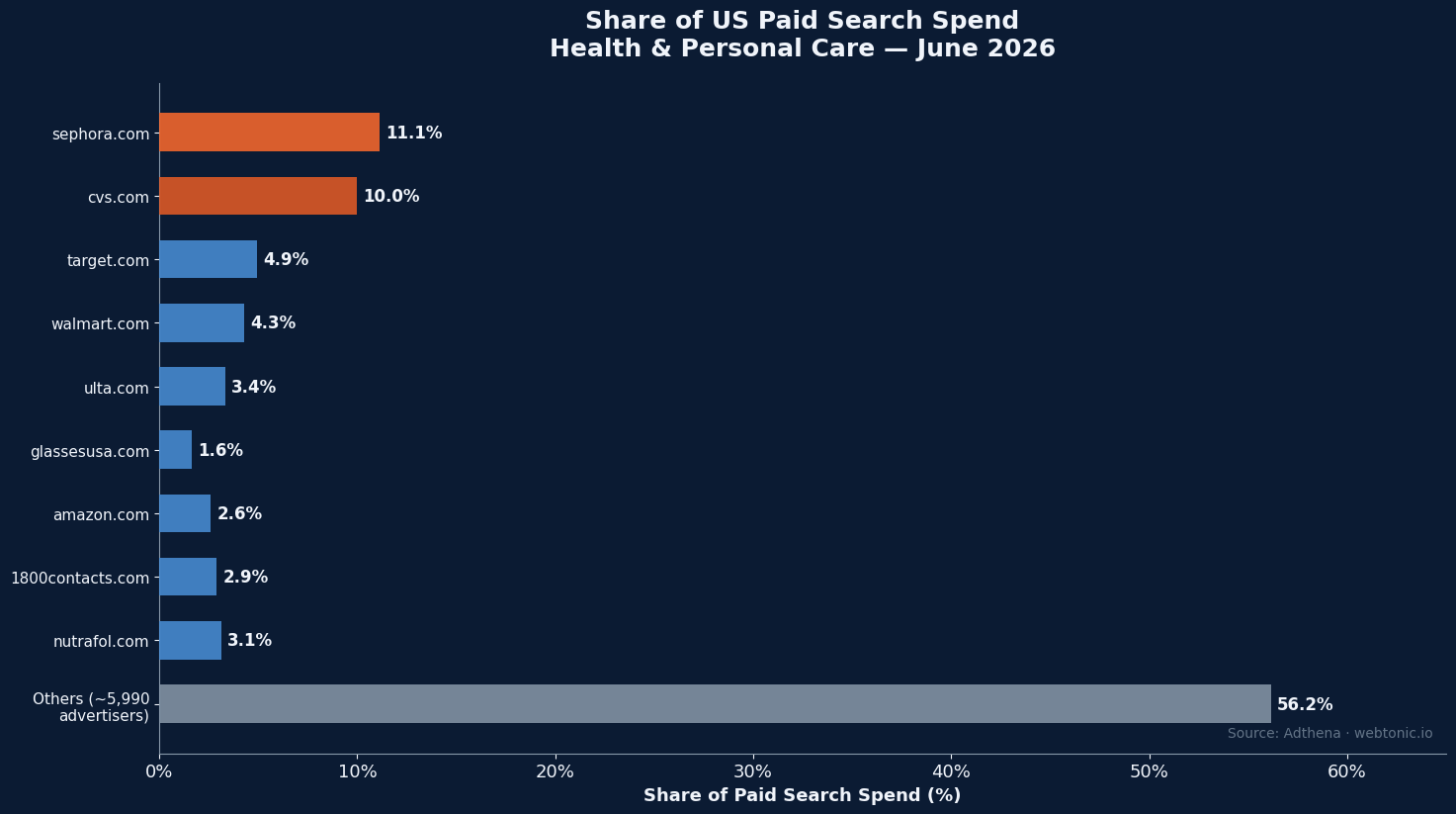
Adthena's Whole Market View for US retail beauty and personal care shows just how crowded the Google Ads auction is for skincare and cosmetics products (Adthena):
- More than 6,000 active advertisers compete in the category on any given day, peaking above 6,100 on high-traffic dates.
- Sephora leads with ~11% share of spend, followed by CVS (~10%), Target (~5%), Walmart (~4.3%), and Ulta (~3.4%).
- Amazon's share of Google Ads spend in the beauty vertical fluctuates between 2% and 4%, showing that even the marketplace giant uses the platform aggressively for its personal care private-label products.
- Niche DTC skincare brands like Nutrafol hold 2–3% share, proving that smaller labels with focused beauty products can compete with retail giants on specific keyword clusters when their ads and landing pages match what consumers are actually searching for.
The implication for mid-size beauty brands and skin care clinics: head-to-head bidding against Sephora or CVS on broad terms is economically irrational. Winning on Google requires owning specific skin concerns — targeting keywords like "best niacinamide serum for hyperpigmentation" rather than "face serum" — where the retail giants' broad catalogues of beauty products dilute their relevance scores in the Google Ads auction.
Beauty Industry Ad Spend: Where the Marketing Budget Flows
The Google Ads numbers sit inside a larger beauty industry advertising story. The global beauty personal care market is projected to reach $720 billion in total revenue in 2026 (Statista), and advertising budgets are expanding at a pace that matches:
- Total ad spend: $11.4 billion projected for 2026, up from $7.7 billion in 2022 — a roughly 48% increase in four years.
- Digital now absorbs 43.7% of total spend, up from 34.1% in 2022 — and is on track to surpass 50% within two years.
- Programmatic digital accounts for 48% of the total, funneling budget into social video, Shopping feeds, and real-time bid optimization.
- Short-form video formats (Reels, Shorts, TikTok) deliver 27% higher click-through rates than static formats, which is why Demand Gen and video action campaigns are growing fastest inside Google's advertising platforms. Beauty consumers engage with video content at higher rates than almost any other industry online.
For beauty marketing teams allocating budgets across channels and platforms, the data suggests Google Ads remains the highest-intent acquisition channel for skincare brands, but it should sit alongside social media advertising (where visual creative drives product discovery among new consumers) and SEO (which compounds over time at lower per-acquisition cost). Most successful beauty brands run a multi-platform marketing strategy where Google captures high-intent demand while social platforms generate awareness.
Google Shopping and Product Feed Optimization for Beauty Brands
Product listing ads — whether in Standard Shopping or Performance Max — are the workhorse Google Ads format for e-commerce operators selling beauty and skincare products online. The data points to several feed optimizations that separate top performers from the pack (AdsPolar):
- Custom labels by concern or skin type (e.g., "Sensitive Skin," "Anti-Aging," "Acne-Prone") allow beauty advertisers to set different ROAS targets and bids by product segment — because a $95 retinol serum and a $12 cleanser require different marketing economics.
- Rich product descriptions with ingredient lists and concern tags improve algorithmic matching and push Shopping ads into higher-quality auctions.
- Review extensions and star ratings are disproportionately influential in Google Shopping ads for beauty products because consumers rely heavily on social proof and online reviews when evaluating skincare formulations for their specific skin type.
- Lifestyle imagery in Merchant Center performs better than pack shots for DTC operators — open-box testing by several agencies shows 15–25% higher CTR with in-use imagery versus white-background product photos.
Beauty brands that treat their Google product feed as a living asset — updating it weekly with seasonal tags, new reviews, and promotional pricing — consistently outperform skincare brands that set-and-forget. The platform rewards fresh, accurate data with better ad placements and lower costs.
7 Data-Backed Best Practices for Beauty and Skincare Google Ads Campaigns
- Segment Google Ads campaigns by skin concern, not just product category. Concern-specific ad groups ("hyperpigmentation serum," "rosacea-friendly moisturizer") convert ~60% better than broad category groups because they match the way beauty consumers actually search online.
- Prioritize Shopping and product-feed quality. With 8–12% conversion rates, Shopping consistently outperforms text search in this vertical. Invest in feed optimization before scaling text ad spend.
- Defend branded terms selectively. The 3.71× incremental ROI on brand search means the return is real but modest. Run brand campaigns where competitor conquesting is active; pause where your organic listing dominates unchallenged.
- Use negative keywords aggressively. A 25% waste rate means a $10,000/month account loses ~$2,500 to irrelevant clicks. Weekly search-term reviews and n-gram analysis pay for themselves immediately.
- Test Demand Gen ads for visual discovery. The format's ~2.2× incremental ROI closely matches the all-industry average, and the highly visual nature of beauty and skincare content — including user generated content from social media platforms — gives this market a natural advantage in Google's visual ad placements.
- Build landing pages around specific concerns. "Best retinol for fine lines" landing pages with ingredient breakdowns, before/after imagery, and quiz-style CTAs convert better than general collection pages. FDA disclosure compliance is non-negotiable for any clinical claim.
- Track micro-conversions, not just purchases. Skin care quiz completions, email signups, sample requests, and "add to routine" clicks give Google's Smart Bidding additional signals about which consumers are most likely to buy. Beauty brands feeding 3+ conversion events to the algorithm see 15–20% better cost efficiency than those tracking purchases alone.
For a detailed tactical walkthrough on Google Ads campaign architecture, see our guide on building a strategy that improves ROI. For cost planning across the entire platform, check our complete Google Ads pricing guide.
Related reading
- 2026 Google Ads Stats for Personal Injury Law: CPC, CPL & ROI Benchmarks
- Plumbing Google Ads Statistics (2026): CPC, CPL & ROI Benchmarks
- Rehab & Addiction Treatment Google Ads Trends: Data-Driven Insights for 2026
- Paid Search services at Web Tonic
FAQ: Google Ads for Beauty and Skincare Brands
What is the average CPC for beauty and skincare Google Ads in 2026?
The average CPC is $5.70, with a typical range of $4.28 to $7.70 depending on keyword category, geography, and competition level. Branded terms can cost under $2, while clinical and procedure-related terms frequently exceed $10–$20.
What ROAS should a beauty or skincare brand target on Google Ads?
Platform-reported ROAS targets of 4–6× are common, but incremental ROI data shows the true return is closer to 2.4–3.7× depending on campaign type. Set targets based on incrementality-adjusted returns and blended customer lifetime value, not just last-click attribution.
Is Performance Max effective for beauty and skincare advertisers?
PMax delivers a median incremental ROI of 2.37× in the vertical — below the cross-industry average of 4.64×. The gap is partly because PMax cannibalizes branded Shopping conversions it would have captured anyway. Operators who exclude brand terms from PMax and run a separate brand search campaign typically see better blended returns.
How can smaller DTC labels compete against Sephora and CVS in the auction?
By targeting specific concerns rather than broad product categories. Niche operators like Nutrafol hold 2–3% of total US paid search spend in the sector despite competing against retailers with 100× their catalogue. The key: own a narrow keyword cluster where your product relevance and landing page experience beat the generalists.
How much should a beauty or skincare brand spend on Google Ads per month?
Most DTC beauty brands start at $3,000–$8,000 per month on Google Ads to generate statistically significant marketing data, then scale based on unit economics. Established multi-product skincare lines often spend $15,000–$50,000+. The decision should be anchored to your CPL target ($45–$81 range) and customer lifetime value, not an arbitrary percentage of revenue.
Sources
PPCChief — Average Cost Per Click: Beauty & Personal Care
Cassandra — Google Ads Benchmarks 2026 (Incremental ROI Analysis)
CreativeGrade — Beauty & Skincare Google Search CPC Benchmark
Adthena — US Retail Health & Beauty PPC Market Share Analysis
AdsPolar — Google Ads Tips for Skincare Brands
WordStream — Google Ads Industry Benchmarks
Statista — Beauty & Personal Care Market Outlook


