Table of contents

An investor-ready growth plan is the marketing half of a diligence pack: unit economics an analyst can rebuild, channel evidence for the trailing year, and a forward plan that reconciles to the financial model. It is not a pitch narrative, and it is needed less often than founders assume.
Key Takeaways
- The plan exists to answer five diligence questions: does the data match the deck, are the unit economics real, is growth diversified, is retention durable, and is the attribution credible.
- It is a finite exercise — about 47 recurring diligence questions, a Series A data room of 80–150 documents, and a practical bar of answering any question with evidence in 10 minutes.
- The numbers are rebuilt, not read: fully loaded CAC, CAC by channel, cohort retention, and gross-margin-adjusted payback, with SaaS payback expected under 12–18 months.
- A 3:1 LTV:CAC ratio is the baseline expectation at Series A; below 2:1 is hard to defend and above 5:1 raises underinvestment questions.
- Concentration is judged as fragility — over 60–70% of new revenue from one channel is a flagged risk even when that channel is efficient.
- Preparation is priced: companies that arrive ready reportedly raise at 20–40% higher valuations, and confirmatory diligence still takes 3–6 weeks after a term sheet.
- You need this when a raise, a board mandate or an acquisition conversation is inside 6 months. You do not need it to run a marketing function well.
What the artefact contains
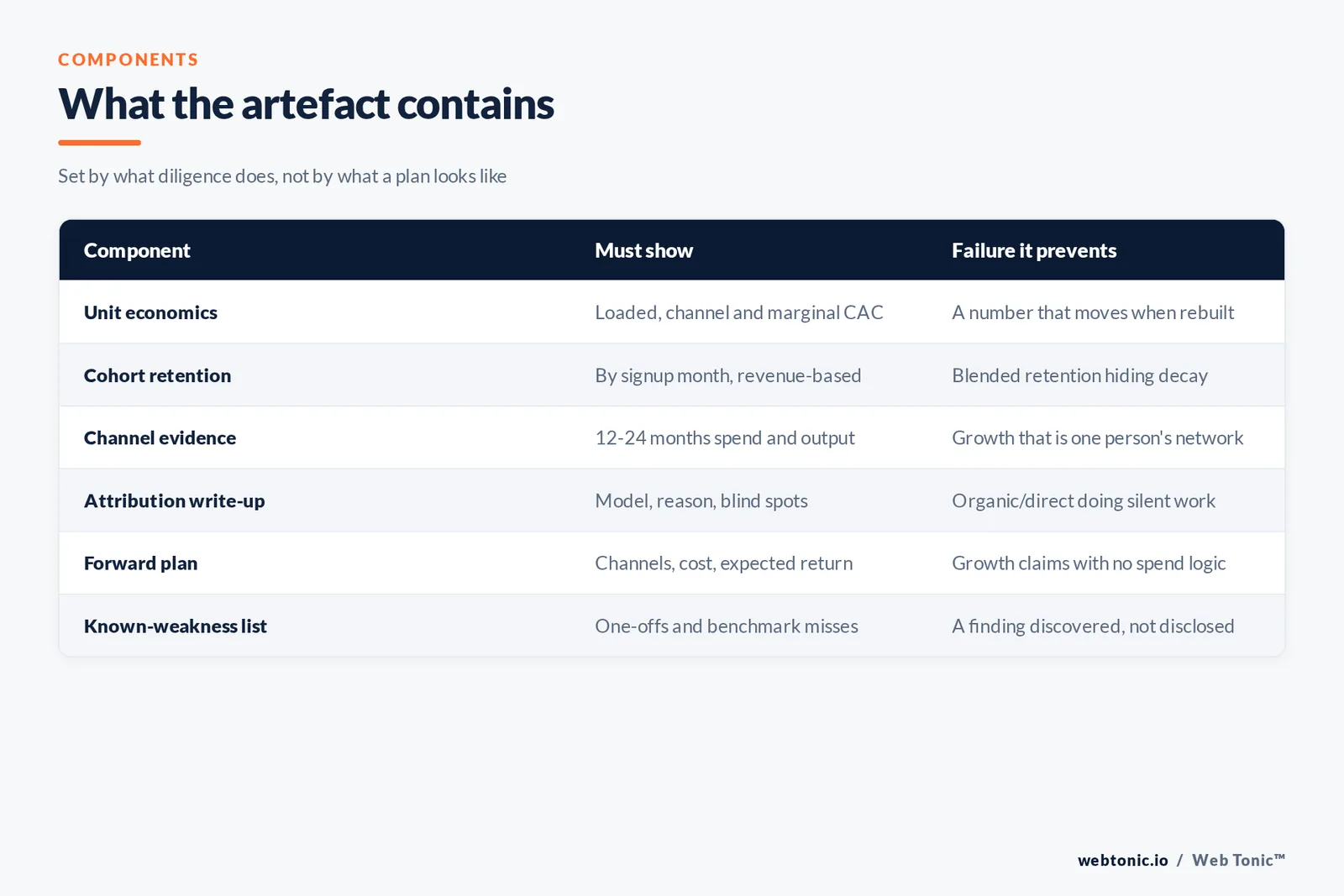
The contents are set by what diligence actually does. Marketing due diligence runs after a fund says it is interested and before a term sheet, conducted by a partner, an associate or an outside consultant, and it tests five things: whether numbers in the pitch survive cross-checking against raw exports, whether CAC and LTV hold when recalculated from source data, how much of new revenue depends on one channel or one person, whether retention is durable cohort by cohort, and whether attribution can show where customers really came from.
That produces a specific document set, narrower and more technical than a generic checklist: the CAC and LTV calculation with formula and source data shown; channel-by-channel spend and output for the trailing 12–24 months; cohort retention tables by signup month; read-only ad-account access or exports covering the same period the deck claims; analytics access so the funnel can be rebuilt independently; a CRM export with pipeline source, win rate and sales-cycle length; an attribution write-up naming its blind spots; and a list of paused or one-time campaigns that inflated any historical period.
| Component | What it must show | The failure it prevents |
|---|---|---|
| Unit economics rebuild | Loaded CAC, channel CAC, marginal CAC, LTV method | A number that moves when someone else calculates it |
| Cohort retention | By signup month, revenue-based where expansion exists | Blended retention hiding a decaying cohort |
| Channel evidence | 12–24 months of spend and output per channel | Growth that turns out to be one founder's network |
| Attribution write-up | The model, the reason, the blind spots | "Organic/direct" doing unexplained work |
| Forward plan | Channels, cost per channel, expected return, dates | A growth claim with no matching spend logic |
| Known-weakness list | One-off campaigns, gaps, benchmark misses | A finding discovered rather than disclosed |
The standards it is judged against
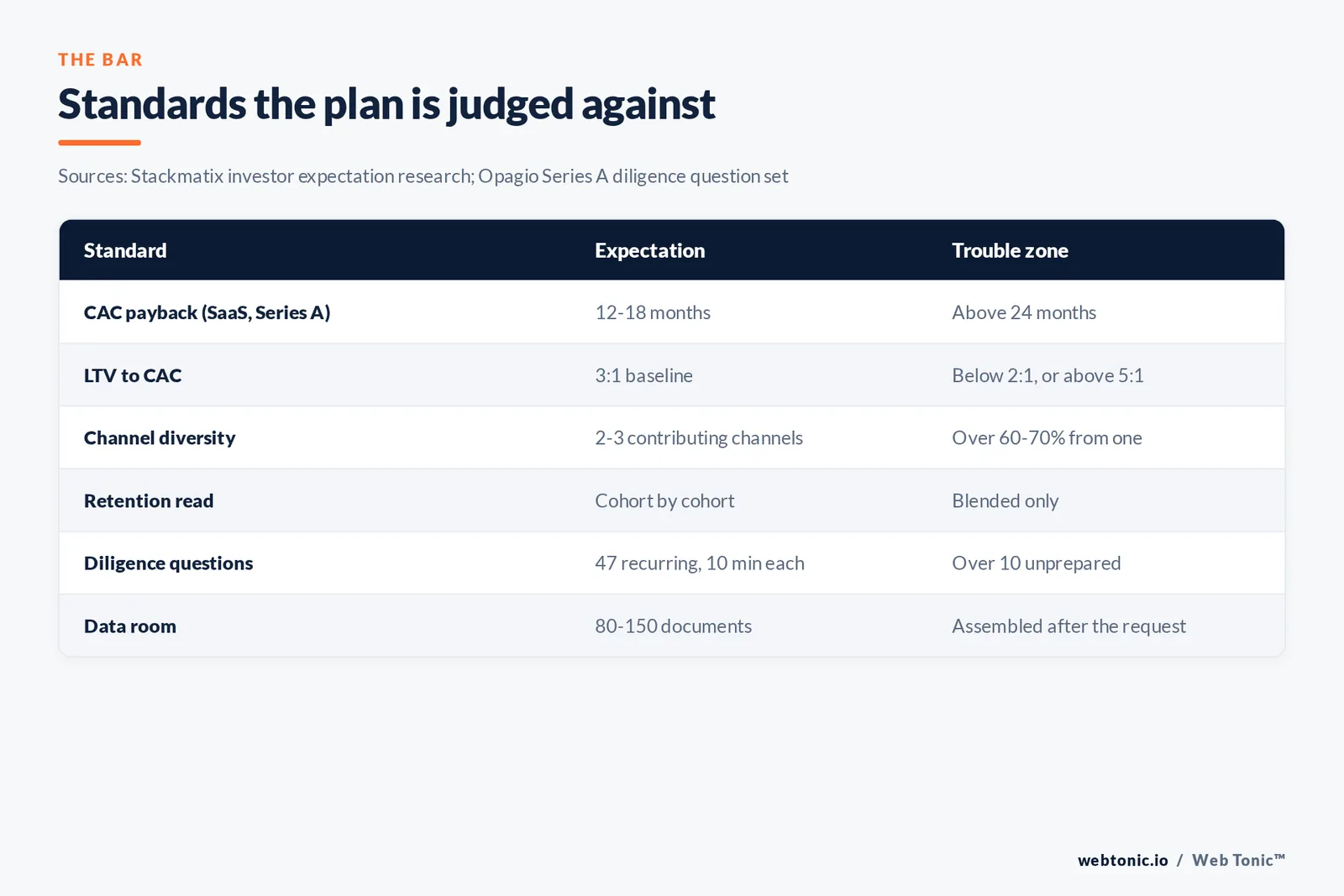
A plan is only investor-ready relative to published expectations. Investor expectation research sets the practical bar: Series A SaaS CAC payback of 12–18 months (consumer faster, and above 24 months needing a compelling LTV argument), an LTV:CAC ratio of 3:1 or better as the baseline, funnel conversion at every stage rather than top-of-funnel traffic, and channel diversity as a resilience indicator — two to three contributing channels reading healthier than one efficient dominant source. It also notes that the expectations shift by stage: seed tests customer-discovery discipline and early retention, Series A tests a repeatable acquisition motion, Series B tests whether the machine scales with headcount and budget.
The question set itself is public. One published diligence framework catalogues 47 recurring questions across seven categories — team, market, product, go-to-market, financials, governance and risk — and makes the operative point that partners do not carry the checklist into the meeting, but the associates writing the memo do. Its threshold is useful as a self-test: fewer than 10 unprepared answers means ready, and the difference between two-week and six-week diligence is how fast questions convert into verifiable evidence.
When you actually need one
The trigger is an outside reader, not an internal ambition. As long as the only audience for your growth numbers is your own team, a working scorecard is enough. The moment someone whose money is at stake will recalculate them, the standard changes: every figure needs a method, a source and a date, and that is a different document.
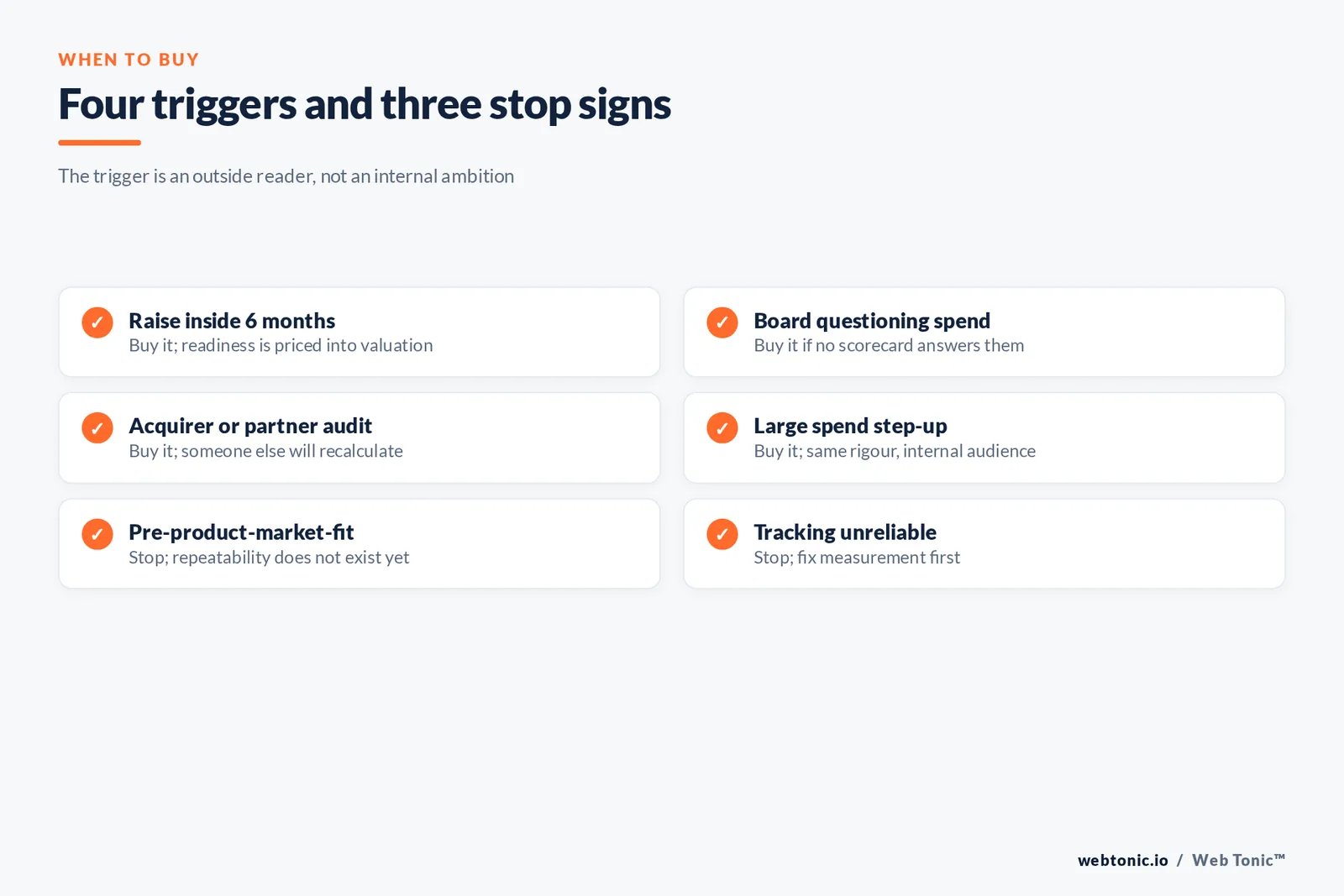
Four situations justify the work. A raise inside 6 months, because readiness guidance defines readiness as surviving 60–90 days of scrutiny without surprises and reports prepared companies raising at 20–40% higher valuations. A new board or investor asking marketing to defend spend. An acquisition or partnership conversation where someone else's analyst will read your numbers. And a large step-up in spend, where the internal case needs the same rigour a fund would apply.
Equally, three situations where it is the wrong purchase. Pre-product-market-fit, when the honest answer to "is acquisition repeatable" is not yet. When the underlying tracking does not exist — that is a measurement project first, and a plan built on broken data will be rebuilt anyway. And when the real need is a competent operator to run marketing, which is a seat rather than an artefact. Series A evaluation guidance frames the test investors are running as whether there is repeatable, capital-efficient growth that more money can accelerate — if the answer is genuinely no, no document fixes it.
| Signal | Buy the plan | Do something else first |
|---|---|---|
| Raise timing | First meetings inside 6 months | No raise planned this year |
| Tracking state | Spend reconciles to invoiced revenue | Conversion tracking unreliable — fix measurement |
| Repeatability | At least one channel works predictably | Pre-PMF; find the motion first |
| Board pressure | Marketing spend being questioned | A working scorecard already answers it |
| Team | Someone can own the pack afterwards | Nobody to maintain it — hire or rent the seat |
| Outside read | An acquirer or partner will audit you | Internal planning only; keep it lightweight |
What "ready" looks like from the outside
Investors form a view before they open the pack. One Series A readiness view puts it bluntly — they Google the company first, and what they see in 30 seconds carries as much weight as months of projections. Its concrete standards are worth copying: a homepage that communicates positioning in under 10 seconds without jargon, quantified case studies rather than "we helped X grow", 8 to 12 long-form articles showing marketing is piloted rather than randomly outsourced, and marketing and sales aligned on shared quarterly objectives with one attribution model. It also puts realistic core preparation at 60 to 90 days.
The forward plan is judged with the same specificity. Investor plan requirements ask for named channels with costs and expected return — "paid search at a $90 blended CAC, plus a partner programme targeting 15 agencies in Q2", not "social media and partnerships". Founder-side guidance names the mirror failure, the unrealistic growth trap: very large year-over-year growth claimed with no corresponding marketing spend, which reads as not understanding your own acquisition cost.
How to commission it
Three rules. Ask for source-level rebuilds rather than restatements — the CAC in the document must be traceable to exports an analyst can re-run, which is the whole point. Insist that known weaknesses are written in: diligence checklist guidance is explicit that assumptions ignoring obvious costs are immediate red flags, and disclosure is cheaper than discovery. And name the owner and the refresh date, because a pack three months stale during a live process is worse than none.
Then scope small. The smallest artefact that answers the five diligence questions beats a twelve-month retainer bought under deadline pressure, and it keeps the option to extend. That is how our growth advisory engagements are shaped, with data intelligence handling measurement repair when the numbers cannot yet be reconciled, and fractional CMO cover when the plan also needs an operator to run it afterwards. Every figure we put in a diligence pack is one an outsider can reproduce — that is the only standard that matters in this document.
The four numbers everything else hangs on
Fully loaded CAC comes first: total sales and marketing spend including salaries, tools and agency fees, divided by new customers. Media spend alone is the most common construction and the easiest to dismantle, because a diligence team will simply add the missing lines and recompute. CAC by channel is second, and it is where blended numbers usually break — one channel with unsustainable economics can prop up an attractive average for a year.
Gross-margin-adjusted payback is third. Computing payback on revenue rather than gross margin flatters the figure, and against the 12–18-month Series A expectation the difference is often the whole answer. Marginal CAC is fourth and most neglected: what the next customer costs at current scale, rather than the historical average that a much larger spend plan would silently inherit. A plan that presents all four, with the method shown, converts the hardest part of a diligence conversation into a short one.
What it costs to be wrong about readiness
The penalty for entering a process unprepared is rarely a flat no. It is time: a longer diligence, more follow-up requests, and a partner's confidence spent on arithmetic instead of on the business. Since confirmatory diligence already runs 3–6 weeks after a term sheet and the process before it commonly takes 6–12 weeks, every avoidable rebuild lands in a window where the company is also trying to hit its quarter.
There is a second, quieter penalty. Numbers assembled under deadline tend to become the numbers the company then manages by, and a CAC definition chosen to look good in a data room is a poor instrument for deciding next year's budget. Building the pack early, from finance-grade inputs, means the artefact that survives diligence is also the one that runs the business — which is the case for doing this work at a calm moment rather than a loud one.
What founders get wrong about the audience
The plan has three readers, and only one of them is the partner who took the meeting. The associate writing the memo needs every claim traceable. The firm's operating advisors want to know whether the growth engine can absorb capital without breaking. And the investment committee reads a summary in which your acquisition economics sit next to other opportunities in the same funding round. Writing for the partner alone produces a document that reads well and fails the second reader.
Practically, that means leading with method rather than ROI claims, stating clearly which channels the capital is meant to scale and what each is expected to return, and separating what you know from what you are assuming. Founders who name their two biggest uncertainties, with the analysis they would run to resolve them, consistently land better than those who present certainty — because the strategic goal of this document is not to look finished. It is to show that the team understands its own numbers well enough to be trusted with more capital.

Frequently Asked Questions
Is this the same as a pitch deck?
No. A deck selects the best numbers to tell a story; this pack is built so the story survives someone else pulling the thread. They should reconcile exactly, which is why the pack is usually written first.
How long does it take to build?
Core preparation realistically takes 60–90 days, though a focused rebuild of unit economics and channel evidence can be done in four to six weeks if access is clean.
Who should own it internally?
One person with authority over both marketing and finance data. Split ownership is the usual reason a pack never reconciles, because nobody can settle a disagreement between platform numbers and invoiced revenue.
What is the most common reason a plan fails diligence?
Optimistic math rather than weak performance — gross instead of net CAC, LTV projected from a young cohort, or payback computed on revenue instead of gross margin. Each is survivable if you flag it first.
Do we need it if we are not raising?
Not as a fundraising artefact, but the components — loaded CAC, cohort retention, channel economics — are how budget decisions should be made anyway. Read more in our resources or talk to our team.
Sources
Marketing due diligence: what VCs check before a term sheet · VC-backed startup marketing: investor expectations · The 47 questions Series A diligence asks · Investor readiness guide and benchmark table · How investors evaluate Series A startups in 2026 · Preparing marketing for a Series A · Business plan requirements for investors 2026 · What makes a business plan investor-ready · Startup due diligence document checklist 2026.