



Table of contents
An investor-ready growth plan is a diligence artifact, not a marketing document: it has to survive an analyst rebuilding your CAC from raw exports. The question is whether you buy that artifact from outside or hire the leader who builds it — and the answer usually turns on your raise calendar, not on price.
Key Takeaways
- The median wait from seed to Series A has stretched to 616 days, and only about 20% of seed-funded companies graduate at all, per Causo's H1 2026 Series A bar report.
- Hiring takes 3 to 5 months to an accepted offer before ramp; Series A diligence itself typically runs 4 to 8 weeks. If the round opens sooner, a hire cannot produce the plan in time.
- A disorganised data room can add 4 to 8 weeks to a close and reduce valuations by 10-15%, while founders who prepare in advance close roughly 30% faster.
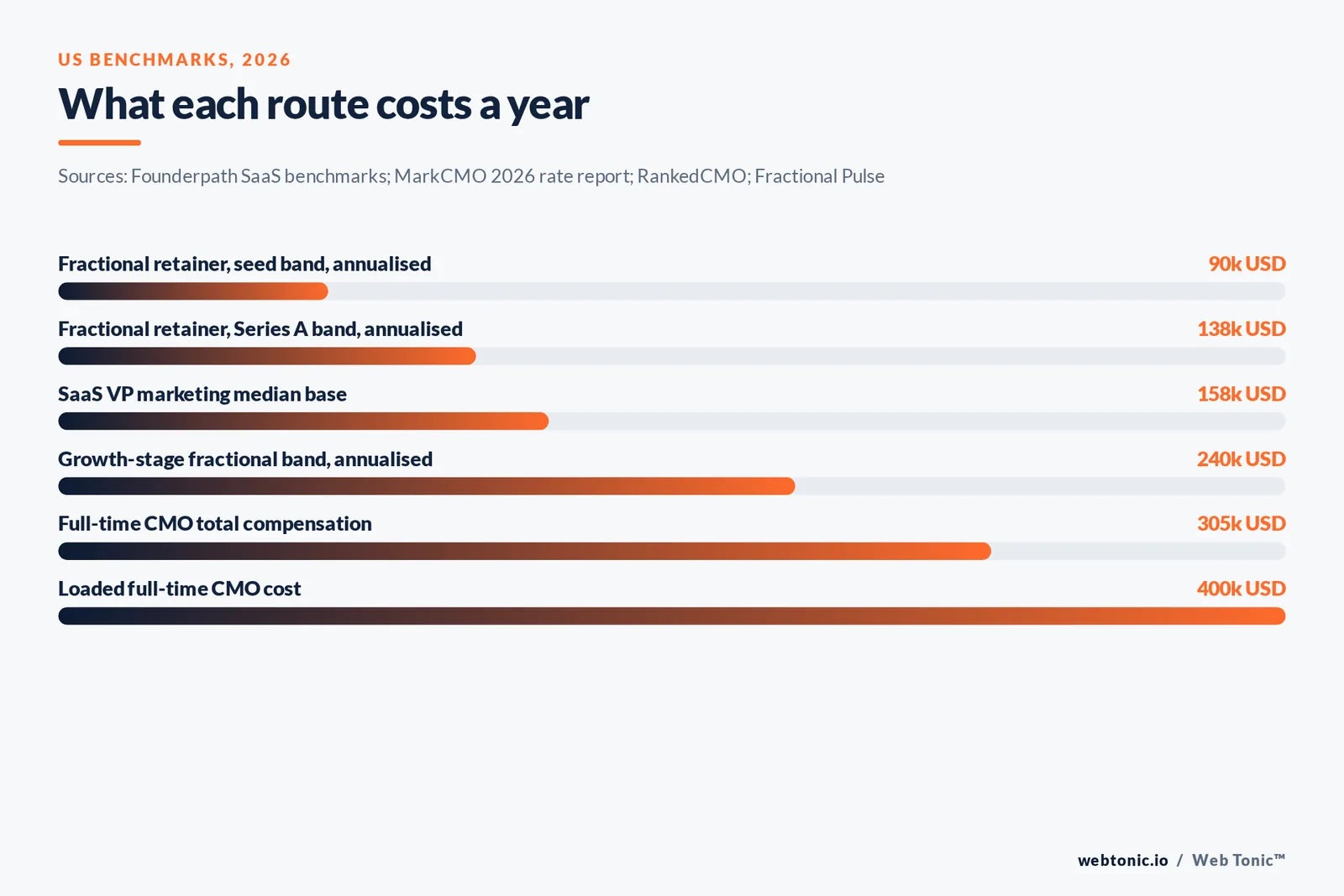
- A full-time marketing leader is a loaded cost: total CMO compensation benchmarks at $293,575 to $316,076 and lands above $400,000 fully loaded, versus fractional retainers of $5,000 to $25,000 a month.
- Advisory buys the artifact and the methodology. A hire buys the engine that runs after the close. Sequenced properly, most companies buy the first and then hire against the plan it produces.
What "investor-ready" actually means
Marketing diligence is the review a fund runs after it says it is interested and before it sends a term sheet. As Stackmatix describes the process, an associate or growth-focused operating partner recalculates CAC, LTV, payback and cohort retention from source data rather than reading them off your slide. Fully-loaded CAC includes salaries, tools and agency fees, not just media spend. LTV has to come from observed retention curves. Payback is expected to be gross-margin-adjusted and typically under 12 to 18 months for SaaS.
That is a different document from a marketing plan. A marketing plan says what you will do next quarter. An investor-ready growth plan says what the last 12 to 24 months of channel spend and output actually prove, what the next dollar buys, and where the model breaks. Fastio's 2026 data room guide puts unit economics by channel, sales pipeline data with win rates and cycle lengths, and a detailed model with stated assumptions inside a Series A room of 40 to 60 documents, reviewed across 8 to 12 categories.
The bar those numbers get measured against has moved. Causo's read of H1 2026 puts a clean non-AI Series A at roughly $3M ARR with 2x year-on-year growth and a burn multiple under 1.0, clearing at a $48M median pre-money, while AI foundational companies clear a $300M median. Fairview's Series A metric guide sets a competitive round at $1.5M+ ARR growing 150%+ with NRR above 110% and CAC payback under 18 months. Against the Aleph and Benchmarkit study of 342 companies, where median payback is 16 months and the top quartile sits at 6, most companies are not far off the bar — they simply cannot prove where they sit.
What diligence does to the plan you already have
The failure mode is rarely a bad business. It is a plan nobody can reconcile. CB Insights' post-mortem analysis attributes 43% of failures to poor product-market fit, 29% to bad timing and 19% to unsustainable unit economics — capital running out is the ending, not the cause. Diligence exists to find those three before the wire.
| What gets tested | What the analyst rebuilds | The red flag |
|---|---|---|
| Fully-loaded CAC | Total sales and marketing spend, including headcount and tooling, over new customers | CAC that counts media spend only |
| CAC by channel | The blended number split into paid, organic, referral and sales-assisted | One channel with unsustainable CAC propping up the average |
| LTV methodology | Cohort retention curves by signup month, revenue-based where expansion exists | Three months of data extrapolated across three years |
| Payback period | Gross-margin-adjusted payback, tested per segment | Payback calculated on revenue, inflating the result |
| Attribution | A funnel rebuilt independently from analytics and CRM access | "Organic/direct" doing a lot of unexplained work |
| Growth concentration | How much of new revenue depends on one channel, campaign or person | A channel that turns out to be one founder's posting habit |
None of that requires a full-time hire to produce. It requires someone who has watched the rebuild happen before, plus clean access to your own systems. That distinction is the whole build-or-buy decision, and it is the same one we walk through on our growth advisory engagements: the deliverable is a defensible model and the methodology behind it, not a headcount.
The in-house route: what the number really is
A senior marketing hire is the right answer often enough that it deserves honest maths. Founderpath's SaaS benchmarks put median VP of Marketing base pay at $157,500. MarkCMO's 2026 benchmark puts total CMO compensation between $293,575 and $316,076, with loaded cost above $400,000 once benefits, bonus and equity are counted. Add a search fee and the first-year commitment rarely resembles the base salary you budgeted.
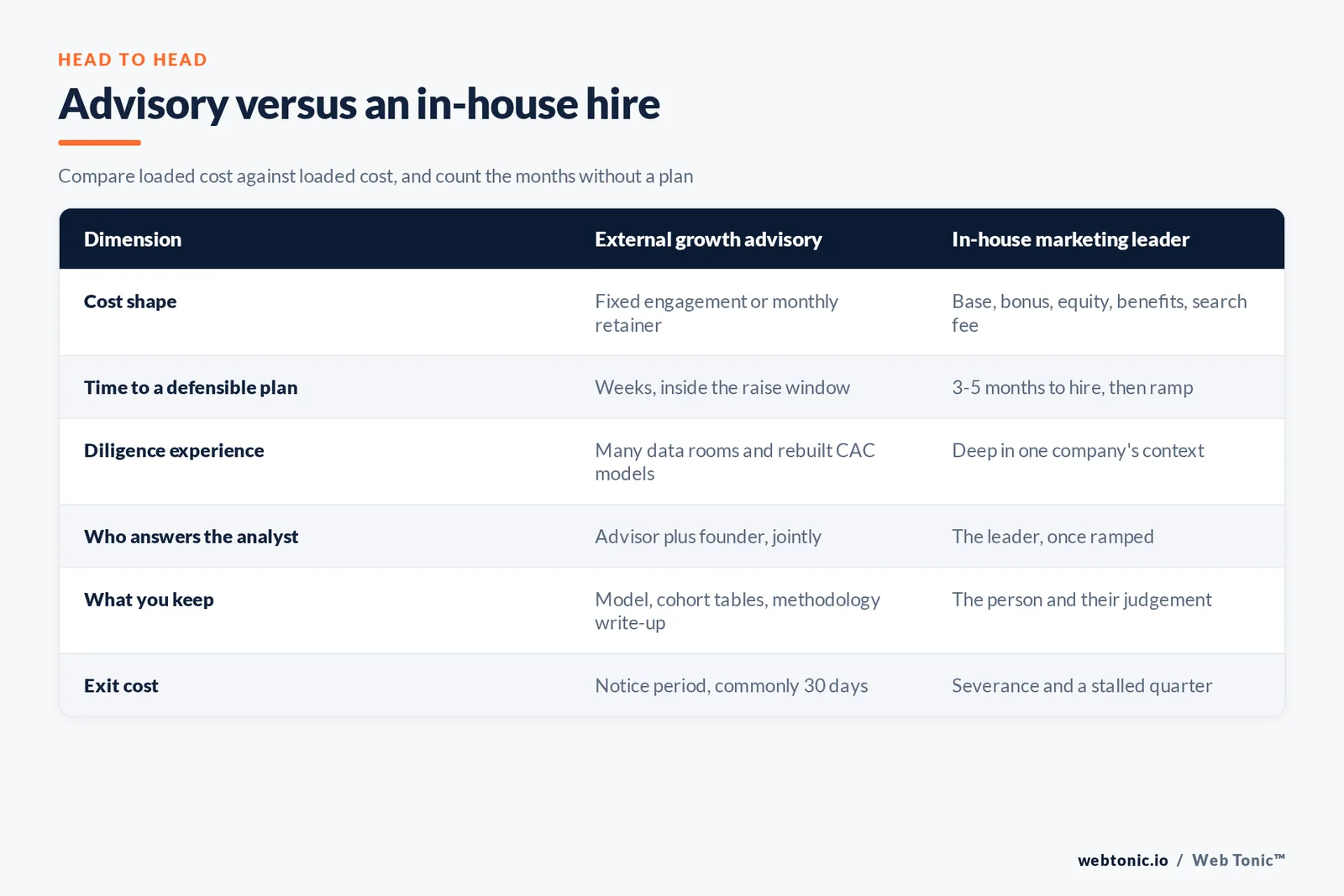
Then add time. A senior search commonly runs 3 to 5 months to an accepted offer, before notice periods and ramp. Compare that against fundraise mechanics: Fastio reports seed diligence closing in 2 to 4 weeks, Series A in 4 to 8 weeks and growth rounds in 2 to 3 months. If your round opens in a quarter, the hire arrives after the term sheet is signed or lost.
Tenure is the other variable founders under-model. Spencer Stuart's CMO tenure study puts average S&P 500 CMO tenure at 4.1 years against 5.0 for the wider C-suite — the shortest seat in the room. In venture-stage companies the churn is faster still, which means the institutional knowledge you are buying with a hire needs to be written down anyway.
The advisory route: what you are buying
External advisory buys three things a hire cannot deliver inside a raise window: pattern recognition across many data rooms, a fixed timeline, and a written methodology you keep. RankedCMO's 2026 cost survey puts fractional engagements at $5,000 to $25,000 a month or $200 to $500 an hour, which it frames as 50-70% below the loaded cost of the equivalent full-time seat. Fractional Pulse's retainer data bands that by stage: $5,000-$10,000 at seed, $8,000-$15,000 at Series A and $15,000-$25,000 at growth stage.
The value is not the discount. It is that the artifact exists before the round opens rather than during it. Preparation is the measurable lever: Fastio's analysis of failed deals found 68% cited incomplete or disorganised documentation as a primary factor, and founders with an organised room in place before investor conversations close roughly 30% faster.
The same discipline pays after the close, because board reporting is a different format from a fundraise model. Prooflytics' board report template compresses the quarterly story into five slides — portfolio scorecard, channel efficiency, revenue contribution, pipeline health, next-quarter plan — and reports that CMOs who show a modelled contribution to pipeline earn 20-40% more board approval on budget asks. MarkCMO's board-ready framework makes the same point about vocabulary: pipeline sourced, CAC payback and marketing-attributed revenue, not impressions and clicks.

Which one fits your situation
| Your situation | Buy advisory | Hire in-house |
|---|---|---|
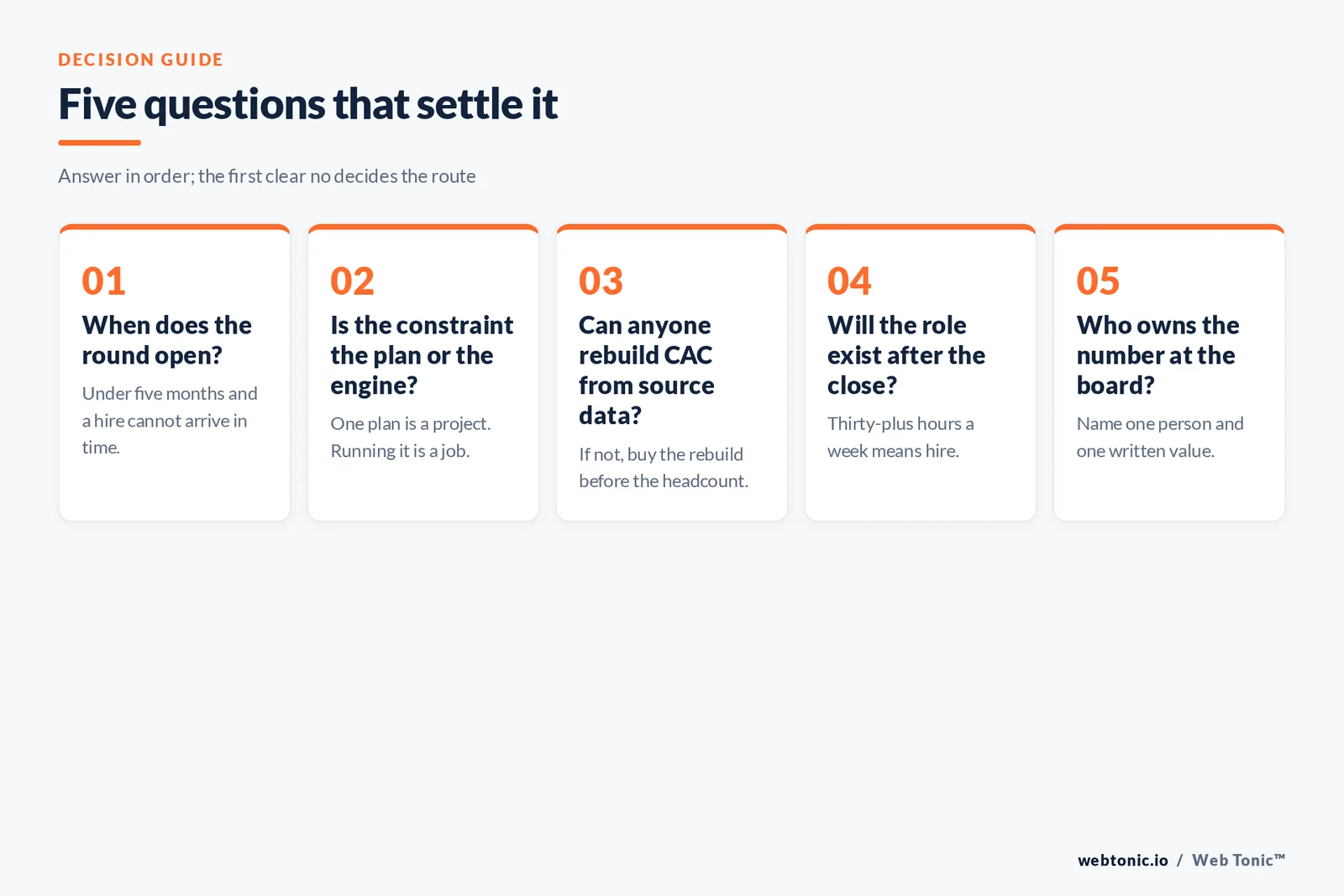
| Round opens in under five months | Yes — the only route that lands in time | No — search alone consumes the window |
| Nobody can rebuild CAC from source data | Yes — buy the rebuild and the methodology | Only if the gap is capacity, not method |
| Leadership work exceeds 30 hours a week | As interim cover during the search | Yes — a full role plainly exists |
| Two or more paid channels, no referee | Yes for arbitration and a stop list | Yes if the channels need daily ownership |
| Board wants one number every quarter | Yes — define the scorecard once | Yes — someone must own it permanently |
| Post-close, plan agreed, execution pending | Oversight only | Yes — hire against the written plan |
Read the table as a sequence, not a fork. The common pattern is advisory first to produce the plan, the cohort tables and the definitions, then a hire made against that plan — with a written scope instead of a job description assembled from guesses. If you want the operating side of that handled by a part-time leader rather than a project, the shape to compare is a fractional CMO, and the instrumentation work sits with data intelligence.
What the plan document itself contains
Whichever route you choose, the deliverable is the same set of sections, and it is worth agreeing them in writing before anyone starts. A comprehensive investor-ready growth plan usually runs to eight parts: market analysis and the addressable opportunity; the ICP and competitive positioning in plain language; channel-level economics with the calculation shown; financial projections tied to those economics rather than to a growth rate typed into a cell; a hiring and capacity plan; the strategic bets for the next four quarters with a stop list beside them; a measurement structure that says which numbers the business will report and how they are defined; and a capital plan showing what the funding buys and when the investment converts to ROI.
Two of those sections carry most of the diligence weight. The financial projections have to reconcile to the channel economics — investors evaluate whether the plan's growth assumptions could be produced by the engine described elsewhere in the same document. And the measurement structure has to be usable after the round: the same definitions should support quarterly board reporting, so the planning work you pay for once keeps providing value through the expansion that follows. Advisors and in-house leaders can both produce this. The difference is how quickly, and whether the methodology stays written down when the person moves on.
The four mistakes that waste either route
1. Starting the work after the term sheet lands. Diligence requests arrive with a deadline attached. Anything built under that deadline is built from whatever data already reconciles, which is rarely the flattering version.
2. Buying a plan without granting access. Read-only access to ad accounts, analytics, CRM and billing is the input. Without it, both an advisor and a new hire produce inference, and an analyst will find the seam in an afternoon.
3. Hiring for the plan and then asking for execution. One defensible growth plan is a project with an end date. Running paid, content, lifecycle and a team is a permanent job. Companies that conflate the two pay for one and expect the other.
4. Letting the model and the board deck diverge. If the fundraise model says payback is 14 months and the quarterly board pack says 9, the number nobody can explain becomes the number everybody distrusts. Fix definitions once, then reuse them everywhere.
How to run the decision in two weeks
Count the leadership hours the business genuinely needs each week, excluding execution capacity. Under eight, this is a project. Between eight and twenty, a fractional or advisory arrangement is the honest fit. Above thirty, a full role exists and should be paid for as one.
Then set the calendar against it. Write the date the round opens, subtract the 4 to 8 weeks diligence typically takes, and subtract again the weeks needed to rebuild cohorts and reconcile CRM against billing. If a hire cannot be seated and productive before that date, the decision is already made for this cycle — and the hire becomes the post-close question instead.
Finally, agree the handover. Whichever route you pick, the artifacts that must exist at the end are the same: a model with stated assumptions, cohort retention tables, channel-level CAC with the formula shown, an attribution write-up including known blind spots, and a one-page scorecard where every row has a source, an owner and a target. If you want that reviewed against how funds actually read it, talk to us or start with the wider services overview.
Related reading
- Investor-Ready Growth Plan Statistics: Hiring vs Outsourcing
- Growth Advisory / Growth Consulting: vs hiring in-house
- Board Advisory / Investor-Ready Growth Plan: what it costs in 2026
- Marketing Strategy Consulting services at Web Tonic
Frequently Asked Questions
How long does it take to make a growth plan investor-ready?
For a company with clean system access, the analytical work is usually a matter of weeks rather than months — the constraint is data reconciliation, not writing. Where CRM and billing disagree, budget extra time before diligence starts, since Fastio reports disorganised documentation can add four to eight weeks to a close.
Will investors discount a plan built with outside help?
No. Diligence teams test whether the numbers reconcile to source data and whether the methodology is disclosed, not who typed the model. What draws scrutiny is a plan the founder cannot defend in conversation, which is why the founder has to sit inside the build rather than receive it.
What does an in-house marketing leader do that advisory does not?
Line management, daily channel ownership, hiring and the cultural work of running a team. Those are full-time responsibilities, and above roughly thirty hours of leadership work per week they justify a permanent seat rather than a retainer.
Which metrics matter most in Series A marketing diligence?
Fully-loaded CAC, CAC by channel, gross-margin-adjusted payback, cohort-based LTV and net revenue retention. Fairview's 2026 read puts a competitive round at NRR above 110% and CAC payback under 18 months; Aleph and Benchmarkit put the market median payback at 16 months.
Can we do both without paying twice?
Yes, and it is the usual pattern. Advisory produces the plan, the definitions and the scorecard; the subsequent hire is briefed against those artifacts, which shortens their ramp and removes the guesswork from the job description.
Sources: Stackmatix, Marketing Due Diligence (2026) · Fastio, How to Set Up a Data Room for Investors (2026) · Causo, The Series A Bar in H1 2026 · Fairview, SaaS Metrics Series A Investors Care About (2026) · Aleph × Benchmarkit, CAC Payback Period SaaS 2026 · CB Insights, Why Startups Fail · Founderpath, SaaS VP Marketing Salary Benchmarks · MarkCMO, Fractional CMO Salary Benchmark and MAGNET Board-Ready Reporting (2026) · Spencer Stuart, CMO Tenure Study · RankedCMO, Fractional CMO Cost (2026) · Fractional Pulse, Fractional CMO Retainer Data · Prooflytics, CMO Board Report Template (2026).


