Table of contents

91% of businesses now use video as a marketing tool, and 96% of consumers have watched an explainer video specifically to understand a product before buying it. For an industry that sells a document nobody reads before a claim happens, that combination makes video one of the higher-leverage budget lines available, and 2026 data now puts real numbers behind how much of it and where.
Key Takeaways
- 91% of businesses use video as a marketing tool in 2026, back to an all-time high.
- 82% of marketers say video gives a good ROI, down from 2025's 93% peak.
- 93% say video increased user understanding of their product or service.
- 85% say video helped generate leads directly.
- 82% say video increased web traffic.
- 96% of people have watched an explainer video to learn about a product.
- 67% of non-video marketers plan to start in 2026.
- 41% of marketers have already paid for video ads this year, up from 36%.
- 92% of current video marketers plan flat or higher 2026 spend.
- 69% say social video is their single most common use case.
- 84% of Gen Z adults use social media for insurance research, per LIMRA.
- 40% of Gen Z recall insurance ads on TikTok specifically, per Gen Re.
- 66% recall insurance ads on TV, still the top platform.
- 46% of Gen Z follow financial advisors on social platforms.
- 33% follow insurance companies directly.
- Roughly half of younger consumers prefer to buy insurance online, per SOA research.
- 47% of insurance purchases already run through digital channels, per J.D. Power.
The baseline case for video, cross-industry
Wyzowl's 2026 State of Video Marketing report, based on 266 respondents surveyed in late 2025 across 12 years of trend data, found 91% of businesses now use video as a marketing tool, matching the category's all-time high. Among marketers who use it, 82% report a good return on investment - a drop from 2025's 93% peak, but still a dominant result - and 67% of the marketers who still do not use video say they plan to start in 2026.
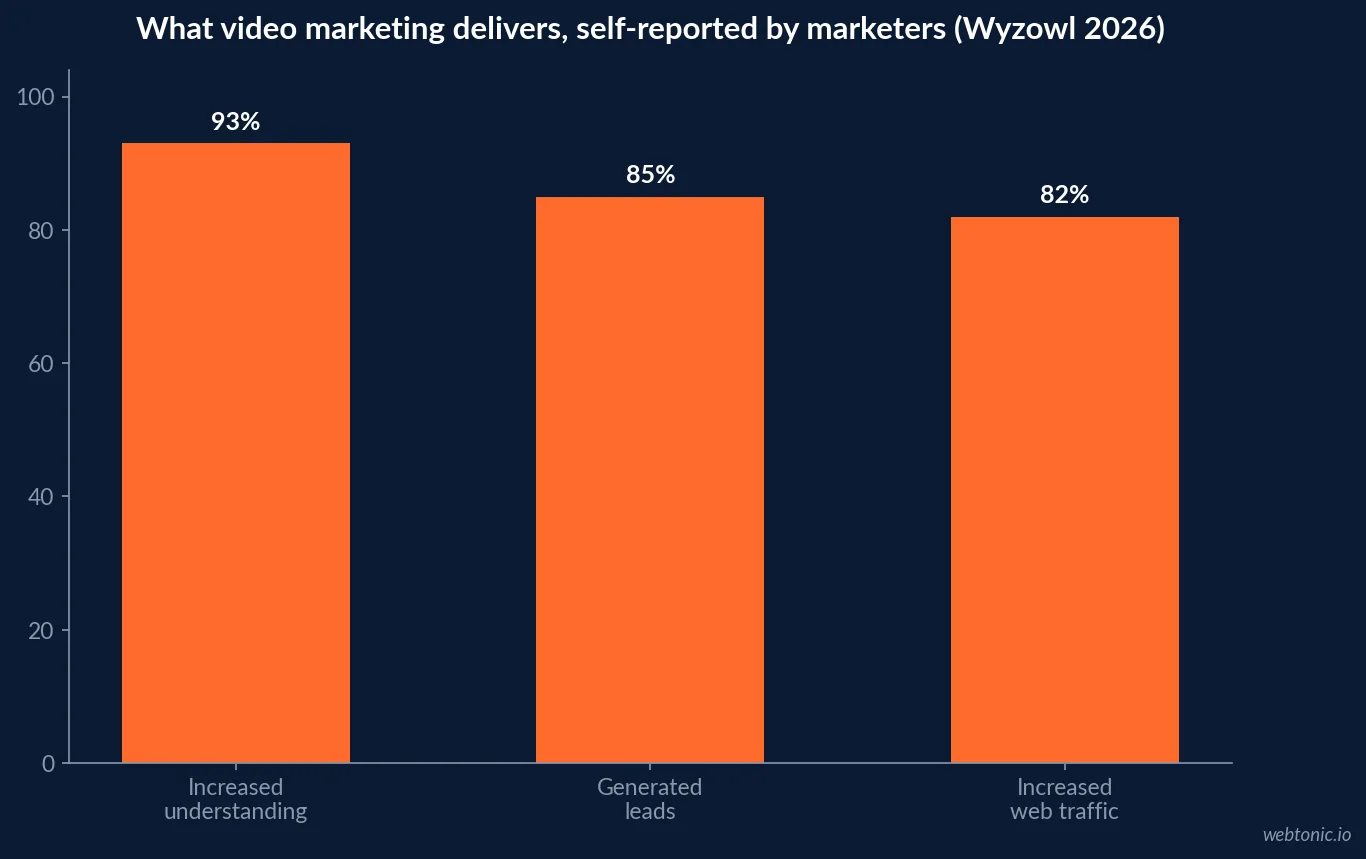
The report also measures what video actually does once it is made: 93% say it increased user understanding of the product, 85% say it generated leads, and 82% say it increased web traffic. For insurance, where the core sales problem is usually comprehension rather than awareness, the understanding figure matters more than the traffic figure.
| Video marketing outcome (2026) | Share reporting it | Source |
|---|---|---|
| Use video as a marketing tool | 91% | Wyzowl 2026 |
| Report good ROI from video | 82% | Wyzowl 2026 |
| Say video increased understanding | 93% | Wyzowl 2026 |
| Say video generated leads | 85% | Wyzowl 2026 |
| Say video increased web traffic | 82% | Wyzowl 2026 |
| Have watched an explainer video to learn about a product | 96% | Wyzowl 2026 |
Why insurance specifically needs the explainer, not just the ad
The category-defining number here is 96%: nearly every consumer has watched an explainer video to understand a product before buying it, and insurance is one of the few categories where the product literally cannot be seen or tried before purchase. A policy is a contract, and the sale usually depends on the buyer understanding a coverage limit, an exclusion, or a deductible trade-off well enough to compare it against a competitor's version of the same thing.
J.D. Power's Insurance Intelligence Report data on 47% of purchases now running through digital channels reinforces the case: a shopper comparing coverage on a screen, without an agent narrating the differences out loud, is exactly the shopper a 60-to-90-second explainer is built to serve.
| Video-budget decision point | Cross-industry benchmark | What it implies for insurance |
|---|---|---|
| Should we budget for video at all | 91% of businesses already do | Not budgeting is now the outlier position |
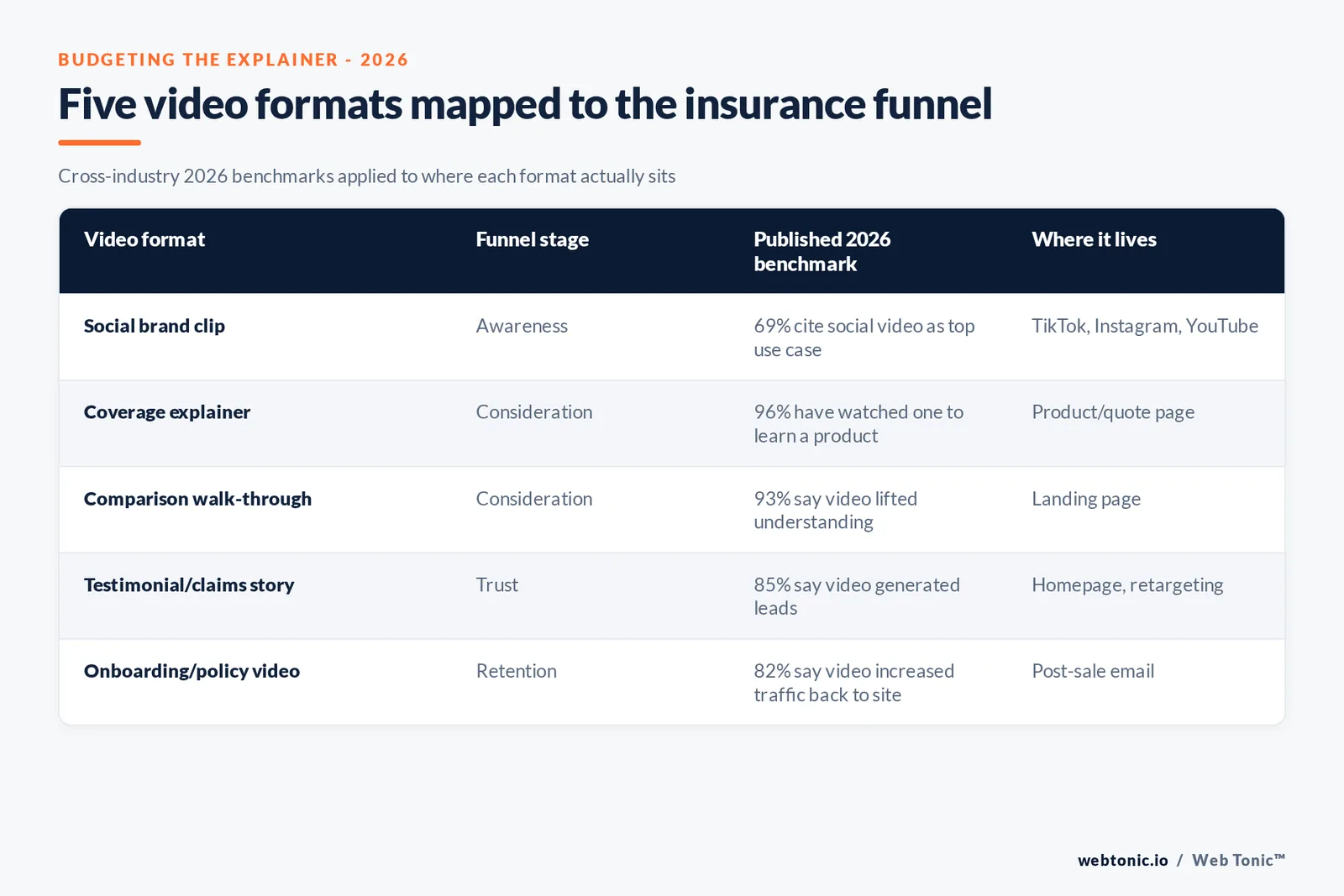
| Paid or organic first | 69% cite social video as top use case | Organic-first, then pay to extend reach |
| Spend paid video ads | 41% already have, up from 36% | Ad spend on video is rising, not niche |
| Explain or just show the brand | 96% watched an explainer to learn a product | Coverage explainers outrank brand films for this category |
| Keep the same budget in 2026 | 92% plan flat-or-higher spend | Cutting video now runs against the market |
Where the audience actually is, by generation
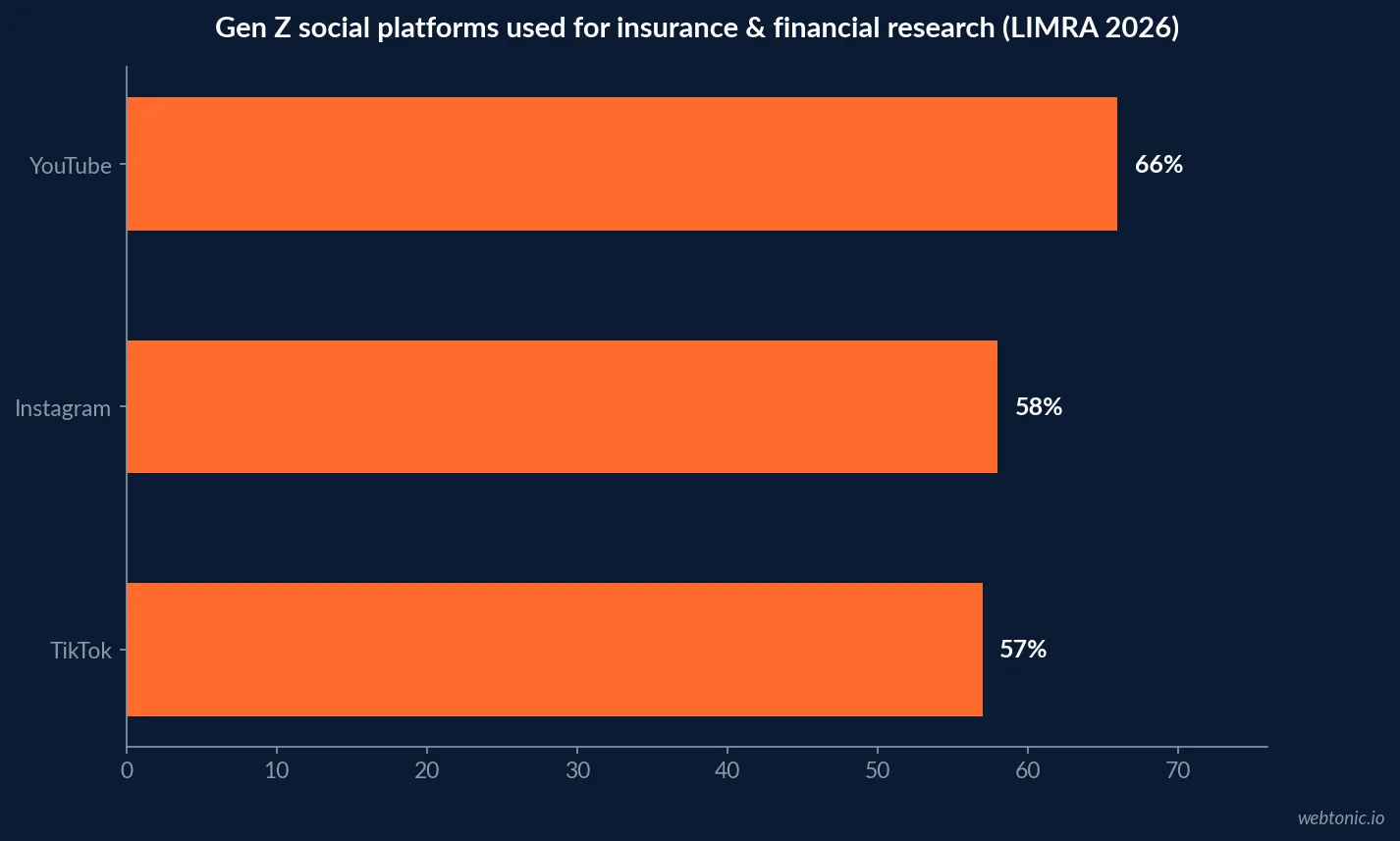
LIMRA's 2026 research on Gen Z and life insurance finds 84% of Gen Z adults use social media to get information and recommendations on financial products, most prominently on YouTube (66%), Instagram (58%) and TikTok (57%) - all video-native platforms. Within that group, 46% follow financial advisors, 33% follow insurance companies directly, and 32% follow financial influencers, meaning the audience is already primed to watch this category of content from a brand account, not only from paid placements.
The Gen Re Gen Z ViewPoint Survey found that when this same audience is asked where they recall seeing insurance advertising, television still leads at 66%, but TikTok (40%), radio (39%) and Instagram (34%) follow closely, and only 6% recall seeing no insurance ads at all - this is not a hard-to-reach audience, it is an over-advertised one that needs a genuinely useful video, not another 15-second brand spot, to stand out.
| Gen Z insurance research behavior (2026) | Figure | Source |
|---|---|---|
| Use social media for financial/insurance research | 84% | LIMRA 2026 |
| Use YouTube for this research | 66% | LIMRA 2026 |
| Use Instagram for this research | 58% | LIMRA 2026 |
| Use TikTok for this research | 57% | LIMRA 2026 |
| Recall seeing insurance ads on TikTok | 40% | Gen Re Gen Z ViewPoint Survey |
| Recall seeing no insurance ads at all | 6% | Gen Re Gen Z ViewPoint Survey |
Where video should live in the funnel, not just the feed
Society of Actuaries research on younger generations and private insurance found that roughly half of consumers under 43 prefer to purchase every type of insurance online, and that this preference is markedly stronger than it is for older buyers. That preference only converts to a sale if the online page itself removes the confusion an agent used to resolve verbally - which is what an on-page explainer video is for, not only the pre-click ad.
Put a short coverage-comparison video directly on the quote or product page rather than only in a pre-roll placement, and it does two jobs at once: it lifts the page's own conversion rate the way general landing-page benchmarks already show video doing, and it gives the compliance team one asset to review instead of a dozen variations spread across ad accounts.
What is actually changing the cost side of the budget
Wyzowl's 2026 data also tracks production economics, and the shift there changes what a video budget can buy. 63% of video marketers say they have used AI tools to help create or edit marketing video, up sharply from 51% the year before. Opinion on what that does to cost is split: 30% say video production costs are getting cheaper and a further 32% report no change, while 38% say costs are rising - a signal that AI tooling is lowering the floor for simple explainer formats while more ambitious production (live action, on-location, testimonial-style) keeps getting more expensive.
51% of video marketers report mostly creating live-action video against 23% animated and 19% screen-recorded, and 59% create video themselves in-house rather than outsourcing it. For a coverage explainer that needs a compliance sign-off on every word, an in-house or AI-assisted animated format is easier to revise after legal review than a live-action shoot with an actor to re-book.
| Video production fact (2026) | Figure | Source |
|---|---|---|
| Marketers who have used AI video tools | 63% (up from 51%) | Wyzowl 2026 |
| Say production costs are getting cheaper | 30% | Wyzowl 2026 |
| Say production costs are rising | 38% | Wyzowl 2026 |
| Create video mostly in live-action format | 51% | Wyzowl 2026 |
| Create video mostly in animated format | 23% | Wyzowl 2026 |
| Create video themselves in-house | 59% | Wyzowl 2026 |
Budgeting the line item
Absent an insurance-specific video-spend survey, the defensible model borrows Wyzowl's cross-industry shape and applies it to the category's actual need. Marketers already routing 41% of their video effort into paid distribution should weight an insurance program toward organic-first coverage explainers given the 69% social-video preference figure, then add paid distribution once the explainer is compliance-approved, rather than reversing that order and paying to promote a script that has not cleared review yet.
Our performance creative team builds that explainer-first sequence for regulated categories, and our write-up on whether paid social is worth the spend is a useful companion read before committing the ad-distribution half of the budget.
The compliance line every insurance video script has to clear
The NAIC's Advertisements of Life Insurance and Annuities Model Regulation applies to video the same way it applies to print: no guaranteed-return language, no unsubstantiated comparison to a named competitor, and no benefit claim inconsistent with the filed policy form. A script that reads clean on paper can still create a misleading implication once it is voiced, paced and scored for video, so build a compliance review step for the final cut, not only the written script.
Frequently Asked Questions
How much of a marketing budget should go to video for an insurance brand?
There is no insurance-specific budget survey, so the honest base is Wyzowl's 2026 State of Video Marketing data: 41% of marketers have already spent money on video ads this year, up from 36% last year, and 92% of current video marketers plan to spend the same or more in 2026. Layer in that 96% of consumers have watched an explainer video to learn about a product, and insurance's case for a video line is at least as strong as the cross-industry average, arguably stronger given how much explaining a policy requires.
Does video actually move insurance shoppers, or is that a general marketing claim?
Two different data points point the same direction. LIMRA's 2026 research finds 84% of Gen Z adults use social media, largely video-first platforms, to research financial and insurance products, and the Gen Re Gen Z ViewPoint Survey found 40% recall seeing insurance ads on TikTok specifically. Neither is an insurance-only video study, but both describe the exact audience an explainer video is trying to reach.
What is the actual ROI evidence for video in 2026?
Wyzowl's 2026 survey of 266 respondents found 82% of marketers who use video call its ROI good, down from 2025's all-time high of 93% but still dominant. The same survey found 93% saying video increased user understanding of a product or service and 85% saying it generated leads directly, which maps onto insurance's core problem: shoppers who do not understand a coverage difference will not convert on a comparison page either.
Should the video budget go to paid ads or organic content?
Wyzowl's data suggests both, in sequence. 41% of marketers are already paying to distribute video, but 69% say social media video is their single most common video use case, which is organic-first by construction. For a regulated category like insurance, the safer sequence is scripting and compliance-reviewing the explainer once, then running it organically before spending to promote it, since ad review adds a second compliance pass on top of the first.
What can an insurer's video legally claim under state advertising rules?
The same NAIC Advertisements of Life Insurance and Annuities Model Regulation that governs written ads applies to video scripts: no guaranteed-return language, no implied comparison to a named competitor's policy without substantiation, and no benefit statement that is not consistent with the filed policy form. A script that reads clean on paper still needs a compliance pass once it is voiced and paced for video, because tone and delivery can create an implication the text alone did not.
Sources
Wyzowl - State of Video Marketing 2026
LIMRA - 2026 Insurance Barometer Study
LIMRA - Facts About Life Insurance: Gen Z, 2026
Gen Re - Gen Z ViewPoint Survey
Society of Actuaries - Perceptions of Younger Generations on Risk and Insurance
Insurance Business America - J.D. Power Insurance Intelligence Report
NAIC - Advertisements of Life Insurance and Annuities Model Regulation #570