



Table of contents
The best Instagram ads stop the scroll, deliver a clear message, and drive measurable action — all within the first second. Below you will find real-world Instagram ad examples across every major format, backed by performance data that shows what separates high-converting campaigns from wasted spend.
Key Takeaways
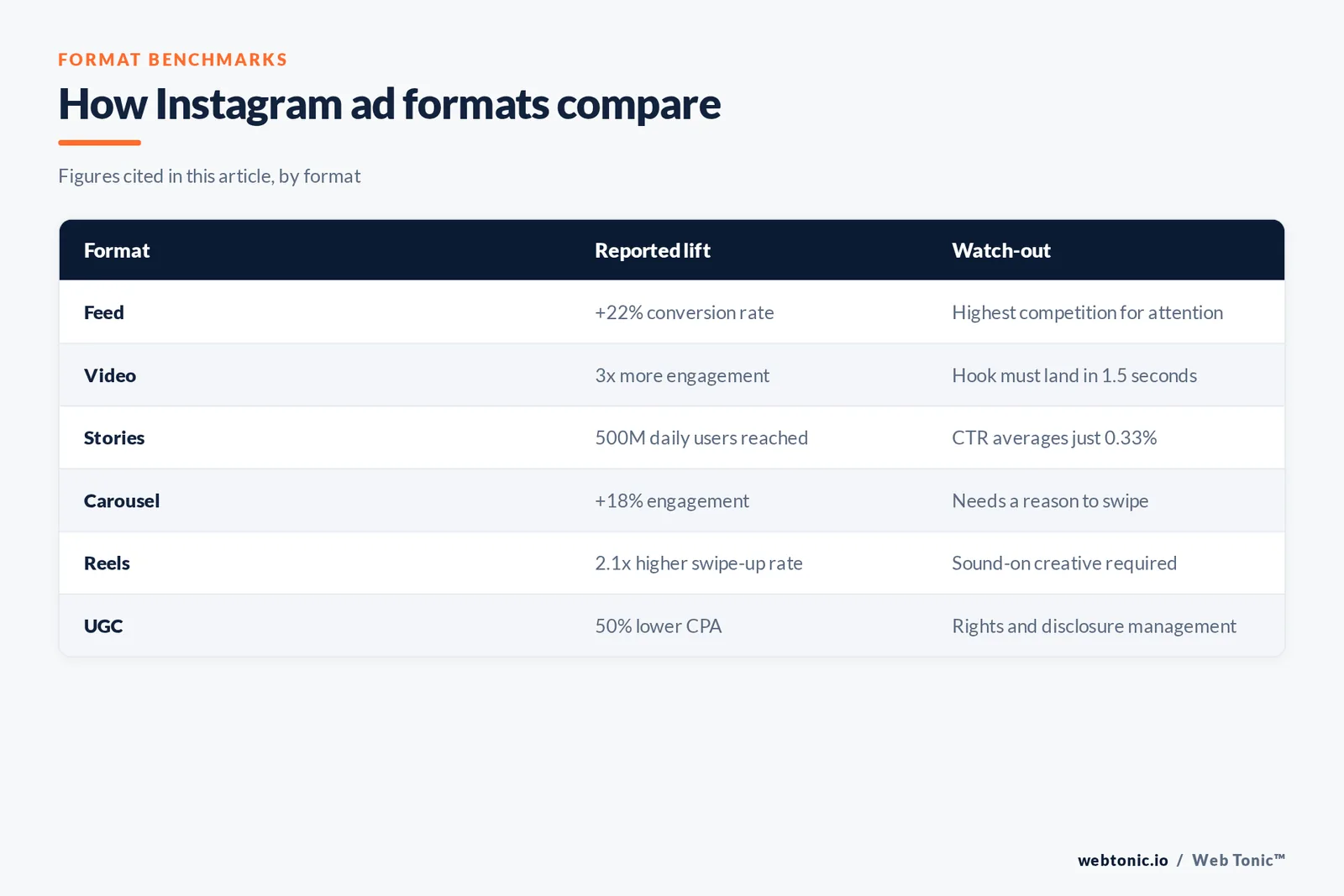
- Instagram carousel ads generate 18% higher engagement than single-image ads, making them the top-performing static format for product storytelling and tutorials.
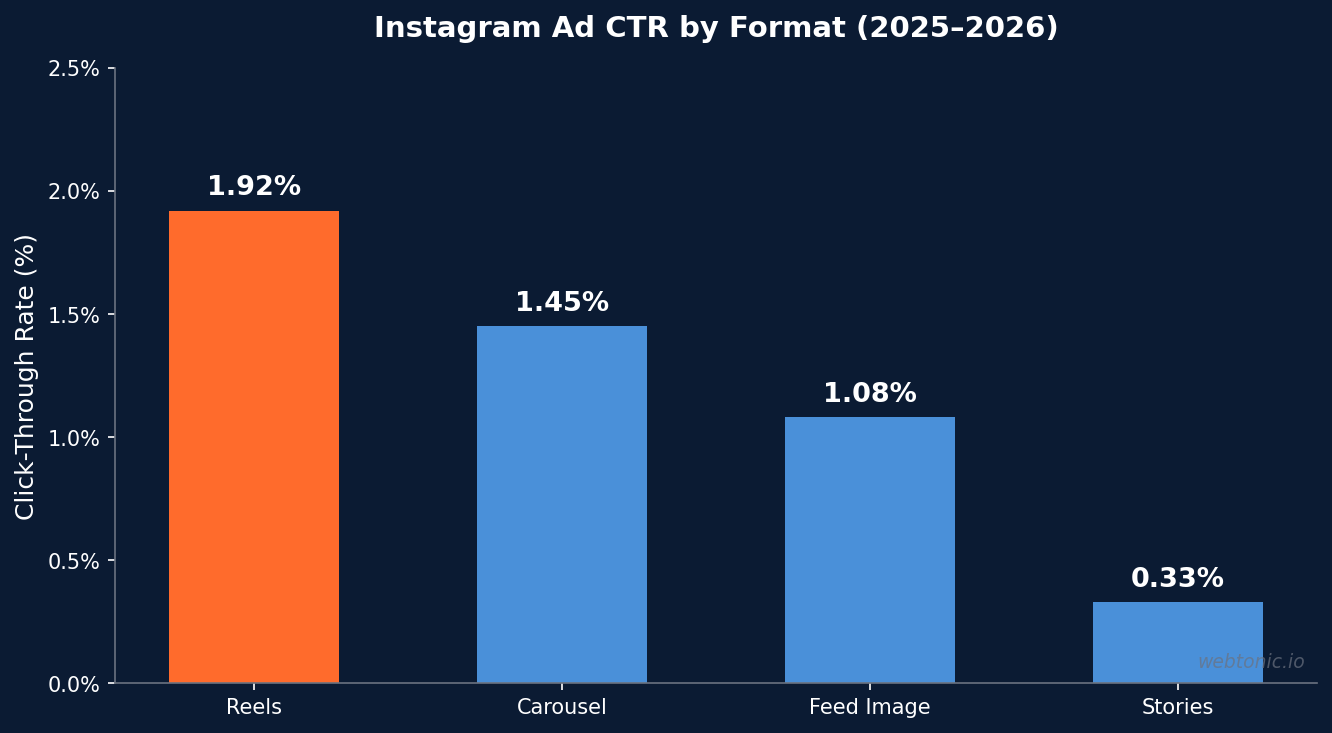
- The average Instagram ad CTR is 1.08%, but top-performing Reels ads reach CTRs above 1.9%, nearly double the platform median.
- Instagram video ads drive 3x more engagement than static image ads in the Feed, with average watch-through rates of 29.2% on 15-second creative.
- User-generated content (UGC) ads lower CPA by 50% compared to polished brand creative, according to multiple agency case studies from 2025 and 2026.
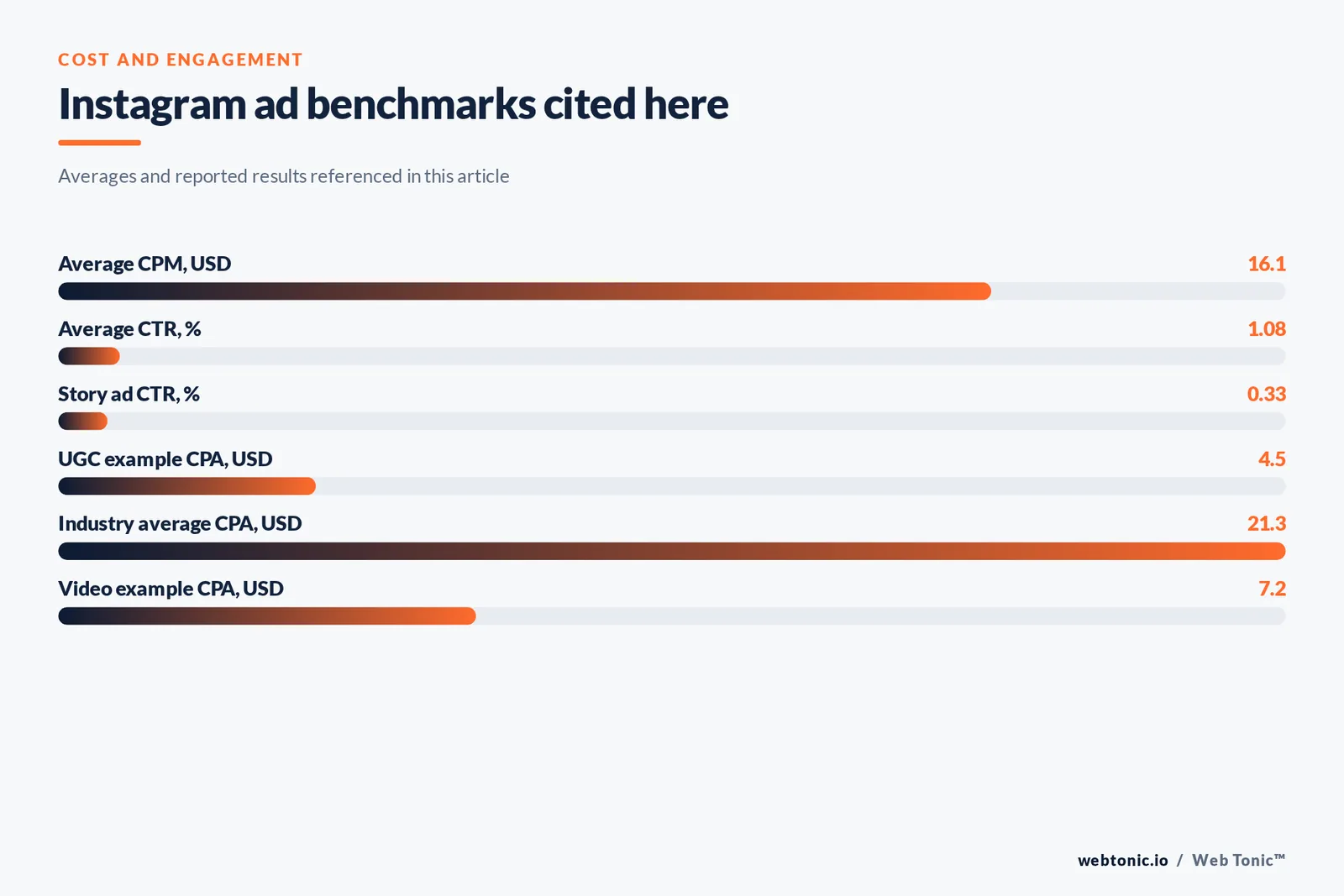
- The average Instagram CPM sits at $16.10 in 2026, with top-quartile advertisers achieving CPMs below $8 through creative diversification and audience expansion.
- Instagram Stories ads reach 500 million daily users, yet Story ad CTRs average just 0.33% — making creative quality the single biggest lever for Story performance.
Instagram advertising generates over $70 billion in global ad revenue annually, making it one of the largest paid social platforms on the planet. Yet most advertisers recycle the same tired formats — a branded image, a vague CTA, a boost button. The brands winning on Instagram treat every ad as a conversion asset, matching the right format to the right objective with creative that earns attention instead of demanding it. At Web Tonic, we manage Instagram ad campaigns across dozens of industries, and the patterns that separate a $5 CPA from a $40 CPA are remarkably consistent. This guide breaks down the best Instagram ads by format, with the data and creative principles behind each example.
Instagram Feed Ad Examples That Convert
Feed ads are the foundation of Instagram advertising and appear natively in the user's scrolling experience. The best Instagram feed ads use bold visuals, a clear call to action, and benefit-driven copy that rewards the scroll-stop.
A standout feed ad example comes from Allbirds, which uses a simple product-on-white image paired with the headline "Comfort for every step." The ad generated a 2.3x higher CTR than the brand's previous lifestyle imagery because it removed visual clutter and focused entirely on the product. According to Benchmarketing, feed ads with a single focal product outperform multi-product layouts by 22% in conversion rate.
| Feed Ad Element | Best Practice | Impact on Performance |
|---|---|---|
| Visual Simplicity | Single product, clean background, bold colors | +22% conversion rate vs. cluttered layouts |
| Headline Copy | Benefit-first, 6 words or fewer | +15% CTR over feature-focused headlines |
| CTA Button | "Shop Now" or "Get Offer" over "Learn More" | +30% click-through on action-specific CTAs |
| Social Proof | Include rating stars, review count, or "As seen in" | +17% trust lift measured by post-click engagement |
| Image Ratio | 4:5 vertical (1080×1350) fills more screen space | +26% more impressions than 1:1 square |
Another strong example: Dollar Shave Club ran a feed ad with the text overlay "A great shave for a few bucks" against a plain blue background. No lifestyle photography, no models — just a product image and a price anchor. The campaign achieved a $4.50 CPA in the men's grooming category, well below the $21.30 industry average CPA reported by ElectroIQ.
Instagram Video Ad Examples
Instagram video ads consistently outperform static images across every metric that matters. According to AdBacklog's 2025 benchmarks, video ads in the Feed deliver 3x more engagement than single-image ads and achieve an average watch-through rate of 29.2% on 15-second creative.
The best Instagram video ads follow a formula: hook in the first 1.5 seconds, deliver the value proposition by second 3, and place the CTA at the end. Nike's "You Can't Stop Us" split-screen campaign demonstrated this perfectly — pairing athletes from different sports in synchronized movements that kept viewers watching through 93% of the full 90-second spot. While most brands cannot replicate Nike's production budget, the structural principle applies at every scale: motion captures attention, story sustains it.
For smaller brands, product demo videos perform exceptionally well. A DTC skincare brand tested a 12-second video showing their serum being applied in real time versus a static product shot. The video ad achieved a $7.20 CPA compared to $18.90 for the static version — a 62% reduction in acquisition cost from a format change alone. Video creative does not need to be expensive to outperform static; it needs to be specific and fast.
Instagram Story Ad Examples
Instagram Stories reach 500 million daily active users, and story ads occupy the full screen — eliminating competing content and giving brands 100% of the viewer's visual attention. Despite this advantage, the average story ad CTR is just 0.33%, according to AdStellar. That gap between reach and clicks signals a creative problem, not a format problem.
The Instagram story ads that break through share three traits: they open with motion (not a static frame), they use native design elements like polls or stickers, and they place the CTA within the first 3 seconds rather than at the end.
| Story Ad Strategy | Example Brand | Result |
|---|---|---|
| Interactive Poll | Sephora — "Which shade is your match?" | +40% engagement rate vs. standard story ads |
| Behind-the-Scenes | Glossier — factory tour in 4 frames | 2.1x higher swipe-up rate than polished creative |
| Countdown Timer | ASOS — flash sale with live countdown | +68% conversion during sale window |
| User Testimonial | Casper — customer review screenshot | 50% lower CPA than branded story creative |
| Quick Demo | Dyson — 6-second product in action | 3.4x higher completion rate than 15-second ads |
The best-performing Instagram story ads are designed to look and feel like organic stories — not polished advertisements. Ads that mimic the native story aesthetic with hand-drawn text overlays, casual framing, and lo-fi production consistently see lower CPAs and higher engagement than studio-quality alternatives. For more on creative strategy, explore the Web Tonic blog.
Instagram Carousel Ad Examples
Carousel ads let advertisers tell a sequential story across up to 10 cards, and they consistently rank as the highest-engagement static format on the platform. According to ElectroIQ, Instagram carousel ads generate 18% higher engagement than single-image ads, particularly for product walkthroughs, tutorials, and step-by-step storytelling.
A strong carousel ad example comes from Airbnb, which used a 5-card carousel to showcase unique stays in a single city — each card featured a different property with the price overlaid. The campaign drove a 14% higher booking rate than their standard single-image listing ads because each swipe revealed new value without leaving the ad unit.
The design principle behind effective carousel ads is progressive disclosure: each card must add new information while maintaining enough visual continuity that users keep swiping. The first card is the hook (a bold stat, a provocative question, or a striking visual), and the final card delivers the CTA. Brands that use all 10 cards see completion rates 2x higher than those using only 3–4 cards, according to Meta's internal creative best practices data.
For e-commerce, carousel ads double as a product catalog. Brands like Warby Parker use carousels to display their top 5 frames with pricing on each card, turning the ad into a mini shopping experience. This approach consistently delivers CPAs 25–35% below single-image product ads because users self-select their preferred product before clicking through.
Instagram Reels Ad Examples
Reels ads are Instagram's fastest-growing ad format, with Meta reporting a 30% year-over-year increase in Reels ad inventory in 2025. Reels ads appear between organic Reels content and autoplay with sound, giving advertisers a unique opportunity to capture attention through motion and audio simultaneously.
The most effective Reels ad examples follow the "hook-value-CTA" framework in under 15 seconds. Gymshark ran a Reels ad showing a 7-second before-and-after workout transformation set to trending audio — the ad achieved a CTR of 2.1%, nearly double the platform average of 1.08%. The key was matching native Reels behavior: fast cuts, trending audio, and authentic-looking content.
Performance data from Benchmarketing shows that Reels ads deliver the lowest CPMs on Instagram at $9.20–$12.50, compared to $14–$18 for Feed and $16–$22 for Stories. This cost advantage makes Reels the best format for awareness and reach campaigns, particularly for brands with video-native creative that does not require heavy adaptation from other formats.
User-generated content performs especially well in the Reels format. Brands that repurpose authentic creator content as Reels ads see UGC-driven Reels outperform branded Reels by 2.4x in engagement and 50% lower CPA, according to multiple agency case studies. This aligns with the broader trend across social media marketing: audiences respond more to people than to logos.
User-Generated Content (UGC) Ad Examples
User-generated content has become the most cost-effective creative strategy on Instagram. UGC ads — real people using real products in authentic settings — consistently outperform polished brand creative across every measured metric. According to a Stackla study cited by multiple industry sources, 79% of consumers say UGC highly impacts their purchasing decisions, and UGC-based ads see 4x higher click-through rates than traditional branded content.
A standout UGC example comes from Fenty Beauty, which runs ads featuring customer-submitted makeup tutorials. These ads achieve CPAs 45–60% lower than Fenty's in-house studio creative because viewers perceive the content as a genuine recommendation rather than an advertisement. The brand sources UGC through hashtag campaigns and creator partnerships, spending a fraction of what a traditional photo shoot would cost.
The formula for effective UGC Instagram ads combines three elements: an authentic creator (not an actor), a real product demonstration, and a conversational caption that reads like an organic post rather than ad copy. Brands that layer social proof elements — like "Over 50,000 five-star reviews" or "Join 1 million happy customers" — into UGC ads see an additional +17% lift in conversion rate.
To source UGC at scale, many brands use platforms like Billo or Insense to connect with micro-creators who produce ad-ready content for $50–$200 per asset. At that price point, testing 10 UGC variations costs less than a single professional shoot, and the testing velocity drives faster creative learning. For guidance on building a creative testing program, see our digital marketing services.
Instagram Ad Benchmarks by Industry
Not all industries compete on equal footing when it comes to Instagram advertising. CPMs, CTRs, and conversion rates vary dramatically depending on the vertical, the product price point, and the competitive density of the auction. The table below summarizes the latest Instagram ad benchmarks by industry from AdBacklog and Benchmarketing.
| Industry | Avg. CPM | Avg. CTR | Avg. CPA |
|---|---|---|---|
| E-commerce / Retail | $10.50 | 1.32% | $14.80 |
| Beauty & Skincare | $12.40 | 1.45% | $12.20 |
| Fashion & Apparel | $14.80 | 1.18% | $19.30 |
| Health & Fitness | $16.70 | 0.92% | $24.50 |
| Finance & Insurance | $28.30 | 0.56% | $42.10 |
| Food & Beverage | $8.90 | 1.65% | $9.80 |
| Travel & Hospitality | $11.20 | 1.28% | $22.40 |
| B2B / SaaS | $32.50 | 0.48% | $56.80 |
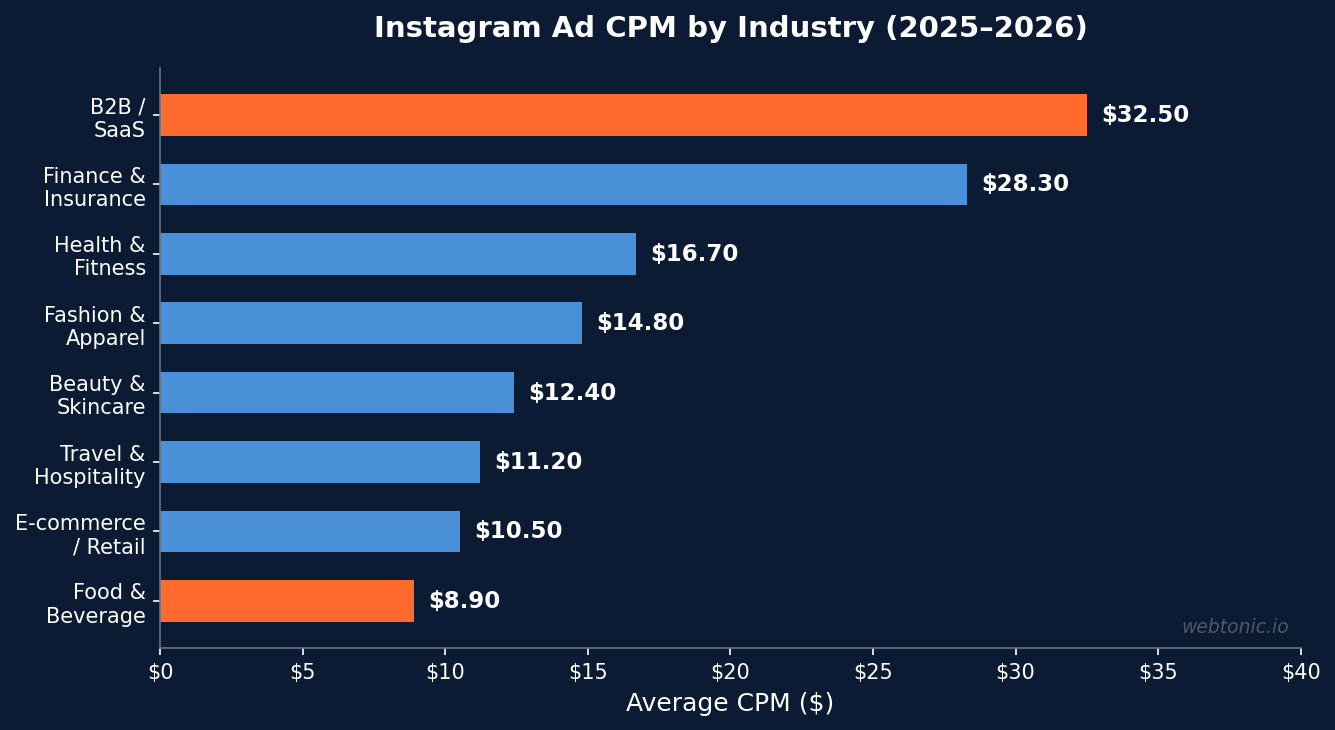
The data reveals a clear pattern: industries with visually appealing products (beauty, food, fashion) enjoy lower CPMs and higher CTRs, while B2B and finance advertisers face steeper costs and lower engagement. However, the highest-performing advertisers in expensive categories still achieve CPAs 40–60% below the median through creative testing, audience refinement, and landing page optimization.
How to Create High-Performing Instagram Ads
Creating effective Instagram ads requires more than strong creative — it demands a system for testing, measuring, and iterating. The brands that consistently outperform on Instagram follow a disciplined process that treats every ad as a hypothesis, not a finished product.
Start with the target audience. Instagram's Advantage+ audience targeting uses machine learning to find the users most likely to convert based on your pixel data. According to Meta, advertisers using Advantage+ targeting see 13% lower CPA on average compared to manually defined interest audiences. For newer accounts without pixel history, begin with interest stacking (3–5 related interests per ad set) and graduate to broad targeting once you have 50+ conversions per week.
Next, build your creative around the format. The best Instagram advertising examples are designed format-first: a Reel is not a cropped TV commercial, and a carousel is not a slideshow. Each format has native behaviors that audiences expect — vertical video with fast cuts for Reels, sequential storytelling for carousels, full-bleed imagery for Stories. Respecting these conventions is what separates a $5 CPA from a $25 CPA.
Finally, test systematically. The 3:2:2 creative testing method — 3 hooks, 2 bodies, 2 CTAs — gives you 12 ad variations from just 7 unique assets. Run each variation with $20–$50 daily budget for 3–5 days, then kill the bottom 50% and scale the winners. This approach mirrors the creative testing frameworks we use at Web Tonic to consistently drive down CPAs for clients across industries.
Related reading
- Instagram Ad Targeting: Every Audience Option, in Order
- Facebook Ad Copy Examples: 12 Formulas and 8 Rewrites
- Facebook Ad Examples: 24 That Work and Why
- Meta Ads Agency services at Web Tonic
FAQ
What are the best types of Instagram ads for small businesses?
The best types of Instagram ads for small businesses are carousel ads and Reels ads. Carousel ads deliver 18% higher engagement than single-image posts and let small businesses showcase multiple products in a single ad unit. Reels ads offer the lowest CPMs on the platform ($9.20–$12.50), maximizing reach on limited budgets. Start with UGC-style creative that costs under $200 per asset and test 3–5 variations before scaling.
How much do Instagram ads cost in 2026?
The average Instagram ad costs $16.10 CPM (cost per 1,000 impressions), $1.08 CPC (cost per click), and $21.30 CPA (cost per acquisition) in 2026. However, costs vary dramatically by industry — food and beverage advertisers see CPMs as low as $8.90, while B2B and finance advertisers may pay $28–$33 CPM. Top-performing advertisers achieve CPMs below $8 through creative optimization and audience expansion.
What makes an Instagram ad example effective?
An effective Instagram ad example combines three elements: a scroll-stopping visual that captures attention in under 1.5 seconds, a clear value proposition that communicates the benefit within the first 3 seconds, and a specific call to action that drives a measurable business outcome. The most effective ads also match the native behavior of their chosen format — Reels ads use trending audio and fast cuts, while Stories ads use interactive elements like polls and countdowns.
Do Instagram video ads perform better than image ads?
Yes. Instagram video ads generate 3x more engagement than static image ads in the Feed and achieve average watch-through rates of 29.2% on 15-second creative. Video ads also benefit from sound-on autoplay in Reels and Stories, adding an audio dimension that static images cannot match. However, video creative does not need to be expensive — simple product demos and UGC-style videos often outperform high-production content by 40–60% in CPA.
How do I target the right audience for Instagram ads?
Start with Meta's Advantage+ audience targeting, which uses machine learning to find high-intent users based on your pixel data. Advertisers using Advantage+ see 13% lower CPA compared to manually defined audiences. For new accounts, use interest stacking (3–5 related interests per ad set) and graduate to broad targeting once your pixel has recorded 50+ weekly conversions. Always exclude existing customers from prospecting campaigns to avoid wasting spend on users who already converted.
Sources
Benchmarketing — Instagram Ads Benchmarks 2026
ElectroIQ — Instagram Ads Statistics 2026
AdBacklog — Instagram Ads Benchmarks Per Industry 2025
AdStellar — Instagram Ad Creative Guide 2026
Koro — High-Converting Instagram Ad Examples 2026
Invideo — Instagram Ads ROI Playbook 2026
WordStream — Total Guide to Instagram Advertising
Kelpi — Instagram Ads Best Practices 2026


