Table of contents
The best Facebook ad examples are not the prettiest ones. They are the ones where the format, the first three seconds and the offer all point at the same job.
Key Takeaways
- Facebook reached 3.07 billion monthly active users and still returns positive ROI for 70% of marketing leaders, so ad quality — not reach — is the constraint.
- Benchmarks to beat: average CTR of 2.59% on leads campaigns and 1.71% on traffic campaigns, CPC of $0.70 (traffic) and $1.92 (leads), and a 7.72% average conversion rate.
- Organic reach cannot carry the load: average Facebook engagement sits at 0.15%, and brands cut posting volume 22% to 39 posts a month.
- 24 examples below, grouped by ad format, each with the mechanism that makes it work and the campaign objective it fits.
- Short-form video is what 48% of Facebook users interact with most, and 500 million people still open Stories daily.
What separates a great Facebook ad from a pretty one
A Facebook ad has roughly a second and a half to earn a scroll-stop, and every element after that is a conversion problem. Across accounts we manage, the ads that win share four traits: one idea per creative, a visible subject at thumbnail size, primary text that front-loads the offer, and a landing experience that repeats the exact promise in the ad. Sprout Social's Facebook ads guide and Buffer's ads breakdown both land on the same hierarchy: hook, clarity, then polish.
Scale is not the issue. Facebook hit 3.07 billion monthly active users, users average 1 hour 7 minutes a day on the platform, and roughly 85% of social media consumers hold a Facebook profile according to Sprout Social's 2026 Facebook statistics. Nearly 40% of social users now use Facebook for product discovery, and 62% of marketers plan to increase investment on the platform this year. Demand-side context is tracked in eMarketer's Meta advertising coverage and Statista's Facebook advertising topic hub.
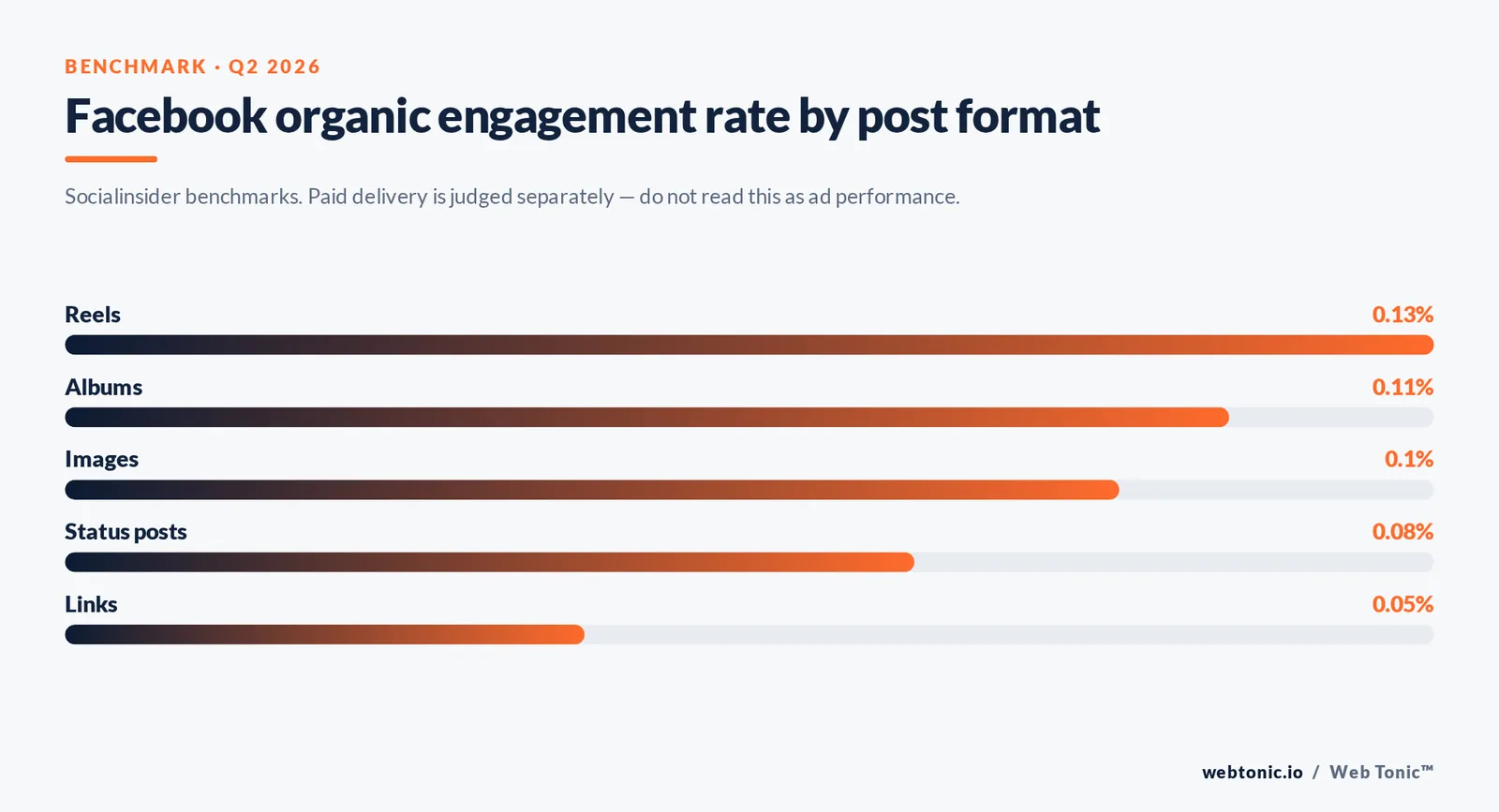
What has changed is that paid has to do the work organic used to. Socialinsider's Facebook benchmark study shows average engagement flat at 0.15%, with Q2 2026 engagement falling across nearly every format: Reels 0.13%, albums 0.11%, images 0.10%, status posts 0.08% and links 0.05%. Brands responded by posting 22% less — an average of 39 posts a month — while audience growth rates doubled from 12.2% to 23.2%.
The benchmarks your examples have to beat
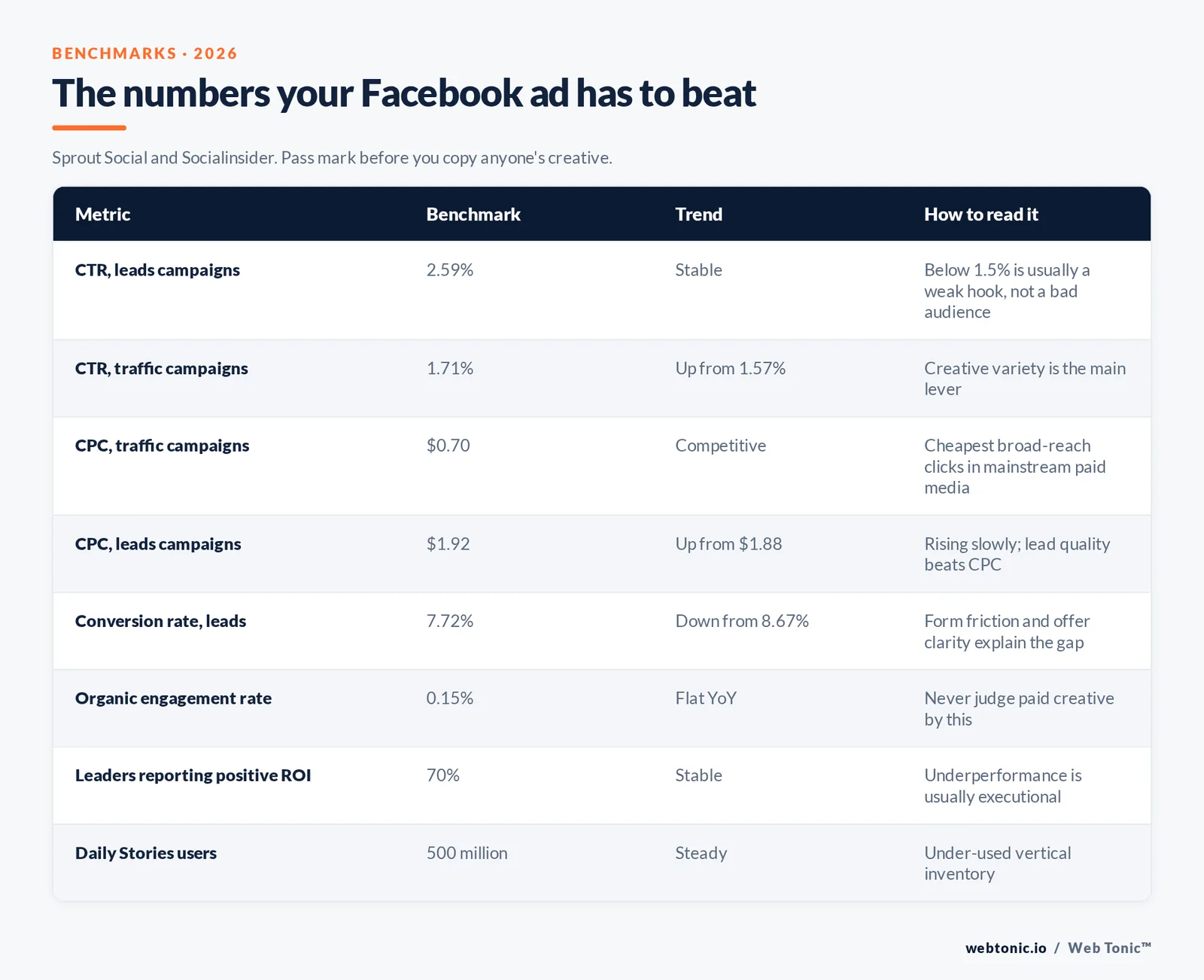
Use these as the pass mark before you copy anyone's creative. If an ad you admire would not clear these numbers in your account, it is inspiration, not a template.
| Metric | Benchmark | Trend | How to read it |
|---|---|---|---|
| CTR, leads campaigns | 2.59% | Stable | Below 1.5% usually means a weak hook, not a bad audience |
| CTR, traffic campaigns | 1.71% | Up from 1.57% | Creative variety is the main lever here |
| CPC, traffic campaigns | $0.70 | Competitive | Cheapest broad-reach clicks in mainstream paid media |
| CPC, leads campaigns | $1.92 | Up from $1.88 | Rising slowly; lead quality matters more than CPC |
| Conversion rate, leads | 7.72% | Down from 8.67% | Form friction and offer clarity explain most of the gap |
| Organic engagement rate | 0.15% | Flat YoY | Do not judge paid creative by organic engagement |
| Marketing leaders reporting positive ROI | 70% | Stable | Underperformance is usually executional |
| Daily Stories users | 500 million | Steady | Under-used vertical inventory for most advertisers |
One caveat on measurement: cross-platform overlap is heavy — about 78.6% of Facebook users are also on Instagram — so placement-level reporting matters more than campaign averages. Attribution discipline is the theme of our data intelligence work.
24 Facebook ad examples by format, and why they work
The examples below are grouped by format because format determines what the creative can even attempt. Each row names the ad archetype, the brand pattern it is associated with, and the mechanism doing the work. Shopify's roundup of Facebook ad examples is a good second source for ecommerce variants.
| # | Format | Example / archetype | Why it works | Best objective |
|---|---|---|---|---|
| 1 | Single video | Founder-to-camera product demo, Dollar Shave Club style | Voice and humour do the differentiation; product shown in 5 seconds | Awareness |
| 2 | Single video | Problem-agitate-solve, 15 seconds, captions burned in | Works with sound off, which is the default state | Conversions |
| 3 | Single video | Material or process close-up, Allbirds style | Texture at thumbnail size signals quality faster than copy | Consideration |
| 4 | Single image | Product on flat colour with one benefit line | Survives compression and small screens; cheap to iterate | Conversions |
| 5 | Single image | Before-and-after split frame | Delivers the outcome without a single word of copy | Conversions |
| 6 | Single image | Room-in-context lifestyle shot, IKEA style | Lets the viewer place the product in their own life | Consideration |
| 7 | Carousel | One benefit per card, 4 cards | Turns a feature list into a swipeable sequence | Consideration |
| 8 | Carousel | Step-by-step how-to across cards | Teaches before it sells; strong for considered purchases | Traffic |
| 9 | Carousel | Best-sellers grid pulled from the catalogue | Lets the algorithm find the product that converts | Sales |
| 10 | Collection | Seasonal edit with a cover video | Cover video earns the stop, grid does the merchandising | Sales |
| 11 | Instant Experience | Full-screen mini-landing page for a launch | Removes the load-time drop-off of an off-platform click | Consideration |
| 12 | Lead ad | 3-field in-platform form with a named deliverable | Pre-filled fields cut friction; benchmark CTR 2.59% | Leads |
| 13 | Lead ad | Quote or estimate request for a local service | Matches intent people already have offline | Leads |
| 14 | Reels / Stories | 9:16 UGC testimonial, phone-shot | Native look outperforms studio polish in feed-adjacent placements | Conversions |
| 15 | Reels / Stories | Unboxing with on-screen price reveal | Answers the price objection inside the creative | Sales |
| 16 | Reels / Stories | 3-second hook compilation of one product's uses | Aligns with the 48% who prefer short-form video | Awareness |
| 17 | Dynamic product ad | Cart abandoners with the exact viewed product | Highest-intent inventory in most ecommerce accounts | Sales |
| 18 | Dynamic product ad | Cross-sell set based on prior purchase | Raises AOV without new creative production | Sales |
| 19 | Social proof | Review screenshot as the creative, 1 highlighted line | Third-party voice outperforms brand voice on claims | Conversions |
| 20 | Social proof | Press or award badge with a single figure | Borrowed credibility compresses the consideration step | Consideration |
| 21 | Offer | Deadline-dated promotion with the date visible in-image | Real urgency, not invented scarcity | Sales |
| 22 | Offer | Bundle framed as a per-use cost | Reframes price against a familiar reference point | Sales |
| 23 | Education | Template or checklist as the lead magnet | Gives the ad a reason to exist beyond the sale | Leads |
| 24 | Education | Myth-versus-fact comparison graphic | Pre-handles the top objection before the click | Traffic |
Pattern to notice: 18 of the 24 lead with either a demonstration or a third-party voice. Almost none lead with a brand statement. That is consistent with what Nielsen's advertising trust research has reported for years, and with Think with Google's video creative guidance on front-loading the payoff.
Primary text and copy patterns that hold up
Copy is where most accounts lose the click they already paid for. These five patterns are the ones we keep returning to across industries.
- Pattern 1 — Offer in the first 8 words. The primary text truncates fast on mobile; everything after the "see more" break is a bonus, not a plan.
- Pattern 2 — One number, not five. A single concrete figure ("3 fields, 40 seconds") outperforms a list of claims because it is checkable.
- Pattern 3 — Name the person, not the market. "If you run a 2-van plumbing business" converts better than "for SMBs" because it filters.
- Pattern 4 — Objection first. Lead with the reason people say no, then dismantle it in one line.
- Pattern 5 — Match the landing headline word-for-word. A mismatch between ad and page is the most common cause of a strong 2%+ CTR converting at under 1%.
If claims involve testimonials, incentivised reviews or creator content, the FTC endorsement guides govern disclosure, and Meta's own review process is stricter than most advertisers expect. Product and policy changes are announced on Meta's newsroom.
How to build your own version in 7 steps
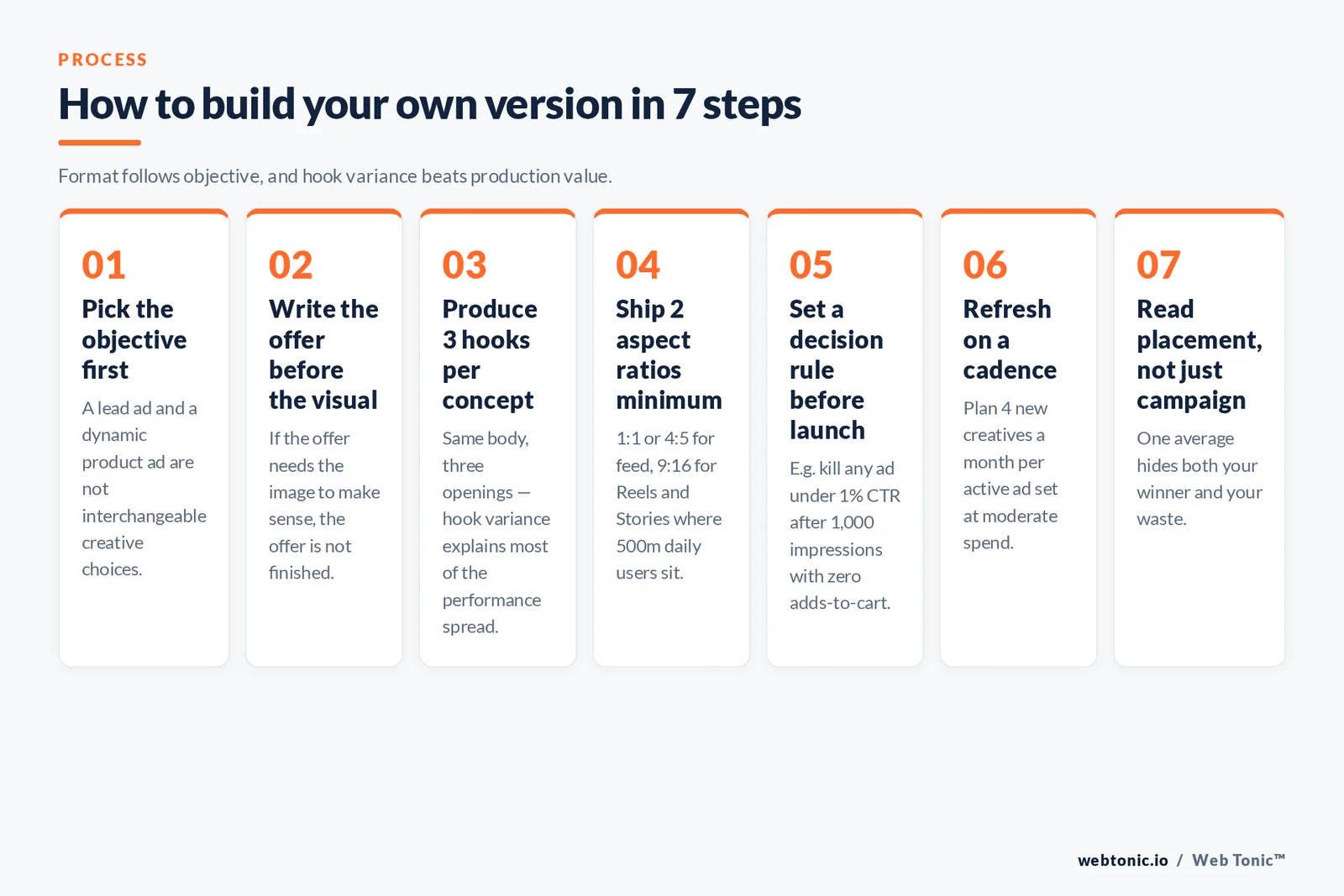
- Step 1 — Pick the objective first. Format follows objective. A lead ad and a dynamic product ad are not interchangeable creative choices.
- Step 2 — Write the offer before the visual. If the offer needs the image to make sense, the offer is not finished.
- Step 3 — Produce 3 hooks per concept. Same body, three openings. Hook variance explains more performance spread than production value.
- Step 4 — Ship 2 aspect ratios minimum. 1:1 or 4:5 for feed, 9:16 for Reels and Stories, where 500 million daily users sit.
- Step 5 — Set a decision rule before launch. For example: kill any ad under 1% CTR after 1,000 impressions with zero adds-to-cart.
- Step 6 — Refresh on a cadence, not on a hunch. Plan 4 new creatives a month per active ad set at moderate spend.
- Step 7 — Read placement, not just campaign. Feed, Reels and Stories behave differently enough that one average hides both your winner and your waste.
Broader planning context sits in Hootsuite's Social Trends research. For production capacity, this is exactly the workload our performance creative team exists to absorb, and the strategy layer around it is covered in our services.
Facebook ad examples by business type
The same creative idea performs differently depending on what you sell. This table maps business type to the ad format, creative approach and offer that we see work most reliably, so you can shortlist examples worth copying rather than admiring all of them.
| Business type | Best format | Creative approach | Offer that converts |
|---|---|---|---|
| Ecommerce, low AOV | Carousel and dynamic product ads | Product-on-colour images plus 9:16 UGC video | Bundle or first-order discount with the price visible |
| Ecommerce, high AOV | Collection and Instant Experience | Material close-ups, founder video, review screenshots | Free returns, financing, or a try-before-you-buy window |
| Local service business | Lead ads | Before-and-after image, van or team photo, captions | Free quote or same-week availability |
| B2B SaaS | Lead ads and single video | Product UI walkthrough, 15 seconds, text-light | Named template, benchmark report or live demo |
| Professional services | Single image and lead ads | Practitioner to camera, one credential on screen | Free consultation with a stated agenda |
| Restaurant and hospitality | Reels and Stories | Food in motion, sound-off friendly, location tagged | Time-boxed menu deal or event booking |
| Events and ticketing | Carousel and video | Crowd footage plus a clear date card | Early-bird pricing with a real deadline |
| Apps and subscriptions | Single video | Screen recording of the core action in 5 seconds | Free tier or a 7-day trial with no card |
| Education and courses | Lead ads and carousel | Instructor to camera, outcome-first copy | Free lesson, syllabus download or workshop seat |
| Nonprofit | Single video | One beneficiary story, no music-led montage | Specific unit of impact per dollar amount |
Read the table as a starting hypothesis, not a rule. The best facebook ad examples in any category are the ones already running in it, which is why the next step is research rather than production.
How to find the best Facebook ad examples yourself
You do not need a curated list. Meta publishes every active ad, so a good creative brief starts with an hour of primary research on the ads your competitors are actually paying to run.
- Search the Ad Library by brand. Filter to your country, then list every active creative for your 5 closest competitors. Ads running longest are the ones working.
- Sort by longevity, not by looks. An image ad live for 90 days is better evidence than a beautiful video launched last week.
- Log the structure, not the design. For each ad record format, hook type, offer, social proof used and call to action in a simple sheet.
- Count formats. If 8 of 10 long-running competitor ads are video, that is a market signal about attention, not a coincidence.
- Check the landing experience. Click through and note whether the page repeats the ad headline; that parity is often the real difference in conversion rate.
- Rebuild, do not copy. Take the structure and apply your own product truth, brand voice and price. Copying the design produces a worse version of someone else's ad.
Two research habits raise the hit rate. First, keep a swipe file organised by objective rather than by industry, because a great lead ad for a dentist often works for a law firm. Second, review your own top ads monthly and write down why they won, in one sentence each. Most teams can name their best-performing creative but not the mechanism behind it, which is why the next batch of ads repeats the design and loses the result.
Where most advertisers go wrong
| Mistake | What it looks like | Fix |
|---|---|---|
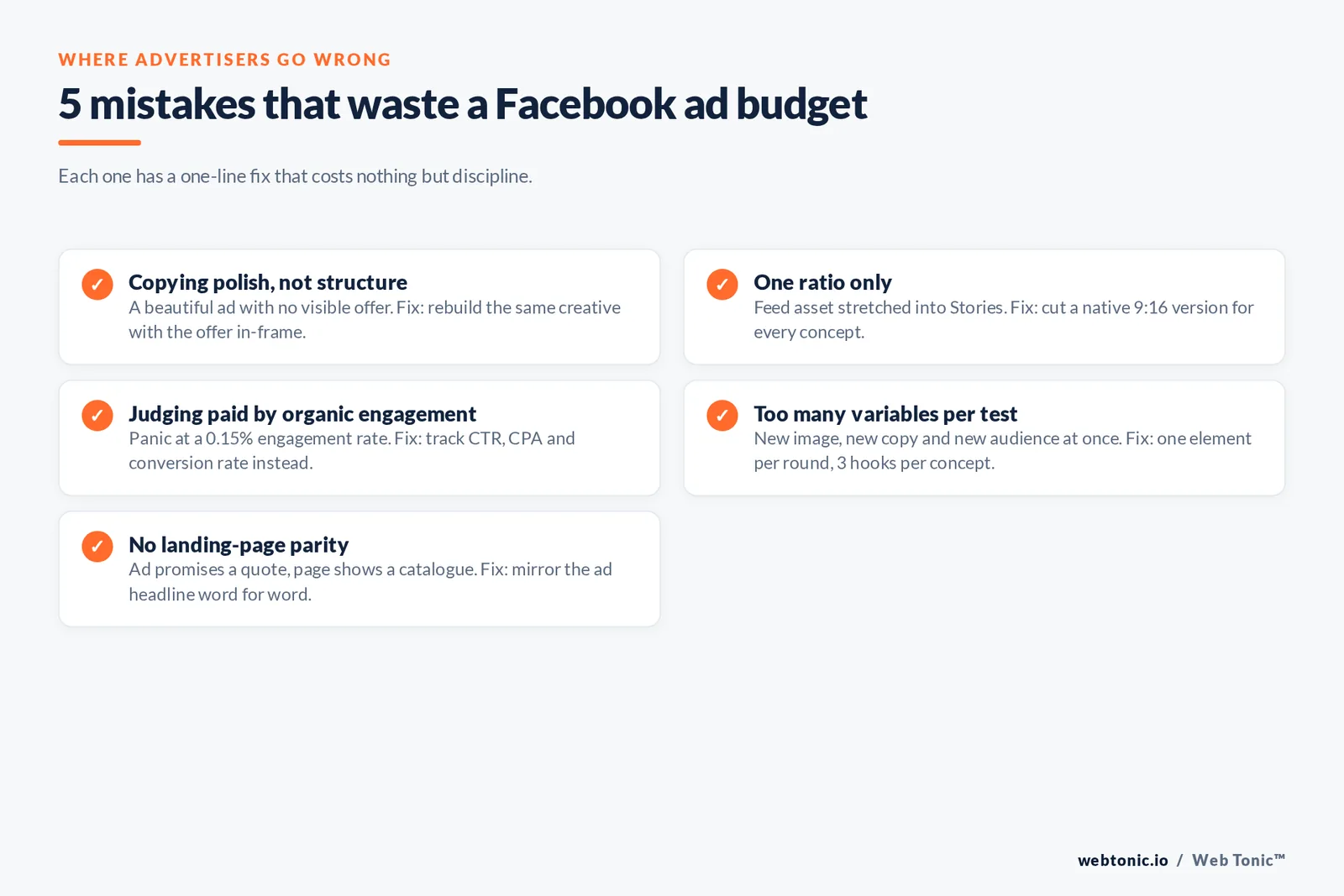
| Copying polish, not structure | A beautiful ad with no visible offer | Rebuild the same creative with the offer in-frame |
| One ratio only | Feed asset stretched into Stories | Cut a native 9:16 version for every concept |
| Judging paid by organic engagement | Panic at a 0.15% engagement rate | Track CTR, CPA and conversion rate instead |
| Too many variables per test | New image, new copy, new audience at once | Change one element per round, 3 hooks per concept |
| No landing-page parity | Ad promises a quote, page shows a catalogue | Mirror the ad headline on the page, word for word |
Want a second opinion on your current creative set? Send it over — and our ongoing paid-social writing lives on the blog.
FAQ
What is a good CTR for a Facebook ad?
Use 2.59% as the reference point for leads campaigns and 1.71% for traffic campaigns, based on Sprout Social's 2026 benchmark data. Anything consistently under about 1% usually points at the hook or the audience-offer match rather than the bid. Compare within your own account and objective first, because industry averages hide wide category variation.
Which Facebook ad format converts best?
There is no single winner; format should follow objective. Dynamic product ads dominate for ecommerce retargeting, lead ads win for local and service businesses because in-platform forms remove friction, and short-form vertical video is strongest for cold audiences — 48% of Facebook users interact most with short-form video.
How much do Facebook ads cost in 2026?
Average CPC sits around $0.70 for traffic campaigns and $1.92 for leads campaigns, with average lead conversion rates near 7.72%. Your real cost depends on category competition, audience size and creative quality, so model cost per acquisition rather than cost per click before setting budgets.
How many Facebook ad creatives should I run at once?
At moderate spend, three to five active creatives per ad set is a workable range, refreshed with about four new assets a month. Fewer than three gives the delivery system nothing to optimise between; many more fragments learning and slows every ad's exit from the learning phase.
Are Facebook ads still worth it given falling engagement?
Yes, and the two numbers are unrelated. Organic engagement averaging 0.15% describes unpaid posts, not paid delivery. On the paid side, 70% of marketing leaders report positive ROI and 62% of marketers plan to increase Facebook investment this year, against an audience of 3.07 billion monthly users.
Sources
Sprout Social — Facebook Statistics for Marketers 2026; Sprout Social — Facebook Ads guide; Socialinsider — Facebook Benchmarks (engagement and format data); Buffer — Facebook Ads resource; Statista — Facebook Advertising topic hub; eMarketer — Meta Advertising insights; Hootsuite — Social Trends research; Nielsen — advertising trust insights; Think with Google — video marketing strategies; Shopify — Facebook ad examples; Meta Newsroom (about.fb.com) — product and policy announcements; US Federal Trade Commission — Endorsement Guides. Benchmarks reflect figures published at time of writing and vary by industry and objective.