Table of contents
Immigration law landing pages convert at a median 5.6%, trailing the 6.3% legal-industry benchmark - a gap Unbounce's 2025 Conversion Benchmark Report documents but does not fully explain. This report lays out the channel, device, and copy-length data behind that number, plus the immigration-specific demand and compliance context shaping who lands on these pages in the first place.
Key Takeaways
- Immigration law landing pages convert at a 5.6% median, per Unbounce 2025 - below the 6.3% legal-industry baseline.
- Family and disability law both convert at 6.3%, ahead of immigration within the same legal category.
- Paid search converts at 8.3% for legal overall, nearly 2x paid social's 4.8% and 3x email's 2.7%.
- Google converts at 8.6% on legal paid search traffic, 3x Bing's 2.8%.
- Instagram converts at 13% on paid social, versus 7.3% for Facebook.
- Mobile drives 88% of legal landing page traffic - the widest gap Unbounce measured across any industry.
- Mobile converts at 21%, ahead of desktop's 15.9%.
- College-level copy converts best in legal, at 7.2%.
- The recommended legal landing page runs ~600 words, the second-highest of any industry Unbounce analyzed.
- Attorneys & Legal Services average an $8.58 CPC on Google Ads in 2025, per WordStream.
- Average cost per lead for the category is $131.63 on Google Ads.
- The U.S. immigration court backlog stood at roughly 3.75 million pending cases as of September 2025, per the Department of Justice's Executive Office for Immigration Review.
- EOIR received over 560,000 new case receipts in FY2025 and projects roughly 600,000 in FY2026.
- USCIS's H-1B program alone drew 479,953 registrations for FY2025, a fraction of total annual immigration filing volume feeding law firm demand.
- ABA Model Rule 7.1 bars misleading result claims on any landing page, including implied outcome guarantees.
- The FTC and USCIS both warn consumers against "notario" fraud, making licensed- attorney disclosure a trust signal, not just a compliance line.
Immigration law's conversion rate versus the rest of legal
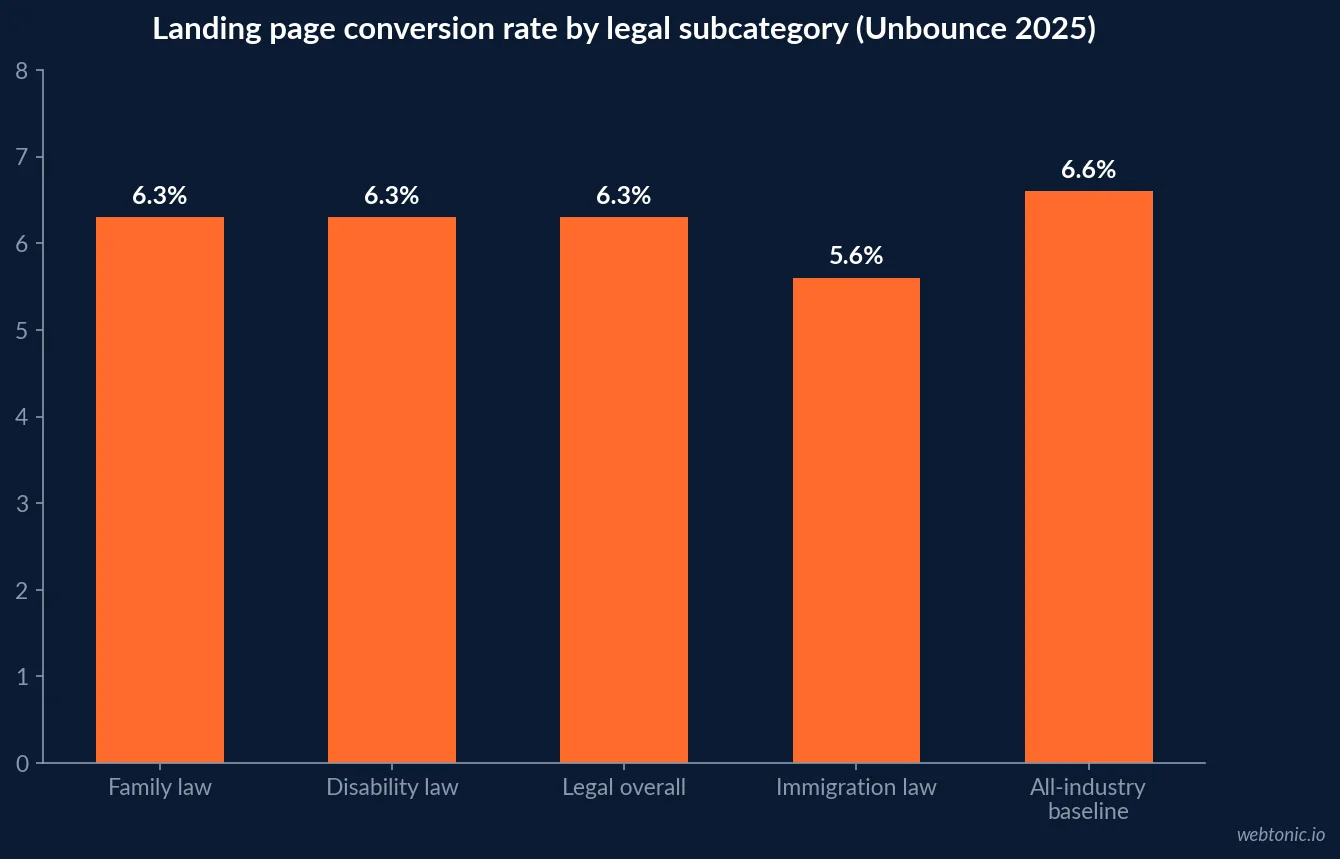
Unbounce's 2025 Conversion Benchmark Report, built from an analysis of legal industry landing pages, put the overall legal median conversion rate at 6.3% against a 6.6% all-industry baseline. Immigration law sits below even that legal median, at 5.6%, while family law and disability law both hold at 6.3%. Unbounce frames the legal category as an outlier versus most industries it studied because paid search dramatically outperforms email - a pattern tied to how urgently a prospect needs to act once they identify a legal need.
| Legal subcategory | Median landing page conversion rate |
|---|---|
| Family law | 6.3% |
| Disability law | 6.3% |
| Legal industry overall | 6.3% |
| Immigration law | 5.6% |
| All industries baseline | 6.6% |
Why the gap: what the data does and does not show
Unbounce's report does not publish a causal explanation for immigration law's lower conversion rate, and no other primary source in this space breaks the gap down further. What can be said honestly from the available data: immigration matters cluster around longer research timelines than urgent-need practice areas, decisions are frequently shared among family members rather than made by a single visitor, and the traffic mix skews more toward "researching options" than the emergency-driven searches that convert best in personal injury or DUI defense. Firms should treat 5.6% as the realistic floor to beat, not a signal that immigration traffic is lower quality - it is a slower-deciding audience, and page design should account for that with clearer next-step options (consultation booking, case-type quiz) rather than a single hard "Call Now" CTA.
Which channel actually converts on an immigration law landing page
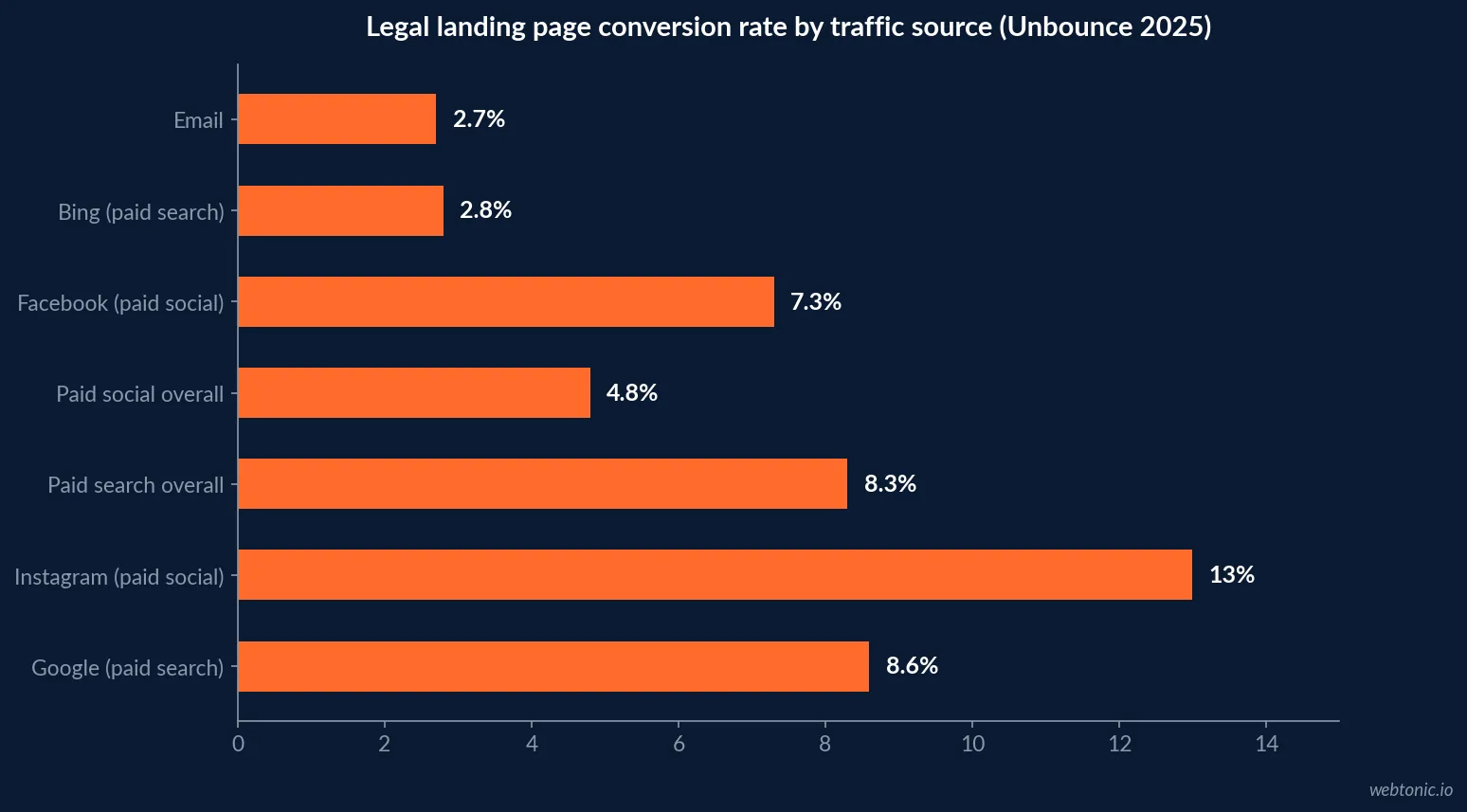
Across the legal category, paid search converts at a median 8.3%, nearly double paid social's 4.8% and more than 3x email's 2.7%. Within paid search, Google's median conversion rate of 8.6% is roughly 3x Bing's 2.8%, and Unbounce says the gap is wide enough to justify concentrating budget on Google rather than splitting it. On paid social, Instagram converts at 13% against 7.3% for Facebook - a reversal of what many firms still assume about the two platforms.
| Traffic channel | Median conversion rate |
|---|---|
| Paid search (legal overall) | 8.3% |
| Google (paid search) | 8.6% |
| Bing (paid search) | 2.8% |
| Instagram (paid social) | 13% |
| Facebook (paid social) | 7.3% |
| Paid social (legal overall) | 4.8% |
| 2.7% |
Mobile is not optional for immigration law pages
Legal recorded the widest mobile/desktop traffic split of any industry Unbounce analyzed in 2025: 88% of legal landing page traffic arrives on mobile. Unlike most industries, where desktop still edges out mobile on conversion, legal traffic converts better on mobile - 21% versus 15.9% on desktop. For an immigration practice where prospects are frequently searching from a phone during a work break or while gathering paperwork on a case, a page that has not been rebuilt mobile-first is losing both volume and rate at once.
| Device | Share of legal landing page traffic | Conversion rate |
|---|---|---|
| Mobile | 88% | 21% |
| Desktop | 12% | 15.9% |
Copy length and reading level: legal breaks the "keep it short" rule
Generic CRO advice pushes short, simple landing page copy. Legal - and immigration law specifically - runs against that. Unbounce's data shows the recommended word count for legal landing pages sits around 600 words, the second-highest of any industry in the report, and college-level reading difficulty converts best in legal at 7.2%, outperforming simpler copy. For immigration pages, that likely reflects the audience: prospects want to see their specific situation named - a particular visa category, a removal-defense scenario, a green card timeline - before they trust the firm understands their case, and a thin, generic page cannot do that.
What immigration law CPC and CPL mean for landing page ROI
Landing page conversion rate matters more in legal than in most verticals because the cost of the click behind it is unusually high. WordStream's 2025 Google Ads Benchmarks report puts Attorneys & Legal Services at an average $8.58 CPC and a $131.63 average cost per lead - both among the highest of any industry it tracks. At that price per click, a landing page converting at 5.6% instead of the legal median 6.3% is not a rounding error; it materially changes the blended cost per consultation booked, which is why CRO work on immigration pages tends to pay back faster than on lower-CPC verticals.
| Google Ads metric (Attorneys & Legal Services, 2025) | Value |
|---|---|
| Average CPC | $8.58 |
| Average CTR | 5.97% |
| Average conversion rate | 5.09% |
| Average cost per lead | $131.63 |
The demand side: how much immigration volume is actually moving
Landing page traffic for immigration firms sits downstream of real filing and court volume. The Department of Justice's Executive Office for Immigration Review (EOIR) reported in September 2025 that the immigration court backlog had fallen to under 3.75 million pending cases, down from more than 4.18 million in January 2025, even as the agency was tracking over 560,000 new case receipts for FY2025 and projecting roughly 600,000 for FY2026. Separately, Migration Policy Institute's 2025 analysis put the pending caseload at 3,783,000 as of July 2025 - both figures describe the same multi-million-case pipeline that keeps search demand for immigration attorneys structurally high regardless of any single firm's landing page quality.
| Immigration court/filing metric | Figure | Source |
|---|---|---|
| Pending immigration court cases (Sept 2025) | under 3.75 million | DOJ EOIR |
| Pending immigration court cases (Jul 2025) | 3,783,000 | Migration Policy Institute |
| New EOIR case receipts, FY2025 | 560,000+ | DOJ EOIR |
| Projected EOIR case receipts, FY2026 | ~600,000 | DOJ EOIR |
| H-1B registrations, FY2025 | 479,953 | USCIS |
Compliance: the one place immigration landing pages cannot cut corners
ABA Model Rule 7.1 prohibits any communication about a lawyer's services that is false or misleading, which reaches into landing page headlines, results claims, and testimonial sections - several state bars layer on their own disclaimer requirements for any language implying a guaranteed outcome. Immigration pages carry an extra compliance dimension most other legal practice areas do not: the FTC's consumer alert on immigration scams and USCIS's own fraud-prevention guidance both warn prospective clients against unlicensed "notario" services. A landing page that clearly states bar admission and attorney credentials in the header is not just a Rule 7.1 safeguard - it is a differentiator against the scam operators that FTC and USCIS actively warn immigrant communities about.
Turning the data into a landing page plan
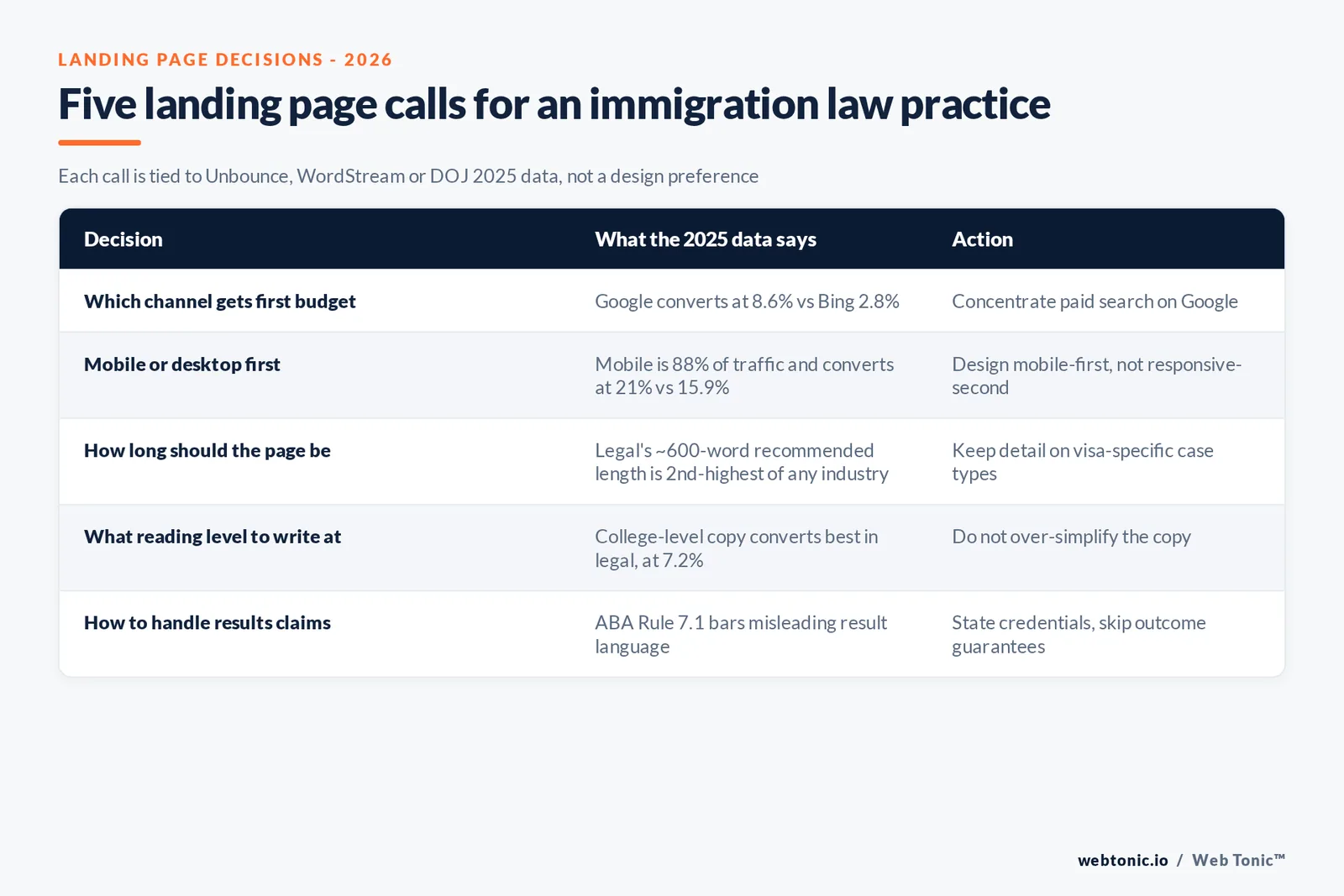
Three moves follow directly from the numbers above. First, budget skews toward Google paid search as the primary channel, given its 8.6% conversion rate against Bing's 2.8% and paid social's 4.8% - test Instagram before Facebook if paid social is added at all. Second, build mobile-first, not mobile-responsive: with 88% of traffic on mobile and mobile out-converting desktop, a page's mobile layout is the primary layout, and desktop is the secondary view. Third, resist the instinct to shorten the page - legal's ~600-word recommended length and college-level copy performing best both suggest immigration prospects want detail that maps to their specific case type before they book a consultation. Anyone running paid search and landing page programs for an immigration practice should treat 5.6% as the number to beat, and re-test the page every time a new visa category or removal-defense service line is added, since Unbounce's data shows legal conversion behavior does not follow the "shorter and simpler" pattern seen elsewhere.
None of this replaces working cost-per-lead benchmarks or conversion rate data from other verticals into the plan - immigration law's numbers are usable context, not a substitute for testing against a firm's own traffic.
Frequently Asked Questions
Why do immigration law landing pages convert below the legal average?
Unbounce's 2025 Conversion Benchmark Report puts immigration law at a 5.6% median landing page conversion rate, versus 6.3% for the legal category overall and 6.3% for family and disability law specifically. Unbounce does not publish a causal breakdown by legal subcategory, but the pattern fits the practice area: immigration matters often involve a longer research phase, multiple family members reviewing the same page, and higher stakes than a single-incident legal need, all of which can slow the click-to-contact decision compared with faster-cycle practice areas.
Which traffic channel converts best for a law firm landing page?
Paid search is the standout, converting at a median 8.3% across the legal category versus 4.8% for paid social and 2.7% for email, per Unbounce. Within paid search, Google outperforms Bing by roughly 3x (8.6% versus 2.8%). Immigration firms budgeting a first paid channel should treat Google Search as the default and test paid social as a secondary, lower-intent channel rather than a primary lead source.
Does mobile or desktop convert better on immigration law landing pages?
Mobile drives 88% of legal-industry landing page traffic - the widest mobile/desktop traffic gap Unbounce measured across any industry in its 2025 report - and mobile also converts better, at 21% versus 15.9% for desktop. A page that has not been rebuilt mobile-first is fighting both a volume and a conversion-rate disadvantage at the same time.
How much copy should an immigration law landing page carry?
More than most industries assume. Unbounce's data shows legal landing pages can carry a recommended word count around 600 words - the second-highest of any industry analyzed - and college-level reading difficulty converts best at 7.2%, ahead of simpler copy. That runs against the generic CRO advice to keep pages short; for an immigration case, prospective clients appear to want enough detail to trust that the firm understands their specific visa category or removal-defense situation before they call.
What compliance rules apply to an immigration law landing page's copy and offers?
ABA Model Rule 7.1 bars any communication that is false or misleading, including implied outcome guarantees a landing page's headline or testimonial section might otherwise use, and several state bars require an added disclaimer on results language. Separately, the FTC and USCIS warn consumers against 'notario' scams - a landing page for a licensed immigration attorney should say so unambiguously in the header and footer, both to build trust and to stay clear of that confusion.
Sources
Unbounce, 2025 Conversion Benchmark Report - Legal
WordStream/LocaliQ, 2025 Google Ads Benchmarks
DOJ Executive Office for Immigration Review, Sept. 2025 milestones release
Migration Policy Institute, Breaking the Cycle of Dysfunction at the U.S. Immigration Courts (2025)
USCIS, H-1B Electronic Registration Process data
American Bar Association, Model Rule 7.1
Federal Trade Commission, Avoiding Scams That Target Immigrants