Table of contents
Webflow gives an HVAC contractor a 68.9% mobile Core Web Vitals pass rate on defaults against WordPress's 49.3% — and none of that matters if the site still hides the phone number and mean mobile LCP sits at 8.35 seconds. Here is the 2026 platform and conversion data, side by side.
Key Takeaways
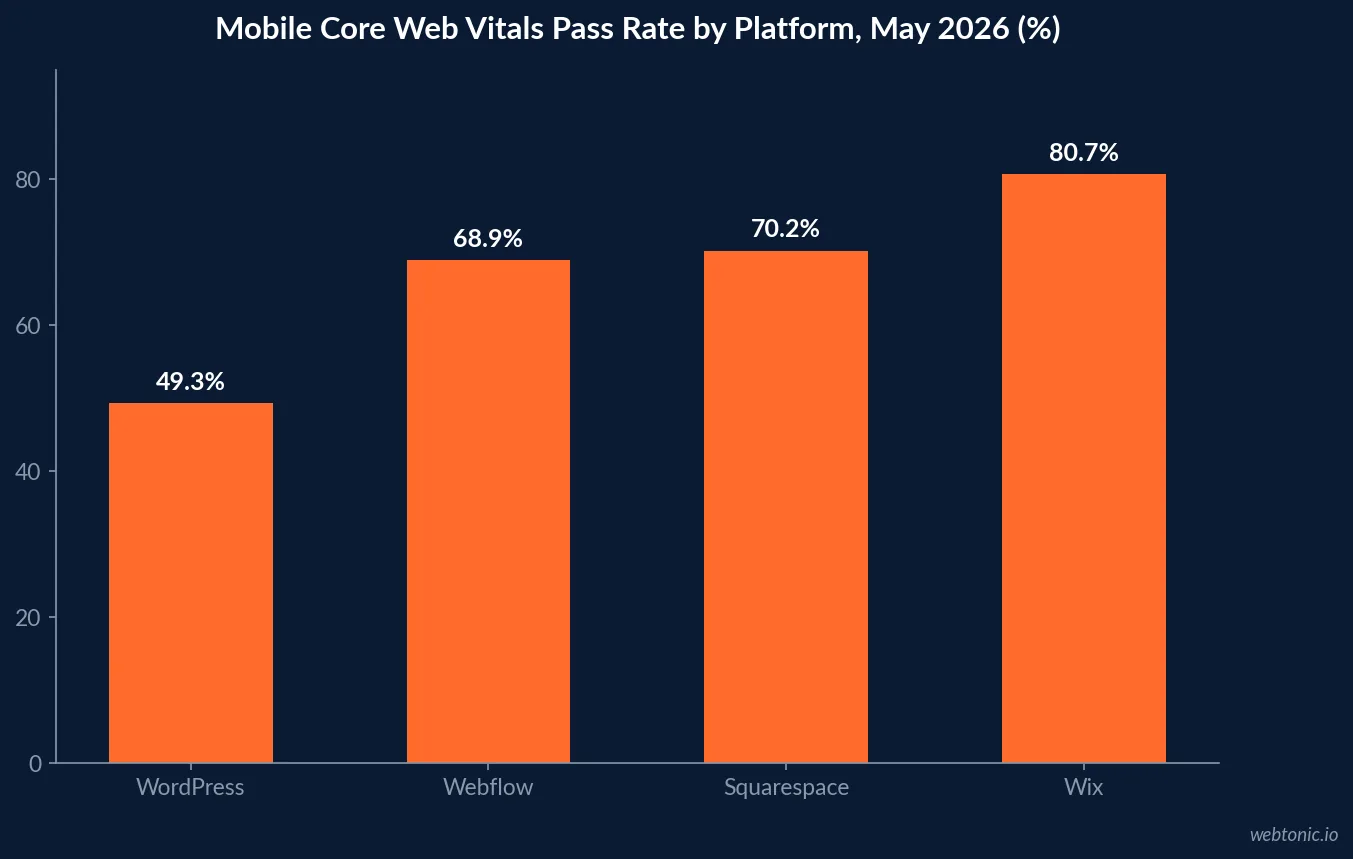
- Webflow: 68.9% mobile CWV pass rate vs WordPress 49.3%, Squarespace 70.2%, Wix 80.7% (May 2026 crawl).
- 55.5% of Webflow origins have good TTFB against 24.8% on WordPress.
- Mean mobile LCP across 104 audited HVAC sites is 8.35s — 3.3x Google's 2.5s threshold.
- The trade scored 65.32/100 on site quality; 25 of 104 sites earned an F.
- 74% put the phone in a persistent header, but only 18.3% have a hero form.
- 56.7% run real online scheduling while 63% of homeowners prefer to book online.
- Self-scheduling lifts booking conversion 20–30% — about $42,000/year at 40 inquiries a month.
- HVAC sites convert at 7.8% on average; emergency pages hit 10–15%.
- Every extra second of load time costs roughly 7% of conversion rate; 53% abandon after 3s.
- Webflow powers ~822,550 sites (0.8% share) on $213M annual revenue.
1. Platform Benchmarks: What Webflow Actually Delivers
The most useful platform data in 2026 is not vendor marketing — it is field data. PageSpeed Matters analysed Chrome User Experience Report data for every origin on each major builder using the HTTP Archive Technology Report from the May 2026 crawl. The results reorder the usual assumptions.
| Platform | Mobile CWV pass | Good TTFB | Median mobile JS | Median mobile images |
|---|---|---|---|---|
| WordPress | 49.3% | 24.8% | 692 KB | 1,029 KB |
| Webflow | 68.9% | 55.5% | 918 KB | 855 KB |
| Squarespace | 70.2% | 80.8% | 1,571 KB | 1,111 KB |
| Wix | 80.7% | 66.9% | 1,707 KB | 185 KB |
Two readings matter for a contractor. First, Webflow's 20-point CWV advantage over WordPress is real and comes for free — hosting, CDN, image conversion and lazy-loading are defaults rather than plugin decisions. Second, Webflow is not the outright winner: Wix leads raw pass rates and Squarespace leads server response. Webflow's distinguishing number is the lightest image payload of the four (855 KB), which is precisely the metric that decides mobile LCP on photo-heavy contractor sites.
The wider context is that the bar keeps rising. The 2026 Web Almanac reports 49.2% of mobile sites now pass all three Core Web Vitals, up from 41.7% a year earlier, while median mobile INP worsened by 11 milliseconds — interactivity is degrading even as loading improves. A contractor site whose only performance advantage is the platform will be average again within two crawls.
2. The State of HVAC Websites in 2026
Platform choice is a rounding error next to what HVAC sites are actually shipping. Between 19 and 22 May 2026, Fervor Studio ran a standardised inspection on 104 HVAC contractor websites across the US and Canada using Lighthouse 13.3.0 and axe-core 4.10.2.
| Metric | HVAC result | Read |
|---|---|---|
| Mean overall score | 65.32 / 100 | A D grade; median 65, range 31–90 |
| Sites earning an A | 1 of 104 | Effectively nobody |
| Sites earning an F | 25 of 104 | Nearly a quarter of the trade |
| Mobile Lighthouse performance | 48.16 mean | Median 46 — broadly failing |
| Mobile LCP | 8.35s mean | Median 6.24s vs 2.5s target |
| Mobile total blocking time | 3,097 ms mean | Script-heavy templates |
| Accessibility score | 3.5 / 8 | Weakest category measured |
| Content & SEO score | 8.79 / 15 | Second weakest |
The pattern is consistent with what we see in audits: desktop is fine (2.27s mean LCP, 75.54 Lighthouse) and mobile is broken. Since mobile is where a homeowner with a dead furnace at 11pm is searching, the mean numbers understate the commercial damage. Our HVAC technical SEO statistics break down the crawl and rendering side of the same dataset.
3. Conversion Elements: What Is Missing
The same audit scored five conversion signals across all 104 brands. HVAC leads the trades on phone-first basics and trails badly everywhere else.
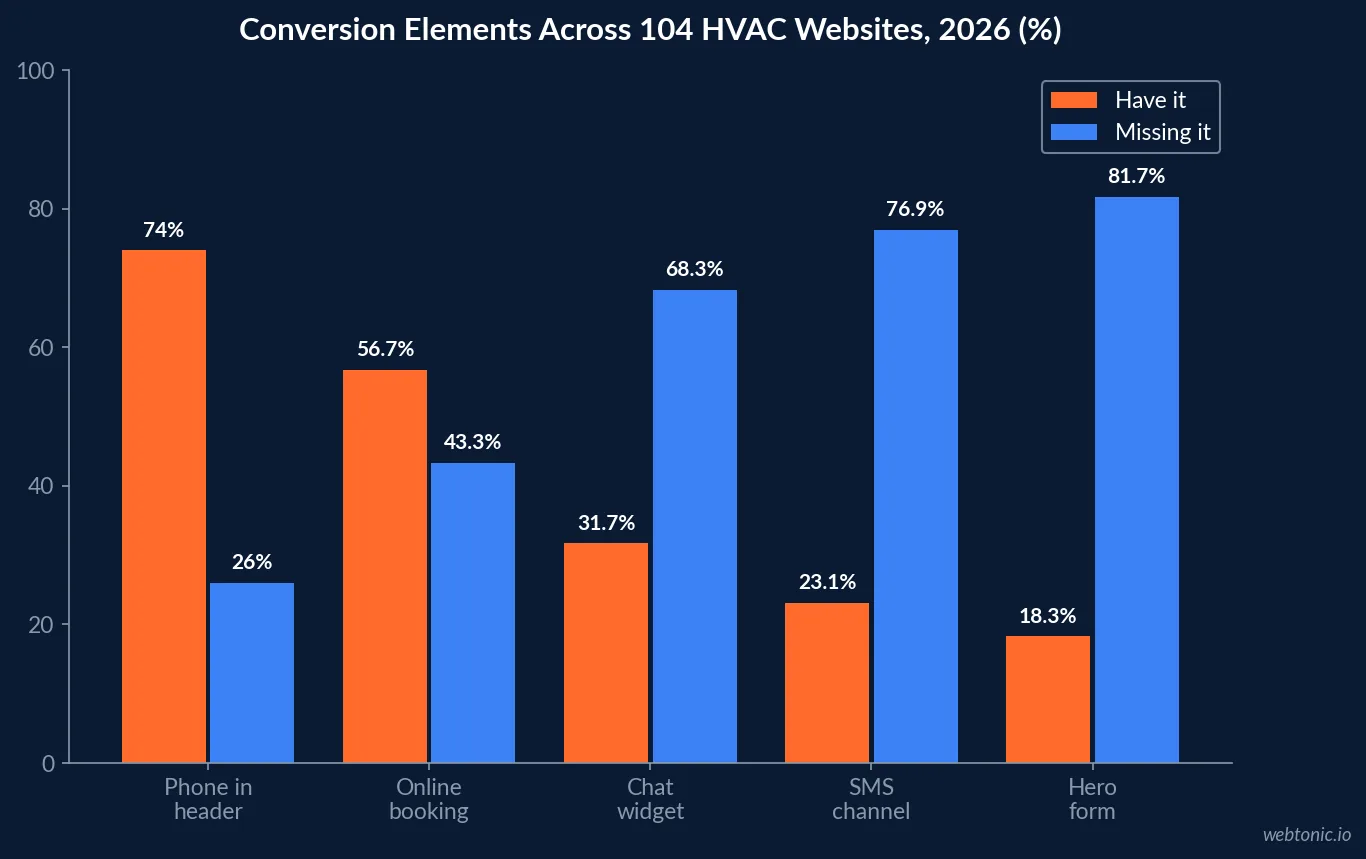
74% (77 of 104) put a clickable phone number in a persistent header — the highest-adoption signal in the trade. 56.7% (59 of 104) run a genuine online-scheduling tool. Then it falls off: 31.7% have a chat widget, 23.1% offer a text channel, and just 18.3% place a form in the hero. Median counts per site were 2 phone links and 6 forms, which tells you forms exist — they are simply buried below the fold.
Conversion research across a wider sample points the same way. Onward Craft scored 200 contractor websites against 27 conversion elements and found HVAC converting at 7.8% overall, 10–15% on emergency pages and 3–6% on replacement pages, with the top 6% of sites converting at 8–12% against a typical 2–4%. Same traffic, 4x the outcome.
4. Booking, Forms and the Phone
Webflow's value here is integration speed, not the platform itself — embedding a scheduler, a call-tracking script and a financing widget is a same-day job rather than a plugin-compatibility project. The demand-side numbers make the case urgent.
| Data point | Figure | Source context |
|---|---|---|
| Homeowners who prefer to request service online | 63% | ServiceTitan platform data |
| HVAC businesses offering online scheduling | 28% | Non-emergency requests |
| Homeowners factoring booking into vendor choice | 80% | 1,040-homeowner survey |
| Booking-conversion lift from self-scheduling | 20–30% | ≈$42,000/yr at 40 inquiries |
| Increase in booked calls with online scheduling | 34% | ServiceTitan platform data |
| Average phone-scheduling time per request | 34 minutes | Staff cost per booking |
| Inbound phone-lead close rate | ~46% | vs 7.8% site conversion |
The gap between 63% of homeowners wanting to book online and 28% of HVAC businesses offering it is the single widest demand mismatch in the dataset. PipelineOn's modelling values closing it at roughly $42,000 a year for a contractor handling 40 monthly inquiries at a $350 average ticket. Note the counterweight from BaaDigi's benchmarks: phone leads still close at about 46%, so booking widgets should be added alongside the phone, never in place of it. We map the full intake pattern in our HVAC landing page statistics.
5. Speed as a Revenue Line
The link between load time and booked jobs is well quantified, and the HVAC baseline is poor enough that the elasticity applies at full strength.
- Each additional second of load time costs roughly 7% of conversion rate.
- 53% of mobile visitors abandon a page taking longer than 3 seconds.
- Sites loading under 2 seconds convert 2.4x better than those at 5s+.
- Bounce probability rises 32% as load time moves from 1s to 3s.
- HVAC mean mobile LCP is 8.35s — well inside Google's "poor" band (>4s).
Applied to the trade average, a site moving from 8.35s to 2.5s is not chasing a rounding error. Searchlab's 2026 compilation would price that as a multi-fold conversion difference before a single word of copy changes. The usual HVAC culprits are unchanged: uncompressed hero photography, autoplaying background video and stacked third-party scripts — chat, reviews, call tracking, pixels — loading before the phone link renders.
6. CMS Collections and City-Page Programs
Where Webflow earns its keep for multi-metro contractors is structured content. CMS collections let one template render a page per row of a dataset, which is why 2026 programmatic-SEO playbooks name Webflow CMS alongside WordPress with ACF and Next.js content collections as a standard platform for service-area coverage.
| Design decision | 2026 guidance | Failure mode if ignored |
|---|---|---|
| Templated share of a city page | 30–40% | Thin-content classification |
| Unique share per city | 60–70% | Pages never gain traction |
| Service-page word count | 800–1,500 words | Thin pages under 300 lose both rankings and conversion |
| Emergency-page word count | 400–600 words | Long copy suppresses crisis-mode calls |
| Time to rank, suburban long-tail | 60–90 days | Programs killed too early |
| Organic outperforming paid | 9–12 month mark | Budget pulled at month six |
| Schema on location pages | LocalBusiness per city | No entity signal for the metro |
The operational win is publishing velocity: adding a metro becomes a CMS row plus unique content, not a developer ticket. The risk is the same velocity applied to template swaps — a 40-city rollout of near-identical pages is the fastest way to build a large indexation problem. Our HVAC local SEO statistics cover the map-pack side of the same program, and the reporting layer sits in our HVAC dashboards data.
7. Migration Economics
Replatforming is a capital decision, so it should be argued in hours and dollars rather than aesthetics. The published cases are consistent about where the return sits.
- A portfolio migration reported ~3x lower running cost, a six-week timeline and a 55% better SEO health score.
- One documented case moved a content change from 45 developer hours to about 20 minutes — roughly $5,400 per cycle at a $120/hour rate.
- Webflow ships AVIF/WebP delivery, lazy-loading, a global CDN and clean markup by default, so 90+ scores are common without tuning.
- WordPress can match or beat that — with caching, a CDN, image tooling and ongoing maintenance budget.
- Webflow now powers ~822,550 sites (0.8% of the web, ~1 in 125) on $213M revenue and a $4B valuation, so platform risk is modest.
The honest decision rule: migrate when your constraint is editorial throughput — seasonal promos, new city pages, financing offers stuck in a developer queue. Do not migrate to fix conversion. A fast empty site books nothing, which is why platform comparisons keep landing on workflow rather than raw speed. Compare the alternative in our HVAC WordPress statistics.
8. A Build Checklist for HVAC Sites
Ordered by the gap between measured adoption and measured value.
- Sticky click-to-call header on mobile — already at 74% adoption; being outside that group is a self-inflicted wound.
- Real online scheduling — 63% want it, 28% of businesses offer it, lift is 20–30%.
- Hero form on service pages — only 18.3% do this today.
- Compress hero media and drop background video — the direct cause of 8.35s LCP.
- Separate emergency and replacement paths — they convert at 10–15% and 3–6% respectively and need different copy lengths.
- Financing visibility on replacement pages — measurably lifts contacts on high-ticket intent.
- Source-level call tracking — phone leads close near 46%; untracked calls make paid spend unauditable.
- Fix accessibility — 3.5/8 mean score is both a legal and a conversion exposure.
- Add SMS as a channel — 23.1% adoption in a trade whose customers text.
None of that list requires a specific CMS. It requires someone owning the numbers, which is what our growth marketing and data intelligence teams do on contractor accounts.
9. The Bottom Line
Webflow is a defensible platform choice for an HVAC contractor: 68.9% mobile CWV pass rate against WordPress's 49.3%, the lightest default image payload of the major builders, CMS collections that make a 40-city program a content problem instead of a development one, and migration cases showing content cycles collapsing from 45 developer hours to 20 minutes. It is also not a strategy. The trade averages 65.32/100 on site quality, 8.35s mobile LCP and 18.3% hero-form adoption while 63% of homeowners want to book online and only 28% of businesses let them. Fix the intake, then argue about the platform. If you want that audit run against your own numbers, talk to our team.
Frequently Asked Questions
Is Webflow actually faster than WordPress for an HVAC site?
On defaults, yes — by a wide margin. The May 2026 HTTP Archive crawl of every origin on each platform shows Webflow at a 68.9% mobile Core Web Vitals pass rate against WordPress at 49.3%, and good TTFB on 55.5% of Webflow origins against 24.8% for WordPress. Webflow also ships a lighter median image payload (855 KB versus 1,029 KB). The caveat matters though: WordPress has the higher optimisation ceiling, and a well-tuned WordPress build on good hosting will beat a Webflow site stuffed with background video. The platform sets your starting line, not your finish line.
What conversion elements are HVAC websites missing in 2026?
Fervor Studio inspected 104 HVAC contractor websites in May 2026 and found the phone-first basics broadly in place but everything else patchy: 74% had a clickable phone number in a persistent header, 56.7% ran a real online-scheduling tool, 31.7% had a chat widget, 23.1% offered a text-message channel and only 18.3% put a form in the hero. The trade averaged 65.32/100 on their scoring framework — a D — with accessibility the weakest category at 3.5/8.
How many city pages can you run on Webflow CMS?
Enough for almost any contractor footprint, but plan the structure before you build. Webflow CMS collections drive templated city and service pages from a single dataset, which is why programmatic-SEO playbooks list it alongside WordPress with ACF and Next.js as a standard platform for the pattern. The constraint is not the CMS — it is content quality. Practitioner guidance in 2026 puts roughly 30–40% of a service-area page as safely templated and 60–70% as genuinely unique per city, which is the ratio that survives Google's duplicate-content classifiers.
Does site speed change how many HVAC jobs a site books?
It changes both traffic and conversion. Mean mobile LCP across the 104 audited HVAC sites was 8.35 seconds against Google's 2.5-second "good" threshold, and mean mobile Lighthouse performance was 48.16. Independent speed research puts the cost of each additional second at roughly 7% of conversion rate, with 53% of mobile visitors abandoning a page that takes longer than three seconds. On a site converting at the HVAC average of about 7.8%, that is the difference between a booked furnace replacement and a competitor's phone ringing.
Is a Webflow migration worth it for a contractor?
It depends on where your cost actually sits. The documented upside is operational: one migration case reported content changes that had taken 45 developer hours dropping to about 20 minutes post-migration, and Webflow's own customer reporting cites a portfolio migration completed in six weeks with roughly 3x lower running cost and a 55% better SEO health score. If your bottleneck is waiting on a developer to publish a seasonal promo or a new city page, that maths is compelling. If your site is fast, editable and converting, a replatform is not the highest-return project on your list.
Sources
PageSpeed Matters — WordPress vs Webflow vs Squarespace Speed (2026)
Fervor Studio — Digital State of the HVAC Industry 2026 (104 sites)
Popupsmart — Webflow Statistics 2026
Pravin Kumar — 2026 Web Almanac Findings for Webflow Audits
Onward Craft — Contractor Website Conversion Study (200 sites)
PipelineOn — Online Booking for HVAC & Plumbing Contractors
SchedulingKit — HVAC Industry Statistics 2026
Searchlab — Website Speed & Performance Statistics 2026
The Stacc — Programmatic SEO for Home Services 2026
Hubstic — Webflow vs WordPress 2026
BaaDigi — HVAC Marketing Benchmarks 2026