



Table of contents
A dedicated HVAC landing page with a specific offer converts at 12–22% while a generic "Contact Us" homepage converts at just 3–6%, according to Elevarus data from accounts spending $25K–$500K per month. Below are 30+ statistics covering HVAC landing page conversion rates, page speed benchmarks, mobile performance, and the optimization tactics that separate top performers from the rest.
Key Takeaways
- The top HVAC landing page conversion rate is 12.4%, with the industry average at 5.2% — a 2.4× gap that top agencies close through dedicated page builds (RYN Digital, 2025).
- Pages loading under 2.5 seconds average 6.8% conversion versus 2.1% for pages over 4.5 seconds — a 3.2× difference across 200 contractor websites (OnwardCraft, 2026).
- 81.1% of home service Facebook ad landing pages miss Google's "good" speed threshold, with the average mobile LCP at 10.09 seconds (PipelineOn, June 2026).
- Forms with 3–4 fields convert 30–60% higher on mobile than forms with 6+ fields (OnwardCraft, 2026).
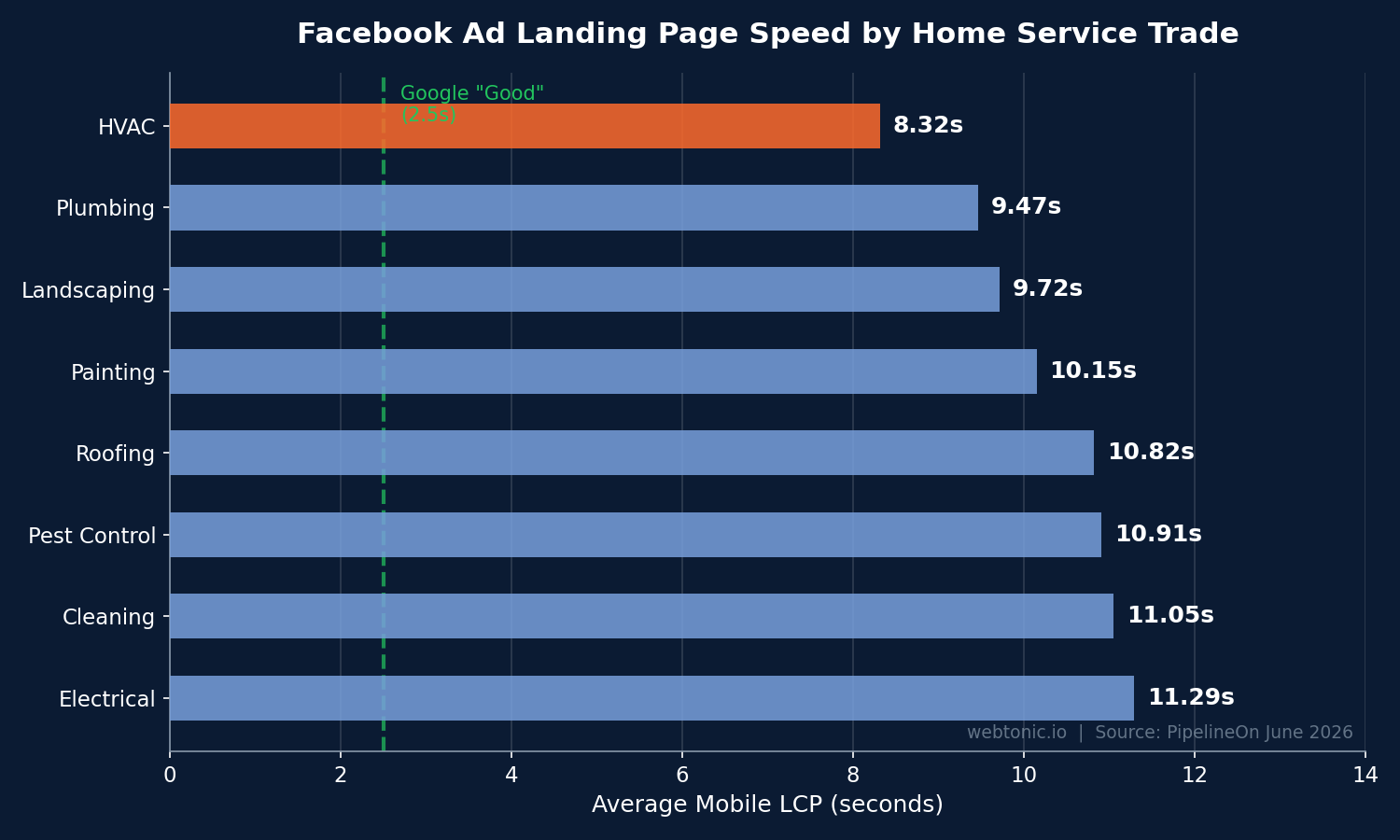
- HVAC runs the fastest Facebook ad landing pages among 8 home service trades at 8.32 seconds average LCP — still 3.3× slower than Google's 2.5-second benchmark (PipelineOn, 2026).
- The median home services landing page conversion rate is 6.7%, with the top 25% of performers exceeding 17.6% (Barham Marketing, 2026).
HVAC Landing Page Benchmarks at a Glance
| Metric | Value | Source |
|---|---|---|
| Top HVAC landing page CVR | 12.4% | RYN Digital 2025 |
| Industry average HVAC LP CVR | 5.2% | RYN Digital 2025 |
| Generic "Contact Us" page CVR | 3–6% | Elevarus 2026 |
| Specific offer page CVR | 12–22% | Elevarus 2026 |
| Median home services LP CVR | 6.7% | Barham Marketing 2026 |
| Top 25% home services CVR | 17.6%+ | Barham Marketing 2026 |
| HVAC website visitor-to-lead CVR | 7.8% | BaaDigi 2026 |
| Home improvement Google Ads avg CVR | 6.82% | Barham Marketing 2026 |
| Avg mobile LCP (home service FB ads) | 10.09 seconds | PipelineOn June 2026 |
| HVAC avg mobile LCP (FB ads) | 8.32 seconds | PipelineOn June 2026 |
Conversion Rate Benchmarks by Page Type
The gap between optimized and unoptimized HVAC landing pages is massive — and the primary driver is not design but offer specificity. Elevarus' 2026 lead generation playbook, drawn from HVAC accounts spending $25K–$500K per month, found that the offer on the page matters more than any other single variable:
- A generic "Contact Us" page: 3–6% conversion rate
- A page with a specific seasonal offer (e.g., "$79 AC Tune-Up"): 12–22% conversion rate
- Creative refresh cycle for sustained performance: every 14–21 days
This means the simplest high-impact change most HVAC contractors can make is not redesigning their website — it is creating a dedicated page for each service with a specific, time-bound offer instead of sending all paid traffic to the homepage.
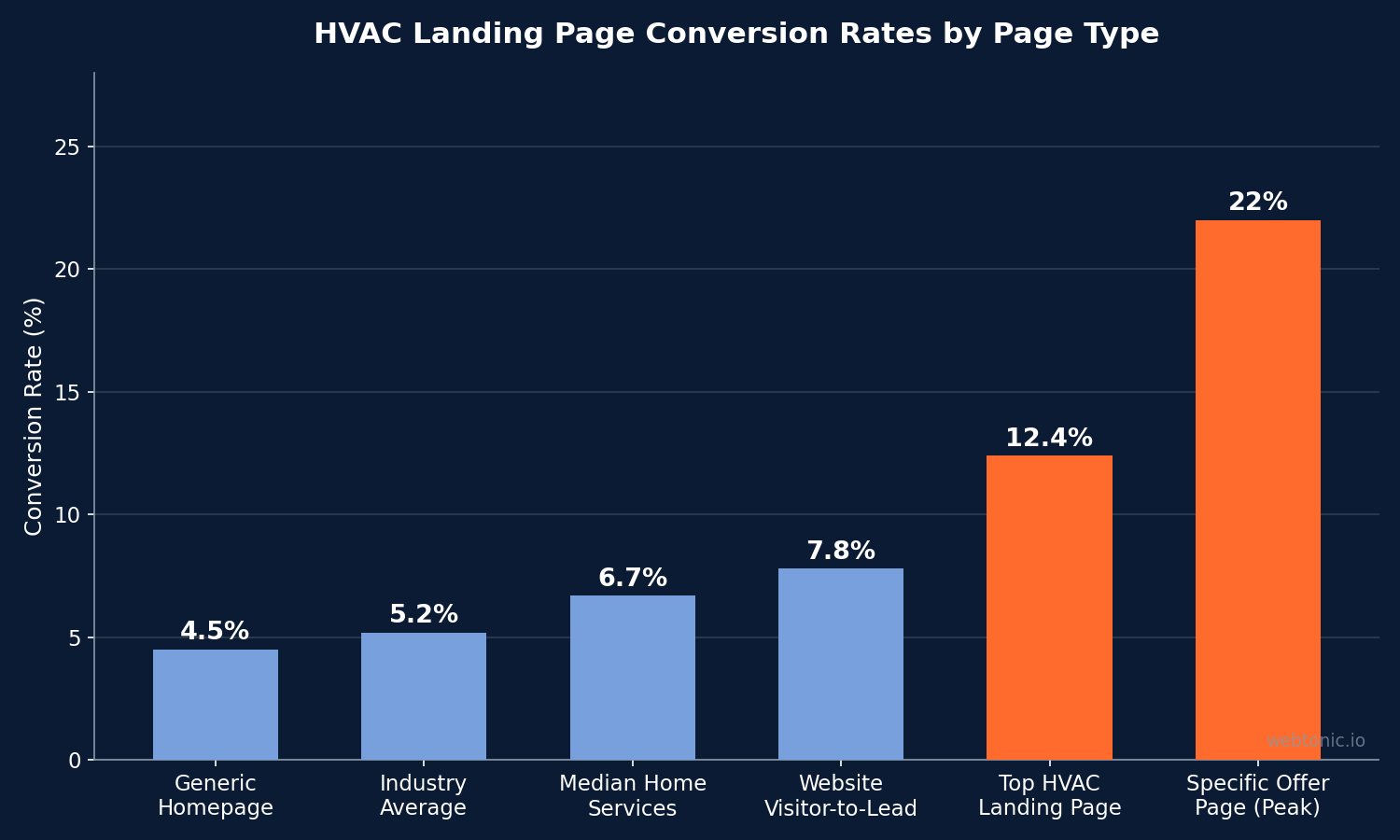
RYN Digital's landing page benchmarks from managed HVAC campaigns confirmed the range, reporting a top CVR of 12.4% against a 5.2% industry average — with their client average showing a 2.4× improvement over baseline after dedicated page builds. Meanwhile, Barham Marketing's compilation of 27+ home services statistics places the median at 6.7% and the top quartile threshold at 17.6%, with emergency services like burst pipe repair or AC failure pushing peak rates above 22% due to urgency compressing the decision window.
Page Speed and Its Impact on HVAC Conversions
Speed kills — or saves — HVAC landing pages. OnwardCraft's 200-site contractor website study measured the impact directly and found a clear linear relationship between load time and conversion rate:
| Load Time | Avg Conversion Rate | Relative Performance |
|---|---|---|
| Under 2.5 seconds | 6.8% | Baseline (top tier) |
| 2.5–4.5 seconds | 3.5–5.0% | Moderate drop |
| Over 4.5 seconds | 2.1% | 3.2× worse than fast |
That 3.2× conversion gap between fast and slow sites translates directly to revenue. A contractor spending $10,000 per month on ads to drive 2,000 visitors would generate 136 leads on a fast page versus just 42 on a slow one — 94 leads lost every month to load time alone. At an average HVAC job value of $500, that speed gap represents roughly $23,500 in monthly lost revenue.
PipelineOn's June 2026 audit of 1,174 home service Facebook ad landing pages found the speed problem is pervasive across the entire industry:
- Average mobile LCP across all 8 trades: 10.09 seconds — nearly 4× Google's 2.5-second "good" threshold.
- HVAC runs the fastest pages among all trades at 8.32 seconds, while electricians are slowest at 11.29 seconds.
- Only 8.7% (102 of 1,174 pages) qualify as "Fast" under 2.5 seconds.
- 48.6% (570 pages) fall into "Poor" above 8 seconds.
- 81.1% miss Google's "good" threshold entirely — the vast majority of paid traffic lands on pages Google considers unacceptably slow.
- The single fastest example in the audit: Liquid Lawn at 0.8 seconds LCP, running 101 active Facebook ads with a Meta Pixel firing — proving fast-plus-tracked is achievable at scale.
Mobile vs. Desktop HVAC Landing Page Performance
Mobile dominates HVAC search behavior. RYN Digital reports that 73% of HVAC searches happen on mobile devices, and Google Ads cost data confirms that mobile CPCs are typically 15–25% lower than desktop — making mobile the more efficient channel when landing pages are properly optimized for it.
OnwardCraft's 200-site study found several mobile-specific optimization factors that consistently move the needle:
- Forms with 3–4 fields (Name, Phone, Email, Service Needed) convert 30–60% higher on mobile than forms with 6+ fields asking for address, project details, and preferred time slots.
- Multi-step forms outperform single-page long forms by 30–60% on mobile devices, because breaking the form into two quick steps reduces perceived friction.
- Click-to-call buttons placed above the fold generate 2–3× more phone leads than buried contact information that requires scrolling.
- Pages loading under 2.5 seconds on mobile produce 3.2× higher conversion rates than those above 4.5 seconds.
The mobile optimization gap is a significant opportunity. Since 73% of HVAC searches start on mobile but most contractor landing pages are designed desktop-first, improving mobile page speed and form design provides an outsized return on a relatively small investment.
Cost Per Lead by Landing Page Quality
Landing page quality directly controls HVAC cost per lead. SearchLight Digital's 2026 HVAC CPL analysis found that sending a "heating repair" click to a generic HVAC homepage instead of a dedicated heating repair page increases bounce rate and decreases conversion rate, which directly inflates CPL. The ad creative promised a specific service — the landing page needs to deliver on exactly that promise.
Elevarus benchmarks CPL by platform for HVAC contractors running dedicated landing pages versus homepages:
| Channel | CPL Range | Cost Per Booked Job |
|---|---|---|
| Local Service Ads (LSA) | $15–$85 | $90–$200 |
| Google Search Ads | $45–$180 | $150–$350 |
| Meta (Facebook/Instagram) | $25–$95 | $120–$280 |
The difference between a $45 and a $180 Google Search CPL is rarely about the ad — it is about where the click lands. Dedicated, service-specific landing pages consistently produce CPLs at the lower end of each range, while generic homepages push costs toward the ceiling. For a contractor spending $5,000 per month on Google Ads, the difference between a $45 and $180 CPL means 111 leads versus 28 — a 4× gap from the same budget.
A/B Testing and CRO Results for HVAC Pages
Yusr Prime's HVAC conversion optimization study, based on aggregate data from HVAC website redesigns and A/B tests, documented measurable lifts from specific optimization tactics:
- Adding a visible phone number to the header: 15–25% increase in call volume.
- Replacing stock photos with real team and truck images: 10–18% CVR lift.
- Adding a time-sensitive offer ("Schedule by Friday for $79"): 20–35% lift in form completions.
- Simplifying navigation to 3–4 primary items: 12–20% reduction in bounce rate.
- Adding trust signals (license numbers, insurance badges, review counts): 8–15% conversion lift.
The study emphasizes that documenting every test in a testing log is critical — HVAC companies that run continuous A/B tests compound improvements over time, while those that redesign once every 2–3 years see diminishing returns within months as market conditions and customer expectations change.
HVAC Landing Pages vs. Other Home Services
| Trade | Avg LP CVR | Avg Mobile LCP | Emergency Peak CVR |
|---|---|---|---|
| HVAC | 5.2–7.8% | 8.32s | 15–22% |
| Plumbing | 5.0–7.0% | 9.47s | 18–25% |
| Roofing | 3.5–5.5% | 10.82s | 8–14% |
| Electrical | 4.0–6.5% | 11.29s | 12–18% |
HVAC leads in page speed among home services but still falls 3.3× short of Google's "good" threshold. Emergency services like AC repair in summer drive the highest peak conversion rates because urgency compresses the decision-making window — a homeowner with a broken AC in July is not comparison-shopping across five contractors.
Seasonal Landing Page Performance in HVAC
HVAC landing page performance follows pronounced seasonal patterns that smart contractors exploit. Summer AC emergencies and winter heating failures create demand spikes where urgency-driven landing pages convert at 15-22% well above the 5-8% average seen during shoulder seasons (Elevarus, Barham Marketing).
The contractors who capture the most value from these seasonal surges prepare their landing pages well in advance. Elevarus recommends planning budgets and landing pages 60-90 days ahead of seasonal peaks, refreshing creative every 14-21 days during high season, and running service-specific pages for seasonal offers like AC tune-ups in spring or furnace inspections in fall.
Contractors who maintain a single generic landing page year-round miss the conversion lift that comes from matching the landing page offer to the seasonal intent. A homeowner searching for AC repair in July expects immediate availability and pricing, not a generic contact form with no mention of emergency service. Building dedicated seasonal pages requires minimal investment but captures the highest-converting traffic windows of the year, where every lead is worth more because customer urgency eliminates comparison shopping and reduces the decision cycle to minutes rather than days.
BaaDigi's 2026 HVAC benchmarks confirm that phone leads convert at 46% across all seasons, but the volume of phone leads spikes dramatically during temperature extremes. Landing pages optimized for mobile with prominent click-to-call buttons capture these seasonal surges most effectively, since 73% of searches happen on mobile and emergency HVAC needs are overwhelmingly phone-driven rather than form-driven.
FAQ
What is a good HVAC landing page conversion rate?
A good HVAC landing page converts at 5–8%, with top performers reaching 12–22% when using dedicated service-specific pages with strong offers (Elevarus, RYN Digital). The median across all home services is 6.7% (Barham Marketing, 2026). If your page converts below 4%, the issue is likely page speed, form length, or a mismatched offer that does not align with the ad creative.
How does page speed affect HVAC landing page conversions?
Pages loading under 2.5 seconds average 6.8% conversion versus 2.1% for pages over 4.5 seconds — a 3.2× difference (OnwardCraft, 200-site study). Since 81.1% of home service Facebook ad landing pages miss Google's speed threshold (PipelineOn, 2026), page speed is the single most under-addressed conversion factor in HVAC digital marketing.
How many form fields should an HVAC landing page have?
Stick to 3–4 fields: Name, Phone, Email, and Service Needed. OnwardCraft found this configuration converts 30–60% higher on mobile than forms with 6+ fields. Multi-step forms that break the process into two quick steps also outperform single-page long forms by 30–60% on mobile devices.
Should HVAC companies use dedicated landing pages or their homepage?
Always use dedicated landing pages. A specific offer page converts at 12–22% versus 3–6% for a generic homepage (Elevarus, 2026). SearchLight Digital confirms that sending intent-specific ad clicks to a generic page inflates cost per lead and bounce rate simultaneously. Each service category should have its own landing page with a matching offer.
What is the average HVAC landing page speed on mobile?
PipelineOn's June 2026 audit measured HVAC at 8.32 seconds average LCP on mobile — the fastest among 8 home service trades but still 3.3× slower than Google's 2.5-second "good" benchmark. Only 8.7% of all audited home service pages qualify as fast, making page speed a significant competitive advantage for the contractors who invest in it.
Sources
ryndigital.com/hvac-marketing-statistics
onwardcraft.com — Contractor Website Conversion Study
pipelineon.com — Home Service Facebook Landing Page Speed
elevarus.com — HVAC Lead Generation Benchmarks
barhammarketing.com — Home Services Conversion Stats
baadigi.com — HVAC Marketing Benchmarks
searchlightdigital.io — HVAC CPL Analysis
yusrprime.com — HVAC Website CRO


